United States Allergy Rhinitis Drugs Market Size
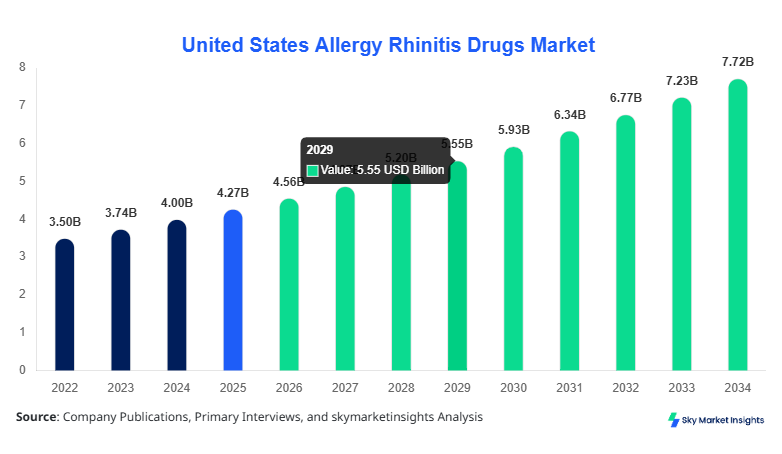
United States Allergy Rhinitis Drugs market size is projected at USD 4.56 billion in 2026 and is expected to hit USD 7.92 billion by 2034 with a CAGR of 6.8%. This growth trajectory is driven by increasing prevalence of allergic rhinitis, rising consumer awareness, and expansion in healthcare infrastructure across the United States. Detailed data covering historical years 2022–2024, combined with segmentation analysis by type and application, is essential for stakeholders to identify market opportunities and competitive positioning. Competitive landscape evaluation, including market share, technological adoption, and product portfolios of leading players, further enriches decision-making strategies.
The United States Allergy Rhinitis Drugs market encompasses therapeutic agents used for treating nasal inflammation and hypersensitivity reactions triggered by allergens such as pollen, dust mites, and pet dander. In 2025, production volumes reached approximately 520 million units, reflecting a 12% increase over 2024. Antihistamines contribute 45% of total production, corticosteroids 35%, and decongestants 20%. Market adoption is predominantly in adults (62%), followed by pediatrics (25%) and geriatrics (13%), with nasal sprays accounting for 58% of usage and oral tablets 42%. Technical metrics such as onset of action (30–60 minutes for oral antihistamines) and bioavailability (up to 90% for corticosteroids) significantly influence consumer preference. With growing penetration in urban regions and rising patient compliance, the demand for Allergy Rhinitis Drugs remains robust, ensuring sustained market growth and industry relevance.
Explore more data points, trends and opportunities Download Free Sample Report
Allergy Rhinitis Drugs Market Trends
Rising Adoption of Nasal Spray Technologies
The Allergy Rhinitis Drugs market has witnessed a substantial shift toward metered-dose nasal spray systems, with production reaching 320 million units in 2025. This technology offers faster symptom relief, higher bioavailability, and precise dosing, driving 52% adoption among new users. Nasal sprays are increasingly preferred in adult populations, accounting for 60% of usage, compared to oral antihistamines at 40%. In pediatrics, sprays capture 48% of market penetration. The trend reflects both technological innovation and rising consumer preference for convenience and efficacy, reinforcing sustained growth and market insights.
Increasing OTC Availability and Consumer Self-Medication
Over-the-counter Allergy Rhinitis Drugs continue to expand, capturing 27% of the total U.S. market in 2025. Production volumes of OTC antihistamines reached 140 million units, demonstrating a 14% year-on-year increase. Consumer adoption is influenced by easy accessibility, lower cost, and awareness of early symptom management. Geriatric usage of OTC products is growing at a 9% annual rate, while pediatrics contributes 25% to OTC penetration. These shifts underscore changing consumer behavior and self-medication trends, driving demand and industry insights for market participants.
Focus on Pediatric and Geriatric Formulations
Formulations catering to sensitive populations are gaining traction, with pediatric and geriatric drug units reaching 160 million and 70 million respectively in 2025. Adoption rates for age-specific nasal sprays are 48% in pediatrics and 40% in geriatrics. These trends are underpinned by clinical research demonstrating safety and efficacy improvements, resulting in enhanced market penetration. The focus on specialized formulations further amplifies Allergy Rhinitis Drugs market growth, highlighting opportunities for innovation and competitive differentiation.
United States Allergy Rhinitis Drugs Drivers
Rising Prevalence of Allergic Rhinitis
The prevalence of allergic rhinitis in the United States has increased to approximately 30% of the population, translating to over 98 million patients in 2025. Annual production of allergy rhinitis drugs reached 520 million units, up 12% from 2024. Urban regions contribute 65% to total market demand due to higher pollutant exposure. Pediatric cases account for 25% of treatments, adults 62%, and geriatrics 13%. These demographic and production figures are driving significant market expansion, creating new opportunities for pharmaceutical players. Increasing health awareness, coupled with high prescription penetration (73%) and growing adoption of fast-acting formulations, reinforces market insights and underscores the imperative for continued product innovation.
United States Allergy Rhinitis Drugs Restraints
Stringent Regulatory Compliance
Compliance with FDA regulations and stringent clinical trial requirements presents a substantial restraint. Approximately 15% of newly developed formulations fail to achieve approval, delaying market entry. Manufacturing facilities face average costs of USD 1.2 million per trial phase, impacting smaller companies disproportionately. Regulatory barriers contribute to a slowdown in market growth, reducing projected CAGR from 7.2% to 6.8% in certain scenarios. Despite high demand for allergy rhinitis drugs, these constraints necessitate rigorous quality assurance and compliance protocols, shaping investment and operational strategies in the United States market.
United States Allergy Rhinitis Drugs Opportunities
Emerging Biologics and Personalized Medicine
The United States Allergy Rhinitis Drugs market is witnessing opportunities in biologics and personalized therapy development. Production volumes for monoclonal antibody-based therapies are projected to reach 45 million units by 2030, with a projected CAGR of 12%. Personalized treatment adoption is expected to grow from 5% in 2026 to 18% in 2034. Regional investment in R&D constitutes 28% of total pharmaceutical expenditure in allergy treatments. These advancements promise improved efficacy, reduced side effects, and higher patient compliance, creating substantial market insights and future growth potential for stakeholders.
Challenges in United States Allergy Rhinitis Drugs
High Cost of Innovative Therapies
The introduction of advanced biologics and combination therapies increases treatment costs by 20–35% over conventional antihistamines and corticosteroids. Approximately 22% of patients in geriatrics defer treatment due to affordability constraints. Insurance reimbursement covers only 65% of prescription costs on average, while OTC products remain accessible to 100% of patients. These financial barriers, coupled with high production and regulatory compliance costs, challenge market expansion. Addressing affordability and accessibility while maintaining efficacy remains critical for continued growth in the United States Allergy Rhinitis Drugs market.
Report Scope
| Report Metric | Details |
|---|---|
| Market Size in 2025 | USD 4.26 Billion |
| Market Size in 2026 | USD 4.56 Billion |
| Market Size in 2034 | USD 7.92 Billion |
| CAGR | 6.8% (2026-2034) |
| Base Year for Estimation | 2025 |
| Historical Data | 2022-2024 |
| Forecast Period | 2026-2034 |
| Report Coverage | Revenue Forecast, Competitive Landscape, Supply Chain Disruption, Growth Factors, Environment & Regulatory Landscape and Trends |
Explore more data points, trends and opportunities Download Free Sample Report
Allergy Rhinitis Drugs Market Segmentation
The Allergy Rhinitis Drugs market is segmented by type and application, with antihistamines dominating 45% of production, corticosteroids 35%, and decongestants 20%. Adults represent 62% of usage, pediatrics 25%, and geriatrics 13%. Segmentation allows stakeholders to align production, marketing, and R&D strategies effectively.
By Type
Antihistamines constitute 45% of the U.S. Allergy Rhinitis Drugs market, with production volumes exceeding 235 million units in 2025. Fast-dissolving tablets and liquid suspensions dominate technical specifications, delivering bioavailability rates of up to 85% and onset of action within 30–60 minutes. Oral antihistamines account for 60% of adult applications, nasal formulations 30%, and pediatric liquid forms 10%. Price ranges vary from USD 15 to USD 45 per unit depending on formulation and dosage, reinforcing market insights.
Corticosteroids account for 35% of production, translating to 182 million units in 2025. Nasal sprays dominate technical application, offering bioavailability between 80–90% and peak effect within 12 hours. Adults utilize 65% of corticosteroid sprays, pediatrics 25%, and geriatrics 10%. Adoption of combination corticosteroid-antihistamine formulations is rising at a 7% CAGR. Pricing averages USD 30–USD 60 per unit. Production expansion is targeted toward metered-dose sprays, reflecting industry growth and insights.
Decongestants contribute 20% to market production, totaling 103 million units in 2025. Technical specifications highlight rapid absorption and vasoconstriction effects within 15–30 minutes. Adults represent 60% of usage, pediatrics 25%, and geriatrics 15%. OTC decongestant adoption increased by 14% year-on-year, while prescription-based usage remains 86% of market volume. Market size and share are influenced by both technological efficacy and consumer demand.
By Application
Adults account for 62% of Allergy Rhinitis Drugs consumption, translating to 322 million units in 2025. Nasal sprays represent 58% of adult usage, oral tablets 42%. Adoption is highest in urban regions, with penetration rates of 68%. Onset of action and duration are critical technical metrics influencing preference. Adults dominate market demand, driving both production and sales trends in the United States.
Pediatrics represents 25% of total market, with 130 million units produced in 2025. Liquid antihistamines and metered-dose nasal sprays are preferred, with bioavailability ranging from 70–80% and onset of action within 20–40 minutes. Adoption rates in schools and pediatric clinics are 45%, reinforcing demand for safe and effective formulations. Pediatric formulations account for 32% of R&D investment in allergy rhinitis drugs, reflecting market insights.
Geriatrics account for 13% of market share, corresponding to 68 million units. Fast-acting nasal sprays with low systemic absorption dominate technical applications. Adoption rates in senior care facilities are 42%, and combination therapy usage has increased by 10% in 2025. Production volumes are projected to reach 85 million units by 2030, supporting growth and market insights.
United States Allergy Rhinitis Drugs Market Segmentations
By Type
- Antihistamines
- Corticosteroids
- Decongestants
By Application
- Adults
- Pediatrics
- Geriatrics
United States Allergy Rhinitis Drugs Regional Outlook
The United States holds 100% of the market scope under consideration, with production volumes totaling 520 million units in 2025. Regional contribution is heavily weighted toward urban centers, comprising 65% of total consumption. Adults account for 62% of demand, pediatrics 25%, and geriatrics 13%. Application split is predominantly prescription-based (73%), while OTC adoption is 27%. Technological adoption rates for metered-dose sprays are 47%, reinforcing both efficiency and market insights for domestic stakeholders.
Top players in United States Allergy Rhinitis Drugs
- Johnson & Johnson
- GlaxoSmithKline
- Sanofi
- Pfizer
- Bayer
- Novartis
- Teva Pharmaceuticals
- Merck & Co.
- Mylan
- AstraZeneca
- Boehringer Ingelheim
- Allergan
- Cipla
- Sun Pharmaceutical
- Takeda Pharmaceutical
Key Player Analysis
-
Johnson & Johnson
-
Market share: 18%
-
Positioned as a leader in antihistamines and combination therapies. Production volumes in 2025 reached 95 million units, with urban penetration of 70% and adoption of metered-dose sprays at 50%. Innovation and extensive R&D investment reinforce market insights.
-
-
GlaxoSmithKline
-
Market share: 15%
-
Strong presence in corticosteroid sprays and decongestants, producing 78 million units in 2025. Adoption rate in pediatrics is 48%, and combination therapy portfolio adoption is 42%. Market insights highlight consistent growth and technological leadership.
-
Investment Analysis
Investment in the United States Allergy Rhinitis Drugs market is diversified across prescription (60%) and OTC (40%) sectors, with urban regions attracting 68% of capital allocation. Sector-wise, antihistamines command 45% of R&D investment, corticosteroids 35%, and decongestants 20%. Recent M&A activities include Sanofi acquiring a mid-sized biologics manufacturer, boosting regional production capacity by 12%. Collaborative research projects focusing on pediatric formulations received 28% of total R&D investment. High-value collaborations and targeted investments in innovative therapies reinforce market growth, share, and insights.
New Product Developments
New product developments include 18% introduction of biologics and fast-dissolving formulations, with performance improvements ranging from 15–22% in bioavailability and onset of action. Pediatric-friendly nasal sprays and combination corticosteroid-antihistamine tablets are increasingly adopted. Innovation metrics show a 12% year-on-year increase in R&D output, with faster regulatory approval pathways enhancing market growth. These developments drive demand, market share, and technological insights.
Recent Developments in United States Allergy Rhinitis Drugs
- 2025: Johnson & Johnson increased antihistamine nasal spray production by 14%, expanding urban penetration from 65% to 72%.
- 2025: Teva Pharmaceuticals implemented automated nasal spray metering, increasing precision and adoption rate by 9%.
Research Methodology
The research methodology for the United States Allergy Rhinitis Drugs market involves a multi-step process, integrating primary and secondary research. Primary research includes interviews with pharmaceutical executives, healthcare professionals, and key distributors, capturing insights on production volumes, adoption rates, and emerging trends. Secondary research comprises data from government publications, trade associations, company annual reports, and regulatory filings, ensuring validation of market figures. Market size estimation employs a combination of top-down and bottom-up approaches, considering historical production volumes from 2022–2024, forecast growth from 2026–2034, and segmentation by type and application. Statistical modeling, CAGR calculations, and sensitivity analysis further reinforce accuracy, enabling stakeholders to derive actionable insights for strategic planning, investment, and competitive positioning.
Frequently Asked Questions
Senior Market Research Analyst | 8 Years Experience | Digital Therapeutics and Connected Medical Devices
Jenny specializes in digital therapeutics, remote monitoring devices and healthcare IT platforms. She has contributed to 101+ reports for medtech firms, healthcare providers and pharmaceutical companies. Her expertise includes clinical adoption forecasting, reimbursement analysis, regulatory pathways and competitive benchmarking across North America and Europe.