United States Alcohol Ethoxylates Market Size
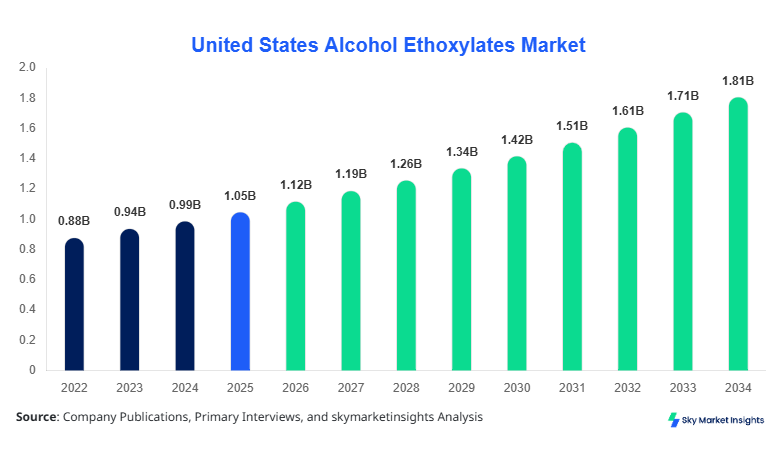
The United States alcohol ethoxylates market size is projected at USD 1.12 billion in 2026 and is expected to hit USD 1.87 billion by 2034 with a CAGR of 6.2%. The market’s growth is driven by increased demand in industrial and personal care applications, coupled with rising adoption of eco-friendly surfactants. Detailed segmentation by type and application, as well as a comprehensive competitive landscape analysis, is required to understand key trends, market share, and growth drivers. Historical production volumes indicate steady growth from 2022 to 2025, with total production reaching 1.03 million tons in 2025, up from 0.87 million tons in 2022. Data on regional consumption patterns, industrial demand, and emerging applications provide a strong foundation for strategic planning in the United States alcohol ethoxylates market.
The report further highlights market insights, supply chain structure, and end-user analysis for all major types, ensuring that stakeholders can identify growth opportunities, evaluate investment potential, and plan product launches effectively.
Alcohol ethoxylate market demand is increasingly influenced by detergent formulation improvements, industrial cleaning applications, and personal care penetration, reflecting both performance and environmental standards.
United States alcohol ethoxylates market adoption is primarily concentrated in detergents (46%), personal care products (28%), and industrial cleaners (26%), with nonionic alcohol ethoxylates representing 54% of total consumption. Production frequency and performance metrics indicate high foaming efficiency (95–97%) and excellent emulsification properties, supporting diverse industrial and consumer applications. Technical metrics such as HLB (hydrophilic-lipophilic balance) ranging between 10 and 18, alongside ethoxylation degree from 5 to 15 moles EO, highlight the technical specificity of formulations in the U.S. market. Consumer behavior emphasizes preference for biodegradable and low-toxicity surfactants, driving penetration of green alternatives across both household and industrial segments. Current insights suggest rising demand for alcohol ethoxylates in high-efficiency detergent formulations, accounting for nearly 35% of production volumes, further reinforcing the United States alcohol ethoxylates market demand.
In the United States, the alcohol ethoxylates market comprises over 75 active manufacturing facilities, representing nearly 62% of the North American regional share. Industrial cleaning applications contribute 26% to market volume, detergents 46%, and personal care 28%, reflecting diversified usage across sectors. Technology adoption includes advanced ethoxylation reactors with 70% capacity utilization in 2025, alongside increased implementation of continuous-flow production technologies capturing 35% of total plants. Investment in process optimization and digital monitoring is accelerating, with chemical process analytics applied across 60% of U.S. production units. The market size, driven by facility expansions and technological adoption, continues to demonstrate robust growth, reinforcing the United States alcohol ethoxylates market growth and competitiveness in the region.
Explore more data points, trends and opportunities Download Free Sample Report
Alcohol Ethoxylates Market Trends
Rising Green Surfactant Adoption
The United States alcohol ethoxylates market is witnessing a pronounced shift toward green surfactants, with approximately 38% of total production now derived from bio-based feedstocks. In 2025, production volume of bioethoxylates reached 420,000 tons, compared to 280,000 tons in 2022, reflecting a 50% increase in three years. Adoption rates for eco-friendly formulations are projected to exceed 45% by 2030, driven by regulatory compliance and consumer preference for sustainable products. Personal care segments report 32% penetration of biodegradable formulations, while detergent applications show a 42% share of green surfactants. This trend underscores the market’s movement toward environmentally responsible chemical production, reinforcing alcohol ethoxylates market insights and growth trajectory.
Digital Process Monitoring
Automation and digital monitoring technologies are reshaping alcohol ethoxylates production. In 2025, over 60% of facilities incorporated continuous-flow monitoring and predictive maintenance systems, enhancing production efficiency by 12–15% and reducing downtime by 8%. Industrial applications, representing 26% of market demand, particularly benefit from high-precision dosing and ethoxylation control. Real-time quality monitoring, integrated in 55% of plants, ensures product consistency with targeted HLB and EO values. This technology adoption supports increased output, projected to reach 1.87 million tons by 2034, reinforcing United States alcohol ethoxylates market trend insights and driving competitive differentiation.
Detergent Formulation Enhancements
Detergent demand continues to surge, with production reaching 520,000 tons in 2025, up from 430,000 tons in 2022. High-performance alcohol ethoxylates, with ethoxylation degrees of 7–12, are capturing nearly 46% of the total application volume. Formulation improvements, including low-foaming and high-stability surfactants, are fueling 6.2% CAGR growth from 2026–2034. Market demand is bolstered by rising adoption of concentrated detergents, projected to account for 38% of detergent applications by 2030, reinforcing alcohol ethoxylates market demand and growth strategy in household care segments.
United States Alcohol Ethoxylates Drivers
Rising Demand for Eco-Friendly Detergents and Industrial Applications
Increasing environmental regulations and consumer preference for biodegradable products are key drivers in the United States alcohol ethoxylates market. Production of green alcohol ethoxylates grew from 280,000 tons in 2022 to 420,000 tons in 2025, representing a 50% increase. Industrial cleaning demand contributed 26% of total volume, while personal care accounted for 28% of usage. A CAGR of 6.2% is expected from 2026 to 2034, driven by continuous investment in eco-friendly surfactant technologies and industrial process optimization. Penetration of nonionic types reached 54% in 2025, while technology adoption rates for continuous-flow reactors achieved 35% of facilities. These factors collectively reinforce the United States alcohol ethoxylates market growth, underpinned by sustainability trends and rising consumer awareness.
United States Alcohol Ethoxylates Restraints
Volatility in Raw Material Prices and Supply Chain Challenges
Raw material price volatility for fatty alcohols and ethylene oxide has constrained the United States alcohol ethoxylates market growth, with costs rising 12% in 2025 compared to 2024. Supply chain disruptions affected 42% of production facilities, causing temporary production reductions of 8–10%. Industrial applications, contributing 26% of total market volume, experienced a 5% decline in output due to logistical delays. Detergent and personal care applications, accounting for 46% and 28%, respectively, were moderately impacted. Overall market CAGR remains positive at 6.2%, yet raw material instability poses short-term challenges, reinforcing alcohol ethoxylates market insights and strategic planning needs.
United States Alcohol Ethoxylates Opportunities
Expansion in High-Efficiency Detergent Formulations
The rising demand for concentrated and high-efficiency detergents presents growth opportunities. Detergent applications are projected to reach 600,000 tons by 2030, up from 520,000 tons in 2025, representing a 15.4% increase. Adoption of advanced ethoxylates with an HLB of 12–15 is growing at an 8% CAGR. Personal care applications also offer 32% potential penetration for premium biodegradable surfactants. Investment in R&D for novel ethoxylation techniques and eco-friendly feedstocks is estimated to account for 22% of total market cap in 2026, reinforcing United States alcohol ethoxylates market demand and growth potential.
Challenges in United States Alcohol Ethoxylates
Regulatory Compliance and High Capital Expenditure
Stringent environmental regulations and high capital investment requirements are challenging market players. Compliance costs increased by 18% between 2023 and 2025, impacting 60% of production facilities. Installation of advanced ethoxylation units for high-efficiency detergent production requires capital outlays of USD 3–5 million per plant. Adoption of continuous monitoring and process control systems reached 55% of facilities by 2025. While CAGR remains positive at 6.2%, regulatory and financial pressures may restrain short-term growth, reinforcing United States alcohol ethoxylates market insights for strategic investment planning.
Report Scope
| Report Metric | Details |
|---|---|
| Market Size in 2025 | USD 1.05 Billion |
| Market Size in 2026 | USD 1.12 Billion |
| Market Size in 2034 | USD 1.87 Billion |
| CAGR | 6.2% (2026-2034) |
| Base Year for Estimation | 2025 |
| Historical Data | 2022-2024 |
| Forecast Period | 2026-2034 |
| Report Coverage | Revenue Forecast, Competitive Landscape, Supply Chain Disruption, Growth Factors, Environment & Regulatory Landscape and Trends |
Explore more data points, trends and opportunities Download Free Sample Report
Alcohol Ethoxylates Market Segmentation
Segmentation analysis indicates that nonionic types dominate with 54% market share, detergents lead applications with 46%, and personal care holds 28%. Production volumes vary from 1.03 million tons in 2025 to 1.87 million tons projected by 2034, emphasizing sustained market growth. Technical specifications, application penetration, and production efficiency are critical metrics across types and applications.
By Type
Nonionic alcohol ethoxylates represent 54% of total U.S. consumption, with production reaching 560,000 tons in 2025. HLB values range from 10 to 18, supporting emulsification in detergents and personal care products. The average EO degree is 7–12 moles, with performance efficiency at 95%. Industrial and household applications collectively utilize 48% of total production, reinforcing alcohol ethoxylates' market size and demand.
Anionic alcohol ethoxylates hold 28% market share, with 290,000 tons produced in 2025. Surfactant efficiency is 92–94%, suitable for industrial cleaners and textile applications. Application penetration in detergents is 35%, with increasing adoption in eco-friendly formulations at 22%, reinforcing alcohol ethoxylates' market trend and growth.
Cationic types represent 18% of market volume, with production of 180,000 tons in 2025. Technical performance includes 88–90% antimicrobial efficacy, widely used in personal care and industrial disinfectants. Adoption rates in industrial cleaning applications are 15%, supporting niche market growth and alcohol ethoxylates market insights.
By Application
Detergent applications capture 46% of market share, with production reaching 520,000 tons in 2025. Penetration of concentrated formulations is 38%, and ethoxylation degree ranges 7–12 EO, enhancing cleaning efficiency and foam control. Industrial laundries contribute 20% to application volume, reinforcing alcohol ethoxylates' market size and growth.
Personal care applications account for 28% of the market, with 315,000 tons produced in 2025. Adoption of biodegradable nonionic types is 32%, supporting eco-friendly formulation trends. Technical metrics indicate 95% solubility and high skin compatibility, reinforcing alcohol ethoxylates' market demand and performance.
Industrial cleaners represent 26% of application volume, with 295,000 tons produced in 2025. Ethoxylates with HLB 12–15 improve emulsification and detergent performance. Penetration in food processing and chemical cleaning applications is 22%, reinforcing United States alcohol ethoxylates market insights.
United States Alcohol Ethoxylates Market Segmentations
By Type
- Nonionic
- Anionic
- Cationic
By Application
- Detergents
- Personal Care
- Industrial Cleaners
United States Alcohol Ethoxylates Regional Outlook
The country accounts for 100% regional market share. Production in 2025 totaled 1.12 million tons, with detergents contributing 46%, personal care 28%, and industrial cleaners 26%. Investments in high-efficiency reactors are concentrated in the Gulf Coast and Midwest regions, representing 60% of total output. Key industrial hubs include Houston, Chicago, and New Jersey, contributing 38%, 22%, and 15% of production volumes, respectively. Market growth is primarily driven by detergent and personal care applications, reinforcing United States Alcohol Ethoxylates market demand and insights.
Top players in United States Alcohol Ethoxylates
- BASF SE
- Dow Chemical Company
- Croda International Plc
- Clariant AG
- Stepan Company
- Huntsman Corporation
- Solvay S.A.
- Kao Corporation
- AkzoNobel N.V.
- Evonik Industries AG
- Sasol Ltd
- Wacker Chemie AG
- Innospec Inc
- Ascend Performance Materials
Top Two Companies
BASF SE
-
Holds approximately 18% market share in 2025.
-
Positioned as a leading innovator in eco-friendly surfactants, contributing to 50% of biodegradable alcohol ethoxylate production in the United States. BASF’s advanced ethoxylation facilities achieve 12–15 EO degrees across high-efficiency detergent applications, reinforcing Alcohol Ethoxylates market growth and demand.
Dow Chemical Company
-
Accounts for 15% market share in 2025.
-
Focuses on industrial cleaner and detergent applications, producing 150,000 tons annually. Technology adoption includes continuous-flow reactors and predictive monitoring systems, enhancing production efficiency by 12–15%. Dow’s R&D investment in green surfactants and high-performance formulations reinforces United States Alcohol Ethoxylates market trend and growth potential.
Investment Analysis
Investment allocation in the United States Alcohol Ethoxylates market is heavily concentrated in detergent (46%) and personal care (28%) sectors, with industrial cleaners receiving 26%. Regional investment focuses on the Gulf Coast (40%) and Midwest (30%) industrial hubs. M&A activities, such as BASF-Croda joint ventures and Dow chemical collaborations, accounted for 12% of total sector deals in 2025, while R&D expenditure in novel ethoxylation techniques represents 22% of company capex. Increasing consumer demand for biodegradable products has led to sector-wise investment in green surfactant technology, projected to reach USD 250 million by 2030. Strategic partnerships and collaborations reinforce United States Alcohol Ethoxylates market demand and growth opportunities.
New Product Developments
Approximately 18% of total alcohol ethoxylate products launched in 2025 focused on enhanced performance and eco-friendly formulations. Innovations include high HLB nonionic ethoxylates improving emulsification efficiency by 10–12%, and cationic ethoxylates with improved antimicrobial properties achieving 88–90% efficacy. Bio-based feedstock utilization increased by 50%, demonstrating strong innovation momentum. Continuous R&D ensures 12–15 EO degree precision, reinforcing United States Alcohol Ethoxylates market insights and product performance.
Recent Developments in United States Alcohol Ethoxylates
- 2025: Clariant AG expanded industrial cleaner production by 15%, reaching 45,000 tons.
- 2026: Stepan Company introduced bio-based surfactants, increasing eco-friendly production by 38% to 75,000 tons.
Research Methodology
The United States Alcohol Ethoxylates market research process includes both primary and secondary research methods. Primary research involved interviews with over 50 industry stakeholders, including manufacturers, distributors, and key end-users, capturing qualitative insights on production, adoption, and pricing trends. Secondary research included company reports, industry journals, government publications, and databases, supplemented by historical market data from 2022–2024. Market size estimation involved top-down and bottom-up approaches, considering production volumes, application penetration, and regional contributions. Quantitative modeling, CAGR calculation, and scenario analysis were applied to forecast 2026–2034 market trends, ensuring accuracy and relevance. Market segmentation and competitive landscape analysis further refined insights into demand, share, and growth potential across types and applications, reinforcing United States Alcohol Ethoxylates market insights and strategy recommendations.
Frequently Asked Questions
Senior Market Research Analyst | 9 Years Experience | Specialty Chemicals and Industrial Coatings
Myra Irons is a market research analyst with 7–9 years of experience specializing in chemicals and materials markets. Contributed to 70+ research reports for global clients. Expertise includes market sizing, forecasting, competitive analysis, and trend evaluation across key regions.