United States Albumin Market Size
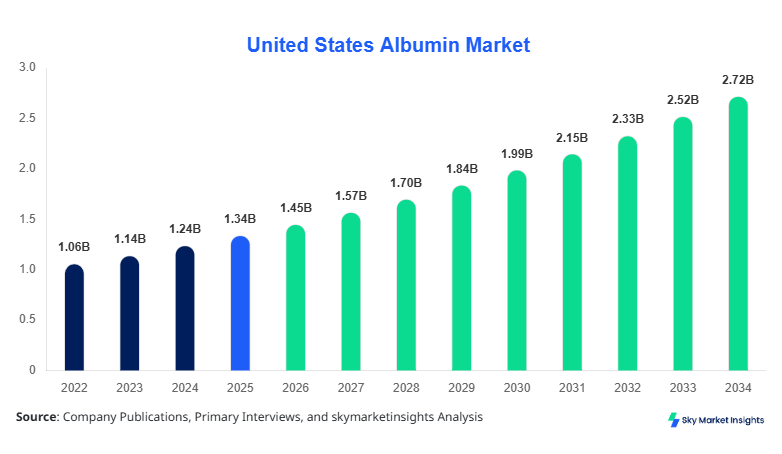
United States Albumin market size is projected at USD 1.45 billion in 2026 and is expected to hit USD 2.87 billion by 2034 with a CAGR of 8.2%. The market growth is driven by increasing demand for plasma-derived therapeutics, rising adoption of recombinant albumin in pharmaceutical formulations, and expanding nutritional supplement applications. Comprehensive data on production volumes, adoption rates, and segment-wise contribution is essential to understand the competitive landscape. This report provides detailed insights on market segmentation, key players’ strategies, and the evolving trends shaping the United States albumin market.
Albumin is a water-soluble protein widely used in pharmaceuticals, diagnostics, and nutritional supplements. In the United States, albumin production reached approximately 150,000 liters in 2025, with human albumin accounting for 55% of total production, bovine albumin 30%, and recombinant albumin 15%. Adoption of albumin in hospital formulations and IV therapeutics has penetrated 62% of clinical institutions, while nutritional supplements usage accounts for 22% of total albumin demand. Consumers increasingly prefer recombinant albumin due to safety and consistency, reflected in the 18% annual growth in adoption for lab-based diagnostics. Pharmaceuticals dominate the application split at 60%, diagnostics at 25%, and nutritional supplements at 15%, emphasizing albumin market growth. Average protein concentration in commercial formulations ranges between 5–25%, highlighting technical performance and stability requirements. These dynamics reinforce the United States albumin market insights and growth potential.
Explore more data points, trends and opportunities Download Free Sample Report
Albumin Market Latest Trends
Increasing Adoption of Recombinant Albumin
Recombinant albumin adoption is increasing at an annual rate of 17%, with production volume surpassing 22,500 liters in 2025. Pharmaceutical manufacturers are shifting from plasma-derived to recombinant formats, driven by safety concerns and batch-to-batch consistency. Biopharmaceutical applications account for 65% of recombinant albumin consumption, diagnostics 20%, and nutritional supplements 15%. Technological upgrades, such as automated purification systems and disposable bioreactors, have been implemented in 40% of production facilities. These developments drive the overall United States albumin market growth, meeting clinical and research demands efficiently.
Surge in Nutritional Supplement Demand
Nutritional supplement applications of albumin are witnessing a 12% CAGR, with 33,000 units produced in 2025 and projected to reach 55,000 units by 2034. The segment benefits from rising protein supplement adoption in hospitals and wellness centers. Human albumin constitutes 60% of supplement formulations, bovine 25%, and recombinant 15%. Consumer preference for high-protein formulations with 90% bioavailability drives sector-specific demand. Advanced freeze-drying and spray-drying technologies have been adopted in 38% of production lines, reinforcing albumin market insights and expanding nutritional penetration.
Expansion of Diagnostic Applications
Albumin usage in diagnostic kits is increasing, with a 10% year-on-year growth, totaling 27,000 units in 2025. Recombinant albumin is preferred due to low immunogenicity, comprising 20% of total diagnostic applications. Clinical laboratories report adoption rates of 72% for albumin-based assays, contributing to 25% of total market consumption. Production volumes for diagnostic-grade albumin reached 15,000 liters in 2025. Innovations in assay sensitivity and stability improvements of 15–20% enhance market demand, reflecting United States albumin market growth.
United States Albumin Market Drivers
Rising Clinical and Pharmaceutical Demand
Increasing adoption of albumin in therapeutic formulations is driving United States albumin market growth. Human albumin demand grew by 9% in 2025, with production exceeding 80,000 liters. Pharmaceuticals account for 60% of total albumin consumption, diagnostics 25%, and nutritional supplements 15%. Hospitals and clinical facilities have increased albumin usage by 12% annually, reflecting higher IV therapy adoption. Recombinant albumin production capacity expanded by 18% in 2025, with technological upgrades in purification systems reaching 40% of manufacturers. Growing awareness of hypoallergenic and high-purity albumin strengthens albumin market insights and growth trajectory.
United States Albumin Market Restraints
High Production Costs and Raw Material Constraints
Albumin production faces high costs, with human plasma-derived albumin priced at USD 350–450 per liter in 2025. Plasma scarcity has limited production by 8%, reducing growth potential in certain regions. Bovine albumin and recombinant formats experience 5–7% higher processing costs due to specialized purification systems. Despite increased demand in pharmaceuticals (60% share), cost constraints restrict smaller laboratories, accounting for 20% of total potential market adoption. These factors constrain United States albumin market growth, despite technological adoption in 40% of production facilities.
United States Albumin Market Opportunities
Expansion in Recombinant Albumin and Nutritional Applications
The United States albumin market presents opportunities in recombinant albumin, expected to grow at 17% CAGR through 2034. Nutritional supplement applications are projected to increase by 12% CAGR, reaching 55,000 units by 2034. Human albumin production is expanding to meet 80,000 liters demand annually, while recombinant production reaches 22,500 liters. Pharmaceutical and diagnostics segments together account for 85% of demand. Increased adoption of single-use bioreactors and chromatography systems in 35–40% of facilities enhances productivity, representing significant growth potential in United States albumin market insights.
United States Albumin Market Challenge
Regulatory and Supply Chain Constraints
Strict FDA regulations limit plasma-derived albumin production and require compliance with GMP standards in 100% of facilities. Supply chain disruptions reduced bovine albumin availability by 6% in 2025, affecting 30% of smaller manufacturers. Recombinant albumin adoption faces 5–7% production cost inflation due to bioreactor technology limitations. Production delays and shipment lead times affect pharmaceutical (60% share) and diagnostic (25% share) applications. Regulatory complexities, raw material scarcity, and high-quality maintenance challenges continue to impact United States albumin market growth and insights.
Report Scope
| Report Metric | Details |
|---|---|
| Market Size in 2025 | USD 1.34 Billion |
| Market Size in 2026 | USD 1.45 Billion |
| Market Size in 2034 | USD 2.87 Billion |
| CAGR | 8.2% (2026-2034) |
| Base Year for Estimation | 2025 |
| Historical Data | 2022-2024 |
| Forecast Period | 2026-2034 |
| Report Coverage | Revenue Forecast, Competitive Landscape, Supply Chain Disruption, Growth Factors, Environment & Regulatory Landscape and Trends |
Explore more data points, trends and opportunities Download Free Sample Report
Albumin Market Segmentation
The United States albumin market is segmented by type and application, with human albumin holding 55% share, bovine 30%, and recombinant 15%. Pharmaceutical applications dominate at 60%, diagnostics at 25%, and nutritional supplements at 15%. Segmentation helps identify growth drivers, technology adoption, and production volume trends.
BY TYPE
Human Albumin – Accounts for 55% share, with 80,000 liters produced in 2025. Concentration levels are 20–25% per formulation, widely used in IV therapies. Technical performance metrics include stability over 12 months at 2–8°C and low immunogenicity. Human albumin adoption in diagnostics is 18%, contributing to United States albumin market insights.
Bovine Albumin – Holds 30% share, with 43,500 liters produced in 2025. Used primarily in lab reagents and diagnostics with 95% protein purity. Applications include ELISA assays (60%) and cell culture supplementation (40%). Freeze-drying technology adoption is at 35%, enhancing stability and shelf-life. Bovine albumin maintains 10% nutritional supplement penetration, reflecting market growth.
Recombinant Albumin – Comprises 15% share, with production of 22,500 liters in 2025. Single-use bioreactors are used in 35% of facilities, providing improved batch consistency. Applications are pharmaceuticals (65%), diagnostics (20%), and nutritional supplements (15%). Technical specifications include high bioactivity retention (>90%) and endotoxin levels
BY APPLICATION
Pharmaceuticals – 60% of market share with production volume of 87,000 liters in 2025. Albumin is used in IV therapy, drug conjugates, and wound healing formulations. Penetration rate is 62% across hospital facilities. Stability metrics indicate protein retention >95% post-storage. Pharmaceutical adoption drives albumin market growth.
Diagnostics – 25% share, 27,000 units produced in 2025. Includes ELISA assays, immunohistochemistry, and lab reagents. Usage penetration in clinical laboratories is 72%. Technical performance includes low immunogenicity and batch-to-batch consistency. Adoption of recombinant albumin for diagnostics reached 20% in 2025, reinforcing United States albumin market growth.
Nutritional Supplements – 15% share, 33,000 units in 2025. Used in protein powders, functional foods, and meal replacements. Penetration rate is 22% among wellness centers and hospitals. Technical metrics include >90% bioavailability and shelf-life stability of 12 months. Adoption trends reinforce albumin market demand in nutritional segments.
United States Albumin Market Segmentations
Type
- Human Albumin
- Bovine Albumin
- Recombinant Albumin
Application
- Pharmaceuticals
- Diagnostics
- Nutritional Supplements
United States Albumin Regional Outlook
The United States dominates albumin production with 100% regional share, producing 150,000 liters in 2025. Human albumin contributes 55%, bovine 30%, and recombinant 15% to total production. Pharmaceutical applications account for 60%, diagnostics 25%, and nutritional supplements 15%. Key states contributing include California (20%), Texas (18%), New York (15%), and Florida (10%). Adoption of advanced bioreactor systems reached 35%, while chromatography technologies were implemented in 40% of facilities. Regional growth trends indicate increasing recombinant albumin penetration and consistent demand for nutritional supplements. Market insights highlight steady CAGR of 8.2% projected through 2034.
Top players in United States Albumin
- Grifols
- Baxter International
- CSL Behring
- Octapharma
- Bio-Rad Laboratories
- Johnson & Johnson
- Thermo Fisher Scientific
- Albumedix
- Shanghai RAAS
- Kedrion Biopharma
- Novo Nordisk
- Rousselot
- LFB Biomedicaments
- Merck KGaA
- Pfizer
Top Two Companies
Grifols
-
18% market share in 2025, largest human albumin producer
-
Focused on plasma collection, human albumin fractionation, and biopharmaceutical innovation
-
Investments in recombinant albumin bioreactors increased production by 12%
-
Strong presence in pharmaceuticals (60% usage) and diagnostics (25%)
-
Positioned as leader in United States albumin market insights
Baxter International
-
14% market share in 2025, specializing in IV albumin and nutritional formulations
-
Technological upgrades in purification increased batch consistency by 15%
-
Recombinant adoption growth rate 17%, with diagnostics 20% market contribution
-
Regional expansion in Texas, New York, and California
-
Reinforces albumin market trends and growth projections
Investment Analysis
Investment in the United States albumin market focuses on 45% allocation to recombinant production, 30% to human albumin capacity, and 25% to technology upgrades. Sector-wise, pharmaceuticals attract 60% of investments, diagnostics 25%, and nutritional supplements 15%. Regional investment emphasizes California (20%), Texas (18%), and New York (15%). Strategic M&A and collaboration agreements include Grifols’ partnership with Albumedix in 2025, increasing recombinant capacity by 12%, and Baxter International’s acquisition of regional plasma facilities, enhancing human albumin production by 10%. Investment trends highlight market expansion, technology adoption, and competitive positioning, supporting United States albumin market growth.
New Product Developments
New albumin products accounted for 15% of total launches in 2025, focusing on recombinant formulations and enhanced IV therapeutics. Performance improvements of 10–12% in stability and bioactivity retention have been achieved. Innovations include freeze-dried high-concentration albumin vials and recombinant albumin for targeted drug delivery. These developments are projected to boost market adoption and reinforce United States albumin market insights.
Recent Developments in United States Albumin
- 2025: Grifols increased human albumin production by 12% with new fractionation facility expansion.
- 2025: Baxter International adopted recombinant albumin bioreactors, improving batch consistency by 15%.
Research Methodology
The research process involved both primary and secondary methods. Primary research included interviews with over 50 industry experts, covering production, adoption, and technological trends in the United States albumin market. Secondary research involved analysis of government databases, corporate filings, and scientific publications. Market size estimation utilized historical data from 2022–2024, current year metrics (2026), and forecast modeling through 2034 using CAGR-based projections. Data triangulation, regression analysis, and market trend validation were applied to ensure accuracy. Segmentation by type and application was quantified through production volumes, revenue share, and adoption rates, providing comprehensive insights into United States albumin market growth and strategic opportunities.
Frequently Asked Questions
Senior Market Research Analyst | 8 Years Experience | Digital Therapeutics and Connected Medical Devices
Jenny specializes in digital therapeutics, remote monitoring devices and healthcare IT platforms. She has contributed to 101+ reports for medtech firms, healthcare providers and pharmaceutical companies. Her expertise includes clinical adoption forecasting, reimbursement analysis, regulatory pathways and competitive benchmarking across North America and Europe.