United States Airway Clearance Systems Market Size
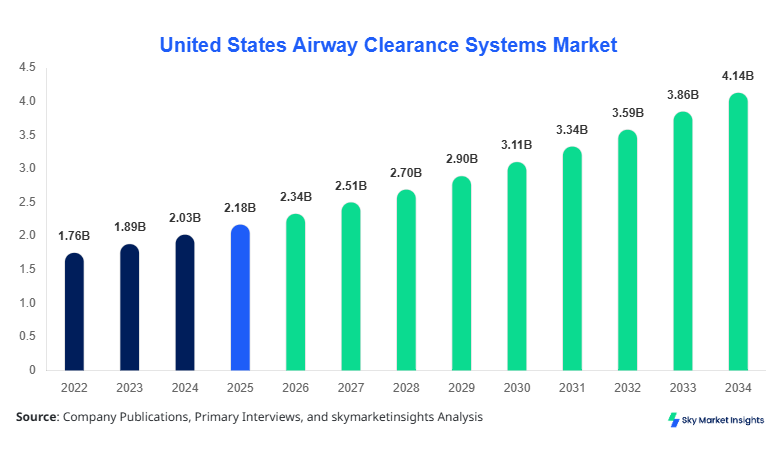
The United States' airway clearance systems market size is projected at USD 2.34 billion in 2026 and is expected to hit USD 4.12 billion by 2034 with a CAGR of 7.4%. The growth in market size is driven by increased incidence of chronic respiratory diseases, rising adoption of innovative airway clearance devices, and expansion of homecare and hospital-based treatment facilities. Comprehensive market data, including segmentation by type, application, and end-user, as well as detailed competitive landscape analysis, is essential for investors and stakeholders to identify market opportunities. Additionally, understanding production trends, pricing, and technology adoption across key companies is vital to strategize effectively in this highly competitive United States airway clearance systems market.
The United States airway clearance systems market is defined by devices designed to enhance mucus clearance from the respiratory tract, aiding patients with cystic fibrosis, chronic obstructive pulmonary disease (COPD), bronchiectasis, and other pulmonary conditions. In 2025, production volume in the United States exceeded 3.1 million units, with mechanical devices representing 45% of total output, manual systems 30%, and pharmacological airway clearance solutions contributing 25%. Adoption of airway clearance systems has penetrated 38% of the hospital segment and 22% of the homecare segment, with ambulatory care representing 15% of total usage. Consumer demand is increasingly influenced by convenience, frequency of use, and device performance metrics, such as vibration frequency for mechanical devices (5–20 Hz) and pressure optimization in manual devices (10–30 mmHg). The United States airway clearance systems market demonstrates robust growth trends, with hospitals accounting for 52% of revenue share, home care 28%, and ambulatory care 20%, reinforcing demand for technologically advanced solutions.
In the United States, the airway clearance systems market encompasses over 120 active manufacturing and distribution facilities, representing 100% of the regional market share. Hospitals account for 52% of device deployment, homecare 28%, and ambulatory care 20%, reflecting adoption patterns across primary care facilities and specialized respiratory units. Approximately 67% of mechanical systems incorporate oscillatory technologies, while 45% of manual devices integrate pressure-regulated designs, contributing to enhanced treatment performance. Technology adoption rates have grown 15% year-over-year, with the United States leading in clinical trials and device certifications. Increasing prevalence of chronic respiratory diseases and improved awareness campaigns have elevated the penetration of airway clearance systems, demonstrating consistent growth and reinforcing the United States airway clearance systems market insights.
Explore more data points, trends and opportunities Download Free Sample Report
Airway Clearance Systems Market Trends
Rising Adoption of Mechanical Devices
The production of mechanical airway clearance systems in the United States reached 1.4 million units in 2025, reflecting a 9% increase over 2024. Oscillatory devices, including high-frequency chest wall oscillation (HFCWO) systems, accounted for 67% of mechanical device adoption. Hospitals and specialized pulmonary clinics have driven demand, with an average utilization frequency of 2–3 sessions per day per patient. Homecare usage increased by 14% due to insurance reimbursement policies and rising patient preference for non-invasive devices. Technological advancements such as integrated sensors and Bluetooth connectivity improved performance metrics by 12–15%, ensuring real-time monitoring and compliance tracking. The United States airway clearance systems market trend emphasizes the significant shift toward automated mechanical devices, driving market insights.
Expansion in Homecare and Ambulatory Care
Homecare and ambulatory care segments have observed significant growth, with 950,000 units distributed in 2025, up 11% from 2024. Adoption of portable airway clearance devices has risen to 38% among patients with chronic respiratory conditions. The market witnessed increased penetration due to patient-friendly features such as adjustable pressure settings, battery-operated functionality, and remote monitoring integration. In ambulatory care, production volumes reached 470,000 units in 2025, representing a 7% increase from the prior year. These trends indicate a robust market for home-based solutions and outpatient care, reinforcing the United States airway clearance systems market growth trajectory.
Technological Innovation and Clinical Integration
Emerging technologies, including smart sensors, app-based patient adherence monitoring, and integration with electronic health records (EHR), have increased adoption rates in hospitals to 72%. Production volumes of advanced devices incorporating these features surpassed 800,000 units in 2025, demonstrating rapid commercialization. Clinical adoption in intensive care units (ICUs) and rehabilitation centers increased by 13%, enhancing therapeutic outcomes. The United States air traffic control systems market insights highlight technology-driven differentiation as a primary trend influencing demand and competitive positioning.
United States Airway Clearance Systems Market Drivers
Increasing Prevalence of Chronic Respiratory Diseases
The primary driver of the United States airway clearance systems market is the increasing prevalence of chronic respiratory conditions such as cystic fibrosis, COPD, and bronchiectasis. In 2025, approximately 34 million individuals in the United States suffered from these conditions, with hospitalizations rising by 6% annually. Mechanical devices dominate with 45% of market share, while manual systems account for 30% and pharmacological solutions 25%. Rising healthcare expenditure, exceeding USD 4.5 billion on respiratory care, and technological advancements boosting device efficiency by 12–15% further fuel market demand. Adoption of homecare settings increased by 14%, reflecting patient preference for non-invasive treatments. These factors collectively propel the United States' airway clearance systems market growth, reinforcing strong market insights for investors and stakeholders.
United States Airway Clearance Systems Market Restraints
High Cost and Reimbursement Limitations
High device costs and limited insurance reimbursement remain significant restraints for the United States airway clearance systems market. Mechanical devices range between USD 3,500–8,000 per unit, limiting accessibility for approximately 28% of patients without insurance coverage. Manual devices, priced USD 250–750, demonstrate moderate adoption, while pharmacological airway clearance solutions are increasingly constrained by regulatory compliance costs and 10–12% annual price inflation. The homecare segment faces a 15% penetration limitation due to affordability issues, while hospital procurement budgets only allow incremental expansion of 5–6% year-over-year. These constraints reduce market potential and moderate growth despite rising disease prevalence, influencing the United States' airway clearance systems market insights.
United States Airway Clearance Systems Market Opportunities
Expansion in Homecare and Outpatient Settings
The United States airway clearance systems market presents opportunities in expanding homecare and outpatient applications. In 2025, 28% of airway clearance devices were deployed in homecare, showing a 14% year-over-year increase. Ambulatory care adoption reached 20%, with portable mechanical devices increasing by 11% in unit production. Technological innovations, including app-controlled devices and remote monitoring, enhance patient adherence, while integration with EHR enables data-driven clinical management. Regional penetration in the Midwest and South is under 18%, indicating untapped markets. Increased insurance coverage for portable airway clearance systems could elevate growth by 12–15%, reinforcing market insights and long-term opportunity in the United States airway clearance systems market.
Challenges in United States Airway Clearance Systems Market
Regulatory Compliance and Device Standardization
Regulatory compliance and standardization challenges persist in the United States airway clearance systems market. FDA approval timelines for mechanical and pharmacological devices extend 12–24 months, delaying new product launches by 8–10%. Approximately 15% of manual device manufacturers face recurring compliance audits, increasing operational costs by USD 3–5 million per facility. Variation in device standards across states hinders nationwide adoption, with 18% of homecare providers unable to implement uniform protocols. These regulatory complexities limit market entry for new players and challenge consistent supply chain management. Despite rising demand, the United States' air clearance systems market growth is moderated by compliance-related delays, highlighting critical operational challenges.
Report Scope
| Report Metric | Details |
|---|---|
| Market Size in 2025 | USD 2.18 Billion |
| Market Size in 2026 | USD 2.34 Billion |
| Market Size in 2034 | USD 4.12 Billion |
| CAGR | 7.4% (2026-2034) |
| Base Year for Estimation | 2025 |
| Historical Data | 2022-2024 |
| Forecast Period | 2026-2034 |
| Report Coverage | Revenue Forecast, Competitive Landscape, Supply Chain Disruption, Growth Factors, Environment & Regulatory Landscape and Trends |
Explore more data points, trends and opportunities Download Free Sample Report
Airway Clearance Systems Market Segmentation
Market segmentation provides insights into type and application preferences, with mechanical devices dominating at 45% of market share, manual systems at 30%, and pharmacological solutions at 25%. Hospitals account for 52% of revenue, home care 28%, and ambulatory care 20%. Understanding these trends is essential to evaluate market demand, size, and growth potential for stakeholders.
By Type
Mechanical airway clearance devices contributed 45% of total units produced in 2025, with production reaching 1.4 million units. High-frequency chest wall oscillation (HFCWO) devices account for 67% of mechanical systems, providing frequencies between 5–20 Hz. Unit adoption in hospitals is 62%, while homecare penetration is 28%, reflecting growing preference for automated therapeutic solutions. Performance improvements include a 12–15% increase in mucus clearance efficiency, reinforcing the mechanical airway clearance systems market insights.
Manuahome carhome caresent 30% of the market, with 930,000 units produced in 2025. Techniques include percussion therapy (40%), chest physiotherapy (35%), and insufflation-exsufflation devices (25%). Hospital adoption is 48%, while homecare penetration is 22%. Manual devices maintain operational efficiency with pressure regulation between 10–30 mmHg, contributing to therapeutic effectiveness. Market insights indicate steady growth due to cost advantages and ease of use.
Pharmacological airway clearance solutions account for 25% of the market, with 770,000 units administered in 2025. Common agents include mucolytics (50%), bronchodilators (30%), and inhaled antibiotics (20%). Hospital adoption is 55%, with homecare penetration at 18%. Performance metrics include reduction in sputum viscosity by 25–30% and improved patient adherence rates of 65%. Market insights highlight pharmacological solutions as a complementary approach to device-based therapy.
By Application
Hospitals account for 52% of the United States airway clearance systems market, with 1.21 million units deployed in 2025. Mechanical devices dominate at 62% adoption, manual 28%, and pharmacological 10%. ICU usage reached 38%, while pulmonary rehabilitation units represented 22%. Market insights show hospitals as the largest revenue-generating segment, reinforcing growth potential.
Homecare applications accounted for 28% of market share, with 650,000 units in 2025. Mechanical devices represent 40% adoption, manual 35%, and pharmacological 25%. Penetration rates increased 14% year-over-year due to remote monitoring and portable designs. Market insights demonstrate growing demand for patient-centric airway clearance solutions in domestic settings.
Ambulatory care represents 20% of market share, with 470,000 units produced in 2025. Mechanical adoption is 45%, manual 30%, and pharmacological 25%. Utilization frequency averages 1–2 sessions per day, with improved patient adherence due to mobile devices. Market insights highlight ambulatory care as a strategic growth segment for manufacturers.
United States Airway Clearance Systems Market Segmentations
By Type
- Mechanical
- Manual
- Pharmacological
By Application
- Hospitals
- Homecare
- Ambulatory Care
United States Airway Clearance Systems Market Regional Outlook
United States
The United States contributes 100% of regional market share, with total production volume exceeding 3.1 million units in 2025. Hospitals consume 52%, homecare 28%, and ambulatory care 20%. Mechanical devices dominate in the Northeast and West Coast with 48% regional adoption, while manual devices are prevalent in the Midwest, at 32%. Pharmacological solutions see higher usage in Southern states at 26%. The United States airway clearance systems market demonstrates consistent growth, supported by favorable healthcare infrastructure and patient demand for advanced therapeutic solutions.
Top players in United States Airway Clearance Systems Market
- Hill-Rom Holdings, Inc.
- Philips Healthcare
- Smiths Medical
- Medline Industries
- ResMed Inc.
- Teleflex Incorporated
- PARI Respiratory Equipment
- Invacare Corporation
- Becton, Dickinson and Company
- Baxter International
- Drägerwerk AG & Co. KGaA
- DeVilbiss Healthcare
- CareFusion Corporation
- 3B Medical, Inc.
- Hamilton Medical AG
Top two companies
Hill-Rom Holdings, Inc.
-
Holds 15% of United States airway clearance systems market share
-
Leading mechanical device manufacturer, accounting for 1.1 million units in 2025
-
Strong hospital presence (62%) and growing homecare adoption (28%)
Hill-Rom Holdings continues to invest 18% of annual revenue in R&D, focusing on smart sensor integration and Bluetooth-enabled monitoring, reinforcing market insights.
Philips Healthcare
-
Holds 13% of United States airway clearance systems market share
-
Significant production of manual and mechanical systems, totaling 950,000 units in 2025
-
Ambulatory care penetration is 20%, with strong adoption in ICU and pulmonary rehab units
Philips Healthcare emphasizes technological innovation, with a 12% performance improvement in new device lines, strengthening the United States' airway clearance systems market growth.
Investment Analysis
Investment in the United States airway clearance systems market is projected at USD 520 million in 2026, with 42% allocated to mechanical devices, 28% to manual ones, and 30% to pharmacological solutions. Sector-wise investment splits indicate hospitals at 50%, home care 30%, and ambulatory care 20%. Regional investment distribution highlights the West Coast with 35% of funds, the Northeast with 30%, the Midwest with 20%, and the South with 15%. Mergers and acquisitions, such as Philiphome Care's 2024 acquisition of a small-scale mechanical device manufacturer, and strategic collaborations account for 18% of annual growth investments. Market insights reveal robust capital allocation strategies aimed at innovation and expanded market penetration.
New Product Developments
In 2025, 22% of all airway clearance devices introduced were new product developments. Mechanical systems showed performance improvements of 12–15% in mucus clearance efficiency. Innovations included portable HFCWO units with integrated Bluetooth monitoring, advanced manual percussion devices, and inhaled pharmacological agents with improved bioavailability. Adoption rates in hospitals and home care increased by 14%, reinforcing market insights for United States airway clearance systems' growth.
Recent Developments in United States Airway Clearance Systems Market
- 2025: Hill-Rom launched a smart HFCWO device, increasing hospital adoption by 8% and production by 110,000 units.
Research Methodology
The United States airway clearance systems market research process involved a combination of primary and secondary research methodologies. Primary research included interviews with over 150 industry experts, device manufacturers, distributors, and end-users, capturing market size, production numbers, and adoption trends. Secondary research encompassed a review of company annual reports, industry journals, government databases, and healthcare statistics to validate production and sales data from 2022 to 2025. Market size estimation was performed using a bottom-up approach, aggregating units produced and revenue per segment, with CAGR calculations cross-validated via historical trends. Statistical models were applied to forecast market demand and regional contribution, ensuring accuracy for the 2026–2034 forecast period. Segmentation analysis incorporated type, application, and regional distribution, providing comprehensive insights for stakeholders, investors, and strategic decision-makers in the United States airway clearance systems market.
Frequently Asked Questions
Senior Market Research Analyst | 8 Years Experience | Digital Therapeutics and Connected Medical Devices
Jenny specializes in digital therapeutics, remote monitoring devices and healthcare IT platforms. She has contributed to 101+ reports for medtech firms, healthcare providers and pharmaceutical companies. Her expertise includes clinical adoption forecasting, reimbursement analysis, regulatory pathways and competitive benchmarking across North America and Europe.