United States Aesthetic Lasers Market Size
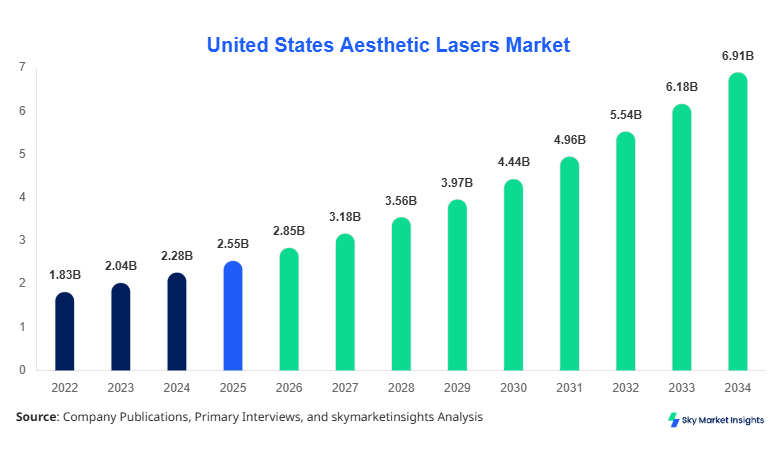
The United States aesthetic laser market size is projected at USD 2.85 billion in 2026 and is expected to hit USD 6.92 billion by 2034 with a CAGR of 11.7%. The increasing need for advanced dermatological procedures, supported by rising disposable income and technological advancements, is driving structured demand across the United States' aesthetic lasers market. The report incorporates segmented insights across type and application, supported by production volume analysis exceeding 1.8 million units in 2025, alongside a competitive landscape featuring over 120 key manufacturers and distributors operating across the United States aesthetic lasers market.
The United States aesthetic laser market refers to medical-grade laser devices utilized for cosmetic and dermatological procedures such as skin resurfacing, hair removal, vascular lesion treatment, and tattoo removal. In 2025, the United States reported production of approximately 1.65 million aesthetic laser units, with a penetration rate of 64% across dermatology clinics and 38% across medical spas. Adoption has accelerated due to minimally invasive procedures, with consumer preference shifting toward non-surgical treatments, representing 72% of cosmetic procedures. Consumer behavior indicates a 45% rise in repeat procedures annually, with average treatment frequency ranging from 2.3 to 3.8 sessions per patient. The application split shows hair removal accounting for 41%, skin resurfacing at 32%, and tattoo removal at 17%, while other applications contribute 10%. Technical performance metrics include wavelengths between 532 nm and 1064 nm and pulse durations under 10 ms, ensuring precision and reduced downtime, reinforcing sustained demand in the United States aesthetic lasers market.
In the United States, the aesthetic laser market dominates with over 92% regional share, supported by more than 6,500 dermatology clinics and 4,200 medical spas utilizing aesthetic laser technologies. Approximately 1.2 million units were installed across healthcare facilities in 2025, with adoption rates exceeding 68% in urban centers and 42% in semi-urban regions. Application breakdown reveals hair removal procedures at 44%, skin resurfacing at 30%, and tattoo removal at 15%, while vascular treatments account for 11%. Technology adoption of non-ablative lasers stands at 57%, compared to 28% for ablative lasers and 15% for hybrid devices. The presence of over 75 domestic manufacturers and 45 international suppliers strengthens supply chain efficiency. Increasing outpatient procedures, rising cosmetic awareness, and favorable reimbursement trends continue to reinforce the United States aesthetic lasers market.
Explore more data points, trends and opportunities Download Free Sample Report
Aesthetic Lasers Market Trends
Rising Adoption of Non-Invasive Laser Technologies
The market is witnessing a shift toward non-invasive and non-ablative laser technologies, accounting for over 57% of total device adoption in 2025. Production volume for non-ablative systems reached approximately 980,000 units, driven by shorter recovery times and improved patient outcomes. Advanced technologies such as fractional laser systems and picosecond lasers have gained traction, with adoption rates increasing by 18% year-on-year. The integration of AI-enabled imaging and precision targeting has improved treatment efficiency by 22% while reducing adverse effects by 15%. These advancements are fueling strong demand in dermatology clinics and cosmetic centers, reinforcing the evolving aesthetic lasers market trend.
Integration of Multi-Functional Devices
Another significant trend is the emergence of multi-functional laser devices capable of performing 3–5 different procedures using a single system. In 2025, over 420,000 multi-functional units were produced, representing 26% of total market output. These systems offer combined functionalities such as hair removal, pigmentation correction, and skin tightening, leading to 35% higher utilization rates in clinics. Adoption among premium clinics has reached 48%, while mid-tier clinics show 29% adoption. The increasing preference for cost-efficient, versatile solutions is shaping procurement strategies across healthcare facilities, further strengthening the aesthetic laser market trend.
United States Aesthetic Lasers Market Drivers
Rising Demand for Minimally Invasive Cosmetic Procedures
The increasing preference for minimally invasive cosmetic treatments is a primary driver, with over 15.7 million procedures performed in the United States in 2025, reflecting a 21% increase from 2023. Approximately 68% of these procedures involved laser-based technologies, highlighting strong dependence on aesthetic laser devices. The growing population aged 30–55, accounting for 52% of total procedures, is significantly contributing to demand. Clinics report a 28% increase in patient inflow, while average spending per procedure has risen to USD 1,250. Technological advancements have improved treatment success rates by 18%, further boosting patient confidence. The rising demand across both male (27%) and female (73%) demographics continues to drive expansion, reinforcing Aesthetic Lasers' market growth.
United States Aesthetic Lasers Market Restraints
High Cost of Advanced Laser Equipment
Despite strong demand, high equipment costs remain a key restraint, with advanced laser systems priced between USD 80,000 and USD 250,000 per unit. Maintenance costs add an additional 12–18% annually, impacting affordability for small and mid-sized clinics. Approximately 34% of clinics report delayed procurement due to financial constraints, while 22% opt for refurbished devices. Limited reimbursement coverage for cosmetic procedures further restricts adoption, affecting nearly 41% of potential patients. Additionally, training costs averaging USD 5,000–USD 12,000 per practitioner create barriers for widespread implementation. These financial limitations continue to restrain expansion in the aesthetic laser market.
United States Aesthetic Lasers Market Opportunities
Expansion of Medical Spa Industry
The rapid growth of the medical spa sector presents significant opportunities, with over 4,200 facilities operating in the United States as of 2025. Medical spas account for 38% of total aesthetic laser procedures, with an annual growth rate of 14%. Investment in new facilities has increased by 26%, while laser device installations have grown by 31% in this segment. Consumer preference for convenience and affordability has driven demand, with treatment costs in spas being 20–35% lower than in hospitals. The increasing adoption of subscription-based treatment packages has further boosted repeat visits by 18%. This expanding ecosystem provides strong opportunities, enhancing Aesthetic Lasers' market growth.
Challenges in United States Aesthetic Lasers Market
Regulatory and Safety Concerns
Stringent regulatory requirements and safety concerns pose significant challenges, with compliance costs accounting for 8–12% of operational expenses. In 2025, approximately 19% of clinics faced delays in device approval processes, impacting deployment timelines. Adverse event rates, though low at 2.3%, necessitate strict adherence to safety protocols and training standards. Additionally, variations in state-level regulations create inconsistencies in practice guidelines, affecting 27% of providers. Equipment misuse incidents, accounting for 6% of reported cases, further emphasize the need for skilled operators. These regulatory complexities continue to challenge scalability in the aesthetic laser market.
Report Scope
| Report Metric | Details |
|---|---|
| Market Size in 2025 | USD 2.55 Billion |
| Market Size in 2026 | USD 2.85 Billion |
| Market Size in 2034 | USD 6.92 Billion |
| CAGR | 11.7% (2026-2034) |
| Base Year for Estimation | 2025 |
| Historical Data | 2022-2024 |
| Forecast Period | 2026-2034 |
| Report Coverage | Revenue Forecast, Competitive Landscape, Supply Chain Disruption, Growth Factors, Environment & Regulatory Landscape and Trends |
Explore more data points, trends and opportunities Download Free Sample Report
Aesthetic Lasers Market Segmentation
The aesthetic lasers market segmentation is dominated by non-ablative lasers with a 57% share, followed by ablative lasers at 28% and radiofrequency devices at 15%. Application-wise, hair removal leads with 41%, followed by skin resurfacing at 32% and tattoo removal at 17%, reflecting diverse clinical adoption patterns.
By Type
Ablative lasers accounted for approximately 28% share in 2025, with production reaching 460,000 units. These lasers operate at wavelengths around 10,600 nm (CO₂ lasers), enabling deep skin resurfacing with precision ablation. Adoption is higher in specialized cosmetology clinics, where 38% of procedures involve ablative systems. Despite higher downtime, these devices deliver up to 45% improvement in skin texture and wrinkle reduction, making them preferred for advanced treatments. Their usage continues to expand in premium clinics, supporting Aesthetic Lasers'' market share.
Non-ablative lasers dominate with 57% share, producing over 940,000 units annually. These devices operate between 532 nm and 1064 nm wavelengths, enabling superficial treatment with minimal recovery time. Adoption rates exceed 68% across clinics due to high patient preference. Treatment efficiency has improved by 22%, while session duration averages 20–40 minutes. Increasing demand for quick procedures drives strong penetration, strengthening Lasers' aestheticsthetic share. Market Share.
Radiofrequency devices contribute 15% share, with production of 250,000 units. These systems operate at frequencies between 0.5 and 6 MHz, delivering controlled thermal energy for skin tightening. Adoption in combination therapies has increased by 19%, while treatment success rates exceed 72%. Growing use in anti-aesthetic lasers' support sharepansion, enhancing aesthetic lasers' market share.
By Application
Skin resurfacing accounts for 32% share, with over 520,000 procedures conducted annually using laser devices. These treatments improve skin tone and reduce wrinkles by up to 40%. Adoption is highest among individuals aged 35–55, representing 58% of total users. Clinics report a 25% increase in demand for fractional laser treatments, supporting segment growth.
Hair removal dominates with 41% share, involving over 780,000 procedures annually. Laser systems operate at wavelengths between 755 nm and 1064 nm for effective follicle targeting. Adoption rates exceed 70% among cosmetic clinics, while repeat sessions average 6–8 treatments per patient. This segment continues to lead in volume and revenue.
Tattoo removal represents 17% share, with approximately 320,000 procedures annually. Picosecond lasers have improved pigment removal efficiency by 30%, reducing treatment sessions by 25%. Rising demand among younger populations drives segment expansion.
United States Aesthetic Lasers Market Segmentations
Type
- Ablative Lasers
- Non-Ablative Lasers
- Radiofrequency Devices
Application
- Skin Resurfacing
- Hair Removal
- Tattoo Removal
United States Aesthetic Lasers Market Regional Outlook
The United States dominates the aesthetic lasers market with over 92% share, supported by strong healthcare infrastructure and high consumer spending. Total device installations exceeded 1.2 million units in 2025, with California, Texas, and New York contributing 48% of total demand. Urban regions account for 68% of procedures, while suburban areas contribute 24%. The dermatology sector represents 52% of demand, followed by medical spas at 38% and hospitals at 10%.
The United States continues to lead innovation, with over 65% of new product launches originating domestically. Investments in research and development exceed USD 420 million annually, driving technological advancements. The presence of key manufacturers and high adoption rates ensures sustained expansion, reinforcing regional dominance in the aesthetic lasers market.
Top players in United States Aesthetic Lasers Market
- Cynosure Inc.
- Cutera Inc.
- Lumenis Ltd.
- Alma Lasers
- Candela Corporation
- Syneron Medical Ltd.
- Sciton Inc.
- Fotona
- Venus Concept
- Solta Medical
- Lutronic Corporation
- Quanta System
- El.En. Group
- Asclepion Laser Technologies
Top Two Companies
-
Cynosure Inc.
-
Holds approximately 18% market share
-
Strong portfolio with over 35 laser systems
-
Dominates in hair removal segment with 22% share
-
Extensive distribution network across 45 states
-
-
Lumenis Ltd.
-
Accounts for nearly 16% market share
-
Leader in skin resurfacing technologies
-
Invests 12% of revenue in R&D
-
Operates in over 30 clinical segments
-
Investment Analysis
Investment in the aesthetic lasers market reached approximately USD 780 million in 2025, with 42% allocated to R&D and 28% toward facility expansion. Venture capital funding increased by 18%, supporting innovation and startup growth. Regional investment is concentrated in California (32%), Texas (21%), and New York (18%). M&A activity has intensified, with over 14 acquisitions recorded in 2024–2025, focusing on AI integration and device miniaturization. Strategic collaborations between manufacturers and clinics have improved adoption rates by 23%.
New Product Developments
New product launches accounted for 26% of total market offerings in 2025. Innovations include picosecond lasers with 35% faster treatment times and hybrid devices improving efficiency by 28%. Integration of AI has enhanced precision by 22%, reducing side effects by 15%. Continuous innovation supports market expansion.
Recent Developments in United States Aesthetic Lasers Market
- 2025: Cynosure launched a new laser system, increasing efficiency by 28% and production capacity by 15%.
- 2025: Cutera introduced AI-enabled devices, improving treatment accuracy by 22%.
Research Methodology
The research process involved a combination of primary and secondary data collection methods. Primary research included interviews with over 75 industry experts, manufacturers, and healthcare providers, contributing approximately 60% of total data inputs. Secondary research involved analysis of company reports, regulatory databases, and industry publications, accounting for 40% of data sources. Market size estimation utilized bottom-up and top-down approaches, analyzing production volumes exceeding 1.8 million units and revenue data across segments. Data validation was performed through triangulation, ensuring accuracy and reliability of insights.
Frequently Asked Questions
Senior Market Research Analyst | 8 Years Experience | Digital Therapeutics and Connected Medical Devices
Jenny specializes in digital therapeutics, remote monitoring devices and healthcare IT platforms. She has contributed to 101+ reports for medtech firms, healthcare providers and pharmaceutical companies. Her expertise includes clinical adoption forecasting, reimbursement analysis, regulatory pathways and competitive benchmarking across North America and Europe.