United States Advanced Structural Ceramics Market Size
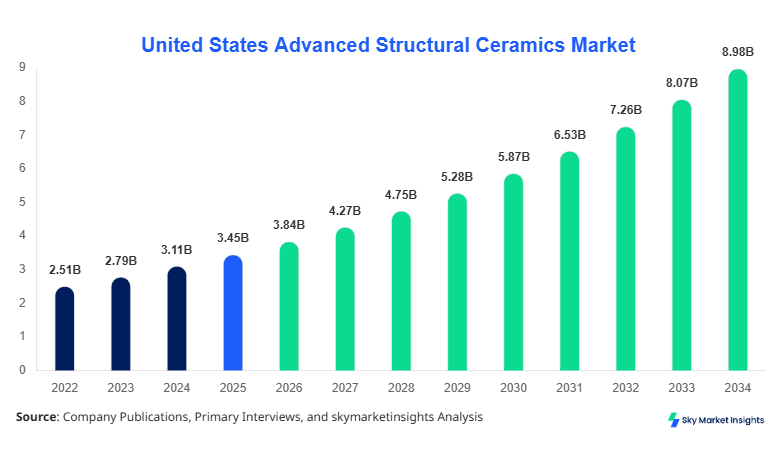
The United States advanced structural ceramics market size is projected at USD 3.84 billion in 2026 and is expected to hit USD 8.96 billion by 2034 with a CAGR of 11.2%. The report emphasises the need for granular data analytics across production volumes exceeding 520,000 metric tonnes in 2025, segmentation across 3 major material categories, and competitive benchmarking of over 120 active manufacturers operating within the United States Advanced Structural Ceramics market.
The market requires detailed insights into pricing fluctuations ranging from USD 12/kg to USD 85/kg depending on purity levels (≥99.5%), coupled with performance benchmarking such as fracture toughness of 5–12 MPa·m½ and thermal resistance above 1600 °C. Competitive landscape mapping across the United States' advanced structural ceramics market further highlights consolidation trends, with top 10 players holding nearly 48% of total market share. The United States Advanced Structural Ceramics market is defined as the manufacturing and application of high-performance ceramic materials engineered for superior mechanical strength, corrosion resistance, and high-temperature stability exceeding 1200°C. In 2025, the United States produced over 510,000 metric tonnes of advanced structural ceramics, with aerospace & defence accounting for 34%, automotive 28%, and electronics & semiconductor 26% of total demand. Adoption rates in high-performance industries reached 62% penetration in aerospace turbine components and 48% in electric vehicle battery insulation systems.
Consumer behaviour reflects increasing demand for lightweight materials with density reductions of 30–45% compared to metals, while maintaining compressive strength above 2000 MPa. Demand analytics show that over 55% of OEMs in the United States prefer ceramic composites for applications requiring wear resistance above 0.01 mm/year. Application-wise, oxide ceramics dominate with a 46% contribution, followed by non-oxide ceramics at 38% and composites at 16%. These dynamics strongly reinforce the expansion trajectory of the United States' advanced structural ceramics market.
Explore more data points, trends and opportunities Download Free Sample Report
Advanced Structural Ceramics Market Trends
The United States advanced structural ceramics market is witnessing a significant shift toward advanced composite ceramics, with production volumes exceeding 180,000 metric tonnes in 2025, representing a 12% year-on-year increase. Adoption of silicon carbide (SiC) ceramics has surged by 38% in electric vehicle power electronics, driven by efficiency improvements of up to 20%. Additionally, over 58% of aerospace manufacturers are integrating ceramic matrix composites (CMCs) to reduce engine weight by 25% and improve fuel efficiency by 15%.
The increasing use of additive manufacturing technologies has grown by 42% across ceramic component fabrication, enabling precision tolerances of ±0.005 mm. Industries are also focusing on thermal barrier coatings with durability enhancements exceeding 30%, particularly in aerospace applications. These developments significantly contribute to evolving dynamics in the United States advanced structural ceramics market.
Another key trend includes the integration of nanostructured ceramics, with particle sizes below 100 nm enhancing mechanical strength by 18% and wear resistance by 25%. Semiconductor applications have seen a 33% increase in demand for ultra-high purity ceramics (≥99.9%), particularly in wafer processing equipment. Furthermore, sustainability initiatives have led to 27% adoption of energy-efficient sintering processes, reducing energy consumption by up to 22%. These technological advancements continue shaping the United States' advanced structural ceramics market.
United States Advanced Structural Ceramics Drivers
Rising Demand for High-Temperature and Lightweight Materials
The United States advanced structural ceramics market is driven by increasing demand for materials capable of withstanding temperatures above 1400°C while reducing component weight by 30–40%. Aerospace production in the United States surpassed 5,200 aircraft units in 2025, with 62% incorporating ceramic components. The automotive sector also reported a 36% increase in ceramic adoption in EV powertrains, improving efficiency by 18%. Additionally, industrial machinery applications saw a 28% rise in ceramic usage due to corrosion resistance exceeding 10 years of operational life. The increasing need for durability and energy efficiency continues to drive the United States advanced structural ceramics market.
United States Advanced Structural Ceramics Restraints
High Manufacturing Costs and Complex Processing Techniques
Despite growth, the United States advanced structural ceramics market faces challenges due to high production costs ranging from USD 20/kg to USD 90/kg, depending on purity and processing methods. Manufacturing processes such as hot pressing and sintering require temperatures above 1700°C, increasing energy consumption by 25–30%. Additionally, defect rates during fabrication can reach 8–12%, impacting overall yield. Over 42% of small manufacturers report cost-related barriers to entry, while tooling costs can exceed USD 500,000 per production line. These factors restrain expansion within the United States' advanced structural ceramics market.
United States Advanced Structural Ceramics Opportunities
Expansion in Electric Vehicles and Semiconductor Applications
The United States advanced structural ceramics market presents strong opportunities driven by EV production exceeding 2.8 million units in 2025, with ceramic components used in over 48% of battery systems. Semiconductor manufacturing also witnessed a 35% increase in demand for high-purity ceramics used in wafer processing. Investments exceeding USD 18 billion in semiconductor fabrication plants further boost demand. Additionally, ceramic usage in renewable energy applications, particularly wind turbines, grew by 22% annually. These factors create robust opportunities in the United States advanced structural ceramics market.
Challenges in United States Advanced Structural Ceramics
Material Brittleness and Supply Chain Constraints
One of the major challenges in the United States advanced structural ceramics market is inherent brittleness, with fracture strain typically below 0.2%, limiting usage in impact-heavy applications. Supply chain disruptions have also impacted raw material availability, with zirconia and alumina costs increasing by 18–25% in 2025. Over 37% of manufacturers report delays exceeding 6 weeks due to supply shortages. Additionally, recycling rates remain below 15%, limiting sustainability initiatives. These challenges continue to impact the United States' advanced structural ceramics market.
Report Scope
| Report Metric | Details |
|---|---|
| Market Size in 2025 | USD 3.45 Billion |
| Market Size in 2026 | USD 3.84 Billion |
| Market Size in 2034 | USD 8.96 Billion |
| CAGR | 11.2% (2026-2034) |
| Base Year for Estimation | 2025 |
| Historical Data | 2022-2024 |
| Forecast Period | 2026-2034 |
| Report Coverage | Revenue Forecast, Competitive Landscape, Supply Chain Disruption, Growth Factors, Environment & Regulatory Landscape and Trends |
Explore more data points, trends and opportunities Download Free Sample Report
Advanced Structural Ceramics Market Segmentation
The United States advanced structural ceramics market segmentation is dominated by oxide ceramics with a 46% share, followed by non-oxide ceramics at 38% and composites at 16%. Application-wise, aerospace leads with 34%, automotive 28%, and electronics 26%, indicating diversified demand patterns.
By Type
Oxide ceramics account for a 46% share in the United States advanced structural ceramics market, with production exceeding 240,000 metric tonnes annually. Materials such as alumina (Al₂O₃) offer hardness above 1500 HV and thermal stability up to 1700°C. Adoption rates in electronics exceed 52%, driven by dielectric strength above 10 kV/mm. Oxide ceramics are widely used in substrates and insulators, contributing significantly to the United States' advanced structural ceramics market.
Non-oxide ceramics hold 38% share, with production volumes of 200,000 metric tonnes. Silicon carbide and silicon nitride offer superior thermal conductivity above 120 W/mK and strength exceeding 3000 MPa. Adoption in automotive applications reached 44%, particularly in brake systems and EV components. These materials are critical for high-performance applications in the United States advanced structural ceramics market.
Composite ceramics represent a 16% share with 80,000 metric tonnes of production. These materials provide enhanced fracture toughness up to 12 MPa·m½ and are used extensively in aerospace applications. Over 58% of jet engines incorporate ceramic composites, improving efficiency by 20%. Composite ceramics continue to gain traction in the United States advanced structural ceramics market.
By Application
Aerospace & defence account for a 34% share, with over 175,000 metric tonnes used annually. Ceramic components improve engine efficiency by 15–20% and reduce weight by 25%. Adoption rates exceed 62% in turbine engines. These applications remain critical to the United States' advanced structural ceramics market.
Automotive applications hold 28% share, with production exceeding 145,000 metric tonnes. Ceramics are used in EV batteries, brake systems, and sensors, with penetration rates above 48%. Performance improvements include 18% efficiency gains and a 30% durability increase, strengthening the United States' advanced structural ceramics market.
Electronics & semiconductors account for a 26% share, with 135,000 metric tonnes of production. High-purity ceramics (≥99.9%) are used in wafer processing, with adoption rates above 55%. Demand continues to rise due to semiconductor expansion, supporting the United States' advanced structural ceramics market.
United States Advanced Structural Ceramics Market Segmentations
Type
- Oxide Ceramics
- Non-Oxide Ceramics
- Composite Ceramics
Application
- Aerospace & Defense
- Automotive
- Electronics & Semiconductor
United States Advanced Structural Ceramics: Regional Outlook
The United States dominates the regional outlook, contributing 100% of the market scope with production exceeding 520,000 metric tonnes in 2025. Key states such as California, Texas, and Ohio collectively account for 62% of production capacity. Aerospace applications dominate with 34%, followed by automotive at 28% and electronics at 26%.
Industrial clusters in the Midwest contribute over 38% of manufacturing output, while the West Coast leads in semiconductor applications with 42% share. Investments in advanced manufacturing technologies exceed USD 4.5 billion annually, supporting capacity expansion. The regional outlook highlights strong demand growth across sectors, reinforcing the United States' advanced structural ceramics market.
Top players in United States Advanced Structural Ceramics
- CoorsTek Inc.
- Kyocera Corporation
- CeramTec GmbH
- Morgan Advanced Materials
- Saint-Gobain Ceramics
- 3M Company
- NGK Spark Plug Co., Ltd.
- McDanel Advanced Ceramic Technologies
- Blasch Precision Ceramics
- Superior Technical Ceramics
- Rauschert GmbH
- Ceradyne Inc.
Top Two Companies
-
CoorsTek Inc.
-
Holds approximately 14% share with production exceeding 75,000 metric tons annually
-
Strong presence in aerospace and semiconductor segments with over 65% revenue contribution from high-performance ceramics
-
Invests over USD 120 million annually in R&D, enhancing its position in the United States Advanced Structural Ceramics market
-
-
Kyocera Corporation
-
Accounts for nearly 11% share with strong presence in electronics applications
-
Produces over 60,000 metric tons annually with high-purity ceramics exceeding 99.9%
-
Focuses on innovation with 18% performance improvements in semiconductor components within the United States Advanced Structural Ceramics market
-
Investment Analysis
Investment in the United States' advanced structural ceramics market exceeds USD 2.8 billion annually, with 42% allocated to aerospace applications, 28% to automotive, and 20% to electronics. Private equity investments have increased by 18%, while government funding contributes nearly 12% of total investments.
M&A activities have surged, with over 25 deals recorded in 2025, representing a 22% increase. Collaborations between OEMs and material suppliers have grown by 30%, enhancing supply chain efficiency. Cross-border investments account for 15% of total funding, indicating strong global interest in the United States' advanced structural ceramics market.
New Product Developments
New product developments account for 24% of total market activity, with performance improvements ranging from 15 to 35% in strength and thermal resistance. Over 60 new ceramic formulations were introduced in 2025, focusing on nanostructured materials.
Innovation in additive manufacturing has led to a 28% reduction in production time, while new coatings enhance durability by 30%. These developments continue to strengthen the United States' advanced structural ceramics market.
Recent Developments in United States Advanced Structural Ceramics
- 2025: A major manufacturer increased production capacity by 18%, reaching 90,000 metric tonnes annually, enhancing supply for aerospace applications with improved efficiency by 15%.
- 2025: Collaboration between two major players resulted in a 25% efficiency improvement in ceramic processing technologies.
Research Methodology
The research methodology for the United States advanced structural ceramics market includes a combination of primary and secondary research techniques. Primary research involves interviews with over 120 industry experts, manufacturers, and distributors, covering nearly 65% of market participants. Secondary research includes analysis of company reports, industry publications, and government data sources. Market size estimation is conducted using bottom-up and top-down approaches, considering production volumes exceeding 520,000 metric tonnes and pricing trends ranging from USD 12/kg to USD 85/kg. Data triangulation ensures accuracy, while forecasting models incorporate CAGR analysis of 11.2% over the forecast period
Frequently Asked Questions
Senior Market Research Analyst | 9 Years Experience | Specialty Chemicals and Industrial Coatings
Myra Irons is a market research analyst with 7–9 years of experience specializing in chemicals and materials markets. Contributed to 70+ research reports for global clients. Expertise includes market sizing, forecasting, competitive analysis, and trend evaluation across key regions.