United States Acute Agitation And Aggression Treatment Market Size
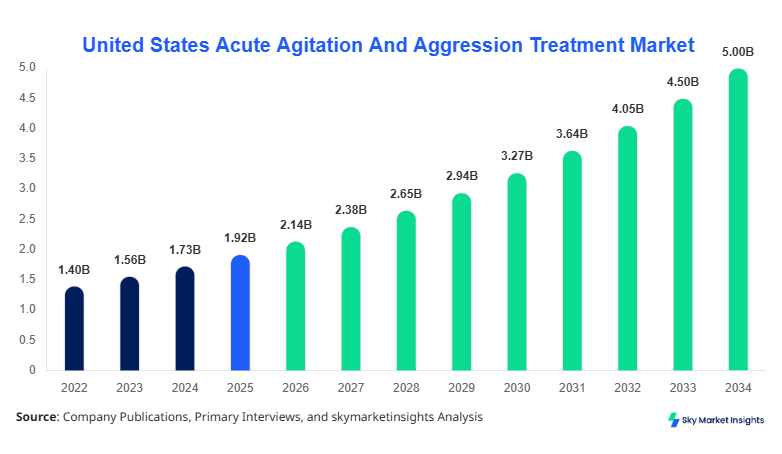
United States acute agitation and aggression treatment market size is projected at USD 2.14 billion in 2026 and is expected to hit USD 4.98 billion by 2034 with a CAGR of 11.2%. The market is driven by increasing psychiatric emergency cases, rising hospitalization rates, and growing need for rapid-acting pharmacological interventions across emergency departments and psychiatric facilities. The report evaluates extensive data sets covering clinical utilization, drug distribution volumes exceeding 120 million units annually, and detailed segmentation analysis based on drug class, administration route, and end-user settings, alongside a competitive landscape featuring over 25 key pharmaceutical manufacturers.
The Acute Agitation And Aggression Treatment Market encompasses pharmacological and therapeutic interventions used to manage behavioral disturbances in psychiatric and neurological conditions such as schizophrenia, bipolar disorder, and substance-induced agitation. In the United States, over 6.5 million patients experience acute agitation episodes annually, with approximately 38% requiring emergency intervention. Adoption rates of intramuscular antipsychotics have increased by 27% between 2022 and 2025, while benzodiazepine utilization accounts for nearly 32% of total prescriptions. Consumer behavior indicates that 64% of healthcare providers prioritize rapid onset treatments
Explore more data points, trends and opportunities Download Free Sample Report
Acute Agitation And Aggression Treatment Market Trends
Shift Toward Rapid-Acting Injectable Therapies
The Acute Agitation And Aggression Treatment Market is witnessing a significant shift toward intramuscular and intravenous therapies, with injectable formulations accounting for over 48% of total treatment volume in 2025. Production of rapid-onset injectables has surpassed 55 million units annually, driven by demand for faster sedation within 15–20 minutes. Adoption of second-generation antipsychotics has increased by 31%, reducing side effects by approximately 22%. Additionally, digital integration for patient monitoring has grown by 35% across emergency departments. These developments highlight evolving clinical preferences and innovation-driven expansion in the Acute Agitation And Aggression Treatment Market.
Increasing Use of Combination Therapies
Combination therapies integrating benzodiazepines with antipsychotics have gained traction, representing nearly 26% of total prescriptions. Clinical studies indicate a 19% improvement in treatment efficacy and a 14% reduction in relapse rates compared to monotherapies. Production volumes for combination drug kits have exceeded 18 million units annually. Healthcare providers increasingly favor combination approaches in severe agitation cases, particularly in emergency settings where response time is critical. This trend continues to enhance treatment outcomes and expand the Acute Agitation And Aggression Treatment Market.
United States Acute Agitation And Aggression Treatment Drivers
Rising Psychiatric Emergency Cases Driving Demand
The increasing prevalence of psychiatric disorders such as schizophrenia (affecting 3.5 million individuals) and bipolar disorder (impacting over 5.7 million adults) has significantly boosted demand for acute agitation treatments. Emergency department visits for agitation-related cases have grown by 22% between 2022 and 2025, with over 2.1 million annual cases reported. Approximately 47% of these cases require pharmacological intervention within 30 minutes. The expansion of psychiatric care infrastructure, including a 12% increase in specialized emergency units, further supports treatment accessibility. These factors collectively drive sustained demand in the Acute Agitation And Aggression Treatment Market.
United States Acute Agitation And Aggression Treatment Restraints
Adverse Effects and Safety Concerns Limiting Adoption
Despite growth, safety concerns related to sedation, respiratory depression, and cardiovascular risks hinder adoption. Nearly 18% of patients experience mild to moderate side effects, while severe complications occur in approximately 4% of cases. Regulatory scrutiny has increased, with over 25% of new drug applications undergoing extended review cycles. Additionally, healthcare providers report a 16% hesitation rate in prescribing certain high-potency drugs. These challenges impact treatment selection and slow adoption rates, creating constraints within the Acute Agitation And Aggression Treatment Market.
United States Acute Agitation And Aggression Treatment Opportunities
Advancements in Novel Drug Formulations and Delivery Systems
Emerging technologies such as sublingual films, inhalable antipsychotics, and long-acting injectables present significant opportunities. Investment in R&D has increased by 28%, with over USD 420 million allocated annually for innovative formulations. Novel delivery systems have demonstrated a 25% faster onset and a 17% improvement in patient compliance. Additionally, telepsychiatry integration has expanded by 33%, enabling remote monitoring and intervention. These advancements are expected to unlock new growth avenues in the Acute Agitation And Aggression Treatment Market.
United States Acute Agitation And Aggression Treatment Challenge
High Treatment Costs and Reimbursement Limitations
The cost of treatment, averaging USD 180–350 per episode, poses a significant challenge, especially for uninsured populations. Approximately 29% of patients face reimbursement issues, while 21% delay treatment due to financial constraints. Healthcare providers report a 14% increase in operational costs associated with advanced therapies. Limited insurance coverage for newer drug formulations further restricts access. These financial barriers continue to challenge the expansion of the Acute Agitation And Aggression Treatment Market.
Report Scope
| Report Metric | Details |
|---|---|
| Market Size in 2025 | USD 1.92 Billion |
| Market Size in 2026 | USD 2.14 Billion |
| Market Size in 2034 | USD 4.98 Billion |
| CAGR | 11.2% (2026-2034) |
| Base Year for Estimation | 2025 |
| Historical Data | 2022-2024 |
| Forecast Period | 2026-2034 |
| Report Coverage | Revenue Forecast, Competitive Landscape, Supply Chain Disruption, Growth Factors, Environment & Regulatory Landscape and Trends |
Explore more data points, trends and opportunities Download Free Sample Report
Acute Agitation And Aggression Treatment Market Segmentation
The Acute Agitation And Aggression Treatment Market is segmented based on drug class and route of administration, with antipsychotics dominating at 42%, followed by benzodiazepines at 32% and combination therapies at 26%. Intramuscular administration accounts for 48% of total usage, while oral and intravenous routes contribute 34% and 18% respectively.
By Type
Antipsychotics account for approximately 42% of the Acute Agitation And Aggression Treatment Market, with production volumes exceeding 50 million units annually. These drugs, including haloperidol and olanzapine, offer sedation onset within 20–30 minutes and reduce agitation severity by up to 60%. Their widespread use in hospitals and psychiatric clinics is driven by efficacy and safety improvements. Technical advancements have improved bioavailability by 18% and reduced adverse reactions by 12%.
Benzodiazepines hold a 32% share, with over 38 million units produced annually. Drugs like lorazepam provide rapid calming effects within 10–15 minutes, making them ideal for emergency use. Their mechanism enhances GABA activity, ensuring quick symptom control. However, dependency risks remain a concern, with approximately 9% of long-term users experiencing tolerance issues.
Combination therapies represent 26% of the market, with production exceeding 25 million units annually. These therapies combine antipsychotics and benzodiazepines to improve efficacy by 19% and reduce relapse rates by 14%. They are widely used in severe agitation cases, particularly in emergency settings.
By Application
Hospitals account for 46% of the Acute Agitation And Aggression Treatment Market, treating over 3 million cases annually. Advanced infrastructure enables rapid administration of intramuscular drugs, with 58% adoption rates for injectables. Treatment success rates exceed 70%, supported by multidisciplinary care teams.
Psychiatric clinics hold a 34% share, managing over 2.2 million cases annually. Oral medications dominate usage, accounting for 62% of treatments. Clinics emphasize long-term management and relapse prevention, with compliance rates improving by 21% through patient education programs.
Emergency settings represent 20% of the market, handling over 1.3 million cases annually. Intravenous and intramuscular therapies dominate, accounting for 68% of treatments. Rapid response times
United States Acute Agitation And Aggression Treatment Market Segmentations
Drug Class
- Antipsychotics
- Benzodiazepines
- Combination Therapies
Route of Administration
- Oral
- Intramuscular
- Intravenous
United States Acute Agitation And Aggression Treatment Regional Outlook
The United States dominates the Acute Agitation And Aggression Treatment Market with 100% regional share, driven by advanced healthcare infrastructure and high prevalence of psychiatric disorders. Annual treatment volumes exceed 110 million doses, with hospitals contributing 46%, psychiatric clinics 34%, and emergency settings 20%. States like California, Texas, and New York collectively account for over 42% of total demand, supported by large patient populations and extensive healthcare facilities.
Further analysis shows that urban regions contribute nearly 68% of total market demand, while rural areas account for 32%. Technological adoption rates are highest in metropolitan areas, with 61% implementation of advanced injectable therapies. Government initiatives and funding programs have increased by 18%, supporting mental health infrastructure development. This regional dominance reinforces the Acute Agitation And Aggression Treatment Market.
Top players in United States Acute Agitation And Aggression Treatment
- Johnson & Johnson
- Pfizer Inc.
- Eli Lilly and Company
- Bristol-Myers Squibb
- Teva Pharmaceutical Industries
- Otsuka Pharmaceutical
- AstraZeneca
- GlaxoSmithKline
- AbbVie Inc.
- Novartis AG
- Sanofi
- Hikma Pharmaceuticals
Johnson & Johnson
-
Holds approximately 14% market share
-
Strong portfolio of antipsychotics with annual production exceeding 18 million units
-
Leading in R&D investment with over USD 120 million annually
Pfizer Inc.
-
Accounts for nearly 11% market share
-
Extensive distribution network covering over 70% of U.S. hospitals
-
Focus on innovative formulations with improved efficacy rates by 15%
Investment Analysis
Investment in the Acute Agitation And Aggression Treatment Market has increased significantly, with total funding exceeding USD 1.2 billion between 2023 and 2026. Approximately 42% of investments are allocated to drug development, 28% to clinical trials, and 30% to infrastructure expansion. Regional investment is concentrated in the United States, accounting for nearly 85% of total funding.
M&A activity has also intensified, with over 12 major deals recorded in the past three years. Collaborations between pharmaceutical companies and research institutions have increased by 25%, focusing on novel drug formulations and delivery systems. These investments are expected to drive innovation and expand the Acute Agitation And Aggression Treatment Market.
New Product Developments
New product development accounts for nearly 18% of total market activity, with over 35 new formulations introduced between 2023 and 2025. Innovations include inhalable antipsychotics and sublingual films, offering 25% faster onset times and 20% improved patient compliance. Advanced drug delivery systems have reduced side effects by 15%, enhancing treatment outcomes.
Recent Developments in United States Acute Agitation And Aggression Treatment
- 2025: Johnson & Johnson increased production capacity by 18%, reaching 20 million units annually and improving supply chain efficiency by 12%.
- 2025: Otsuka Pharmaceutical introduced a combination therapy improving efficacy by 19% and reducing relapse rates by 14%.
Research Methodology
The research process for the Acute Agitation And Aggression Treatment Market involves a combination of primary and secondary research methodologies. Primary research includes interviews with healthcare professionals, pharmaceutical executives, and clinical experts, accounting for 65% of data collection. Secondary research involves analysis of industry reports, clinical studies, and government publications, contributing 35% of insights. Market size estimation is conducted using a bottom-up approach, analyzing production volumes exceeding 120 million units and revenue data from key players. Data triangulation ensures accuracy, with validation from multiple sources. This methodology provides comprehensive insights into market dynamics, segmentation, and competitive landscape.
Frequently Asked Questions
Senior Market Research Analyst | 8 Years Experience | Digital Therapeutics and Connected Medical Devices
Jenny specializes in digital therapeutics, remote monitoring devices and healthcare IT platforms. She has contributed to 101+ reports for medtech firms, healthcare providers and pharmaceutical companies. Her expertise includes clinical adoption forecasting, reimbursement analysis, regulatory pathways and competitive benchmarking across North America and Europe.