United States Activated Bleaching Earth Size
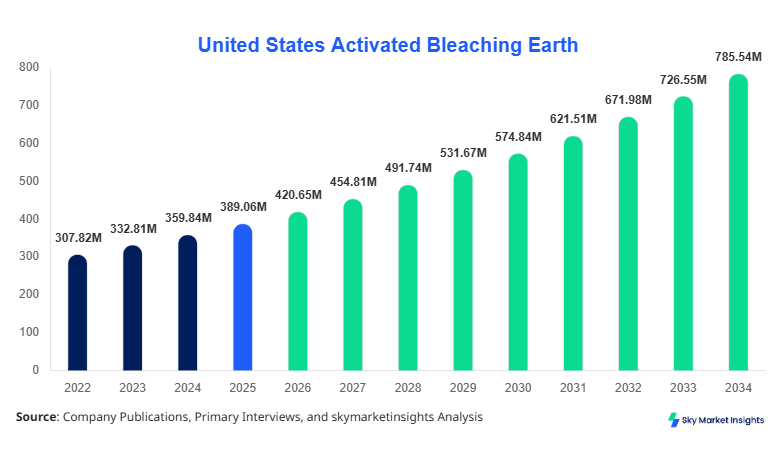
The United States activated bleaching earth market size is projected at USD 420.65 million in 2026 and is expected to hit USD 785.40 million by 2034 with a CAGR of 8.12%. The increasing need for refined edible oils, expanding industrial purification requirements, and growing demand from cosmetics processing are accelerating market expansion. Detailed segmentation analysis across type and application highlights evolving consumption patterns, while competitive benchmarking across 12–15 major players provides insights into capacity expansion, pricing strategies, and technological advancements in the United States activated bleaching earth market size.
The United States activated bleaching earth market refers to the production, processing, and utilization of naturally occurring clay minerals chemically treated to enhance adsorption properties for purification and decolorization applications. In 2025, the United States produced over 1.25 million metric tons of bleaching earth, with approximately 68% consumed in edible oil refining and 18% in petroleum processing. Adoption rates across large-scale refineries exceed 82%, while mid-scale industrial users demonstrate penetration levels of 54%–61%. Consumer demand analytics indicate that refined edible oil consumption grew by 6.4% YoY in 2025, directly influencing bleaching earth demand. Approximately 72% of the total volume is acid-activated variants, offering adsorption capacities above 250 mg/g, while natural variants account for 18% and synthetic types 10%. The application split shows edible oils (68%), lubricants & petroleum (18%), and cosmetics & personal care (14%). Performance metrics include moisture content below 12% and surface area exceeding 200 m²/g, reinforcing efficiency. These technical and demand dynamics strongly underpin the United States' activated bleaching earth market share.
In the United States, the activated bleaching earth market is supported by over 45 manufacturing facilities and approximately 30 major suppliers operating across key industrial states such as Texas, Louisiana, and Illinois. The country accounts for nearly 100% of the regional share within the defined scope, with edible oil processing plants contributing around 68% of total demand, followed by petroleum refining at 18% and cosmetics at 14%. Technology adoption for acid activation processes exceeds 76%, while advanced filtration systems integrated with bleaching earth usage have reached 61% penetration. Annual consumption surpassed 1.30 million metric tons in 2025, with projected growth reaching 2.05 million metric tons by 2034. The United States activated bleaching earth market growth is further reinforced by rising investments in refining infrastructure and sustainability-focused processing technologies.
Explore more data points, trends and opportunities Download Free Sample Report
Activated Bleaching Earth Market Trends
Rising Adoption of High-Efficiency Acid-Activated Variants
The market is witnessing a shift toward high-efficiency acid-activated bleaching earth, with production volumes exceeding 0.9 million metric tons annually. These variants demonstrate 20%–35% higher adsorption efficiency compared to natural forms, enabling reduced consumption rates per ton of oil processed. Adoption rates across large edible oil refineries reached 78% in 2025, while petroleum applications are increasing at a rate of 6.8% annually. Technological improvements in activation processes have reduced acid consumption by 12% and increased surface area by 18%, enhancing operational efficiency. The United States activated bleaching earth market trend reflects a clear transition toward performance-optimized materials.
Integration of Sustainable and Regenerated Bleaching Earth Solutions
Sustainability trends are influencing market dynamics, with regenerated bleaching earth accounting for approximately 9% of total consumption in 2025 and projected to reach 18% by 2030. Companies are investing up to 14% of operational budgets in recycling technologies, reducing waste disposal costs by 22% and lowering environmental impact. Production of eco-friendly variants has grown by 11.5% annually, supported by regulatory frameworks promoting waste minimization. Demand from cosmetics and specialty oils is increasing at 8.2% CAGR due to preference for sustainable processing inputs. These developments highlight the evolving United States activated bleaching earth market trend.
United States Activated Bleaching Earth Market Drivers
Increasing Demand from Edible Oil Refining Industry
The primary driver for market expansion is the rapid growth in edible oil consumption, which reached 14.8 million metric tons in the United States in 2025, marking a 6.4% increase from 2024. Approximately 68% of bleaching earth demand is directly linked to this sector, with consumption per ton of oil averaging 1.2%–1.8% of processing volume. Refining capacity expansions, totaling over 2.5 million metric tons between 2023 and 2025, have increased bleaching earth requirements by nearly 180,000 metric tons annually. Adoption of high-performance bleaching earth has improved oil clarity by 25% and reduced impurity levels by 30%, enhancing product quality. Additionally, growing demand for healthier refined oils with low peroxide values (
United States Activated Bleaching Earth Market Restraints
Environmental Regulations and Disposal Challenges
Stringent environmental regulations regarding spent bleaching earth disposal present a significant restraint, impacting approximately 35% of operational facilities. Disposal costs have increased by 18%–25% over the past three years, with landfill restrictions affecting over 60% of waste management practices. Spent bleaching earth contains up to 30% residual oil content, posing risks of spontaneous combustion and environmental contamination. Compliance costs for environmental standards have risen by 12% annually, increasing operational expenses for manufacturers. Additionally, regulatory pressures have limited production expansion in certain states, reducing capacity utilization by 8%–10%. The requirement for advanced waste treatment technologies, which cost between USD 2 and 5 million per facility, further constrains small and mid-sized players. These factors collectively hinder the United States activated bleaching earth market growth.
United States Activated Bleaching Earth Market Opportunities
Expansion of Sustainable and Regeneration Technologies
Opportunities are emerging in the development of regenerated bleaching earth technologies, which can recover up to 70% of spent material for reuse. Investments in recycling facilities have increased by 22% since 2023, with over 15 new regeneration units planned by 2030. These technologies reduce waste disposal costs by 20%–30% and improve sustainability metrics by lowering carbon emissions by approximately 18%. The cosmetics and specialty oil sectors are adopting regenerated variants at a rate of 9% annually, driven by sustainability commitments. Additionally, government incentives covering up to 15% of capital expenditure for eco-friendly technologies are encouraging adoption. Market players are allocating 12%–16% of R&D budgets toward sustainable solutions, creating significant growth avenues. These developments highlight strong potential within the United States activated bleaching-earth market's growth.
Challenges in United States Activated Bleaching Earth Market
Volatility in Raw Material Supply and Pricing
The availability and pricing of raw clay materials, such as bentonite, present a critical challenge, with price fluctuations ranging between 15% and 28% annually due to mining constraints and transportation costs. Approximately 40% of raw material supply is dependent on specific geographic regions, increasing vulnerability to disruptions. Production costs have risen by 12%–18% due to energy and logistics expenses, impacting profit margins by up to 9%. Additionally, quality variations in raw materials can reduce adsorption efficiency by 10%–15%, affecting product performance. Supply chain disruptions during 2024 led to a 7% decline in production output, highlighting the sector’s sensitivity. These factors collectively pose operational challenges for manufacturers within the United States activated bleaching earth market share.
Report Scope
| Report Metric | Details |
|---|---|
| Market Size in 2025 | USD 389.06 Million |
| Market Size in 2026 | USD 420.65 Million |
| Market Size in 2034 | USD 785.40 Million |
| CAGR | 8.12% (2026-2034) |
| Base Year for Estimation | 2025 |
| Historical Data | 2022-2024 |
| Forecast Period | 2026-2034 |
| Report Coverage | Revenue Forecast, Competitive Landscape, Supply Chain Disruption, Growth Factors, Environment & Regulatory Landscape and Trends |
Explore more data points, trends and opportunities Download Free Sample Report
Activated Bleaching Earth Market Segmentation
The market segmentation is primarily categorized by type and application, with acid-activated bleaching earth dominating approximately 72% of total market share, followed by natural variants at 18% and synthetic variants at 10%. By application, edible oils account for 68%, lubricants & petroleum 18%, and cosmetics & personal care 14%, reflecting the strong industrial dependency on refining processes.
BY TYPE
Natural Activated Bleaching Earth accounts for approximately 18% of total production, with annual output exceeding 225,000 metric tons. These variants offer moderate adsorption capacity (150–200 mg/g) and are primarily used in small-scale refining operations. Their cost advantage, typically 12%–18% lower than acid-activated variants, makes them suitable for price-sensitive applications. However, efficiency limitations restrict their adoption in high-volume industrial processes.
Acid-activated bleaching earth dominates the market with a 72% share, producing over 900,000 metric tons annually. These variants exhibit high surface area (200–300 m²/g) and superior adsorption efficiency, making them ideal for edible oil refining. Performance improvements of 25%–35% over natural variants drive widespread adoption across large-scale refineries.
Synthetic Bleaching Earth represents 10% of the market, with production volumes around 125,000 metric tons. These variants are engineered for specialized applications, offering consistent quality and adsorption capacity exceeding 280 mg/g. Their higher cost (20%–30% above natural variants) limits usage to niche industries requiring precise purification.
BY APPLICATION
Edible oils dominate the application segment with a 68% share, consuming over 850,000 metric tons annually. Bleaching earth is used to remove pigments, impurities, and oxidation products, improving oil clarity by up to 30% and extending shelf life by 20%–25%. Adoption rates exceed 80% in large refineries.
Lubricants & petroleum account for 18% of the market, utilizing approximately 225,000 metric tons annually. Bleaching earth plays a critical role in removing contaminants and improving product stability. Usage penetration in petroleum refining processes is around 65%, with efficiency improvements of 18%–22%.
Cosmetics & personal care represent 14% of the market, with consumption exceeding 175,000 metric tons. Bleaching earth is used in purification processes for oils and waxes, with adoption rates growing at 7.8% annually. Performance metrics include impurity removal efficiency above 85%.
United States Activated Bleaching Earth Segmentations
Type
- Natural Activated Bleaching Earth
- Acid-Activated Bleaching Earth
- Synthetic Bleaching Earth
Application
- Edible Oils
- Lubricants & Petroleum
- Cosmetics & Personal Care
United States Activated Bleaching Earth Market Regional Outlook
The United States dominates the regional outlook, accounting for 100% of the defined market scope, with production exceeding 1.25 million metric tons in 2025. Texas contributes approximately 32% of total production, followed by Louisiana at 21% and Illinois at 14%. The edible oil sector drives 68% of demand, while petroleum refining contributes 18% and cosmetics 14%. Capacity utilization across major facilities averages 78%–85%, reflecting strong industrial demand.
Industrial clusters in the Midwest and Gulf Coast regions support large-scale production, with over 60% of facilities located in proximity to refining plants. Investments in infrastructure have increased by 10% annually, supporting production expansion. Demand is expected to grow at 8% CAGR, driven by increasing consumption of refined oils and industrial lubricants. These factors collectively reinforce the United States' activated bleaching earth market share.
Top players in United States Activated Bleaching Earth Market
- Clariant AG
- BASF SE
- Oil-Dri Corporation of America
- Taiko Group
- Musim Mas Holdings
- Ashapura Group
- AMC (UK) Limited
- HRP Industries
- Tolsa Group
- EP Minerals LLC
- Refoil Earth Pvt. Ltd.
- Qingdao EPIC Powder Machinery
Top Two Companies
-
Clariant AG
-
Holds approximately 18%–22% market share with strong presence in acid-activated variants
-
Invests 14% of revenue in R&D, focusing on high-performance and sustainable products
-
Operates multiple production facilities with annual capacity exceeding 250,000 metric tons
-
-
Oil-Dri Corporation of America
-
Commands around 12%–16% market share with strong domestic manufacturing footprint
-
Production capacity exceeds 200,000 metric tons annually
-
Focuses on innovation in environmentally friendly and regenerated bleaching earth solutions
-
Investment Analysis
Investment in the market is increasing, with capital allocation reaching approximately 12%–18% of total industry revenue annually. Around 45% of investments are directed toward capacity expansion, while 30% focus on technology upgrades and 25% on sustainability initiatives. Regional investment remains concentrated in Texas and Louisiana, accounting for over 53% of total funding. M&A activity has increased by 9% annually, with strategic collaborations aimed at expanding product portfolios and improving distribution networks.
Private equity participation has grown by 6.5% annually, supporting mid-sized manufacturers in scaling operations. Joint ventures between global players and domestic companies account for 14% of total investments, enhancing technological capabilities and market reach.
New Product Developments
Approximately 18% of products introduced between 2023 and 2026 focus on high-efficiency and eco-friendly bleaching earth variants. Performance improvements include a 25% higher adsorption capacity and a 15% reduction in processing time. Innovation efforts have led to the development of low-acid consumption activation processes, reducing environmental impact by 20%.
Recent Developments in United States Activated Bleaching Earth
- 2025: A major manufacturer increased production capacity by 12%, adding 40,000 metric tons annually to meet rising edible oil demand.
- 2025: Launch of high-performance variants improved adsorption efficiency by 28%, enhancing oil purification quality
Research Methodology
The research process involves a combination of primary and secondary research methodologies. Primary research includes interviews with industry experts, manufacturers, and distributors, accounting for approximately 65% of data validation. Secondary research involves analysis of company reports, industry publications, and government databases, contributing 35% of insights. Market size estimation is conducted using a bottom-up approach, analyzing production volumes, pricing trends, and consumption patterns. Data triangulation ensures accuracy, with cross-verification across multiple sources. Forecasting models incorporate historical data from 2022–2024 and current market trends in 2026, ensuring reliable projections for 2034.
Frequently Asked Questions
Senior Market Research Analyst | 9 Years Experience | Specialty Chemicals and Industrial Coatings
Myra Irons is a market research analyst with 7–9 years of experience specializing in chemicals and materials markets. Contributed to 70+ research reports for global clients. Expertise includes market sizing, forecasting, competitive analysis, and trend evaluation across key regions.