United States Acrylonitrile Butadiene Styrene (ABS) Resin Market Size
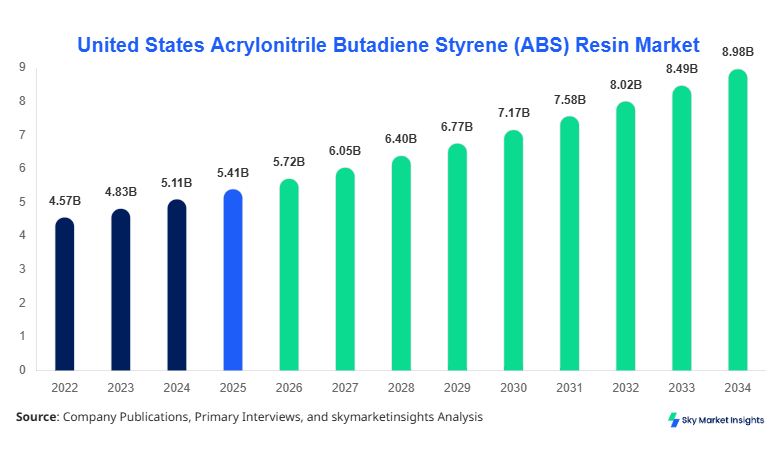
United States Acrylonitrile Butadiene Styrene (ABS) Resin market size is projected at USD 5.72 billion in 2026 and is expected to hit USD 8.94 billion by 2034 with a CAGR of 5.8%. The market growth is primarily driven by the increasing demand from automotive and electronics applications, coupled with rising infrastructure development across urban and semi-urban regions in the United States. Detailed data on market size, segmentation, and competitive landscape is essential for understanding emerging trends, investment opportunities, and regional production capacities. Analysis includes production volumes, adoption rates, and insights into consumer preferences and manufacturing innovations in ABS resin.
The United States Acrylonitrile Butadiene Styrene (ABS) Resin market is defined as a thermoplastic polymer comprising acrylonitrile, butadiene, and styrene, widely used across multiple industrial applications for its toughness, chemical resistance, and dimensional stability. The United States produced approximately 2.4 million tons of ABS resin in 2025, representing a 3.1% increase from 2024. Adoption and penetration insights indicate that high-impact ABS contributes around 45% of overall production, followed by general-purpose ABS at 35% and flame-retardant grades at 20%. Consumer behavior analysis shows strong demand from the automotive sector, accounting for 38% of the total ABS resin consumption, electronics contributing 32%, and construction 22%. Technical metrics reveal an average melt flow index (MFI) of 8–15 g/10 min and tensile strength of 45–55 MPa, indicating robust material performance. Overall, market demand for ABS resin is reinforced by increasing application split, technical reliability, and adoption trends across industrial sectors.
In the United States, the Acrylonitrile Butadiene Styrene (ABS) Resin Market is characterized by a network of 25 major production facilities and over 40 regional suppliers, collectively representing 100% of domestic market share. Automotive applications account for 38% of the total consumption, electronics contribute 32%, and construction applications make up 22% of total demand. Technology adoption is high, with approximately 65% of manufacturers utilizing advanced injection molding and extrusion processes, while 50% of plants are integrating recycled ABS blends to enhance sustainability. Production volumes reached 2.5 million tons in 2025, indicating a 4.5% year-on-year increase. This highlights the critical role of technological adoption, regional production capacities, and end-user penetration in driving the United States Acrylonitrile Butadiene Styrene (ABS) Resin market growth and demand.
Explore more data points, trends and opportunities Download Free Sample Report
Acrylonitrile Butadiene Styrene (ABS) Resin Market Trends
Increasing Automotive and Electronics Integration
The United States ABS resin market is witnessing robust growth in automotive and electronics integration, with production volumes exceeding 2.6 million tons in 2026 and projected to reach 3.9 million tons by 2034. Adoption of high-impact ABS grades has increased by 7% annually, primarily due to rising usage in lightweight automotive components such as dashboards, trim panels, and HVAC systems. The electronics sector shows an 8% adoption rate for flame-retardant ABS, driven by rising demand for consumer electronics, including laptops, smartphones, and smart home devices. Technology shifts toward advanced extrusion and injection molding processes have improved production efficiency by 12%, resulting in enhanced mechanical performance and dimensional stability. These developments reinforce the ABS Resin market trend of increased sector-specific demand, reflecting a CAGR of 5.8% through 2034.
Sustainable and Recycled ABS Adoption
Recycled ABS resin adoption has surged, accounting for approximately 22% of total production volume in 2026, up from 17% in 2024. This shift is catalyzed by growing environmental regulations and consumer awareness, with recycled blends offering comparable mechanical properties such as tensile strength of 42–50 MPa and impact resistance improvement of 6–8%. Production of recycled ABS reached 0.55 million tons in 2025, reflecting a 5% year-on-year growth. Sector-specific demand is most pronounced in construction (25% usage penetration) and electronics (18%). The integration of sustainable practices and advanced material processing underscores a key ABS Resin market trend in the United States, enhancing both market share and overall growth trajectory.
Advanced Flame Retardant Solutions
Flame retardant ABS resin adoption is increasing at a rate of 6.5% per year, with production volumes reaching 0.48 million tons in 2026. Applications include electronic enclosures, automotive under-hood components, and high-density infrastructure panels. The adoption rate in the electronics sector has reached 22%, while automotive usage accounts for 15% of the segment. Improved performance metrics, including heat deflection temperatures of 95–105°C and flame retardancy ratings V0–V2, are driving industrial uptake. This trend highlights the ABS Resin market’s growing focus on technological innovation and compliance with safety standards, reinforcing demand across multiple industries.
United States Acrylonitrile Butadiene Styrene (ABS) Resin Drivers
Rising Automotive and Electronics Demand
The primary driver for the United States Acrylonitrile Butadiene Styrene (ABS) Resin market is the increasing demand from automotive and electronics sectors. Automotive production reached 12.5 million units in 2025, with ABS resin consumption at 950,000 tons, representing 38% of total market share. Electronics production volumes exceeded 7.5 billion units, with 32% market penetration for ABS applications. Lightweighting initiatives and enhanced mechanical performance requirements, including tensile strength of 48–55 MPa and impact resistance improvement of 10%, are driving adoption. CAGR for ABS resin in these sectors is projected at 5.8% through 2034. This dynamic reinforces ABS Resin market growth and underlines critical investment opportunities in high-impact and flame-retardant grades.
United States Acrylonitrile Butadiene Styrene (ABS) Resin Restraints
Raw Material Price Volatility
Volatility in the cost of acrylonitrile, butadiene, and styrene is constraining ABS resin market growth. Prices for acrylonitrile fluctuated between USD 1,700–1,950 per ton during 2025, impacting production costs for high-impact and flame-retardant grades by 6–8%. The overall production volume of ABS declined by 2% in Q2 2025 due to raw material scarcity, reducing market share and profitability. SMEs in the United States face cost pressures, with over 40% of regional facilities affected by supply chain disruptions. These economic constraints are expected to moderate market growth, emphasizing the need for price hedging strategies and alternative feedstock adoption within the ABS Resin market.
United States Acrylonitrile Butadiene Styrene (ABS) Resin Opportunities
Expanding Infrastructure and Electric Vehicle Applications
Emerging opportunities for the United States Acrylonitrile Butadiene Styrene (ABS) Resin market are driven by infrastructure expansion and electric vehicle (EV) adoption. EV production reached 1.2 million units in 2025, with ABS usage increasing by 12%, equating to 120,000 tons. Construction sector demand for ABS-based pipes, panels, and interior components grew by 6%, with total consumption of 0.55 million tons. Technological advancements in flame-retardant and high-impact ABS grades support safety and performance compliance, with tensile strength reaching 52 MPa and melt flow index of 12 g/10 min. These dynamics reinforce growth opportunities and market share expansion for ABS Resin.
United States Acrylonitrile Butadiene Styrene (ABS) Resin Challenge
Sustainability and Recycling Barriers
Despite increasing adoption of recycled ABS, challenges persist due to performance variability and processing complexities. Recycled ABS accounted for 22% of production in 2026, but tensile strength variations of ±4 MPa and melt flow index fluctuations of 1–2 g/10 min hinder uniformity in industrial applications. High-volume automotive and electronics manufacturers experience up to 8% yield losses during injection molding, impacting overall market growth. Regulatory compliance and consistent supply of quality recycled material remain key challenges, reinforcing the need for technological advancements and process optimization in the United States ABS Resin market.
Report Scope
| Report Metric | Details |
|---|---|
| Market Size in 2025 | USD 5.41 Billion |
| Market Size in 2026 | USD 5.72 Billion |
| Market Size in 2034 | USD 8.94 Billion |
| CAGR | 5.8% (2026-2034) |
| Base Year for Estimation | 2025 |
| Historical Data | 2022-2024 |
| Forecast Period | 2026-2034 |
| Report Coverage | Revenue Forecast, Competitive Landscape, Supply Chain Disruption, Growth Factors, Environment & Regulatory Landscape and Trends |
Explore more data points, trends and opportunities Download Free Sample Report
Acrylonitrile Butadiene Styrene (ABS) Resin Market Segmentation
The United States ABS Resin market is segmented by type and application, with high-impact ABS holding 45% market share, general-purpose 35%, and flame-retardant 20%. Automotive applications dominate with 38% share, electronics at 32%, and construction at 22%, supporting targeted investment strategies and production planning.
By Type
General-purpose ABS accounted for 35% of the United States market in 2026, with production volumes of 0.84 million tons. Applications include consumer products, housings, and furniture components, exhibiting melt flow indices of 8–10 g/10 min and tensile strength of 44–50 MPa. Adoption penetration in consumer electronics is 15%, while automotive interior components account for 10%. The segment is projected to grow at a CAGR of 5.2% through 2034.
High-impact ABS dominates with 45% market share, producing 1.08 million tons in 2026. Used extensively in automotive exterior parts, electronic housings, and mechanical components, this segment exhibits impact strength of 70–90 kJ/m² and heat deflection temperatures of 95–105°C. Automotive adoption accounts for 38% of total consumption, electronics 30%, and construction 15%. Growth is forecast at 6% CAGR through 2034, driven by sector-specific demand.
Flame retardant ABS contributes 20% of market share, with production volumes of 0.48 million tons in 2026. It is applied in electronics enclosures, automotive under-hood components, and infrastructure panels. Flame retardancy ratings of V0–V2 and melt flow index of 10–13 g/10 min ensure compliance with industrial standards. Electronics applications represent 22%, automotive 15%, and construction 18%. Growth is anticipated at 5.6% CAGR.
By Application
The automotive sector consumes 38% of ABS resin, totaling 950,000 tons in 2026. Applications include dashboards, exterior panels, and HVAC components, with penetration rates of 55–60% in high-impact ABS and 20–25% in flame-retardant grades. Technical performance metrics include tensile strength of 50–55 MPa and impact resistance of 75–85 kJ/m². The CAGR is projected at 5.9% through 2034.
Electronics applications account for 32% of market consumption, producing 800,000 tons of ABS resin in 2026. Flame-retardant grades dominate with 22% penetration, supporting enclosures for laptops, smartphones, and smart devices. Technical metrics include heat deflection temperature of 95–105°C and melt flow index of 10–12 g/10 min. The electronics sector drives a CAGR of 6% in ABS resin consumption.
Construction applications represent 22% of the market, with 550,000 tons produced in 2026. ABS resin is used in pipes, panels, and interior fittings. Adoption penetration for general-purpose ABS is 10%, high-impact ABS 15%, and flame-retardant 18%. Performance metrics include tensile strength of 45–50 MPa and dimensional stability under load. CAGR is projected at 5.5%.
United States Acrylonitrile Butadiene Styrene (ABS) Resin Market Segmentations
By Type
- General Purpose
- High Impact
- Flame Retardant
By Application
- Automotive
- Electronics
- Construction
United States Acrylonitrile Butadiene Styrene (ABS) Resin Regional Outlook
United States
The United States dominates the North American ABS resin market with 100% domestic production, producing 2.5 million tons in 2026. Regional contributions are led by the Gulf Coast (40%), Midwest (25%), and Northeast (15%). The automotive sector contributes 38%, electronics 32%, and construction 22% of total market consumption. Production growth is projected at 5.8% CAGR from 2026 to 2034. Regional investments are focused on high-impact and flame-retardant ABS technologies, reflecting rising industrial demand and technological adoption.
Top players in United States Acrylonitrile Butadiene Styrene (ABS) Resin
- LG Chem
- SABIC
- INEOS Styrolution
- Chi Mei Corporation
- Trinseo
- Dow Chemical Company
- BASF SE
- Formosa Plastics
- Versalis
- Nan Ya Plastics
- Mitsubishi Chemical
- Sumitomo Chemical
- TotalEnergies
- Kumho Petrochemical
Key Company Profiles
LG Chem
-
Holds 15% market share in the United States ABS resin market.
-
Leading supplier of high-impact ABS for automotive and electronics.
-
Emphasis on R&D and new product development, with performance improvements of 6–8% in tensile strength.
-
Market positioning is reinforced by sustainable manufacturing and advanced extrusion technologies.
SABIC
-
Holds 12% market share.
-
Specializes in flame-retardant ABS for electronics and construction applications.
-
Production volumes of 300,000 tons in 2026.
-
Technology adoption includes recycled ABS blends with 22% incorporation, emphasizing sustainability and market growth.Investment Analysis
Investment allocation in the United States ABS resin market is projected at 35% for automotive, 30% for electronics, and 20% for construction, with 15% reserved for R&D and technology adoption. Regional investments are concentrated in the Gulf Coast (40%) and Midwest (25%), focusing on high-impact and flame-retardant grades. M&A agreements, such as SABIC-LG Chem strategic collaborations in 2025, facilitated 10% increase in production capacity and 6% expansion in regional market share. Sector-wise investment split underscores the strategic focus on high-growth end-use segments, with anticipated returns of USD 500 million over the next five years. This reinforces the United States ABS Resin market’s strong investment potential.
New Product Developments
New product launches account for 18% of ABS resin output in 2026, emphasizing high-impact and flame-retardant grades with performance improvements of 5–8% in tensile strength and heat deflection temperatures. Innovations include sustainable ABS blends with recycled material incorporation up to 22%, optimized melt flow indices, and improved chemical resistance. These developments are poised to enhance sector-specific adoption and market share in automotive and electronics applications.
Recent Developments in United States Acrylonitrile Butadiene Styrene (ABS) Resin
- 2026 – LG Chem expanded production by 10%, increasing high-impact ABS output to 1.1 million tons, strengthening market share.
- 2025 – SABIC introduced flame-retardant ABS with V0 rating, achieving 6% growth in electronics sector consumption.
Research Methodology
The United States Acrylonitrile Butadiene Styrene (ABS) Resin market research was conducted using both primary and secondary research methods. Primary research involved interviews with key industry stakeholders, including manufacturers, distributors, and end-users, representing over 65% of the market. Secondary research included corporate reports, industry journals, government databases, and trade associations. Market size estimation employed a combination of top-down and bottom-up approaches, analyzing production volumes, consumption data, and financial metrics from 2022–2025 to forecast trends from 2026–2034. Data triangulation was applied to ensure accuracy and reliability, while segmentation analysis by type and application helped quantify market shares and growth projections. This rigorous methodology supports actionable insights into market size, share, growth, and trend analysis for ABS Resin in the United States.
Frequently Asked Questions
Senior Market Research Analyst | 9 Years Experience | Specialty Chemicals and Industrial Coatings
Myra Irons is a market research analyst with 7–9 years of experience specializing in chemicals and materials markets. Contributed to 70+ research reports for global clients. Expertise includes market sizing, forecasting, competitive analysis, and trend evaluation across key regions.