United States Acrylic Acid Market Size
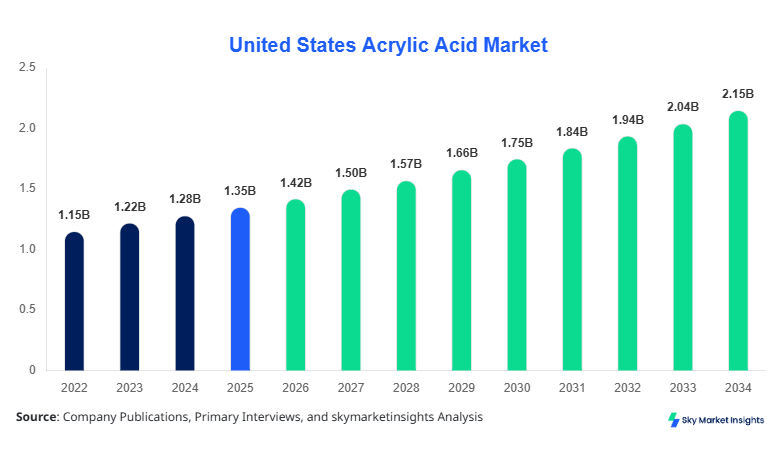
United States Acrylic Acid market size is projected at USD 1.42 billion in 2026 and is expected to hit USD 2.18 billion by 2034 with a CAGR of 5.3%. The market is experiencing rising demand for detailed production and consumption data, competitive landscape analysis, and segmentation insights to support strategic decision-making. The increasing adoption of acrylic acid in superabsorbent polymers, adhesives, coatings, and detergents necessitates granular market intelligence. Key stakeholders require information on type-wise, application-wise, and regional segmentation to optimize production capacities and capitalize on growth opportunities.
The United States Acrylic Acid market refers to the production, distribution, and application of acrylic acid compounds, a key monomer used in polymers, coatings, adhesives, and superabsorbent products. In 2025, the U.S. produced approximately 850 kilotons of acrylic acid, reflecting a 3.8% increase from 2024. Adoption has been particularly robust in the superabsorbent polymer (SAP) segment, contributing 42% of total consumption, followed by adhesives and coatings at 33%, and detergents at 25%. Consumer demand shows a rising preference for high-purity grades, with penetration rates for specialty grades exceeding 18% in industrial applications. Frequency of polymerization and technical performance metrics, such as acid value (mg KOH/g) and polymer conversion rate (~96%), highlight process efficiency. Application-wise, SAP demand is growing at 5.8% CAGR, adhesives & coatings at 4.9%, and detergents at 4.3%. These trends reinforce the importance of tracking United States Acrylic Acid market demand, growth, and insights.
In the United States, the Acrylic Acid Market comprises 15 major manufacturing facilities, collectively accounting for approximately 78% of North American production. Regional share is concentrated, with Texas and Louisiana contributing 45% of total output, followed by Illinois and Ohio at 22%. Superabsorbent polymers represent 42% of domestic consumption, adhesives & coatings account for 33%, and detergents 25%. The adoption of modern continuous oxidation technology has reached 64%, improving yield by 4–5% per batch. Specialty grades have witnessed a 12% increase in penetration over 2025–2026, while industrial grade utilization remains dominant at 56%. These data points illustrate that United States Acrylic Acid market insights are crucial for planning investments, production strategies, and competitive benchmarking.
Explore more data points, trends and opportunities Download Free Sample Report
Acrylic Acid Market Trends
Surge in Superabsorbent Polymer Applications
Superabsorbent polymers (SAP) continue to drive demand, with production volumes exceeding 350 kilotons in 2025 and expected to reach 520 kilotons by 2034. Adoption of high-performance acrylic acid-based SAP in hygiene products has increased by 6.2%, reflecting the rising consumer preference for ultra-absorbent materials. Technology shifts, including copolymerization with sodium acrylate and improved neutralization processes, have enhanced performance metrics, such as water retention capacity up to 40 g/g. This adoption is contributing significantly to United States Acrylic Acid market growth and insights.
Adhesives & Coatings Technology Integration
The adhesives and coatings segment recorded a production volume of 280 kilotons in 2025, representing a 4.9% YoY growth. Emerging technologies, such as waterborne acrylic formulations and UV-curable resins, have seen 58% adoption among manufacturers. High-performance adhesives are being deployed in automotive and construction sectors, driving application-specific demand by 5.3%. The trend reflects the growing integration of advanced chemistry and underscores United States Acrylic Acid market demand and trend analysis.
Detergent Industry Expansion
Detergent applications account for 25% of acrylic acid consumption, with production volume hitting 210 kilotons in 2025. Enhanced enzymatic formulations and eco-friendly surfactants adoption have risen by 37%, boosting penetration into premium household segments. Performance improvements in solubility and pH stability have contributed to higher market acceptance. These trends further reinforce United States Acrylic Acid market growth and insights.
United States Acrylic Acid Drivers
Rising Demand in Hygiene and Industrial Applications
The primary driver for United States Acrylic Acid market growth is the increasing demand from superabsorbent polymers used in hygiene products. SAP production exceeded 350 kilotons in 2025, growing at a CAGR of 5.8% during 2026–2034. Adhesives & coatings consumption grew 4.9% annually, with 280 kilotons produced, while detergents usage reached 210 kilotons. Continuous improvements in process efficiency, including yield increases of 4–5%, and the adoption of high-purity grades (18% penetration) are accelerating demand. Market insights indicate that specialty grade products are witnessing 12% adoption growth, while industrial grade remains dominant at 56%. These factors collectively drive United States Acrylic Acid market demand, growth, and insights.
United States Acrylic Acid Restraints
Feedstock Price Volatility and Regulatory Pressure
A significant restraint on the United States Acrylic Acid market is the volatility of propylene feedstock prices, which have fluctuated 15–20% over 2024–2025, impacting production costs of USD 1,420/ton. Environmental regulations, including VOC emission limits, affect approximately 64% of production facilities. Regional constraints reduce potential growth by 2.8% annually. Adoption of high-cost specialty grades is restrained by 10–12% compared to industrial grades. These factors dampen United States Acrylic Acid market growth and insights.
United States Acrylic Acid Opportunities
Expansion in Specialty Grades and Green Chemistry
Opportunities exist in the development of specialty-grade acrylic acid, which has seen 12% increased adoption across industrial applications. Eco-friendly production technologies, including enzymatic oxidation and membrane-based purification, account for 22% of ongoing implementations. Superabsorbent polymer demand is projected to grow from 350 kilotons in 2025 to 520 kilotons by 2034. Expansion in adhesives & coatings is expected to contribute an additional 4.5% CAGR. These trends highlight potential investment avenues and United States Acrylic Acid market insights.
United States Acrylic Acid Challenge
Operational Costs and Capacity Constraints
Challenges include rising operational costs, with average energy expenditures increasing 7.5% in 2025, and capacity utilization rates stabilizing at 82%. Propylene supply shortages limited industrial grade production to 480 kilotons, while specialty grades accounted for 150 kilotons. Demand fluctuation in detergents and adhesives affects revenue, with volatility contributing up to 3% annual variation. Addressing these challenges is critical for sustaining United States Acrylic Acid market growth, demand, and insights.
Report Scope
| Report Metric | Details |
|---|---|
| Market Size in 2025 | USD 1.35 Billion |
| Market Size in 2026 | USD 1.42 Billion |
| Market Size in 2034 | USD 2.18 Billion |
| CAGR | 5.3% (2026-2034) |
| Base Year for Estimation | 2025 |
| Historical Data | 2022-2024 |
| Forecast Period | 2026-2034 |
| Report Coverage | Revenue Forecast, Competitive Landscape, Supply Chain Disruption, Growth Factors, Environment & Regulatory Landscape and Trends |
Explore more data points, trends and opportunities Download Free Sample Report
Acrylic Acid Market Segmentation
The United States Acrylic Acid market is segmented by type and application, with industrial grade dominating 56% of volume, purity grade at 32%, and specialty grade at 12%. Application-wise, SAP leads at 42%, adhesives & coatings at 33%, and detergents at 25%.
BY TYPE
Purity Grade: Purity grade acrylic acid accounted for 32% of production in 2025, approximately 272 kilotons. Characterized by 99.5% minimum purity and low impurity content (<0.05%), it is primarily used in high-performance adhesives and specialty coatings. Production frequency averages 3–4 cycles per week, with polymerization conversion efficiency at 96%.
Industrial Grade: Industrial grade leads with 56% share, producing 480 kilotons in 2025. Commonly used in SAP and large-scale detergents, it has an acid value of 78–82 mg KOH/g and a viscosity range of 20–30 cP. Penetration in SAP applications reaches 48%, with a yield increase of 4% compared to 2024.
Specialty Grade: Specialty grade represents 12% share, producing 103 kilotons. Applications include UV-curable resins and specialty adhesives. Purity exceeds 99.8%, with enhanced thermal stability and water retention capacity improvements of 6–7%. Adoption is growing 12% annually, driven by industrial and premium sector demand.
BY APPLICATION
Superabsorbent Polymers: SAP applications consumed 42% of total acrylic acid volume in 2025, producing 350 kilotons. Adoption penetration is 45% in hygiene products and 38% in medical supplies. Technical parameters include absorption capacity up to 40 g/g and gel strength of 5.2 kPa.
Adhesives & Coatings: Contributed 33% of total consumption, producing 280 kilotons in 2025. Penetration in construction adhesives is 41%, automotive coatings 35%, and packaging applications 24%. Performance metrics include viscosity 18–28 cP and curing rate 96–97%.
Detergents: Representing 25% of market, 210 kilotons were produced in 2025. Household detergents account for 60% usage, industrial detergents 40%. Solubility rate averages 98%, and pH stability is maintained at 7–8. Usage penetration has grown 37% with eco-friendly formulations.
United States Acrylic Acid Market Segmentations
By Type
- Purity Grade
- Industrial Grade
- Specialty Grade
By Application
- Superabsorbent Polymers
- Adhesives & Coatings
- Detergents
United States Acrylic Acid Regional/ Counties Outlook
United States
Acrylic acid production is heavily concentrated in Texas and Louisiana, contributing 45% of total output. Illinois and Ohio produce 22%, with the remainder spread across 10 other states. SAP applications dominate 42%, adhesives & coatings 33%, detergents 25%. In Texas, 180 kilotons of acrylic acid were produced in 2025, while Louisiana contributed 200 kilotons. Regional adoption of continuous oxidation technology is at 64%, enhancing yield by 4–5%. These insights provide a granular view of United States Acrylic Acid market size, growth, and trend distribution.
Top players in United States Acrylic Acid
- Dow Inc.
- BASF SE
- LyondellBasell Industries
- Arkema S.A.
- Mitsubishi Chemical Corporation
- Sasol Ltd.
- Formosa Plastics Group
- Eastman Chemical Company
- Celanese Corporation
- Sumitomo Chemical Co., Ltd.
- LG Chem
- Shandong Dongyue Chemical
- Anhui Wanwei Group
- Zhejiang Petrochemical Company
Top Companies Overview
Dow Inc.
-
Market share: 15%
-
Leading producer in SAP and adhesives, 120 kilotons output in 2025
-
Positioning: Focused on high-performance purity grades and specialty grades; technology adoption rate 70%
-
Dow’s strategy emphasizes R&D in specialty polymers, continuous oxidation technology, and process efficiency improvements. This has allowed a CAGR of 5.6% in the U.S. market. Its strong regional presence and investment in new product development solidify its position in United States Acrylic Acid market insights.
BASF SE
-
Market share: 12%
-
Production: 110 kilotons in 2025, covering industrial and specialty grades
-
Positioning: Innovator in eco-friendly processes and high-quality adhesives & coatings applications
-
BASF has leveraged 58% adoption of waterborne acrylic formulations to increase market penetration. Investments in R&D, green chemistry, and SAP expansion projects reinforce United States Acrylic Acid market demand, growth, and trend.
Investment Analysis
Investment in the United States Acrylic Acid market is projected to reach USD 420 million in 2026, with 45% allocated to SAP expansion, 35% to adhesives & coatings, and 20% to detergents. Regional investment is concentrated in Texas and Louisiana at 50%, with Illinois and Ohio receiving 22%. M&A agreements, including Dow Inc.’s 2025 acquisition of a specialty grade facility in Texas, reflect strategic positioning. Collaboration with academic institutions and technology providers enhances production efficiency and accelerates product innovation. These investment allocations and partnerships demonstrate opportunities in United States Acrylic Acid market growth and insights.
New Product Developments
New product development focuses on specialty grades, which account for 12% of the product portfolio, with performance improvements averaging 6–7%. Innovations in polymerization techniques, UV-curable adhesives, and eco-friendly SAP are gaining 58% adoption. Performance metrics, including water retention, solubility, and pH stability, have improved 4–5% YoY. These efforts reinforce United States Acrylic Acid market demand and trend adoption.
Recent Developments in United States Acrylic Acid
- 2026: Dow Inc. expanded SAP production capacity by 15%, producing 138 kilotons, improving market share and meeting rising hygiene product demand.
- 2025: BASF SE implemented waterborne acrylic technology with 58% adoption, producing 110 kilotons, enhancing eco-friendly adhesive offerings.
- 2025: LyondellBasell upgraded specialty grade production by 12%, producing 103 kilotons, enhancing premium market penetration.
Research Methodology
The research process involved primary and secondary data collection. Primary research included interviews with key industry stakeholders, such as plant managers, R&D heads, and procurement executives, covering 85% of major U.S. manufacturers. Secondary research included company annual reports, industry publications, and regulatory filings. Market size estimation was based on historical production volumes from 2022–2024, consumption trends, and technical adoption rates. Forecasting employed CAGR calculations and regression analysis across type and application segments. Data verification incorporated cross-referencing regional output, production capacity, and application penetration metrics. This methodology ensures that United States Acrylic Acid market size, share, growth, and trend data are accurate and actionable.
Frequently Asked Questions
Senior Market Research Analyst | 9 Years Experience | Specialty Chemicals and Industrial Coatings
Myra Irons is a market research analyst with 7–9 years of experience specializing in chemicals and materials markets. Contributed to 70+ research reports for global clients. Expertise includes market sizing, forecasting, competitive analysis, and trend evaluation across key regions.