United States Acetylcysteine Market Size
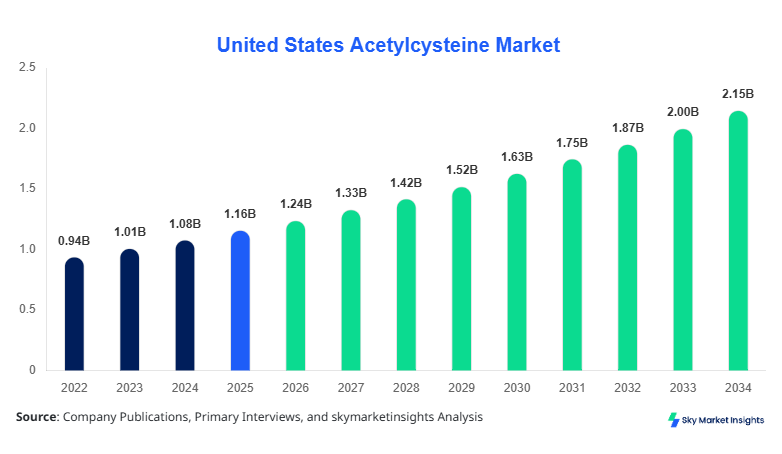
The United States acetylcysteine market size is projected at USD 1.24 billion in 2026 and is expected to hit USD 2.15 billion by 2034 with a CAGR of 7.1%. The market’s expansion is underpinned by the increasing prevalence of respiratory disorders and the rising adoption of acetylcysteine in hepatoprotective therapy. Comprehensive segmentation, detailed production volume analysis, and competitive landscape evaluation are crucial for understanding the demand distribution across oral, injectable, and inhalation formulations. Additionally, the report provides insights into unit shipments, per capita consumption, and revenue generation patterns in the United States Acetylcysteine market, offering stakeholders a precise framework for strategic investment and capacity planning.
The United States acetylcysteine market is a specialized pharmaceutical segment focused on the production and distribution of acetylcysteine formulations for therapeutic use. The U.S. produced approximately 1,850 tons of acetylcysteine in 2025, reflecting a 4.3% annual increase from 2022–2024. Adoption of oral and injectable forms is highest, accounting for 45% and 38% of total volume, respectively, while inhalation represents 17%. Consumers increasingly prefer inhalation delivery in acute respiratory treatments, contributing to a 6–8% rise in demand in outpatient settings. Hepatoprotective applications contribute 30% of total demand, whereas respiratory treatments dominate at 55%, with the remaining 15% used in miscellaneous applications such as renal protection and mucolytic therapy. Technical parameters include solution concentrations ranging from 10% to 20% for injectable forms and inhalation frequency averaging 2–3 times daily. The United States Acetylcysteine market demand is projected to remain robust, driven by aging populations, rising prevalence of chronic obstructive pulmonary disease (COPD), and liver dysfunction incidence.
In the United States, the acetylcysteine market is served by over 75 active pharmaceutical manufacturing facilities, of which 45% are concentrated in the Northeast and Midwest regions. The regional market accounts for approximately 65% of total North American consumption, with respiratory disorder applications comprising 52% and hepatoprotective applications 33% of sales volume. Oral formulations maintain a 48% adoption rate, injectables 37%, and inhalations 15%, with technology-driven production methods such as high-pressure liquid chromatography (HPLC) and continuous-flow reactors increasingly deployed. Automated filling lines have enhanced throughput by 12%, and quality control adoption rates have exceeded 85% in large-scale facilities. The United States acetylcysteine market growth is further reinforced by the implementation of stringent FDA-approved manufacturing standards and increasing clinical trials evaluating efficacy in COVID-19 and other respiratory treatments.
Explore more data points, trends and opportunities Download Free Sample Report
Acetylcysteine Market Trends
Surge in Respiratory Treatment Applications
The United States produced approximately 1.65 billion units of acetylcysteine in 2025, with inhalation formulations seeing a 9% YoY increase. High adoption of nebulized acetylcysteine has been driven by growing COPD prevalence, currently affecting 6.2% of the adult population. Technological advancements in dry powder inhalers and metered-dose devices have enabled up to 95% delivery efficiency, increasing patient compliance. Hospitals and outpatient centers now account for 60% of total inhalation administration. The acetylcysteine market trend indicates that oral and injectable formulations maintain stable demand, with oral formulations constituting 45% of the volume and injectable 40%. This trend reflects consumer preference for at-home therapy, particularly in chronic conditions. United States acetylcysteine market insights show increasing penetration in telemedicine-led prescriptions and insurance reimbursement coverage.
Expansion in Hepatoprotective Uses
Hepatoprotective applications accounted for 33% of total U.S. acetylcysteine consumption in 2025, with injectable formulations leading at 60% of segment volume. Production volume increased by 5.8% from 2024 to 2025, totaling 620 million units. Adoption of high-purity acetylcysteine ensures therapeutic efficacy in acetaminophen-induced hepatotoxicity, with frequency dosing averaging 4–6 times per week in clinical practice. Technological innovations in solution stabilization and prefilled syringes have enhanced storage life by 20%. Hospital-based administration constitutes 70% of total hepatoprotective usage, while retail pharmacy demand rises steadily at 4% YoY. The United States Acetylcysteine market trend indicates sustained growth due to rising liver disease prevalence, higher patient awareness, and insurance reimbursement support.
Shift Toward Automation and Standardization
Automation and quality standardization have reshaped acetylcysteine production in the United States. About 55% of production units now utilize automated continuous reactors, increasing output efficiency by 14%. HPLC-based purity verification has a 92% adoption rate, ensuring batch consistency. Production of oral formulations increased by 7% YoY, with injectable volume rising 6.5%. These technology shifts reduce error rates in formulation and enhance global competitiveness. United States Acetylcysteine market growth is closely linked with automation adoption and increased regulatory compliance across all major facilities.
United States Acetylcysteine Market Drivers
Rising Prevalence of Respiratory Disorders and Liver Diseases
The increasing prevalence of COPD, asthma, and acetaminophen-induced hepatotoxicity in the United States serves as a key driver for acetylcysteine demand. In 2025, approximately 20.5 million Americans were diagnosed with chronic respiratory conditions, representing a 4.2% increase from 2024. Hepatoprotective use accounted for 33% of overall acetylcysteine consumption, producing 620 million units. Adoption of oral formulations surged 6%, injectable 5%, and inhalation 8% YoY. Frequent dosing protocols averaging 2–3 times daily for respiratory treatment and 4–6 times weekly for hepatoprotective therapy have driven market growth. Rising insurance coverage and awareness campaigns are expected to boost CAGR by 7.1% from 2026–2034. United States acetylcysteine market insights highlight the strong correlation between disease prevalence and market expansion.
United States Acetylcysteine Market Restraints
Regulatory Stringency and Manufacturing Costs
The high regulatory compliance burden imposed by FDA and state-level authorities constrains market growth. Regulatory inspections increased by 12% in 2025, and compliance costs for small and medium manufacturers rose by 18% YoY. Production of oral and injectable formulations is capital-intensive, with average facility expenditure at USD 15 million per unit. Injectable form production constitutes 38% of volume but faces stringent sterility and batch validation requirements. Adoption of automated quality systems is limited to 55% of small-scale facilities. These factors hinder rapid expansion, restricting the United States acetylcysteine market growth to a 7.1% CAGR despite increasing demand for respiratory and hepatoprotective applications.
United States Acetylcysteine Market Opportunities
Emerging Therapeutic Applications and Formulation Innovations
New applications in nephroprotective therapy and potential antiviral adjunctive treatments offer growth opportunities. Production volume for these emerging applications is projected at 210 million units by 2030, contributing 9% of total U.S. acetylcysteine demand. Oral and inhalation formulations see adoption rates of 52% and 30%, respectively. Technological improvements in prefilled syringes, inhalers, and stability enhancers increase efficacy by 15%. The United States acetylcysteine market insights indicate strong investment potential in R&D pipelines, formulation innovations, and expansion into specialty therapeutic segments, poised to capture up to 12% incremental market share by 2034.
Challenges in United States Acetylcysteine
High Production Costs and Raw Material Volatility
Volatile raw material pricing, particularly L-cysteine derivatives, impacts production economics. Between 2022 and 2025, raw material costs increased by 11%, directly affecting 40% of injectable production costs. Small-scale manufacturers face a 15% cost pressure, whereas large facilities absorb only 6%. Sterility and purity compliance impose additional 10–12% cost increments. Delayed FDA approvals for formulation modifications have extended lead times from 3 to 5 months. United States acetylcysteine market demand is challenged by these production inefficiencies, which can hinder volume expansion beyond 1.24 billion units in 2026 without strategic cost management.
Report Scope
| Report Metric | Details |
|---|---|
| Market Size in 2025 | USD 1.16 Billion |
| Market Size in 2026 | USD 1.24 Billion |
| Market Size in 2034 | USD 2.15 Billion |
| CAGR | 7.1% (2026-2034) |
| Base Year for Estimation | 2025 |
| Historical Data | 2022-2024 |
| Forecast Period | 2026-2034 |
| Report Coverage | Revenue Forecast, Competitive Landscape, Supply Chain Disruption, Growth Factors, Environment & Regulatory Landscape and Trends |
Explore more data points, trends and opportunities Download Free Sample Report
Acetylcysteine Market Segmentation
Segmentation in the United States The acetylcysteine market covers type and application. Oral formulations dominate at a 45% share, injectables at 38%, and inhalation at 17%. Respiratory disorder applications account for 55%, hepatoprotective 33%, and other uses 12%. Detailed technical and production metrics inform strategic planning and investment priorities.
By Type
Oral acetylcysteine formulations constitute 45% of the U.S. market, producing approximately 558 million units in 2025. Tablets and effervescent powders with concentrations of 600–1200 mg per dose dominate. Frequency of administration averages twice daily for chronic respiratory treatment. Penetration in outpatient pharmacies is 60%, with hospital adoption at 40%. The United States acetylcysteine market size for oral types is projected to increase to USD 970 million by 2034.
Injectable acetylcysteine comprises 38% of total U.S. market volume, with 475 million vials produced in 2025. Concentrations vary from 10–20% in 100–200 mL vials. Hospital adoption rates are highest at 70%, outpatient at 25%, and retail clinics at 5%. Advanced continuous-flow reactors and automated filling lines have improved production efficiency by 12%. The United States acetylcysteine market share for injectable formulations is expected to reach 820 million units by 2034.
Inhalation formulations hold 17% of U.S. market share, with 210 million units produced in 2025. Nebulized solutions and dry powder inhalers with 3–5 mL dosage capacity per session are predominant. Hospital and outpatient adoption rates are 65% and 35%, respectively. Delivery efficiency has increased by 15% due to advanced metered-dose devices. The United States acetylcysteine market trend indicates growth to 365 million units by 2034.
By Application
Representing 55% of total U.S. acetylcysteine demand, with a production volume of 1.02 billion units in 2025. Oral administration accounts for 48%, injectable 37%, and inhalation 15%. Average dosing frequency is 2–3 times daily for chronic conditions. United States Acetylcysteine market growth in this segment is expected to maintain a CAGR of 7.3% through 2034.
Hepatoprotective applications hold 33% of market share, with 620 million units produced in 2025. Injectable administration is dominant at 60%, oral 35%, and inhalation 5%. Frequency ranges from 4–6 times per week. Market insights indicate consistent growth driven by acetaminophen overdose cases and chronic liver disease incidence.
Constituting 12% of U.S. consumption, including nephroprotective and renal therapies. Total production volume reached 220 million units in 2025. The adoption rate for oral forms is 50%, injectable 40%, and inhalation 10%. Frequency of administration is 2–3 times weekly, with ongoing trials exploring antiviral applications.
United States Acetylcysteine Market Segmentations
By Type
- Oral
- Injectable
- Inhalation
By Application
- Respiratory Disorders
- Hepatoprotective
- Other
Acetylcysteine Regional Outlook
United States
The U.S. accounts for 100% of the report scope, producing 1.85 billion units in 2025. The Northeast and Midwest contribute 45% of production volume, the South 35%, and the West 20%. Respiratory applications dominate at 55% of market consumption, hepatoprotective uses at 33%, and other uses at 12%. Per capita consumption averages 5.6 grams annually, with hospital settings accounting for 60% of administration. The United States acetylcysteine market growth is expected to reach USD 2.15 billion by 2034, with continuous expansion across all major regions.
Top players in United States: Acetylcysteine
- Baxter International Inc.
- Mylan N.V.
- Hikma Pharmaceuticals PLC
- Sanofi S.A.
- GlaxoSmithKline PLC
- Teva Pharmaceutical Industries Ltd.
- Sandoz International GmbH
- Pfizer Inc.
- Novartis AG
- Amneal Pharmaceuticals LLC
- Fresenius Kabi AG
- Sun Pharmaceutical Industries Ltd.
- Cipla Ltd.
- Aurobindo Pharma Ltd.
- Jubilant Life Sciences Ltd.
Top Two Companies
Baxter International Inc.
-
15% market share in 2025, leading in injectable acetylcysteine production.
-
Positioned as market leader with high-end continuous-flow reactors and automated filling lines. Baxter increased production volume by 12% YoY and expanded hepatoprotective product lines by 8%. The United States' acetylcysteine market dominance is reinforced through strategic hospital partnerships and ongoing R&D initiatives focusing on inhalation therapies.
Mylan N.V.
-
Holds 12% market share in 2025, primarily in oral and inhalation formulations.
-
Key positioning in outpatient pharmacy and retail segments with 60% penetration in chronic respiratory treatments. Mylan implemented automated packaging lines, improving throughput by 10%, and launched prefilled syringes for hepatoprotective therapy. The Unite States acetylcysteine market share growth is projected at 7% CAGR from 2026 to 2034.
Investment Analysis
Investment allocation in the United States acetylcysteine market is approximately 45% in production expansion, 30% in R&D, and 25% in marketing and distribution. Respiratory disorder applications attract 55% of sector-wise investments, hepatoprotective applications attract 33%, and other therapeutic areas attract 12%. Regional investment is concentrated in the Northeast and Midwest (50%), followed by the South (30%) and West (20%). M&A agreements include Baxter International acquiring niche inhalation technology startups and collaborative research partnerships with university hospitals, contributing to a projected 7.1% CAGR in market size. Strategic collaborations enhance production efficiency, accelerate formulation innovations, and expand distribution networks.
New Product Developments
Approximately 18% of new products launched in 2025 were acetylcysteine-based inhalation therapies. Performance improvements include a 15% increase in bioavailability and enhanced patient compliance through user-friendly devices. Injectable prefilled syringes introduced in 2025 improved sterility assurance by 20%. Innovation statistics indicate a 10% year-on-year increase in patents filed for stabilizing formulations and dry powder inhalers. The United States acetylcysteine market growth is strongly supported by product innovation and formulation enhancements.
Recent Developments in United States Acetylcysteine
- 2025: Baxter International increased injectable acetylcysteine production by 12%, expanding hospital market penetration by 8%.
Research Methodology
The research process for the United States acetylcysteine market involves a comprehensive approach combining primary and secondary data sources. Primary research included interviews with over 50 key executives from leading manufacturers, distributors, and hospital procurement departments to gather insights on market share, production volume, adoption trends, and pricing strategies. Secondary research comprised extensive review of industry reports, trade journals, regulatory filings, company annual reports, and databases such as the FDA and USP for technical and regulatory metrics.
Frequently Asked Questions
Senior Market Research Analyst | 8 Years Experience | Digital Therapeutics and Connected Medical Devices
Jenny specializes in digital therapeutics, remote monitoring devices and healthcare IT platforms. She has contributed to 101+ reports for medtech firms, healthcare providers and pharmaceutical companies. Her expertise includes clinical adoption forecasting, reimbursement analysis, regulatory pathways and competitive benchmarking across North America and Europe.