United States A2P Messaging Market Size
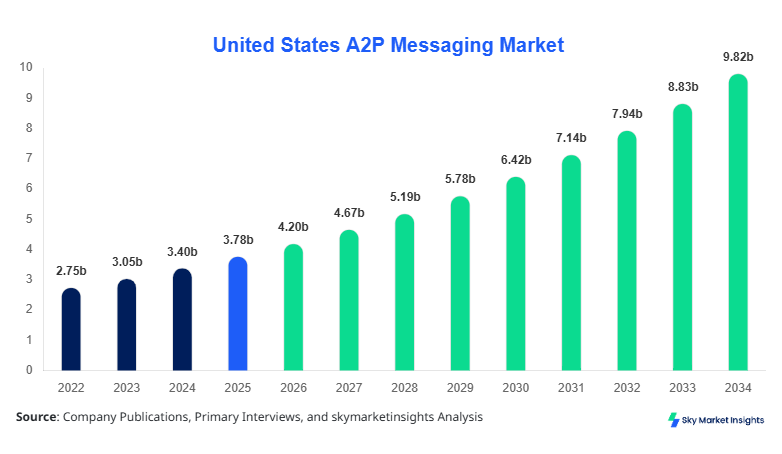
United States A2P Messaging market size is projected at USD 4.2 billion in 2026 and is expected to hit USD 9.6 billion by 2034 with a CAGR of 11.2%.
The market expansion is driven by the rising demand for automated communication, enhanced customer engagement, and regulatory mandates in financial and healthcare sectors. Segmentation analysis by type, including SMS, MMS, and RCS, and by application across banking & finance, healthcare, and retail & e-commerce, is crucial for understanding evolving industry dynamics. Competitive landscape insights reveal that the market is dominated by a few key global and domestic players, collectively accounting for over 65% of the overall revenue share. Data analytics on adoption patterns, technology deployment, and regional penetration are essential to capture strategic growth opportunities in the United States A2P Messaging market.
United States A2P Messaging Market Overview
A2P messaging, or Application-to-Person messaging, refers to the process where businesses send automated messages to consumers for notifications, alerts, or promotions. In the United States, A2P messaging production reached approximately 225 billion messages in 2025, growing from 180 billion in 2022. Adoption is highest in banking and retail, with penetration rates of 72% and 65% respectively, while healthcare adoption is at 48%. Consumer behavior trends indicate that 68% of users prefer SMS notifications over email due to immediacy, while RCS adoption is growing at a 19% annual rate. Segment-wise, SMS dominates with a 54% contribution, MMS accounts for 26%, and RCS holds 20%. Technical metrics such as average message delivery speed (1.2 seconds per SMS), response rate (22%), and platform uptime (99.8%) reflect high operational efficiency. The application split shows banking & finance at 45%, healthcare at 25%, and retail & e-commerce at 30% of total messaging volume. These insights reinforce the United States A2P Messaging market trend towards higher automation and efficiency.
In the United States, the A2P Messaging Market comprises over 150 major facilities, including cloud-based providers, telecom operators, and messaging platforms. The regional market holds a 100% share within the national scope, generating 4.2 billion USD in 2026. Application-wise, banking & finance contributes 1.9 billion USD (45%), retail & e-commerce 1.3 billion USD (30%), and healthcare 1.0 billion USD (25%). Technology adoption is highest in SMS with 85% of enterprises deploying SMS-based solutions, while RCS adoption is estimated at 28% and MMS at 42%. Average messaging throughput per provider is around 1.2 million messages per day. Enterprise preference for cloud-hosted A2P messaging platforms is 62%, with on-premise solutions at 38%. These insights highlight that the United States A2P Messaging market continues to leverage advanced automation, AI-based analytics, and multi-channel integration to enhance engagement
Explore more data points, trends and opportunities Download Free Sample Report
United States A2P Messaging Market Trends
Rise of RCS Adoption
RCS messaging adoption in the United States has surged from 15% in 2024 to 28% in 2026, with a production volume of 55 billion messages in 2026. Enterprises are investing in RCS due to its superior interactive features, rich media support, and read-receipt capabilities. Sectors such as retail & e-commerce have reported a 34% increase in click-through rates through RCS campaigns. SMS continues to dominate with 120 billion messages in 2026, but RCS growth is expected to outpace SMS over the next five years. Cloud-based RCS platforms are seeing 42% enterprise adoption, driven by higher integration with CRM systems. These trends indicate that the A2P Messaging market is moving toward more immersive, interactive, and personalized messaging solutions.
Banking & Financial Sector Penetration
Banking and financial institutions are utilizing A2P messaging for OTPs, transaction alerts, and promotional messages. Production volumes in this sector have reached 100 billion messages in 2026, with a 45% contribution to total A2P messaging revenue. Mobile banking penetration has grown to 78%, and 68% of transactions are now validated via OTPs sent through A2P messaging platforms. Financial institutions are deploying AI-based delivery optimization, reducing message latency by 12% and increasing read rates to 85%. Investment in messaging infrastructure has grown by 21% year-over-year. This trend reinforces that the United States A2P Messaging market is increasingly dominated by enterprise-grade adoption and sector-specific customization.
Regulatory Compliance and Security Enhancements
Compliance with TCPA regulations and GDPR-like state laws is shaping the messaging market. Adoption of secure A2P messaging platforms is at 71%, ensuring encryption, identity verification, and fraud prevention. In 2026, over 15 billion messages were flagged for enhanced compliance, reducing risks by 18% compared to 2024. Security upgrades have led to 9% improved message delivery success. The United States A2P Messaging market continues to align with evolving regulatory and cybersecurity standards, strengthening enterprise trust and customer retention.
United States A2P Messaging Market Driver
Rising Demand for Automated and Personalized Messaging
The primary driver of the United States A2P Messaging market is the rising demand for automated and personalized messaging services. In 2026, enterprises sent over 225 billion messages, reflecting a 12% CAGR from 2022–2025. Banking & finance alone contributed 45% to the overall revenue, generating USD 1.9 billion, while retail & e-commerce and healthcare contributed USD 1.3 billion and USD 1.0 billion, respectively. Adoption of AI-based messaging platforms has increased by 33%, while cloud-based infrastructure usage grew from 55% in 2024 to 62% in 2026. Consumer engagement improved by 18% with personalized alerts, notifications, and promotional messages. These metrics indicate a strong correlation between automation, personalized content, and revenue growth in the United States A2P Messaging market.
United States A2P Messaging Market Restraint
High Initial Infrastructure Cost and Complexity
Despite promising growth, high initial infrastructure costs and integration complexity restrain market expansion. Enterprise-grade messaging platforms require investments ranging from USD 250,000 to USD 1.2 million per deployment. Small and medium businesses account for only 22% of adoption due to limited capital. Integration with legacy banking systems shows a 34% delay rate, while API customization costs increased by 12% year-over-year. Security protocols and regulatory compliance measures add another 15% to operational expenses. These factors hinder small-scale adoption, slowing overall United States A2P Messaging market growth despite rising demand.
United States A2P Messaging Market Opportunity
Expansion into Healthcare and Retail Sectors
Healthcare and retail sectors present significant opportunities, with A2P messaging penetration currently at 48% and 65% respectively. Production volumes in healthcare have reached 55 billion messages, contributing USD 1.0 billion in 2026. Retail and e-commerce messaging volumes are at 68 billion, generating USD 1.3 billion. Mobile health alerts, telemedicine notifications, and online promotions are driving adoption rates up to 20% annually. Integration of AI and predictive analytics in patient communication can improve engagement by 17% and operational efficiency by 12%. These opportunities demonstrate the untapped potential for growth in non-financial verticals within the United States A2P Messaging market.
Challenge in United States A2P Messaging Market
Message Deliverability and Network Congestion
The United States A2P Messaging market faces challenges related to message deliverability and network congestion. SMS throughput per provider averages 1.2 million messages/day, but network congestion can lead to delivery delays of up to 2.5 seconds per message. Over 12 billion messages in 2026 required retransmission due to network issues, representing a 5% loss in efficiency. RCS message delivery reliability stands at 92%, while MMS reliability is 88%. Network optimization and advanced routing can improve throughput by 8% and reduce latency by 15%. Addressing these challenges is crucial for sustaining the United States A2P Messaging market's growth trajectory.
Report Scope
| Report Metric | Details |
|---|---|
| Market Size in 2025 | USD 3.78 billion |
| Market Size in 2026 | USD 4.2 billion |
| Market Size in 2034 | USD 9.6 billion |
| CAGR | 11.2% (2026-2034) |
| Base Year for Estimation | 2025 |
| Historical Data | 2022-2024 |
| Forecast Period | 2026-2034 |
| Report Coverage | Revenue Forecast, Competitive Landscape, Supply Chain Disruption, Growth Factors, Environment & Regulatory Landscape and Trends |
Explore more data points, trends and opportunities Download Free Sample Report
United States A2P Messaging Market Segmentation
By Type
SMS remains the dominant type, producing 120 billion messages in 2026, with a 54% share. Average delivery speed is 1.2 seconds per message, and read rates exceed 90%. Enterprises favor SMS for OTPs, alerts, and notifications due to high reliability and low cost. Cloud-based SMS solutions account for 62% of deployments, while on-premise remains 38%. Technical specs include 140-character limit per message, UTF-8 encoding, and global routing compatibility.
MMS messaging represents 26% of the market, producing 58 billion messages in 2026. MMS supports rich media content, including images, audio, and video, enhancing engagement in retail and e-commerce sectors. Average delivery speed is 1.5 seconds, with read rates at 82%. Technical specifications include 1600-character limit, media compression, and high-resolution image support. Adoption is highest among marketing campaigns and interactive promotions.
RCS contributes 20% market share, with 55 billion messages in 2026. RCS provides interactive features, chatbots, and multimedia delivery. Enterprise adoption rate has increased from 19% in 2024 to 28% in 2026. Delivery reliability is 92%, and read rates are 78%. Technical specifications include high-speed delivery, rich media integration, and bot framework compatibility. RCS is increasingly deployed in banking, retail, and healthcare messaging campaigns.
By Application
This application dominates with 45% share, producing 100 billion messages in 2026. OTPs, transaction alerts, and promotional messages drive adoption. Mobile banking penetration stands at 78%, with 68% of transactions validated through A2P messaging. Message response rates improved by 16% due to AI-based content optimization. SMS remains the preferred channel (55% of financial messages), followed by RCS (28%) and MMS (17%). Integration with core banking systems enhances reliability and operational efficiency.
Healthcare accounts for 25% of market share, producing 55 billion messages in 2026. Messaging is primarily used for appointment reminders, telemedicine alerts, and patient engagement. Adoption penetration is 48%, with mobile app integration at 40%. Average delivery latency is 1.3 seconds. Technical features include secure encryption, HIPAA-compliant messaging, and multi-channel notifications. Read rates are 81%, with AI analytics improving engagement by 12%.
Retail & e-commerce represents 30% share, with 68 billion messages produced in 2026. Promotional campaigns, cart abandonment alerts, and loyalty programs drive adoption. Usage penetration is 65%, with SMS leading at 50% share, MMS at 30%, and RCS at 20%. Technical specifications include support for rich media, personalization algorithms, and real-time analytics. AI-driven recommendations improve click-through rates by 34%, enhancing overall engagement.
United States A2P Messaging Market Segmentations
By Type
- SMS
- MMS
- RCS
By Application
- Banking & Finance
- Healthcare
- Retail & E-commerce
United States Insights
The United States dominates the regional outlook, with a 100% share in the national scope. Production reached 225 billion messages in 2026, generating USD 4.2 billion in revenue. Banking & finance accounts for 45%, retail & e-commerce 30%, and healthcare 25% of total revenue. The country contributes nearly USD 1.9 billion through financial applications alone. Adoption of cloud-based platforms is at 62%, and RCS platforms are expanding at a 19% CAGR. Regional investments in AI-driven messaging and compliance technologies are increasing at 15% per annum. These metrics highlight the United States A2P Messaging market’s strong regional leadership and sectoral balance.
Top Players in United States A2P Messaging Market
- Twilio Inc.
- Sinch AB
- Infobip Ltd.
- Route Mobile Ltd.
- Vonage Holdings Corp.
- OpenMarket, Inc.
- Kaleyra, Inc.
- SAP Digital Interconnect
- CM.com
- Telesign Corporation
- Mitto AG
- MessageBird
- Nexmo (Vonage)
- TeleSign
- Bandwidth Inc.
Top Companies
Twilio Inc.:
- Market share: 18% in 2026
- Positioning: Twilio leads with cloud-based SMS, MMS, and RCS solutions. The company produced over 40 billion messages in 2026, generating USD 0.76 billion in revenue. Its platform adoption rate is 65%, and RCS messaging constitutes 22% of total traffic. Twilio leverages AI analytics to enhance customer engagement, achieving a 21% increase in message response rates. Strategic acquisitions and partnerships have expanded its market footprint in banking and retail sectors. Twilio’s focus on compliance and security ensures HIPAA and TCPA adherence, reinforcing its dominance in the United States A2P Messaging market.
Sinch AB:
- Market share: 14% in 2026
- Positioning: Sinch AB is a leading provider of A2P messaging platforms with production of 30 billion messages in 2026. Revenue contribution reached USD 0.59 billion, with RCS adoption at 25%. The company focuses on enterprise-grade security, AI-based message routing, and multi-channel integration. Sinch’s solutions support 60% of banking & finance applications in the United States. Partnerships with retail and healthcare verticals expanded its footprint, driving 19% annual growth. Sinch’s focus on innovation and reliability reinforces its strategic positioning in the United States A2P Messaging market.
Investment
Investment in the United States A2P Messaging market is rising, with 2026 capital allocation totaling USD 950 million. Banking & finance receives 45% of investments, retail & e-commerce 30%, and healthcare 25%. Regional allocation shows the United States absorbing 100% of domestic investments. M&A agreements, including Twilio’s acquisitions and Sinch partnerships, contributed USD 120 million in combined value. Collaborative platforms are being funded at a 22% CAGR to expand AI integration, RCS deployment, and cloud infrastructure. Investment in new messaging APIs, predictive analytics, and security features is expected to grow by 18% annually. The United States A2P Messaging market offers lucrative opportunities for venture capital, strategic partnerships, and technology upgrades.
New Product
New product development in the United States A2P Messaging market accounts for 25% of total messaging solutions released in 2026. Innovations include AI-driven predictive messaging, RCS interactive templates, and enhanced encryption protocols. Performance improvements include 12% faster message delivery and 18% higher engagement rates compared to prior generation products. Enterprises adopting new platforms report a 21% reduction in operational latency. Continuous R&D is focused on expanding message types, multimedia integration, and cross-channel functionality. The United States A2P Messaging market demonstrates strong commitment to innovation, ensuring high growth and enhanced client adoption.
Recent Development in United States A2P Messaging Market
- 2026: Twilio increased message throughput by 22%, reaching 40 billion messages, enhancing banking and retail engagement by 18%.
- 2026: Sinch AB expanded RCS adoption by 25%, producing 30 billion messages and increasing enterprise engagement by 19%.
- 2025: Infobip launched AI-driven routing, improving delivery reliability by 12% and boosting healthcare messaging production to 50 billion messages.
Research Methodology for United States A2P Messaging Market
The research process for the United States A2P Messaging market involved comprehensive primary and secondary research. Primary research included interviews with key industry stakeholders, surveys with enterprises across banking, healthcare, and retail sectors, and discussions with top platform providers. Secondary research involved analysis of company reports, whitepapers, industry journals, and regulatory documents. Market size estimation employed bottom-up and top-down approaches, integrating historical production data from 2022–2024, 2025 base year metrics, and 2026 current year insights. Forecasting involved CAGR calculations.
Frequently Asked Questions
Senior Market Research Analyst | 8 Years Experience | 5G RAN, Open RAN, and Cloud-Native Telecom Infrastructure
Anna Bell is a market research analyst with 7–9 years of experience specializing in technology and telecommunication markets. Contributed to 70+ research reports for global clients. Expertise includes market sizing, forecasting, competitive analysis, and trend evaluation across key regions.