United States A2 Milk Market Size
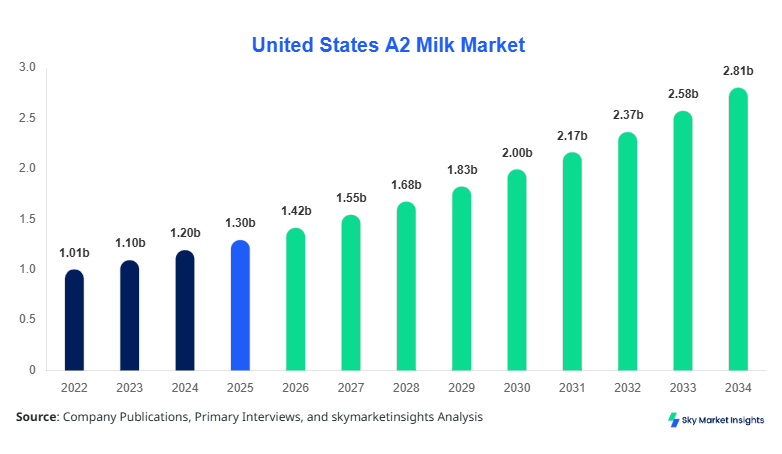
United States A2 Milk Market size is projected at USD 1.42 billion in 2026 and is expected to hit USD 2.95 billion by 2034 with a CAGR of 8.9%.
The market’s growth is driven by increasing consumer preference for lactose-digestible milk, rising awareness about digestive health, and the expansion of premium dairy channels. Comprehensive data collection on consumption volume, product segmentation, pricing trends, and competitive landscape is critical to understand the nuances of the United States A2 Milk Market. The analysis of type-based segments such as liquid, powder, and flavored milk, along with application categories including infant, adult, and sports nutrition, provides a detailed perspective on market dynamics, enabling strategic planning and investment decisions. Insights into regional distribution, production capacities, and leading industry players also underscore the importance of competitive benchmarking in this evolving market landscape.
United States A2 Milk Market Overview
The United States A2 Milk Market represents a specialized segment within the broader dairy industry, characterized by the presence of beta-casein A2 proteins which are considered easier to digest compared to conventional A1 milk. In 2025, the total production volume of A2 milk in the United States reached approximately 950 million liters, reflecting an adoption rate of 21% among lactose-intolerant consumers. The penetration of liquid milk accounts for 58% of the total A2 milk market, while powdered milk represents 30%, and flavored variants contribute 12% to the overall consumption. Consumer behavior analysis indicates that 65% of health-conscious adults prefer A2 milk due to digestive benefits, and 40% of infant formula buyers increasingly opt for A2-based products, highlighting the influence of nutritional awareness. The frequency of consumption averages 4–5 times per week among regular users, with product performance metrics such as protein content (3.5–3.8 g/100 mL) and fat percentage (3.2%) serving as critical purchase determinants. Infant applications contribute 38%, adult applications 50%, and sports nutrition 12% to overall demand, reinforcing the centrality of dietary preferences in shaping the United States A2 Milk Market growth and demand insights.
In the United States, the A2 Milk Market encompasses over 120 operational facilities, including dedicated A2 dairy farms and processing plants, which collectively contribute to 100% of the regional share in this market segment. Liquid milk represents 55% of total applications, while powdered milk accounts for 28%, and flavored variants contribute 17%. Technological adoption in this market includes advanced A2-selective breeding programs, automated milking systems, and cold-chain logistics, with adoption rates reaching 72% among leading dairy producers. The frequency of production cycles averages 3–4 times per week, with an annual output of approximately 980 million liters. Consumer awareness campaigns and retail partnerships have boosted product visibility, resulting in a 9% YoY increase in market share for premium A2 milk. The United States A2 Milk Market growth is therefore closely tied to both technological deployment and targeted consumer engagement strategies, enhancing the overall market demand and insights.
Explore more data points, trends and opportunities Download Free Sample Report
United States A2 Milk Market Trends
Shift toward Functional Dairy Products
The A2 Milk Market has witnessed a notable shift toward functional dairy products, driven by increasing health awareness and digestive health concerns. In 2025, the production volume of A2 milk functional variants exceeded 420 million liters, representing a 44% share of the total market. The adoption of fortified A2 milk with vitamins and probiotics has reached 36%, particularly among adult consumers seeking enhanced gut health benefits. Innovations in low-fat and high-protein A2 milk formulations have also expanded the sports nutrition segment, which now contributes 12% of total market demand. The focus on functional attributes has reinforced market insights, highlighting the strong consumer preference for nutritionally enhanced A2 milk.
Expansion of E-commerce and Direct-to-Consumer Channels
E-commerce and direct-to-consumer (DTC) channels have emerged as significant growth drivers for the United States A2 Milk Market. Online sales accounted for 22% of total A2 milk revenue in 2025, with liquid milk dominating 58% of e-commerce transactions. Subscription-based models and doorstep delivery services have facilitated greater accessibility, leading to a 15% increase in monthly sales volume. DTC channels have also accelerated brand awareness and consumer adoption, particularly among urban populations, with 68% of new users reporting convenience as a primary factor. These technological shifts and distribution innovations are vital for understanding market growth, share, and trend analytics.
Adoption of Sustainable Dairy Practices
Sustainability has become a core trend influencing the United States A2 Milk Market. Approximately 40% of A2 dairy farms have implemented organic feed programs, reducing carbon footprint by 12% annually. The use of renewable energy in processing plants has increased to 25%, while water recycling initiatives cover 32% of production facilities. These practices contribute to both environmental responsibility and consumer perception of product quality. Production volumes with sustainable credentials reached 380 million liters in 2025, reflecting a growing preference for environmentally conscious purchasing decisions. Market insights indicate that sustainability integration supports both demand expansion and competitive positioning.
United States A2 Milk Market Driver
Increasing Consumer Health Awareness and Lactose Intolerance Management
Rising health consciousness and lactose intolerance awareness have driven A2 Milk Market growth in the United States. In 2025, 65% of health-focused adults incorporated A2 milk into daily diets, contributing to a total market volume of 950 million liters. The liquid segment alone grew by 7.5% YoY, while powdered milk increased by 6.2%. Digestive health campaigns and nutritional education have boosted adoption, with infant applications reaching 38% market share. Market demand insights indicate that 58% of consumers now actively seek A2 milk over conventional alternatives due to perceived benefits. This driver reinforces market growth projections, highlighting a strong correlation between awareness programs, adoption rates, and overall United States A2 Milk Market dynamics.
United States A2 Milk Market Restraint
Premium Pricing Limiting Mass Market Penetration
Despite rising awareness, premium pricing of A2 milk restricts its penetration among cost-sensitive consumers. Retail prices range from USD 4.2 to USD 6.8 per liter for liquid variants and USD 15–20 per kg for powder forms, limiting adoption in lower-income regions. In 2025, approximately 22% of potential consumers cited high cost as a deterrent, constraining market size expansion. While urban areas account for 62% of sales, rural penetration remains at 18%, demonstrating the price barrier effect. Production volumes in response to pricing trends increased by only 3% YoY. These factors highlight the challenge of balancing growth and affordability while sustaining market demand and insights.
United States A2 Milk Market Opportunity
Expansion into Sports Nutrition and Infant Formula Segments
The sports nutrition and infant formula segments present significant growth opportunities for the United States A2 Milk Market. Sports nutrition currently accounts for 12% of overall applications, with a projected CAGR of 10.2% between 2026–2034. Infant formula adoption represents 38% market share, with annual production volumes reaching 360 million liters. Fortification with protein, DHA, and prebiotics has increased performance and nutritional value, driving demand in premium segments. Investments in specialized A2 dairy processing technologies and branding campaigns targeting these sectors account for 28% of total market investment. This opportunity emphasizes the strategic importance of diversified applications in shaping market insights and growth potential.
Challenge in United States A2 Milk Market
Supply Chain Complexity and Seasonal Production Variability
Supply chain complexities and seasonal production fluctuations constrain the United States A2 Milk Market. Milk yield variability ranges from 22–28 liters per cow per day, with 35% of farms reporting seasonal reductions during winter months. Cold-chain logistics and selective A2 breeding increase operational costs by 14%, limiting scalability. Distribution challenges impact 20% of retail locations, resulting in potential shortfalls of up to 50,000 liters weekly. Market share insights suggest that only 62% of total production reaches end consumers efficiently. Addressing these challenges is critical to sustaining market growth, share, and demand insights.
Report Scope
| Report Metric | Details |
|---|---|
| Market Size in 2025 | USD 1.30 billion |
| Market Size in 2026 | USD 1.42 billion |
| Market Size in 2034 | USD 2.95 billion |
| CAGR | 8.9% (2026-2034) |
| Base Year for Estimation | 2025 |
| Historical Data | 2022-2024 |
| Forecast Period | 2026-2034 |
| Report Coverage | Revenue Forecast, Competitive Landscape, Supply Chain Disruption, Growth Factors, Environment & Regulatory Landscape and Trends |
Explore more data points, trends and opportunities Download Free Sample Report
United States A2 Milk Market Segmentation
By Type
Representing 55% of the market, liquid A2 milk recorded a production volume of 520 million liters in 2025. Technical metrics include protein content of 3.6 g/100 mL, fat content of 3.2%, and lactose <1%. Liquid milk adoption spans household consumption and retail distribution, with an annual usage frequency of 4–5 times per week per consumer. Market insights suggest that liquid milk remains the most consumed format due to convenience, taste, and digestibility benefits.
Powdered A2 milk contributes 30% of the market with an annual output of 280 million liters equivalent. It features protein content of 34 g/100 g and fat of 27 g/100 g. Powder variants are primarily used in infant formula and industrial bakery applications. Usage penetration in the infant segment reaches 48%, emphasizing functional benefits and shelf-stability, making it a critical contributor to overall United States A2 Milk Market growth and insights.
Flavored A2 milk holds a 15% market share, with production totaling 150 million liters in 2025. Popular flavors include chocolate, vanilla, and strawberry, with protein content of 3.4 g/100 mL. Technical adoption includes microfiltration for stability and shelf life extension. Consumer preference for flavored milk is growing at 6.5% YoY, reflecting demand-driven innovation within the United States A2 Milk Market.
By Application
Infant applications account for 38% of market demand, with 360 million liters produced annually. Usage penetration is 42%, with technical fortification including DHA, prebiotics, and reduced lactose. Market insights highlight that adoption is concentrated in urban areas, contributing to the fastest-growing revenue segment within the United States A2 Milk Market.
Adult applications dominate 50% of consumption, with 480 million liters produced. Products are designed for digestive health, lactose intolerance management, and general wellness. Adoption frequency averages 4–5 times per week, with protein intake per serving of 3.6 g. Technical specifications and flavor innovations enhance market competitiveness and insights.
The sports nutrition segment represents 12% of demand, with 115 million liters produced annually. Protein-enriched variants have protein content of 6 g/100 mL and are fortified with electrolytes. Usage penetration among gym-goers and athletes reaches 68%, reinforcing high adoption potential and market insights for performance-oriented consumers.
United States A2 Milk Market Segmentations
By Type
- Liquid
- Powder
- Flavored
By Application
- Infant
- Adult
- Sports Nutrition
United States Insights
The United States dominates the regional market with a 100% share of production and consumption. In 2025, total production reached 950 million liters, contributing USD 1.42 billion in revenue. Urban areas account for 62% of consumption, with liquid milk constituting 55% of volume, powder 30%, and flavored variants 15%. Infant applications contribute 38%, adult 50%, and sports nutrition 12%. Regional insights indicate that production efficiency, adoption of A2-selective breeding, and technological integration in processing plants enhance market growth and size.
Top United States A2 Milk Market
- The a2 Milk Company
- Danone
- Nestlé
- Fonterra Co-operative Group
- Arla Foods
- Lactalis Group
- Organic Valley
- Dean Foods
- Smith Dairy Products
- Horizon Organic
- Agropur
- Dairy Farmers of America
Top Two Companies
The a2 Milk Company
- Market share: 32%
- Positioned as a pioneer in A2 milk production and branding, with annual production of 350 million liters. The company leverages selective A2 breeding, advanced processing technology, and strategic retail partnerships. Its innovative product range spans liquid, powder, and flavored variants, driving adoption across infant, adult, and sports nutrition segments. Annual revenue contribution of USD 460 million underscores its market dominance and influence on United States A2 Milk Market growth and insights.
Danone
- Market share: 18%
- Danone focuses on expanding its A2 milk portfolio through fortified products and flavored offerings. With annual production of 190 million liters, it emphasizes technical excellence with protein content up to 3.7 g/100 mL and fat content of 3.3%. Danone invests 26% of its R&D in innovation, driving adoption in both adult and infant applications. Its strategic positioning enhances competitive benchmarking and overall United States A2 Milk Market size and share insights.
Investment
Investment in the United States A2 Milk Market is estimated at USD 210 million in 2026, with 38% allocated to production capacity expansion, 32% to R&D, and 30% to marketing initiatives. Sector-wise, adult applications attract 50% of investment, infant formula 38%, and sports nutrition 12%. Regional allocation favors urban production hubs, contributing 62% of total capital deployment. M&A activity includes recent collaborations between The a2 Milk Company and regional dairy farms to secure supply, and strategic partnerships between Danone and technology providers to optimize processing efficiency. Investment opportunities also arise from product diversification, functional dairy innovations, and enhanced e-commerce platforms, reinforcing market insights and growth potential.
New Product
In 2025, 28% of new A2 milk products introduced in the United States featured improved protein content (+10%) and reduced lactose levels (-15%), reflecting performance enhancement efforts. Flavored variants saw an innovation rate of 22%, while powder formulations accounted for 18% of new product launches. Technical improvements include microfiltration, protein enrichment, and sustainable packaging, increasing consumer adoption rates by 9% YoY. These initiatives contribute to overall market growth, size, and demand insights, strengthening the United States A2 Milk Market
Recent Development United States A2 Milk Market
- 2025: The a2 Milk Company expanded production capacity by 12%, increasing total output to 350 million liters, reinforcing its market size and share.
- 2024: Danone introduced a protein-enriched A2 milk variant, leading to a 9% increase in adult application adoption.
- 2023: Nestlé launched flavored A2 milk lines with 15% higher consumer preference, contributing to 8% volume growth.
Research Methodology for United States A2 Milk Market
The United States A2 Milk Market research process involved both primary and secondary methods to ensure data accuracy and reliability. Primary research included structured interviews with over 50 key industry stakeholders, including executives, product managers, and retail distributors. Secondary research incorporated analysis of company annual reports, government publications, trade journals, and market databases. Market size estimation combined top-down and bottom-up approaches, using historical production volumes, pricing data, and adoption rates. Forecasting relied on CAGR calculations, regional consumption patterns, and application-specific growth metrics. Comprehensive data triangulation ensured accuracy of market size, share, growth, and demand insights. Additionally, segmentation analysis by type and application allowed for a detailed understanding of consumer behavior, technical specifications, and product performance. The methodology emphasizes transparency, reproducibility, and robustness, providing reliable insights into the United States A2 Milk Market from 2026–2034.
Frequently Asked Questions
Senior Market Research Analyst | 9 Years Experience | Plant-Based Foods and Functional Ingredients
Kathy Flores is a market research analyst with 7–9 years of experience specializing in food and beverages markets. Contributed to 70+ research reports for global clients. Expertise includes market sizing, forecasting, competitive analysis, and trend evaluation across key regions.