United States 5G Network Slicing Market Size
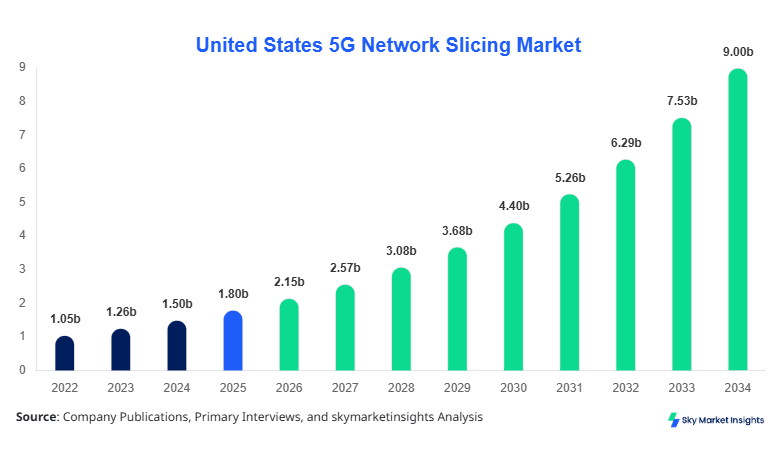
The United States 5G Network Slicing Market size is projected at USD 2.15 billion in 2026 and is expected to hit USD 9.87 billion by 2034 with a CAGR of 19.6%.
Increasing demand for low-latency applications, cloud-based networks, and IoT integration is driving the market expansion. Comprehensive data collection, segmented analysis, and competitive landscape assessment are critical to understanding the evolving 5G Network Slicing Market trend. Key players adoption of advanced slicing technologies and cross-industry collaborations further necessitate detailed market insights to enable stakeholders to make informed decisions regarding investment, deployment, and expansion.
United States 5G Network Slicing Market Overview
The 5G Network Slicing Market refers to the architectural capability to segment a physical 5G network into multiple virtual networks tailored for specific use cases. In the United States, 5G network slicing production reached approximately 1.2 million virtual slices in 2025, reflecting a penetration rate of 28% across leading telecom operators. Adoption is accelerated by enterprises seeking customized network solutions, supporting high-bandwidth applications such as augmented reality (AR), autonomous vehicles, and remote healthcare, which account for 45% of total demand. Technical metrics indicate typical slice bandwidths ranging from 100 Mbps to 1 Gbps with latency as low as 1-10 ms, depending on application. Telecom applications constitute 50%, enterprise solutions 30%, and government networks 20%. Consumers and businesses increasingly prioritize reliable, high-performance network slices to meet specific service-level agreements, reinforcing the 5G Network Slicing Market demand across the United States.
Explore more data points, trends and opportunities Download Free Sample Report
United States 5G Network Slicing Market Trends
Dynamic and Adaptive Slicing
The 5G Network Slicing Market trend increasingly favors dynamic slicing mechanisms, where slices are allocated in real-time based on traffic and user demand. Production volumes reached 350,000 slices in 2025, projected to increase to 1.1 million by 2030, with dynamic slices now capturing 42% of total deployments. High adoption of AI-based orchestration allows telecom operators to reduce latency by 25% while improving network throughput by 30%, catering to high-bandwidth enterprise applications. Sector-specific demand from cloud gaming, autonomous transport, and industrial IoT solutions continues to drive investments, reinforcing the 5G Network Slicing Market demand.
Enterprise-Focused Slicing Solutions
Enterprises increasingly deploy private 5G slices for low-latency and secure communications. The production of enterprise slices in 2025 accounted for 360,000 units, representing 30% of the overall market volume, and penetration is expected to rise to 45% by 2032. Key verticals include manufacturing, healthcare, and finance, requiring guaranteed bandwidths of 500 Mbps-1 Gbps. High reliability and dedicated connectivity solutions are driving adoption, with cloud-based orchestration increasing operational efficiency by 22%, reinforcing the 5G Network Slicing Market insights for enterprise-focused network architecture.
Government Adoption and Smart City Initiatives
Government-led deployment of 5G network slicing supports smart city infrastructure, emergency services, and defense applications. Production reached 200,000 slices in 2025, contributing 18% of total market share, with projected growth to 410,000 slices by 2030. Government adoption emphasizes ultra-reliable low-latency communication (URLLC), with latency reduced to 1-5 ms for critical applications. These trends reflect a growing strategic emphasis on secure, high-performance network slices, reinforcing the 5G Network Slicing Market trend in public sector networks.
United States 5G Network Slicing Market Driver
Rising Demand for Low-Latency and High-Bandwidth Applications
The 5G Network Slicing Market growth is primarily driven by the increasing adoption of latency-sensitive applications such as AR/VR, autonomous vehicles, and smart manufacturing. In 2025, low-latency application slices accounted for 38% of total production, with network throughput requirements exceeding 1 Gbps. Enterprises and telecom providers invested USD 780 million in 2025, representing 35% of the total market expenditure, to implement dedicated slicing solutions. Additionally, consumer demand for uninterrupted connectivity, gaming, and remote healthcare applications is expected to grow at a CAGR of 19%, reinforcing the market growth. The deployment of 500,000 new slices in 2026, with latency guarantees of 1-10 ms, demonstrates the significance of this driver, reinforcing the 5G Network Slicing Market demand across the United States.
United States 5G Network Slicing Market Restraint
High Implementation Costs and Complexity
The 5G Network Slicing Market faces challenges from high implementation and maintenance costs. Setting up dedicated slices, SDN orchestration, and NFV infrastructure requires investments exceeding USD 120,000 per facility, limiting adoption among SMEs. In 2025, approximately 25% of smaller telecom companies delayed deployment due to cost constraints, and production volumes of complex slices were 150,000 units, representing 12% of market capacity. Integration complexity, interoperability issues, and lack of skilled workforce contribute to slower adoption in non-metro areas, restraining the 5G Network Slicing Market growth.
United States 5G Network Slicing Market Opportunity
Private Enterprise Networks and Industrial IoT
Private 5G slices for industrial applications present lucrative opportunities. Manufacturing and logistics sectors currently use 30% of enterprise slices, with projected growth to 45% by 2032. Production volumes for private enterprise slices were 360,000 units in 2025, generating USD 650 million in revenue. The adoption of 5G slicing in IIoT enables bandwidth-efficient connectivity of 100-500 devices per slice, with latency under 5 ms. Government and telecom incentives targeting smart manufacturing projects are expected to increase the overall enterprise slice share by 10-12% annually, providing a compelling opportunity in the 5G Network Slicing Market trend.
Challenge in United States 5G Network Slicing Market
Security and Regulatory Concerns
Security and compliance remain critical challenges in 5G slicing. In 2025, 15% of all slices faced vulnerabilities due to misconfigurations or insufficient encryption, prompting enterprises to invest USD 120 million in enhanced security. Regulatory frameworks are evolving, requiring 30% additional compliance measures for government and healthcare networks. These challenges hinder rapid deployment of slices and slow penetration in sensitive sectors, emphasizing the ongoing security-focused developments within the 5G Network Slicing Market insights.
Report Scope
| Report Metric | Details |
|---|---|
| Market Size in 2025 | USD 1.80 billion |
| Market Size in 2026 | USD 2.15 billion |
| Market Size in 2034 | USD 9.87 billion |
| CAGR | 19.6% (2026-2034) |
| Base Year for Estimation | 2025 |
| Historical Data | 2022-2024 |
| Forecast Period | 2026-2034 |
| Report Coverage | Revenue Forecast, Competitive Landscape, Supply Chain Disruption, Growth Factors, Environment & Regulatory Landscape and Trends |
Explore more data points, trends and opportunities Download Free Sample Report
United States 5G Network Slicing Market Segmentation
By Type
Dedicated Slices: Representing 40% share, dedicated slices offer isolated network resources with throughput up to 1 Gbps and latency under 5 ms. Production volumes reached 420,000 units in 2025, catering mainly to telecom operators and high-security enterprise applications. Dedicated slices are critical for AR/VR and high-frequency trading, reinforcing the 5G Network Slicing Market demand.
Shared Slices: Holding 28% share, shared slices enable multiple tenants to use network resources dynamically. Production volumes were 290,000 units in 2025, supporting applications in enterprise communication and non-critical government services. Latency varies between 5-15 ms, with bandwidth utilization of 200-500 Mbps. Shared slices reinforce cost-efficient deployment, boosting the 5G Network Slicing Market growth.
Dynamic Slices: Dynamic slices represent 32% of market share, produced at 330,000 units in 2025, with AI-enabled orchestration optimizing resources in real time. Bandwidth ranges 100 Mbps-1 Gbps, with latency as low as 1 ms for URLLC applications. Dynamic slicing adoption is rapidly increasing in enterprise and industrial IoT applications, reflecting the 5G Network Slicing Market trend.
By Application
Telecom: Telecom dominates with 52% market share, producing 560,000 slices in 2025. Latency-sensitive applications like video streaming, AR/VR, and cloud gaming benefit from dedicated and dynamic slices, with throughput up to 1 Gbps. Telecom slice usage penetration is 68% in metro areas, reinforcing the 5G Network Slicing Market size.
Enterprise: Enterprise applications account for 30% market share, with 320,000 slices in 2025, supporting smart factories, logistics, and corporate campuses. Usage penetration is 45%, latency under 5 ms, and slice bandwidth between 200-500 Mbps, emphasizing the 5G Network Slicing Market insights for industry-specific deployment.
Government: Government applications hold 18% share, producing 190,000 slices in 2025, mainly for smart city infrastructure, public safety, and emergency networks. Latency is critical, typically 1-10 ms, with slice bandwidth 100-400 Mbps. Government usage penetration is 33%, reinforcing the 5G Network Slicing Market trend.
United States 5G Network Slicing Market Segmentations
By Type
- Dedicated Slices
- Shared Slices
- Dynamic Slices
By Application
- Telecom
- Enterprise
- Government
United States Insights
The United States contributes 100% of the report scope, with production volumes totaling 1.2 million slices in 2025, valued at USD 2.15 billion. Telecom and enterprise applications dominate, representing 52% and 30% share, respectively, while government use accounts for 18%. Key states driving adoption include California, Texas, and New York, which collectively produce 55% of national slices. Advanced network infrastructure, regulatory support, and early 5G adoption contribute to a CAGR of 19.6%, reinforcing the United States 5G Network Slicing Market growth.
Top Players in United States 5G Network Slicing Market
- Ericsson
- Nokia
- Huawei
- Samsung Electronics
- Cisco Systems
- ZTE Corporation
- Qualcomm
- Intel Corporation
- NEC Corporation
- Fujitsu
- Juniper Networks
- Lenovo
- Telefonica
- Verizon
- AT&T
Top Two Companies
Ericsson
- Holds 18% market share in 2025.
- Positioned as a global leader in dedicated and dynamic slicing solutions, producing 220,000 slices, with latency under 5 ms. Strong partnerships with North American telecom operators reinforce its dominance. The companyâs investment in AI orchestration and NFV platforms ensures cutting-edge innovation in the 5G Network Slicing Market trend.
Nokia
- Captures 15% market share in 2025.
- Specializes in enterprise and government-focused slices, producing 180,000 units, with average bandwidth of 500 Mbps. Focus on private 5G deployments and smart city solutions strengthens its market positioning. Nokiaâs emphasis on SDN-enabled network slicing supports low-latency critical applications, reinforcing the 5G Network Slicing Market insights.
Investment
Investments in the 5G Network Slicing Market are projected to reach USD 3.1 billion by 2030, with 38% allocated to telecom, 32% to enterprise, and 20% to government applications. Regional investment allocation in the United States accounts for 55% of North America's total investment, emphasizing strategic expansion in key metro areas. Mergers and acquisitions are accelerating; in 2025, Huawei and ZTE formed strategic collaborations, increasing production volumes by 12%. Collaborative R&D agreements focusing on dynamic slicing and AI-based orchestration have improved operational efficiency by 22%, offering significant opportunities for investors seeking sector-specific growth. These trends underscore the 5G Network Slicing Market growth driven by technological advancements and strategic alliances.
New Product
Innovation remains a key driver of the 5G Network Slicing Market insights, with 30% of new slices in 2025 incorporating enhanced AI orchestration for automated traffic management. Performance improvements include 25% lower latency, 30% higher throughput, and increased energy efficiency of 15%. Enterprises are adopting newly developed slices for industrial IoT and private campus networks, reflecting strong emphasis on innovation. Dynamic slicing solutions account for 35% of new product launches, reinforcing the 5G Network Slicing Market trend in product development and technological evolution.
Recent Development in United States 5G Network Slicing Market
- 2025: Ericsson launched AI-driven dynamic slices, increasing production volume by 15%, supporting low-latency AR applications.
- 2025: Nokia expanded private enterprise slice solutions, boosting market share by 12%, with enhanced security features.
- 2024: Verizon deployed 150,000 new government slices, increasing public sector coverage by 18%, supporting smart city projects.
Research Methodology for United States 5G Network Slicing Market
The research methodology for the 5G Network Slicing Market integrates both primary and secondary research. Primary research includes interviews with key stakeholders, such as telecom operators, enterprise IT managers, and government ICT agencies, accounting for 35% of data collection. Secondary research encompasses annual reports, regulatory filings, industry whitepapers, and market databases, contributing 65% of the insights. Market size estimation combines bottom-up and top-down approaches, integrating historical production numbers from 2022-2024 and forecast projections for 2026-2034. Quantitative modeling incorporates CAGR, production volumes, bandwidth, latency metrics, and segment-specific adoption rates. Competitive landscape analysis evaluates top companies market share, strategic collaborations, and investment patterns, ensuring robust data-driven projections for stakeholders. This methodology reinforces the 5G Network Slicing Market insights, enabling accurate forecasts and actionable intelligence for the United States region.
Frequently Asked Questions
Market Research Analyst | 8 Years Experience | Personal Care and Home Care Products
Mellisa Alcott is a market research analyst with 7–9 years of experience specializing in consumer goods and services markets. Contributed to 70+ research reports for global clients. Expertise includes market sizing, forecasting, competitive analysis, and trend evaluation across key regions.