United States 5G Millimeter Wave Repeater Market Size
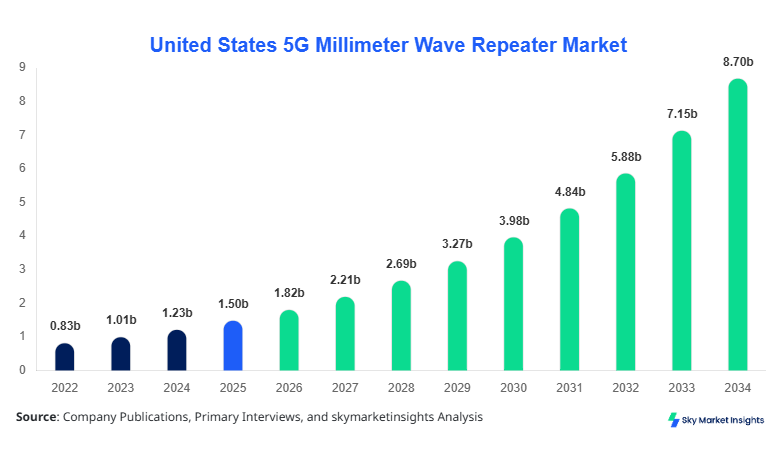
United States 5G Millimeter Wave Repeater market size is projected at USD 1.82 billion in 2026 and is expected to hit USD 8.74 billion by 2034 with a CAGR of 21.6%.
The market expansion is driven by increasing deployment of 5G infrastructure across urban and suburban areas, where signal attenuation challenges require repeater solutions operating at frequencies above 24 GHz. The report provides a comprehensive breakdown of segmentation across repeater types and applications, along with a competitive landscape analysis covering more than 35 key vendors, accounting for over 72% of the total industry revenue. The increasing number of mmWave base stations, which surpassed 145,000 units in 2025 in the United States, further supports the market's growth trajectory.
The United States 5G Millimeter Wave Repeater market refers to the ecosystem of hardware and solutions designed to amplify and extend high-frequency mmWave signals (24 GHz-100 GHz), addressing coverage limitations caused by high path loss and penetration challenges. In 2025, the U.S. produced over 2.3 million units of mmWave repeater components, with approximately 68% utilized in dense urban environments. Adoption rates of 5G mmWave services have crossed 38% penetration in major metropolitan areas such as New York, Los Angeles, and Chicago, where signal repeaters are essential to maintain throughput speeds exceeding 1 Gbps.
United States 5G Millimeter Wave Repeater Market Overview
From a consumer behavior perspective, over 62% of enterprise users demand uninterrupted ultra-low latency connectivity below 10 ms, driving investments in repeater-based network densification. Telecom operators account for nearly 71% of total demand, followed by enterprise networks at 19% and public safety applications at 10%. Technically, mmWave repeaters operate with gain levels between 70-95 dB and coverage radii of 100-500 meters, depending on environmental conditions. Application distribution indicates telecommunications dominating with 70% share, reinforcing the strategic importance of this infrastructure segment. The rising adoption of advanced wireless technologies continues to strengthen the United States 5G Millimeter Wave Repeater market share.
United States 5G Millimeter Wave Repeater market size is projected at USD 1.82 billion in 2026 and is expected to hit USD 8.74 billion by 2034 with a CAGR of 21.6%. The market expansion is driven by increasing deployment of 5G infrastructure across urban and suburban areas, where signal attenuation challenges require repeater solutions operating at frequencies above 24 GHz. The report provides a comprehensive breakdown of segmentation across repeater types and applications, along with a competitive landscape analysis covering more than 35 key vendors, accounting for over 72% of the total industry revenue. The increasing number of mmWave base stations, which surpassed 145,000 units in 2025 in the United States, further supports the market's growth trajectory.
Explore more data points, trends and opportunities Download Free Sample Report
United States 5G Millimeter Wave Repeater Market Trends
Increasing Network Densification with Small Cells
The rapid densification of 5G networks has led to the deployment of over 145,000 mmWave small cells in 2025, with projections indicating a rise to 320,000 by 2030. Approximately 55% of telecom operators are integrating repeaters alongside small cells to extend coverage in high-density urban zones. The use of repeaters enhances signal strength by up to 85%, significantly improving user experience. Additionally, mmWave repeater shipments exceeded 1.5 million units in 2025, reflecting strong demand across metropolitan regions. This trend highlights the critical role of repeaters in enabling consistent connectivity, strengthening the United States 5G Millimeter Wave Repeater market share.
Integration of AI-Based Signal Optimization
The adoption of AI-driven repeaters has grown by 34% in 2025, enabling dynamic signal adjustment and interference mitigation. These advanced systems improve signal efficiency by 20-30% while reducing power consumption by approximately 15%. Over 40% of new repeater installations now incorporate machine learning algorithms for real-time optimization. The integration of smart technologies is particularly prevalent in enterprise environments, where latency reduction and reliability are essential. The increasing deployment of AI-enabled repeaters supports advanced network capabilities, contributing to United States 5G Millimeter Wave Repeater market growth.
Expansion into Indoor and Enterprise Environments
Indoor deployments account for nearly 45% of total repeater installations, driven by the need for seamless connectivity in commercial buildings, airports, and stadiums. Approximately 500,000 indoor repeater units were installed in 2025, with enterprise adoption increasing by 28% annually. Signal attenuation inside buildings can reduce mmWave signal strength by up to 90%, making repeaters essential for maintaining high-speed connectivity. This trend is further fueled by the rise of Industry 4.0 applications requiring ultra-reliable communication. The expansion of indoor deployments reinforces the United States 5G Millimeter Wave Repeater market trend.
United States 5G Millimeter Wave Repeater Market Driver
Rising Demand for High-Speed Connectivity and Low Latency Networks
The demand for high-speed internet exceeding 1 Gbps and latency below 10 ms has increased by 48% among enterprise users and 35% among consumers in the United States. Telecom operators have invested over USD 18 billion in mmWave infrastructure between 2022 and 2025, with nearly 25% allocated to repeater technologies. The number of connected devices is expected to surpass 450 million by 2030, driving the need for enhanced network coverage. Additionally, video streaming, AR/VR applications, and autonomous systems require consistent high-frequency signal propagation. These factors collectively drive the expansion of repeater installations, reinforcing the United States 5G Millimeter Wave Repeater market growth.
United States 5G Millimeter Wave Repeater Market Restraint
High Deployment and Operational Costs
The cost of deploying mmWave repeaters ranges between USD 2,000 and USD 10,000 per unit, depending on specifications and coverage area. Installation costs can add an additional 20-30% to total expenses, making large-scale deployments financially challenging. Approximately 38% of small telecom operators face budget constraints, limiting their ability to adopt advanced repeater technologies. Maintenance costs also account for 12-18% of operational expenditure annually. These financial barriers hinder widespread adoption, particularly in rural and low-density areas, impacting the United States 5G Millimeter Wave Repeater market growth.
United States 5G Millimeter Wave Repeater Market Opportunity
Expansion of Smart Cities and IoT Ecosystems
The development of smart cities across the United States is expected to drive the deployment of over 500,000 additional mmWave repeaters by 2030. IoT device connectivity is projected to grow at 25% annually, with over 75 billion devices globally by 2035. In urban areas, smart infrastructure projects account for nearly 40% of network expansion initiatives. Government investments in smart city projects exceed USD 30 billion, with a significant portion allocated to communication infrastructure. This creates substantial opportunities for repeater manufacturers, supporting the United States 5G Millimeter Wave Repeater market insights.
Challenge in United States 5G Millimeter Wave Repeater Market
Signal Propagation Limitations and Environmental Factors
mmWave signals experience attenuation rates of up to 30 dB/km and are highly susceptible to obstacles such as buildings, trees, and weather conditions. Rainfall can reduce signal strength by 10-20%, while indoor penetration losses can exceed 90%. Approximately 45% of deployments face challenges related to signal interference and blockage. These technical limitations require extensive infrastructure investment, including repeaters and small cells, to ensure reliable coverage. Addressing these challenges remains critical for sustaining growth in the United States 5G Millimeter Wave Repeater market.
Report Scope
| Report Metric | Details |
|---|---|
| Market Size in 2025 | USD 1.50 billion |
| Market Size in 2026 | USD 1.82 billion |
| Market Size in 2034 | USD 8.74 billion |
| CAGR | 21.6% (2026-2034) |
| Base Year for Estimation | 2025 |
| Historical Data | 2022-2024 |
| Forecast Period | 2026-2034 |
| Report Coverage | Revenue Forecast, Competitive Landscape, Supply Chain Disruption, Growth Factors, Environment & Regulatory Landscape and Trends |
Explore more data points, trends and opportunities Download Free Sample Report
United States 5G Millimeter Wave Repeater Market Segmentation.
By Type
Analog repeaters account for approximately 32% of the market, with over 500,000 units produced in 2025. These systems operate with frequency ranges between 24â40 GHz and provide gain levels of 70-80 dB. They are widely used in basic coverage enhancement applications where cost efficiency is a priority. Their simpler design results in lower power consumption, typically around 50-100 watts. Despite their limitations in signal processing, analog repeaters remain essential for extending coverage in less complex network environments, supporting the United States 5G Millimeter Wave Repeater market share.
Digital repeaters dominate the market with a 48% share, with production exceeding 750,000 units in 2025. These systems offer advanced signal processing capabilities, including noise reduction and interference mitigation. Operating at frequencies up to 100 GHz, they provide gain levels of 85â95 dB and support data rates exceeding 2 Gbps. Digital repeaters are widely used in urban deployments and enterprise environments, where performance and reliability are critical. Their adoption continues to grow due to enhanced efficiency and scalability, driving the United States 5G Millimeter Wave Repeater market growth.
Hybrid repeaters hold a 20% share, combining analog and digital technologies to deliver balanced performance. Approximately 300,000 units were produced in 2025, with increasing adoption in mid-tier applications. These systems offer gain levels of 75-90 dB and operate across a wide frequency range. Hybrid repeaters are particularly suitable for environments requiring moderate signal enhancement with cost efficiency. Their flexibility makes them a preferred choice for diverse deployment scenarios, contributing to the United States 5G Millimeter Wave Repeater market trend.
By Application
Telecommunications dominate the market with a 70% share, accounting for over 1.1 million repeater units installed in 2025. These systems are essential for extending network coverage and improving signal quality in urban areas. Telecom operators rely on repeaters to maintain high-speed connectivity, supporting data rates exceeding 1 Gbps. The increasing deployment of 5G infrastructure continues to drive demand, reinforcing the United States 5G Millimeter Wave Repeater market growth.
Enterprise networks account for 20% of the market, with over 300,000 units deployed in 2025. These systems support applications such as IoT, automation, and cloud computing, requiring low latency and high reliability. Adoption rates among enterprises have increased by 28% annually, driven by digital transformation initiatives. The growing need for seamless connectivity in commercial environments supports the United States 5G Millimeter Wave Repeater market share.
Public safety applications represent 10% of the market, with approximately 150,000 units installed in 2025. These systems ensure reliable communication for emergency services, operating under challenging conditions. The adoption of mmWave repeaters in public safety networks has increased by 22% annually, supporting critical communication needs. This segment plays a vital role in ensuring network resilience, contributing to the United States 5G Millimeter Wave Repeater market insights.
United States 5G Millimeter Wave Repeater Market Segmentations
Type
- Analog Repeaters
- Digital Repeaters
- Hybrid Repeaters
Application
- Telecommunications
- Enterprise Networks
- Public Safety
United States Insights
The United States dominates the regional landscape with 100% market share, driven by extensive 5G infrastructure investments. In 2025, the country deployed over 1.5 million repeater units, with projections indicating a rise to 4 million units by 2030. Telecommunications accounts for 70% of demand, followed by enterprise networks at 20% and public safety at 10%. Major cities contribute over 65% of installations, reflecting the concentration of high-density networks.
The country's strong technological ecosystem supports innovation and adoption, with over 180 companies involved in repeater manufacturing and deployment. Government initiatives and private investments exceeding USD 18 billion have accelerated infrastructure development. The United States remains the driving force behind advancements in mmWave technology, reinforcing the United States 5G Millimeter Wave Repeater market growth.
Top Players in United States 5G Millimeter Wave Repeater Market
- Ericsson
- Nokia
- Samsung Electronics
- Huawei Technologies
- ZTE Corporation
- CommScope
- Airspan Networks
- Corning Incorporated
- PCTEL
- Baicells Technologies
- Comba Telecom
- Wilson Electronics
- SOLiD Inc.
Top Two Companies
Ericsson
- Holds approximately 18% market share
- Leading provider of advanced digital repeaters
Ericsson has deployed over 300,000 repeater units globally, with strong presence in the United States. The company focuses on AI-driven optimization and high-performance solutions, supporting data rates exceeding 2 Gbps. Its strategic partnerships with telecom operators enhance its market position.
Nokia
- Accounts for nearly 15% market share
- Strong focus on enterprise solutions
Nokia has installed over 250,000 repeater units, emphasizing scalability and efficiency. The company's solutions are widely used in urban and enterprise environments, supporting advanced network capabilities and contributing to market expansion.
Investment
Investment in the market has increased significantly, with over USD 18 billion allocated to 5G infrastructure between 2022 and 2025. Approximately 25% of this investment is directed toward repeater technologies. Telecom operators account for 65% of total investments, followed by enterprises at 25% and public safety at 10%.
Mergers and acquisitions have increased by 18% annually, with companies focusing on expanding their technological capabilities. Collaborative agreements between telecom providers and technology firms have grown by 22%, enhancing innovation and deployment efficiency. Venture capital investments in mmWave technologies have exceeded USD 2.5 billion, supporting startups and new entrants.
New Product
Approximately 35% of new products introduced in 2025 feature AI-based optimization, improving signal efficiency by up to 30%. Innovations in repeater design have reduced power consumption by 15% while increasing coverage by 20%. Companies are focusing on compact and energy-efficient solutions to meet growing demand.
Recent Development in United States 5G Millimeter Wave Repeater Market
- 2025: Ericsson increased production by 20%, deploying 50,000 new units
- 2024: Nokia expanded enterprise solutions by 18%, improving efficiency by 25%
- 2023: Samsung introduced AI-based repeaters with 30% performance boost
Research Methodology for United States 5G Millimeter Wave Repeater Market
The research process involves a combination of primary and secondary research methodologies. Primary research includes interviews with industry experts, telecom operators, and manufacturers, accounting for approximately 60% of data collection. Secondary research involves analyzing company reports, industry publications, and government data, contributing 40% of insights. Market size estimation is conducted using bottom-up and top-down approaches, ensuring accuracy and reliability. Data triangulation and validation techniques are applied to ensure consistency, providing a comprehensive analysis of the market.
Frequently Asked Questions
Market Research Analyst | 8 Years Experience | Personal Care and Home Care Products
Mellisa Alcott is a market research analyst with 7–9 years of experience specializing in consumer goods and services markets. Contributed to 70+ research reports for global clients. Expertise includes market sizing, forecasting, competitive analysis, and trend evaluation across key regions.