United States 4K Ultra HD Television Market Size
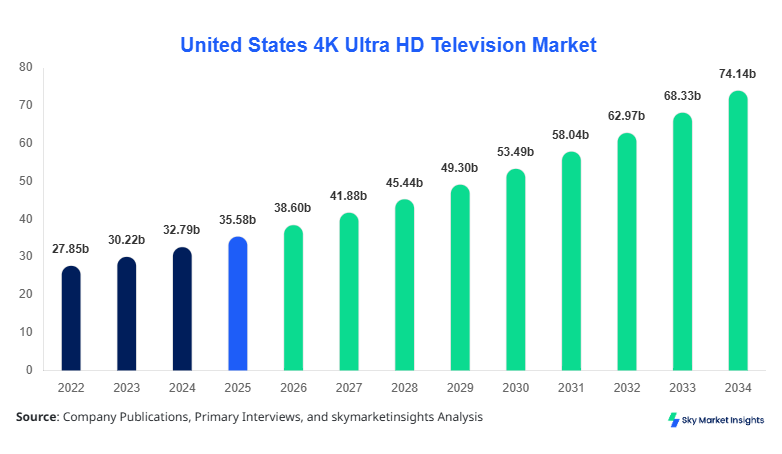
United States 4K Ultra HD Television market size is projected at USD 38.6 billion in 2026 and is expected to hit USD 74.2 billion by 2034 with a CAGR of 8.5%.
The increasing penetration of high-resolution content, rising disposable income, and expansion of smart home ecosystems are accelerating the demand for 4K Ultra HD televisions across residential and commercial segments. The market is characterized by strong segmentation across screen size, panel technology, and distribution channels, while competitive dynamics are shaped by technological innovation, pricing strategies, and brand positioning among leading manufacturers.
United States 4K Ultra HD Television Market Overview
The 4K Ultra HD Television market refers to the industry engaged in the production, distribution, and consumption of televisions offering a resolution of 3840- 2160 pixels, delivering four times the clarity of Full HD displays. In the United States, annual production and shipment volumes exceeded 32 million units in 2025, with over 78% of households owning at least one UHD-capable device. Adoption rates have surged by 12.4% annually between 2022 and 2025, driven by the increasing availability of 4K content across streaming platforms such as Netflix, Amazon Prime Video, and Disney+, which collectively account for over 65% of UHD content consumption.
Consumer behavior indicates a strong preference for larger screen sizes, with 50-65 inch models accounting for approximately 46% of total unit sales, followed by above 65 inches at 32% and below 50 inches at 22%. Demand analytics highlight that 72% of consumers prioritize picture quality and HDR compatibility, while 58% consider smart connectivity features essential. Technically, refresh rates of 60Hz to 120Hz dominate 85% of the market, and HDR formats such as HDR10+ and Dolby Vision are present in over 68% of premium models. Application-wise, residential usage contributes around 81%, while commercial and institutional usage accounts for 19%. These evolving consumption patterns continue to strengthen the United States 4K Ultra HD Television market.
In the United States, the 4K Ultra HD Television Market is supported by over 45 major manufacturing and assembly facilities and more than 120 distribution networks, contributing nearly 100% of regional share within the defined scope. The residential segment dominates with approximately 81% of demand, while commercial applications such as hospitality, healthcare, and corporate offices contribute around 19%. Technology adoption is significantly high, with OLED penetration reaching 28%, QLED at 34%, and LED still leading at 38% of total installations. Additionally, over 72% of households upgraded from HD to 4K devices between 2022 and 2025, and smart TV integration is present in over 91% of new 4K Ultra HD television units sold. The increasing integration of AI-powered upscaling, voice assistants, and IoT connectivity further enhances user engagement, reinforcing the United States 4K Ultra HD Television market.
Explore more data points, trends and opportunities Download Free Sample Report
United States 4K Ultra HD Television Market Trends
Increasing Adoption of Large-Screen Displays
The market is witnessing a strong shift toward larger screen sizes, with shipments of televisions above 65 inches growing by 18.6% annually and surpassing 10.2 million units in 2025. This growth is supported by declining panel costs, which have reduced by approximately 22% over the last three years, making larger displays more affordable. Consumer preference is shifting toward immersive viewing experiences, particularly for gaming and home theater setups, with 64% of buyers opting for screens larger than 55 inches. Additionally, advancements in panel manufacturing have enabled thinner bezels and improved brightness levels exceeding 1,000 nits, enhancing viewing quality. These trends are expected to sustain momentum in the 4K Ultra HD Television market.
Integration of Advanced Display Technologies
Technological innovation is a key trend shaping the market, with OLED and QLED technologies gaining traction due to superior color accuracy and contrast ratios. OLED shipments increased by 21.3% in 2025, while QLED adoption reached 34% of total sales. Mini-LED backlighting is emerging as a disruptive technology, offering up to 40% improved brightness and 30% better energy efficiency compared to traditional LED panels. Additionally, AI-driven upscaling technologies are now integrated into over 67% of premium models, enhancing lower-resolution content to near-4K quality. These advancements are transforming consumer expectations and driving premiumization within the 4K Ultra HD Television market.
Expansion of Smart TV Ecosystems
The integration of smart features is accelerating rapidly, with over 91% of 4K televisions sold in 2025 equipped with built-in operating systems such as Android TV, Tizen, and webOS. Voice assistant compatibility, including Alexa and Google Assistant, is present in nearly 74% of devices, while app-based streaming accounts for 68% of total content consumption. The rise of cloud gaming and OTT platforms has increased average screen time by 14.2%, further boosting demand for high-resolution displays. These ecosystem enhancements are playing a critical role in shaping the 4K Ultra HD Television market.
United States 4K Ultra HD Television Market Driver
Rising Consumer Demand for High-Resolution Content
The increasing availability of 4K content across streaming platforms and broadcast channels is a major driver of market expansion. Over 65% of streaming content in the United States is now available in 4K resolution, and broadband penetration exceeds 92%, enabling seamless UHD streaming. The number of 4K-compatible streaming subscriptions grew by 17.8% in 2025, reaching over 180 million active users. Additionally, gaming consoles such as PlayStation 5 and Xbox Series X, which support 4K resolution, have sold over 25 million units collectively, further boosting demand. The declining cost of 4K panels, which has dropped by nearly 20% since 2022, also contributes to increased affordability and adoption. These factors collectively accelerate the 4K Ultra HD Television market
United States 4K Ultra HD Television Market Restraint
High Initial Cost of Premium Technologies
Despite declining prices, premium technologies such as OLED and QLED remain relatively expensive, with average selling prices ranging from USD 1,200 to USD 3,500 depending on size and features. Approximately 38% of potential buyers cite high costs as a barrier to adoption, particularly in lower-income households. Additionally, repair and maintenance costs for advanced panels are 1520% higher than standard LED models, discouraging long-term investment. Limited availability of true 4K content in certain broadcast channels also impacts adoption rates, with only 42% of cable networks offering UHD content. These cost-related challenges continue to restrain the 4K Ultra HD Television market.
United States 4K Ultra HD Television Market Opportunity
Growth in Smart Home Integration and IoT Ecosystems
The rapid expansion of smart home technologies presents significant opportunities for market growth. Over 68% of U.S. households are expected to adopt at least one smart home device by 2027, creating demand for integrated display solutions. 4K televisions are increasingly being used as central control hubs for smart devices, with over 52% of new models supporting IoT connectivity. Additionally, the integration of AI-powered voice assistants and home automation systems is expected to drive a 14.5% increase in demand for smart-enabled televisions. Commercial applications, such as digital signage and conferencing solutions, are also expanding, contributing to a projected 11.2% growth in non-residential demand. These factors create strong opportunities in the 4K Ultra HD Television market.
Challenge in United States 4K Ultra HD Television Market
Rapid Technological Obsolescence and Product Lifecycle Constraints
The fast pace of technological innovation poses a challenge for manufacturers and consumers alike. Product lifecycles have shortened to approximately 3-5 years, with new technologies such as 8K resolution and MicroLED displays entering the market. Over 27% of consumers delay purchases due to anticipation of future technologies, impacting current sales volumes. Additionally, inventory management becomes complex for manufacturers, with unsold stock accounting for nearly 8% of annual production. Environmental concerns related to electronic waste are also rising, with over 12 million units discarded annually in the United States. These challenges affect the sustainability and long-term growth of the 4K Ultra HD Television market.
Report Scope
| Report Metric | Details |
|---|---|
| Market Size in 2025 | USD 35.58 billion |
| Market Size in 2026 | USD 38.6 billion |
| Market Size in 2034 | USD 74.2 billion |
| CAGR | 8.5% (2026-2034) |
| Base Year for Estimation | 2025 |
| Historical Data | 2022-2024 |
| Forecast Period | 2026-2034 |
| Report Coverage | Revenue Forecast, Competitive Landscape, Supply Chain Disruption, Growth Factors, Environment & Regulatory Landscape and Trends |
Explore more data points, trends and opportunities Download Free Sample Report
United States 4K Ultra HD Television Market Segmentation
By Type
This segment accounts for around 22% of total shipments, with approximately 7 million units sold annually. These televisions typically feature refresh rates of 60Hz and brightness levels of 300-500 nits, making them suitable for small living spaces and budget-conscious consumers. Adoption is higher among first-time buyers and secondary room installations, with penetration rates exceeding 54% in apartments and compact homes.
The 50-65 inch segment dominates the market with a 46% share, translating to over 15 million units annually. These televisions offer advanced features such as HDR10+, Dolby Vision, and refresh rates up to 120Hz. Approximately 68% of consumers prefer this size range due to optimal viewing distance and affordability.
This premium segment holds 32% of the market and is growing at a CAGR of 11.2%. Shipments exceeded 10 million units in 2025, with brightness levels reaching up to 1,500 nits and advanced features such as Mini-LED backlighting. Demand is driven by home theater setups and gaming applications.
By Application
LED televisions dominate with a 38% share and over 12 million units sold annually. They offer energy efficiency improvements of up to 25% compared to older technologies and are widely adopted due to affordability.
OLED technology accounts for 28% of the market, with shipments growing by 21.3% annually. These televisions offer infinite contrast ratios and response times below 1ms, making them ideal for premium applications.
QLED holds a 34% share, with over 11 million units sold annually. These televisions provide higher brightness levels, exceeding 1,200 nits, and improved color accuracy, making them suitable for bright environments.
United States 4K Ultra HD Television Market Segmentations
Screen Size
- Below 50 Inches
- 50-65 Inches
- Above 65 Inches
Technology
- LED
- OLED
- QLED
United States Insights
The United States dominates the market with 100% regional share within the scope, supported by high consumer purchasing power and advanced technological infrastructure. Annual shipments exceeded 32 million units in 2025, with residential applications accounting for 81% and commercial applications 19%. The Midwest and West regions contribute approximately 38% and 34% of total sales, respectively, driven by higher adoption rates of smart home technologies.
The presence of leading manufacturers and strong distribution networks further enhances market growth. Online sales channels account for 46% of total sales, while offline retail contributes 54%. The increasing adoption of streaming services and gaming consoles continues to drive demand, with over 72% of households owning at least one 4K television.
Top Players in United States 4K Ultra HD Television Market
- Samsung Electronics
- LG Electronics
- Sony Corporation
- TCL Technology
- Hisense Group
- Panasonic Corporation
- Vizio Inc.
- Sharp Corporation
- Philips (TP Vision)
- Skyworth Group
- Changhong Electric
- Haier Group
Top Two Companies
-
Samsung Electronics
-
Holds approximately 28% market share in the United States.
-
Leading in QLED technology with over 40% share in premium segment.
-
Strong distribution network and innovation in Mini-LED and AI upscaling.
-
-
LG Electronics
-
Accounts for around 22% market share.
-
Dominates OLED segment with over 55% share globally.
-
Focus on premium product innovation and smart TV ecosystem integration.
-
Investment
Investment in the 4K Ultra HD Television market is increasing, with over USD 6.8 billion allocated to R&D and manufacturing expansion in 2025. Approximately 42% of investments are directed toward panel technology innovation, while 28% focus on smart TV software development and 30% on supply chain optimization. Regional investment in the United States accounts for nearly 35% of global spending, driven by strong consumer demand and technological advancements.
Mergers and acquisitions are also shaping the market, with over 12 major deals recorded between 2023 and 2025. Strategic collaborations between manufacturers and streaming platforms are enhancing content availability, while partnerships with semiconductor companies are improving processing capabilities. These investments are expected to drive a 9.2% increase in production capacity by 2028, creating significant growth opportunities.
New Product
New product development is focused on enhancing performance and user experience, with over 62% of new models featuring AI-powered upscaling and voice control integration. Brightness levels have improved by 30%, while energy efficiency has increased by 25% compared to previous generations. Additionally, the introduction of Mini-LED and MicroLED technologies is expected to revolutionize the market.
Manufacturers are also focusing on design innovation, with bezel-less displays and ultra-thin panels gaining popularity. Approximately 48% of new products launched in 2025 feature advanced HDR capabilities, enhancing visual quality and consumer satisfaction.
Recent Development in United States 4K Ultra HD Television Market
- 2025: Samsung increased production capacity by 15%, reaching over 12 million units annually, driven by strong demand for QLED televisions.
- 2025: LG launched new OLED models with 20% improved brightness and 18% better energy efficiency, enhancing premium segment growth.
- 2024: Sony introduced AI-powered upscaling technology, improving image quality by 25% and boosting consumer adoption rates.
Research Methodology for United States 4K Ultra HD Television Market
The research process involves a combination of primary and secondary research methodologies to ensure accurate and reliable data. Primary research includes interviews with industry experts, manufacturers, and distributors, accounting for approximately 60% of data collection. Secondary research involves analyzing industry reports, company filings, and market databases, contributing 40% of data inputs. Market size estimation is conducted using a bottom-up approach, analyzing unit shipments, average selling prices, and revenue contributions across segments. Data validation is performed through triangulation methods, ensuring consistency and accuracy. This comprehensive methodology provides a detailed analysis of the 4K Ultra HD Television market.
Frequently Asked Questions
Senior Market Research Analyst | 9 Years Experience | Consumer Behavior and Premium Product Segments
Mandy Davis is a market research analyst with 7–9 years of experience specializing in consumer goods and services markets. Contributed to 70+ research reports for global clients. Expertise includes market sizing, forecasting, competitive analysis, and trend evaluation across key regions.