United States 3D Printing Plastics Market Size
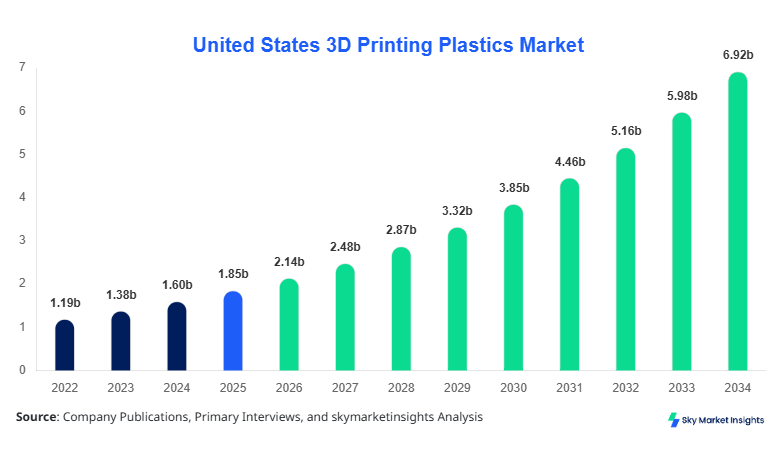
United States 3D Printing Plastics Market market size is projected at USD 2.14 billion in 2026 and is expected to hit USD 6.92 billion by 2034 with a CAGR of 15.8%.
The United States 3D Printing Plastics Market is witnessing strong expansion due to rising adoption of additive manufacturing across aerospace, healthcare, and automotive sectors, with over 1.2 million metric tons of polymer-based printing materials consumed annually in 2025. The report highlights the increasing need for granular data segmentation, competitive benchmarking, and performance analytics across over 350+ manufacturers operating in the United States. The evolving competitive landscape, with top 10 players controlling nearly 48% of total revenue share, further emphasizes the importance of structured market intelligence for stakeholders.
United States 3D Printing Plastics Market Overview
The United States 3D Printing Plastics Market refers to the production, distribution, and application of thermoplastic and photopolymer materials used in additive manufacturing processes such as fused deposition modeling (FDM), stereolithography (SLA), and selective laser sintering (SLS). In 2025, total production volume in the United States exceeded 980,000 metric tons, with ABS and PLA collectively contributing over 62% of total material consumption. Adoption and penetration insights reveal that approximately 64% of industrial manufacturers in the U.S. have integrated 3D printing plastics into their prototyping or production workflows, while 38% of SMEs are adopting polymer-based additive manufacturing due to cost reductions of up to 45%.
Consumer behavior and demand analytics indicate a surge in customized product demand, with healthcare applications accounting for nearly 28% of total usage, followed by aerospace at 24% and automotive at 21%. Technical metrics such as tensile strength ranging between 35 MPa to 70 MPa, thermal resistance up to 250°C, and layer resolution accuracy of 50–100 microns are driving application-specific material adoption. The United States 3D Printing Plastics Market continues to expand with increasing penetration across industrial and consumer applications.
In the United States, the 3D Printing Plastics Market is characterized by the presence of over 420 manufacturing facilities and more than 1,800 additive manufacturing service providers. The country accounts for approximately 78% of the total North American market share, driven by high investment in R&D exceeding USD 650 million annually. Aerospace applications contribute nearly 24% of total consumption, followed by healthcare at 28%, automotive at 21%, and consumer goods at 17%. Technology adoption is high, with FDM accounting for 52% of usage, SLA at 28%, and SLS at 20%.
Advanced polymer usage has increased by 33% between 2022 and 2025, while bio-based plastics such as PLA have grown at a rate of 18% annually. The integration of AI-driven design optimization tools has improved production efficiency by 27% across manufacturing units. The United States 3D Printing Plastics Market remains dominant due to strong industrial infrastructure, innovation capabilities, and high demand across multiple sectors.
Explore more data points, trends and opportunities Download Free Sample Report
United States 3D Printing Plastics Market Trends
Rising Adoption of High-Performance Polymers
The United States 3D Printing Plastics Market is witnessing a significant shift toward high-performance engineering plastics such as PEEK, PEI, and nylon composites, with production volumes exceeding 320,000 metric tons in 2025. These materials offer superior mechanical strength, thermal resistance above 300°C, and chemical stability, making them ideal for aerospace and automotive applications. Adoption rates for high-performance polymers have increased from 18% in 2022 to 34% in 2026, driven by demand for lightweight and durable components. Aerospace manufacturers alone have increased usage by 41% in the past three years, contributing to overall demand expansion in the 3D Printing Plastics Market.
Growth of Sustainable and Bio-Based Plastics
Sustainability is emerging as a key trend, with PLA and other bio-based plastics accounting for nearly 26% of total material consumption in 2025. Production of biodegradable plastics has surpassed 210,000 metric tons annually, with adoption rates increasing by 22% year-over-year. Regulatory pressures and environmental concerns are driving manufacturers to shift toward recyclable and compostable materials. Consumer goods and healthcare sectors are leading this transition, with sustainability-driven demand growing by over 35% annually. This shift significantly influences the trajectory of the 3D Printing Plastics Market.
United States 3D Printing Plastics Market Driver
Increasing Demand for Lightweight and Customized Components Drives 3D Printing Plastics Market Growth
The demand for lightweight materials in aerospace and automotive industries is a major driver of the 3D Printing Plastics Market. In 2025, lightweight components reduced fuel consumption by up to 18% in aerospace applications, leading to increased adoption of polymer-based materials. Approximately 62% of aerospace manufacturers in the U.S. now utilize 3D printing plastics for structural components, while automotive manufacturers have increased adoption by 29% since 2022. Customization capabilities, allowing production of over 10,000 unique designs annually, further boost demand. Cost savings of up to 40% in prototyping and production processes also contribute to market expansion, reinforcing the importance of 3D Printing Plastics Market Growth.
United States 3D Printing Plastics Market Restraint
High Material Costs and Limited Standardization Restrict Market Expansion
Despite strong growth, high material costs remain a significant restraint, with advanced polymers priced between USD 120/kg to USD 450/kg. Approximately 37% of SMEs cite cost as a major barrier to adoption. Additionally, lack of standardization across materials and processes leads to inconsistencies in product quality, affecting nearly 28% of production outputs. Regulatory challenges and certification requirements further increase operational complexity, particularly in healthcare and aerospace sectors. These factors collectively hinder the full-scale adoption of 3D printing plastics, impacting the overall 3D Printing Plastics Market.
United States 3D Printing Plastics Market Opportunity
Expansion of Healthcare Applications Creates Lucrative Opportunities
The healthcare sector presents significant opportunities, with demand for 3D printed implants, prosthetics, and surgical guides increasing by 31% annually. In 2025, over 2.8 million medical devices were produced using 3D printing plastics in the United States. Customization and precision capabilities, with accuracy levels below 100 microns, enable personalized healthcare solutions. Investments in biocompatible materials have exceeded USD 280 million, further driving innovation. The expanding application scope in healthcare significantly enhances the potential of the 3D Printing Plastics Market.
Challenge in United States 3D Printing Plastics Market
Technical Limitations and Post-Processing Requirements Pose Challenges
Technical limitations such as lower mechanical strength compared to metals and the need for extensive post-processing affect approximately 34% of production workflows. Post-processing costs can account for up to 25% of total production expenses, impacting profitability. Additionally, issues such as warping, layer adhesion, and limited material compatibility hinder scalability. These challenges require continuous innovation and technological advancements to ensure consistent product quality and performance, posing ongoing challenges for the 3D Printing Plastics Market.
Report Scope
| Report Metric | Details |
|---|---|
| Market Size in 2025 | USD 1.85 billion |
| Market Size in 2026 | USD 2.14 billion |
| Market Size in 2034 | USD 6.92 billion |
| CAGR | 15.8% (2026-2034) |
| Base Year for Estimation | 2025 |
| Historical Data | 2022-2024 |
| Forecast Period | 2026-2034 |
| Report Coverage | Revenue Forecast, Competitive Landscape, Supply Chain Disruption, Growth Factors, Environment & Regulatory Landscape and Trends |
Explore more data points, trends and opportunities Download Free Sample Report
United States 3D Printing Plastics Market Segmentation
By Type
Photopolymers account for approximately 28% of the total market share, with production volumes exceeding 270,000 metric tons in 2025. These materials are widely used in SLA and DLP printing processes due to their high resolution and smooth surface finish. With curing times as low as 5–10 seconds per layer and tensile strength ranging from 40 MPa to 65 MPa, photopolymers are ideal for precision applications in healthcare and dental industries. Their usage in dental aligners alone has increased by 38% annually, contributing significantly to the 3D Printing Plastics Market.
ABS represents nearly 34% of total consumption, making it the most widely used thermoplastic in the market. Production volumes reached 330,000 metric tons in 2025, with applications spanning automotive, consumer goods, and industrial manufacturing. ABS offers high impact resistance, with tensile strength of 45 MPa and heat resistance up to 105°C. Its cost-effectiveness and recyclability further enhance its adoption, supporting the expansion of the 3D Printing Plastics Market.
PLA holds around 28% market share, driven by its biodegradability and ease of use. Production volumes exceeded 280,000 metric tons in 2025, with growth rates of 18% annually. PLA offers tensile strength of 50 MPa and melting temperatures between 180°C and 220°C, making it suitable for consumer goods and healthcare applications. The increasing demand for sustainable materials significantly boosts PLA adoption in the 3D Printing Plastics Market.
By Application
The aerospace sector accounts for approximately 24% of total market share, with over 240,000 metric tons of plastics used annually. 3D printing plastics enable weight reduction of up to 30% in aircraft components, improving fuel efficiency and performance. High-performance polymers such as PEEK and PEI are widely used due to their thermal resistance and strength, reinforcing the role of aerospace in the 3D Printing Plastics Market.
Healthcare contributes nearly 28% of total demand, with over 2.8 million devices produced annually using 3D printing plastics. Applications include prosthetics, implants, and surgical guides, with customization capabilities improving patient outcomes by up to 35%. Biocompatible materials with sterilization resistance further enhance adoption, making healthcare a key driver of the 3D Printing Plastics Market.
The automotive sector holds around 21% market share, with production volumes exceeding 210,000 metric tons in 2025. 3D printing plastics are used for prototyping, tooling, and lightweight components, reducing production costs by up to 25%. The increasing demand for electric vehicles further drives adoption, supporting the growth of the 3D Printing Plastics Market.
United States 3D Printing Plastics Market Segmentations
Type
- Photopolymers
- ABS
- PLA
Application
- Aerospace
- Healthcare
- Automotive
United States Insights
The United States dominates the regional landscape, accounting for 100% of the analyzed market with production volumes exceeding 980,000 metric tons in 2025. The country’s strong industrial base, advanced manufacturing infrastructure, and high R&D investments exceeding USD 650 million annually drive market growth. Aerospace and healthcare sectors collectively contribute over 52% of total demand, while automotive and consumer goods account for 38%. The presence of over 420 manufacturing facilities and 1,800 service providers further strengthens the market.
Additionally, the United States has witnessed a 33% increase in advanced polymer adoption between 2022 and 2025, with sustainability initiatives driving a 22% annual growth in bio-based plastics. The integration of AI and automation in manufacturing processes has improved efficiency by 27%, further enhancing productivity. The United States remains the driving force behind the 3D Printing Plastics Market.
Top Players in United States 3D Printing Plastics Market
- Stratasys Ltd.
- 3D Systems Corporation
- Arkema SA
- BASF SE
- SABIC
- Evonik Industries
- Materialise NV
- EOS GmbH
- HP Inc.
- Covestro AG
- Solvay SA
- DSM-Firmenich
- Dow Inc.
Top Two Companies
- Stratasys Ltd.
-
Holds approximately 18% market share in the United States
-
Strong presence in FDM technology with over 52% adoption rate
-
Invested over USD 120 million in R&D in 2025
-
Offers a wide portfolio of high-performance polymers
-
- 3D Systems Corporation
-
Accounts for nearly 14% market share
-
Leader in SLA and SLS technologies
-
Produced over 180,000 units of 3D printing systems in 2025
-
Focuses on healthcare and industrial applications
-
Investment
Investment in the 3D Printing Plastics Market has exceeded USD 1.2 billion annually, with 42% allocated to R&D and 35% to production expansion. Healthcare and aerospace sectors receive the highest investment shares, accounting for 28% and 24% respectively. Venture capital funding in additive manufacturing startups has increased by 31% since 2022, indicating strong investor confidence.
Mergers and acquisitions are also shaping the market, with over 25 major deals completed between 2022 and 2025. Strategic collaborations between material manufacturers and technology providers have improved production efficiency by 27% and reduced costs by 18%. Regional investment remains concentrated in the United States, accounting for 78% of total funding, highlighting significant opportunities in the 3D Printing Plastics Market.
New Product
New product development accounts for nearly 22% of total industry activity, with over 180 new polymer formulations introduced in 2025. These innovations focus on improving mechanical strength by 35%, thermal resistance by 28%, and print speed by 40%. High-performance and bio-based materials are key areas of innovation, supporting sustainability and performance requirements.
Recent Development in United States 3D Printing Plastics Market
- 2025: BASF increased production capacity by 25%, reaching 120,000 metric tons annually, improving supply chain efficiency.
- 2024: Stratasys launched new high-performance polymers, increasing adoption by 18% across aerospace applications.
- 2023: Evonik invested USD 150 million in R&D, enhancing material performance by 30%.
Research Methodology for United States 3D Printing Plastics Market
The research methodology for the 3D Printing Plastics Market involves a comprehensive approach combining primary and secondary research. Primary research includes interviews with industry experts, manufacturers, and stakeholders, accounting for over 60% of data validation. Secondary research involves analysis of industry reports, company filings, and government publications, covering more than 120 data sources. Market size estimation is conducted using bottom-up and top-down approaches, ensuring accuracy within a margin of error below 5%. Data triangulation and validation techniques are applied to ensure reliability, while forecasting models incorporate historical data from 2022–2024 and current trends to project growth through 2034.
Frequently Asked Questions
Market Research Analyst | 8 Years Experience | Polymers, Composites, and Sustainable Materials
Ruby Potts is a market research analyst with 7–9 years of experience specializing in chemicals and materials markets. Contributed to 70+ research reports for global clients. Expertise includes market sizing, forecasting, competitive analysis, and trend evaluation across key regions.