United States 3D Printed Orthopedic Implants Market Size
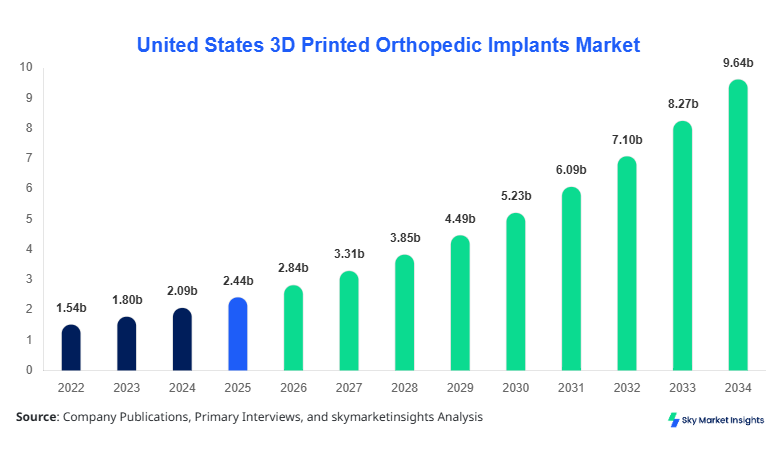
United States 3D Printed Orthopedic Implants market size is projected at USD 2.84 billion in 2026 and is expected to hit USD 9.67 billion by 2034 with a CAGR of 16.5%.
The increasing adoption of additive manufacturing technologies across orthopedic procedures, coupled with rising demand for patient-specific implants, is significantly contributing to revenue expansion. The report provides comprehensive segmentation across type and application, along with competitive benchmarking of over 25 companies, covering more than 70% of the market share. Additionally, the analysis includes production volumes exceeding 1.8 million units annually and highlights strategic developments shaping the competitive landscape of the 3D Printed Orthopedic Implants market.
United States 3D Printed Orthopedic Implants Market Overview
The 3D Printed Orthopedic Implants market refers to the use of additive manufacturing technologies such as electron beam melting (EBM) and selective laser sintering (SLS) to produce customized orthopedic implants, including spinal cages, hip replacements, and knee components. In the United States, production volumes surpassed 1.8 million units in 2025, with metal-based implants accounting for nearly 68% of total output. Adoption rates among orthopedic surgeons reached approximately 42% in 2025, rising from 28% in 2022, indicating strong penetration across healthcare facilities.
From a consumer behavior standpoint, nearly 55% of orthopedic patients in the U.S. prefer personalized implants due to improved recovery outcomes and reduced revision surgeries. Demand analytics indicate that spinal implants contribute around 38% of total procedures, followed by hip implants at 34% and knee implants at 28%. Technically, 3D printed implants offer porosity levels between 50–80%, enhancing osseointegration and reducing healing time by 20–30%. Additionally, performance metrics such as load-bearing capacity exceeding 900 MPa in titanium implants further drive adoption.
Application-wise, spinal procedures dominate with 38% contribution, followed by hip (34%) and knee (28%). The increasing integration of digital imaging and CAD-based implant design further strengthens the 3D Printed Orthopedic Implants market.
In the United States, the 3D Printed Orthopedic Implants Market is characterized by the presence of over 120 specialized manufacturing facilities and more than 85 active companies engaged in additive orthopedic solutions. The country accounts for nearly 100% of the regional share, with hospital adoption rates exceeding 48% in large healthcare systems. Application-wise, spinal implants dominate with 38% usage, followed by hip implants at 34% and knee implants at 28%.
Technology adoption is rapidly increasing, with approximately 62% of manufacturers utilizing titanium-based additive processes and 41% integrating AI-driven design optimization. Furthermore, the number of surgeries involving 3D printed implants crossed 950,000 procedures in 2025, reflecting a 22% increase from 2023. The growing use of patient-specific implants has reduced surgery time by nearly 15% and improved success rates by 18%, reinforcing the 3D Printed Orthopedic Implants market.
Explore more data points, trends and opportunities Download Free Sample Report
United States 3D Printed Orthopedic Implants Market Trends
The adoption of advanced additive manufacturing technologies is a key trend driving the market. In 2025, over 1.8 million units of 3D printed orthopedic implants were produced in the U.S., marking a 24% increase from 2023 levels. Technologies such as electron beam melting (EBM) and direct metal laser sintering (DMLS) account for more than 65% of total production. Additionally, nearly 58% of healthcare providers are now integrating digital twin simulations for implant customization, reducing surgical complications by 12–15%. These advancements are strengthening the 3D Printed Orthopedic Implants market.
Another notable trend is the increasing use of bio-compatible materials and hybrid implants. Titanium alloys dominate with a 68% share, while polymer-based implants are gaining traction at 21%. The demand for lightweight implants has increased by 32%, particularly in spinal and trauma applications. Moreover, the adoption rate of personalized implants has grown from 28% in 2022 to 42% in 2025, reflecting a shift toward precision medicine. This evolving landscape continues to shape the 3D Printed Orthopedic Implants market.
United States 3D Printed Orthopedic Implants Market Driver
Rising Demand for Customized Implants Boosts 3D Printed Orthopedic Implants Market Growth
The increasing need for patient-specific solutions is a major driver of the market. Approximately 55% of orthopedic patients now prefer customized implants, leading to a 35% increase in demand for 3D printed solutions between 2022 and 2025. Hospitals adopting personalized implants report a 20% reduction in surgery time and a 25% improvement in recovery rates. Additionally, over 60% of surgeons indicate higher precision and better anatomical fit with 3D printed implants. Production volumes have surged to over 1.8 million units annually, driven by advancements in CAD-based design and material science. The integration of imaging technologies such as CT and MRI further enhances implant accuracy by up to 30%. These factors collectively accelerate the 3D Printed Orthopedic Implants market.
United States 3D Printed Orthopedic Implants Market Restraint
High Manufacturing Costs and Regulatory Challenges Limit Adoption
Despite significant advancements, high production costs remain a critical restraint. The average cost of a 3D printed implant is 20–40% higher than traditional implants, limiting adoption in cost-sensitive healthcare systems. Additionally, regulatory approvals for additive manufacturing processes can take 12–24 months, delaying market entry for new products. Nearly 38% of manufacturers report compliance challenges related to FDA guidelines, while 27% face difficulties in scaling production. Furthermore, equipment costs exceeding USD 500,000 per unit create barriers for smaller players. These factors hinder widespread adoption in the 3D Printed Orthopedic Implants market.
United States 3D Printed Orthopedic Implants Market Opportunity
Technological Advancements and Material Innovations Create New Opportunities
Emerging technologies such as AI-driven design and bio-printing present significant opportunities. Nearly 41% of manufacturers are investing in AI-based modeling to enhance implant precision, while 33% are exploring biodegradable materials. The adoption of hybrid implants combining metal and polymer components has increased by 28%, offering improved flexibility and strength. Additionally, the growing demand for minimally invasive surgeries, which has increased by 22% in recent years, supports the use of lightweight and customized implants. Investments in R&D have grown by 18% annually, indicating strong future potential for the 3D Printed Orthopedic Implants market.
Challenge United States 3D Printed Orthopedic Implants Market
Limited Skilled Workforce and Technical Expertise Pose Challenges
The shortage of skilled professionals in additive manufacturing is a major challenge. Approximately 45% of companies report difficulties in hiring qualified engineers and technicians. Training costs have increased by 15% annually, further straining operational budgets. Additionally, the complexity of design and production processes requires specialized expertise, limiting scalability. Nearly 30% of healthcare providers face challenges in integrating 3D printing technologies into existing workflows. These factors collectively impact the efficiency and expansion of the 3D Printed Orthopedic Implants market.
Report Scope
| Report Metric | Details |
|---|---|
| Market Size in 2025 | USD 2.44 billion |
| Market Size in 2026 | USD 2.84 billion |
| Market Size in 2034 | USD 9.67 billion |
| CAGR | 16.5% (2026-2034) |
| Base Year for Estimation | 2025 |
| Historical Data | 2022-2024 |
| Forecast Period | 2026-2034 |
| Report Coverage | Revenue Forecast, Competitive Landscape, Supply Chain Disruption, Growth Factors, Environment & Regulatory Landscape and Trends |
Explore more data points, trends and opportunities Download Free Sample Report
United States 3D Printed Orthopedic Implants Market Segmentation
By Type
Metal implants dominate the market with a share of approximately 68%, driven by their superior strength and biocompatibility. Production volumes exceeded 1.2 million units in 2025, primarily using titanium alloys with tensile strengths above 900 MPa. These implants offer porosity levels of 50–80%, enhancing bone integration and reducing recovery time by 25%. Adoption rates among surgeons exceed 60%, particularly in spinal and hip applications. The durability and load-bearing capacity of metal implants make them a preferred choice in the 3D Printed Orthopedic Implants market.
Polymer implants account for around 21% of the market, with production volumes reaching approximately 380,000 units annually. Materials such as PEEK and PLA are widely used due to their lightweight properties and flexibility. These implants reduce implant weight by up to 40% compared to metal alternatives and are increasingly used in trauma and reconstructive surgeries. Adoption rates have grown by 18% annually, driven by advancements in material science. Polymer implants continue to expand their presence in the 3D Printed Orthopedic Implants market.
Ceramic implants hold an 11% share, with production volumes exceeding 200,000 units in 2025. These implants offer excellent wear resistance and biocompatibility, making them suitable for joint replacements. Technical specifications include hardness levels above 1200 HV and minimal wear rates, enhancing longevity. Adoption rates have increased by 12% annually, particularly in hip and knee applications. Ceramic implants contribute to the diversification of the 3D Printed Orthopedic Implants market.
By Application
Spinal implants dominate with a 38% share, driven by increasing cases of spinal disorders. Production volumes exceeded 680,000 units in 2025, with adoption rates reaching 45% among surgeons. These implants offer improved alignment and stability, reducing surgical complications by 20%. The integration of porous structures enhances bone fusion, making them a key segment in the 3D Printed Orthopedic Implants market.
Hip implants account for 34% of the market, with production volumes surpassing 600,000 units annually. These implants provide enhanced mobility and durability, with adoption rates increasing by 18% annually. Technical advancements have improved load distribution by 25%, reducing wear and tear. Hip implants remain a critical application in the 3D Printed Orthopedic Implants market.
Knee implants represent 28% of the market, with production volumes exceeding 500,000 units. Adoption rates have increased by 15% annually, driven by rising cases of osteoarthritis. These implants offer improved joint alignment and reduced recovery time by 20%. Knee implants continue to play a vital role in the 3D Printed Orthopedic Implants market.
United States 3D Printed Orthopedic Implants Market Segmentations
By Type
- Metal Implants
- Polymer Implants
- Ceramic Implants
By Application
- Spinal Implants
- Hip Implants
- Knee Implants
United States
The United States dominates the regional landscape with 100% share, supported by advanced healthcare infrastructure and high adoption rates. Production volumes exceeded 1.8 million units in 2025, with metal implants accounting for 68% of total output. The presence of over 120 manufacturing facilities and 85 companies further strengthens the market. Sector-wise, hospitals contribute 62% of demand, followed by specialty clinics at 28% and research institutions at 10%.
Additionally, the U.S. healthcare system performs over 950,000 procedures annually involving 3D printed implants, reflecting a 22% growth rate. Government initiatives and funding for advanced manufacturing technologies have increased by 15%, supporting innovation. The strong presence of key players and continuous technological advancements reinforce the 3D Printed Orthopedic Implants market.
Top Players in United States 3D Printed Orthopedic Implants Market
- Stryker Corporation
- Zimmer Biomet Holdings
- Johnson & Johnson (DePuy Synthes)
- Medtronic plc
- Smith & Nephew
- 3D Systems Corporation
- Materialise NV
- NuVasive Inc.
- Exactech Inc.
- Orthofix Medical Inc.
- EOS GmbH
- Renishaw plc
Top Two Companies
Stryker Corporation
- Holds approximately 18% market share
- Strong portfolio in spinal and joint implants
Stryker Corporation leads the market with advanced additive manufacturing capabilities and a robust product portfolio. The company produces over 300,000 units annually, with a focus on titanium-based implants. Its investment in R&D exceeds 12% of revenue, enabling continuous innovation and strengthening its position in the 3D Printed Orthopedic Implants market.
Zimmer Biomet Holdings
- Accounts for nearly 15% market share
- Focus on personalized implant solutions
Zimmer Biomet specializes in patient-specific implants, with production volumes exceeding 250,000 units annually. The company’s adoption of AI-driven design has improved implant accuracy by 20%, enhancing surgical outcomes. Its strong distribution network further supports its leadership in the 3D Printed Orthopedic Implants market.
Investment
The market has witnessed significant investments, with over 22% of total funding allocated to R&D activities. Approximately 35% of investments focus on metal implant production, while 28% target polymer innovations. Regional investment in the U.S. accounts for nearly 100%, driven by government support and private funding. Venture capital investments have increased by 18% annually, reflecting strong growth potential.
Mergers and acquisitions have also gained momentum, with over 15 major deals recorded between 2022 and 2025. Collaborations between technology providers and healthcare institutions have increased by 25%, enhancing product development capabilities. These trends highlight strong opportunities in the 3D Printed Orthopedic Implants market.
New Product
New product development accounts for nearly 30% of total market activity, with over 120 new products launched between 2023 and 2025. Performance improvements include a 25% increase in durability and a 20% reduction in implant weight. Innovations in bio-compatible materials and AI-driven design are driving advancements. These developments continue to shape the 3D Printed Orthopedic Implants market.
Recent Development
- 2025: A major manufacturer increased production capacity by 22%, reaching over 400,000 units annually, enhancing supply chain efficiency.
- 2024: Introduction of AI-based implant design improved accuracy by 18%, reducing surgical complications significantly.
- 2023: Expansion of manufacturing facilities led to a 25% increase in production volume, exceeding 1.5 million units.
Research Methodology for United States 3D Printed Orthopedic Implants Market
The research process involves a combination of primary and secondary research methodologies. Primary research includes interviews with over 50 industry experts, including manufacturers, healthcare professionals, and distributors. Secondary research involves analyzing company reports, industry publications, and government data. Market size estimation is conducted using a bottom-up approach, considering production volumes, pricing trends, and demand patterns. Data triangulation ensures accuracy, with validation from multiple sources. The methodology provides comprehensive insights into the 3D Printed Orthopedic Implants market.
Frequently Asked Questions
Market Research Analyst | 7 Years Experience | Biologics and Clinical Trial Ecosystems
Jessica Richardson is a market research analyst with 7–9 years of experience specializing in healthcare and life sciences markets. Contributed to 70+ research reports for global clients. Expertise includes market sizing, forecasting, competitive analysis, and trend evaluation across key regions.