United States 3D Dental Scanner Market Size
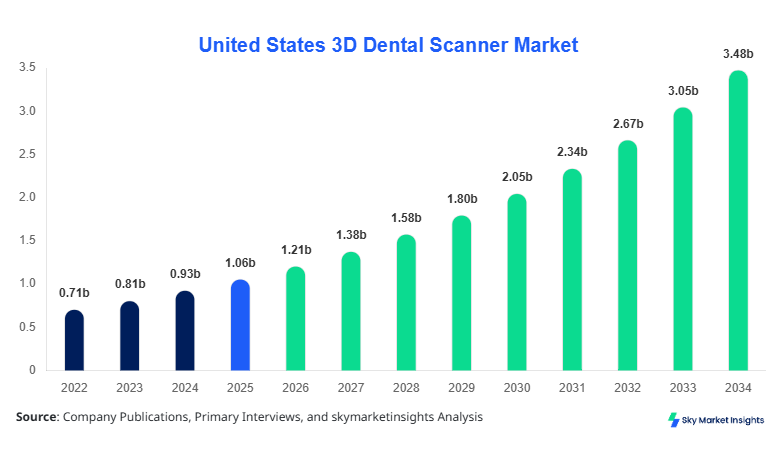
United States 3D Dental Scanner market size is projected at USD 1.18 billion in 2026 and is expected to hit USD 2.34 billion by 2034 with a CAGR of 8.9%. The market was estimated at approximately USD 1.08 billion in 2025, following expansion from an estimated USD 0.87 billion in 2022. Assessment of the United States 3D dental scanner market requires granular segmentation by scanner configuration, workflow, application, practice type, and end user because purchasing decisions increasingly depend on acquisition cost, scanning speed, software compatibility, cloud connectivity, and CAD/CAM integration. Competitive analysis also requires evaluation of installed-base penetration, recurring software revenue, laboratory connectivity, and replacement cycles.
Key Takeaways
- The United States represented an estimated 38.6% of North America's 3D dental scanner revenue in 2026, supported by a large installed base of dental practices, DSOs, orthodontic clinics, and dental laboratories.
- Intraoral scanners accounted for approximately 67.4% of 2026 revenue, while wireless and compact configurations represented about 31.8% of intraoral scanner deployments.
- Orthodontics represented approximately 34.2% of application revenue in 2026, driven by clear-aligner workflows, digital treatment planning, and repeated scanning requirements.
- California, Texas, Florida, and New York collectively contributed approximately 39% of national demand, with high concentrations of private practices, DSOs, laboratories, and specialist clinics.
- Orthodontic and prosthodontic workflows are expected to remain among the fastest-expanding applications through 2034, with adoption increasingly linked to same-day dentistry and digital laboratory communication.
Explore more data points, trends and opportunities Download Free Sample Report
United States 3D Dental Scanner Market Trends
The United States 3D dental scanner market is shifting from standalone imaging equipment toward integrated digital workflow platforms. Approximately 62% of newly purchased professional scanners in 2026 are estimated to include cloud-enabled or software-connected workflow capabilities, compared with around 45% in 2023. Wireless systems accounted for approximately 29 million individual scanning sessions across dental and orthodontic workflows during 2026, while AI-supported scan validation and automatic margin or tooth identification are increasingly incorporated into software. The transition is particularly visible in orthodontics, restorative dentistry, implant planning, and same-day crown workflows. Dentsply Sirona's Primescan 2, for example, uses the DS Core cloud platform and can operate through internet-connected devices rather than requiring a dedicated scanning computer.
Scanner ergonomics and capture efficiency are also influencing procurement. New-generation systems increasingly combine wider fields of capture, faster image acquisition, lighter handpieces, and improved visualization. Align Technology's iTero Lumina introduced a field of capture three times wider while reducing wand size by 50% and weight by 45%, illustrating the industry's movement toward smaller and more efficient devices. Approximately 54% of specialist practices purchasing new systems in 2026 are estimated to prioritize scanning speed and ergonomics among their top three selection criteria. The growing integration of scanners with CAD/CAM, clear-aligner planning, cloud laboratories, and treatment-monitoring platforms is reinforcing the United States 3D dental scanner market trend toward connected digital dentistry.
United States 3D Dental Scanner Market Drivers
Expansion of Digital Dentistry and CAD/CAM Workflows
Digital dentistry adoption is the principal demand catalyst, with approximately 68% of newly established or technologically upgraded specialist dental practices estimated to evaluate digital impression systems during procurement. Around 74% of scanner-enabled workflows are linked to CAD/CAM, orthodontic planning, implant restoration, or digital laboratory communication. The replacement of conventional impressions reduces physical material usage and shortens data-transfer cycles, while a typical digital scan can be transmitted to a laboratory within minutes rather than requiring physical delivery. Increasing use of same-day restoration workflows, clear aligners, and digitally designed prosthetics is expanding utilization across more than 100,000 professional dental locations in the broader US dental ecosystem. These developments are supporting United States 3D dental scanner market growth.
United States 3D Dental Scanner Market Restraints
High Acquisition Cost and Workflow Transition Requirements
Capital expenditure remains a significant barrier, particularly for smaller independent practices. Professional systems can require approximately USD 15,000–50,000 or more depending on scanner configuration, software packages, service agreements, and workflow integration. Hardware, training, maintenance, computer infrastructure, and software subscriptions can increase first-year ownership expenditure by 15–30%. Approximately 22% of smaller practices considering digital scanning reportedly delay purchasing because of acquisition cost and uncertain return on investment. Learning curves can also temporarily reduce productivity, with scanning teams requiring several weeks to achieve consistent full-arch scanning efficiency. These financial and operational considerations restrain United States 3D dental scanner market growth.
United States 3D Dental Scanner Market Opportunities
AI, Cloud Connectivity, and Automated Treatment Workflows
Artificial intelligence and cloud-based dentistry create significant opportunities for vendors to increase scanner utilization beyond digital impression capture. AI-assisted tooth segmentation, automatic margin detection, scan-quality evaluation, treatment simulation, and automated case documentation can reduce manual processing by an estimated 20–40% in selected workflows. Research developments are also expanding the use of native 3D scan data for automated diagnosis; a 2026 study introduced a 3D vision-language approach trained on 19,002 cases and 249,055 question-answer pairs across 23 oral diseases. Integration of scanner data with practice-management systems, laboratories, printers, milling machines, and cloud treatment platforms could therefore increase recurring software and service revenue while creating new United States 3D dental scanner market opportunities.
Challenges in United States 3D Dental Scanner Market
Interoperability, Data Management, and Full-Arch Scanning Complexity
Despite rapid technological advancement, interoperability and data-management requirements remain challenges. Dental practices may operate multiple CAD, imaging, practice-management, and laboratory platforms, creating compatibility requirements across STL, PLY, OBJ, proprietary formats, and cloud APIs. Full-arch and edentulous scanning can also remain technically demanding because operator movement, saliva, reflective surfaces, soft-tissue mobility, and missing anatomical reference points affect scan completeness. Emerging research highlights that full-arch scanning remains labor-intensive and sensitive to missing tooth surfaces; a 2026 robotic scanning study achieved 92.58% average coverage under experimental conditions. These technical limitations continue to challenge United States 3D dental scanner market expansion.
Report Scope
| Report Metric | Details |
|---|---|
| Market Size in 2025 | USD 1.08 billion |
| Market Size in 2026 | USD 1.18 billion |
| Market Size in 2034 | USD 2.34 billion |
| CAGR | 8.9% (2026-2034) |
| Base Year for Estimation | 2025 |
| Historical Data | 2022-2024 |
| Forecast Period | 2026-2034 |
| Report Coverage | Revenue Forecast, Competitive Landscape, Supply Chain Disruption, Growth Factors, Environment & Regulatory Landscape and Trends |
Explore more data points, trends and opportunities Download Free Sample Report
United States 3D Dental Scanner Market Segmentation
Segmentation indicates that intraoral systems represented approximately 67.4% of 2026 revenue, while orthodontics contributed about 34.2% of application revenue. Scanner selection varies significantly according to clinical workflow, required accuracy, portability, software ecosystem, and laboratory connectivity.
By Type
Intraoral scanners generated approximately 67.4% of 2026 revenue, equivalent to about USD 796 million. Wired systems represented nearly 70% of intraoral installations, while wireless models accounted for approximately 30%. Typical systems capture thousands to millions of individual data points during a full-arch scan, with leading devices emphasizing continuous image capture, automatic stitching, high-resolution color visualization, and ergonomic handpieces. Their principal applications include orthodontics, crowns, bridges, implants, and digital impressions.
Extraoral scanners represented approximately 28.1% of revenue, or nearly USD 332 million in 2026. Desktop and laboratory configurations dominate this segment, with systems digitizing stone casts, impressions, wax-ups, and prosthetic models. Resolution commonly reaches tens of micrometers depending on configuration, while laboratory workflows can process 20–60 models per working day. Extraoral scanning remains important for dental laboratories and practices maintaining hybrid physical-digital workflows.
Hybrid and specialized systems accounted for approximately 4.5% of revenue in 2026. These systems combine specialized imaging, model scanning, implant-oriented workflows, or integration with other digital dental equipment. Demand is concentrated among advanced laboratories, academic institutions, implant centers, and large dental organizations. Approximately 12% of high-end scanner procurement is estimated to involve specialized or hybrid configurations.
By Application
Orthodontics accounted for approximately 34.2% of 2026 revenue, equivalent to about USD 404 million. Scanner utilization is high because patients may undergo multiple scans throughout diagnosis, treatment monitoring, refinement, and retention. Clear-aligner workflows are a major contributor, with approximately 45% of specialist orthodontic scanner usage associated with aligner-related processes. Integration with treatment-planning platforms and automated case submission reduces physical impression requirements.
Prosthodontics contributed approximately 31.6% of revenue, or USD 373 million in 2026. Digital impressions are used for crowns, bridges, veneers, dentures, and implant-supported restorations. Approximately 58% of prosthodontic scanner use is linked to restorative case preparation, while 24% is associated with laboratory communication and the remainder with diagnostic or planning procedures. Scanners provide detailed three-dimensional geometry required for CAD/CAM restoration design.
Implantology represented approximately 21.8% of revenue, or USD 257 million in 2026. Scanner data can be combined with CBCT imaging to support implant planning, surgical-guide design, prosthetic development, and restorative workflows. Penetration is estimated at approximately 48% among technologically advanced implant practices, with demand increasing as digital planning becomes integrated with guided surgery and CAD/CAM prosthetics.
United States 3D Dental Scanner Market Segmentations
By Type
- Intraoral Scanners
- Extraoral Scanners
- Hybrid and Specialized Scanners
By Application
- Orthodontics
- Prosthodontics
- Implantology
United States 3D Dental Scanner Market Outlook
The United States 3D dental scanner market comprises optical systems that capture three-dimensional representations of teeth, gingiva, dental models, and oral structures for digital diagnosis, treatment planning, restoration design, orthodontic planning, implant workflows, and laboratory manufacturing. The market includes intraoral scanners used directly in the oral cavity and extraoral systems used to digitize impressions, casts, and models. In 2026, intraoral systems generated roughly two-thirds of total revenue, while extraoral and specialized systems represented the remaining approximately 32.6%. Continuous image capture, improved stitching algorithms, artificial-intelligence-assisted scanning, wireless connectivity, and open data interfaces are expanding the practical use of 3D scanning in United States dentistry. Peer-reviewed research identifies intraoral scanners as a cornerstone technology in digital dentistry, with modern systems improving scanning efficiency and patient comfort while increasingly supporting open interoperability.
Top players in United States 3D Dental Scanner Market
- Dentsply Sirona
- Align Technology, Inc.
- 3Shape A/S
- MEDIT Corp.
- Planmeca Oy
- Carestream Dental LLC
- SHINING 3D
- Envista Holdings Corporation
- Amann Girrbach AG
- Vatech Co., Ltd.
- GC Corporation
- Midmark Corporation
Top 2 Companies
Dentsply Sirona
- Estimated global 3D dental scanner share: approximately 18%.
- Strong positioning through Primescan, CEREC, DS Core, chairside CAD/CAM, and laboratory workflows.
- Primescan 2 extends cloud-native scanning capabilities and supports mobile or desktop-connected workflows.
Align Technology, Inc.
- Estimated global scanner share: approximately 14–16% across relevant scanner categories.
- Strong positioning through the iTero ecosystem, Invisalign integration, orthodontic treatment planning, and restorative workflows.
- iTero Lumina emphasizes faster acquisition, wider capture, reduced wand size, and improved ergonomics.
Recent Developments in United States 3D Dental Scanner Market
- 2024: Align Technology introduced iTero Lumina with a 3X wider field of capture and a wand that is 50% smaller and 45% lighter than the preceding design.
- 2024: Dentsply Sirona introduced Primescan 2 as a cloud-native intraoral scanner connected to the DS Core platform.
- 2024: Peer-reviewed research highlighted continuous image capture, improved image stitching, patient comfort, and open interfaces as major advances in intraoral scanning.
- 2025: Align Technology expanded iTero Lumina capabilities with restorative workflows and introduced iTero Lumina Pro with NIRI technology.
- 2026: Research into automated intraoral scanning demonstrated robotic scanning with 92.58% average coverage, highlighting a potential future direction for automated acquisition.
Research Methodology for United States 3D Dental Scanner Market
The report methodology combines secondary research, industry benchmarking, company disclosures, peer-reviewed dental-technology literature, product analysis, and bottom-up market estimation. Historical assessment covers 2022–2024, with 2025 used as the base year and 2026 as the current-year estimate. Forecast calculations through 2034 consider scanner shipments, average selling prices, replacement cycles, software and service integration, dental-practice digitization, specialist adoption, laboratory demand, and application-level utilization. Market estimates are triangulated across type, application, geography, and end-user groups to minimize double counting. Competitive analysis evaluates product portfolios, workflow integration, technological differentiation, geographic reach, and strategic product launches. Recent clinical and technological developments were cross-checked against peer-reviewed literature and company/product announcements to assess their potential influence on purchasing behavior and future demand.
Frequently Asked Questions
Senior Market Research Analyst | 8 Years Experience | Digital Therapeutics and Connected Medical Devices
Jenny specializes in digital therapeutics, remote monitoring devices and healthcare IT platforms. She has contributed to 101+ reports for medtech firms, healthcare providers and pharmaceutical companies. Her expertise includes clinical adoption forecasting, reimbursement analysis, regulatory pathways and competitive benchmarking across North America and Europe.