United Kingdom Positive Material Identification Market Size
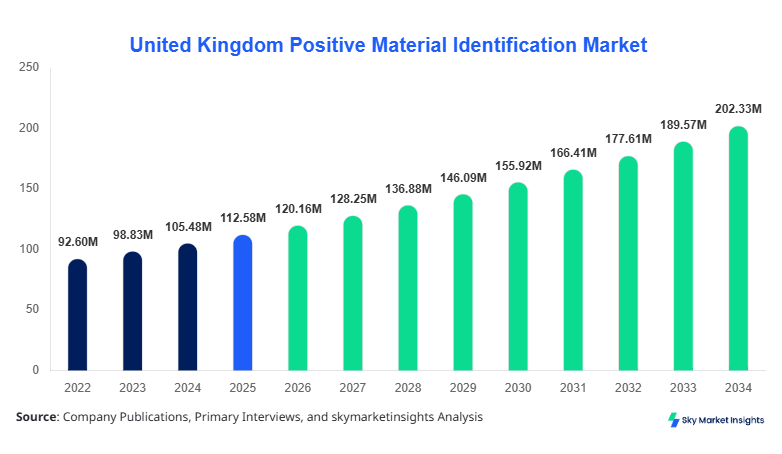
United Kingdom Positive Material Identification Market size is projected at USD 120.16 million in 2026 and is expected to hit USD 202.93 million by 2034 with a CAGR of 6.73%. The industry covers analytical equipment, software, and testing services used to verify alloy composition and material grades across safety-critical industrial environments. Market assessment requires detailed evaluation of technique adoption, offering mix, form factor, end-use requirements, and the competitive positioning of analyzer manufacturers and testing-service providers.
Key Takeaways
- England represents the dominant county-level cluster, supported by the country's largest concentration of aerospace, manufacturing, refining, fabrication, and engineering activity; Scotland is a major PMI demand center because of North Sea oil and gas operations.
- X-ray Fluorescence (XRF) dominates technique segmentation at USD 59.33 million in 2026, equivalent to approximately 49.38% of the technique total, and is forecast to reach USD 101.11 million by 2034 at 6.89% CAGR.
- Equipment dominates offering segmentation at USD 54.55 million in 2026, representing approximately 45.41% of the offering total, while software records the fastest listed CAGR at 6.91%.
- LIBS is projected to advance from USD 24.77 million in 2026 to USD 41.47 million in 2034, reflecting a 6.65% CAGR and continued penetration of rapid handheld elemental-analysis workflows.
- Software rises from USD 38.44 million in 2026 to USD 65.61 million by 2034, increasing its role in instrument connectivity, material traceability, reporting, and quality-control workflows.
The market encompasses non-destructive and minimally destructive technologies used to identify elemental composition, verify alloy grades, prevent material mix-ups, and document compliance. Based on supplied technique data, total value increases from USD 112.55 million in 2025 to USD 120.16 million in 2026. XRF contributes approximately 49.38% of 2026 technique revenue, compared with 30.01% for OES and 20.61% for LIBS. On the offering side, equipment accounts for approximately 45.41% of the USD 120.12 million 2026 total, software 32.00%, and services 22.59%. These figures indicate substantial penetration of instrument-led PMI workflows alongside increasing digitization of inspection records.
Explore more data points, trends and opportunities Download Free Sample Report
United Kingdom Positive Material Identification Market Trends
Portable Analysis and Digitized Material Verification
Portable inspection is increasingly embedded in workflows involving millions of individual components, welds, pipes, valves, fittings, fabricated assemblies, and recycled-metal batches over their operating lives. Handheld XRF and LIBS systems reduce the need to move specimens to laboratories, while modern analyzers can deliver screening results within seconds rather than multi-stage laboratory cycles measured in hours or days. Adoption is particularly relevant where operators seek near-100% verification of designated critical components rather than relying exclusively on sample-based inspection.
Digitalization is also shifting PMI from standalone measurements toward connected quality systems. Wireless transfer, cloud-compatible reporting, instrument libraries, GPS-enabled records, and automated grade matching can reduce manual transcription stages by 1 or more steps per test and support hundreds or thousands of stored readings per instrument. Oil and gas, aerospace, power, recycling, and fabrication applications are consequently emphasizing traceability alongside elemental accuracy.
United Kingdom Positive Material Identification Market Drivers
Stricter Material Traceability Across Safety-Critical Assets
Material verification requirements across pipelines, pressure equipment, aircraft components, power infrastructure, and fabricated assemblies are strengthening demand for documented alloy identification. A single industrial facility can contain thousands of alloy-bearing components, while inspection programs may target 100% verification for designated critical items instead of limited sampling. Portable analyzers can shorten individual screening procedures to seconds or minutes, allowing inspection teams to process tens to hundreds of points per shift. The combination of 24/7 industrial operations, high-value assets, and increasingly digitized quality documentation supports wider integration of PMI into maintenance, shutdown, fabrication, and incoming-material inspection.
United Kingdom Positive Material Identification Market Restraints
Capital Costs and Technique-Specific Analytical Limitations
PMI deployment requires investment in instruments, calibration standards, operator training, maintenance, software, and radiation-safety procedures where applicable. A facility requiring 5–10 analyzers can face materially higher program expenditure than one relying on periodic third-party testing. Technique limitations also remain relevant: XRF is highly effective across many alloy applications but has constraints involving certain light elements, while OES and LIBS introduce different surface-preparation, calibration, or ablation considerations. Where utilization remains below 20–30% of available instrument capacity, outsourcing can therefore remain economically attractive.
United Kingdom Positive Material Identification Market Opportunities
Connected Handheld Instruments and Automated Compliance Records
Connected analyzers create opportunities to combine elemental measurements with asset IDs, timestamps, operator information, photographs, and location records in a single inspection workflow. Digitizing 90–100% of PMI records can eliminate several manual documentation stages and enable thousands of measurements to be searched centrally. Opportunities are particularly strong in recycling, aerospace maintenance, advanced manufacturing, hydrogen infrastructure, and energy-transition projects, where dozens of alloy families may coexist and rapid sorting or verification is essential. Integration with enterprise quality systems can further increase analyzer utilization and recurring software and service requirements.
Challenges in United Kingdom Positive Material Identification Market
Maintaining Measurement Consistency Across Diverse Operating Conditions
Reliable identification depends on calibration, surface condition, sample geometry, operator competence, and correct technique selection. Industrial users may test hundreds of components during a single campaign across temperatures, coatings, corrosion conditions, and alloy families. Even when automated grade libraries exceed hundreds of stored specifications, incorrect surface preparation or unsuitable measurement settings can affect results. Maintaining calibration compliance across fleets of 10, 50, or more instruments therefore creates continuing requirements for training, certification, maintenance, reference standards, and standardized operating procedures.
Report Scope
| Report Metric | Details |
|---|---|
| Market Size in 2025 | USD 112.59 Million |
| Market Size in 2026 | USD 120.16 Million |
| Market Size in 2034 | USD 202.93 Million |
| CAGR | 6.73% (2026-2034) |
| Base Year for Estimation | 2025 |
| Historical Data | 2022-2024 |
| Forecast Period | 2026-2034 |
| Report Coverage | Revenue Forecast, Competitive Landscape, Supply Chain Disruption, Growth Factors, Environment & Regulatory Landscape and Trends |
Explore more data points, trends and opportunities Download Free Sample Report
United Kingdom Positive Material Identification Market Segmentation
Segmentation covers technique, offering, form factor, and end use. In 2026, XRF represents approximately 49.38% of technique revenue, while equipment contributes approximately 45.41% of offering revenue. Software represents about 32.00%, services 22.59%, OES 30.01%, and LIBS 20.61%.
By Technique
X-ray Fluorescence is the largest technique, increasing from USD 55.51 million in 2025 to USD 59.33 million in 2026 and USD 101.11 million by 2034. Its 6.89% CAGR is supported by rapid, portable, non-destructive alloy screening and broad applicability across metals, fabrication, recycling, oil and gas, and manufacturing.
OES increases from USD 36.06 million in 2026 to USD 60.35 million in 2034 at 6.65% CAGR, while LIBS rises from USD 24.77 million to USD 41.47 million at 6.65%. XRF consequently records both the largest supplied value and the fastest CAGR among the listed techniques.
By Offering
Equipment is the largest offering, valued at USD 51.16 million in 2025 and USD 54.55 million in 2026, before reaching USD 91.09 million in 2034 at 6.62% CAGR. Portable/handheld and benchtop systems support inspection programs requiring on-site verification and laboratory-quality analytical workflows.
Software is the fastest-growing supplied offering at 6.91% CAGR, advancing from USD 38.44 million in 2026 to USD 65.61 million in 2034. Services rise from USD 27.13 million to USD 45.45 million at 6.66% CAGR, encompassing onsite PMI programs and third-party laboratory testing.
By Form Factor
Handheld/portable instruments form the principal operational format because they allow measurements directly on installed pipes, welds, valves, structural components, scrap, and fabricated parts. The strong position of XRF—USD 59.33 million in 2026 and 49.38% of technique revenue—supports portable analyzer deployment, with XRF expanding at 6.89% CAGR.
Fixed/benchtop systems remain important where controlled measurement environments, repeated sample analysis, and laboratory workflows take priority. OES, a key laboratory and industrial analytical technique, is valued at USD 36.06 million in 2026 and expands at 6.65% CAGR through 2034.
By End Use
Oil and gas, aerospace and defense, metals and mining, automotive, power generation, pharmaceuticals, recycling, construction, and industrial fabrication constitute the principal demand industries. Equipment's USD 54.55 million 2026 value and 45.41% offering contribution indicate the importance of direct analyzer ownership across inspection-intensive facilities, with equipment forecast at 6.62% CAGR.
Software is the fastest-growing supplied offering at 6.91% CAGR and supports traceability requirements across these industries. Its value rises from USD 38.44 million in 2026 to USD 65.61 million by 2034, while services reach USD 45.45 million at 6.66% CAGR as outsourced inspection and laboratory verification remain integral to end-user programs.
United Kingdom Positive Material Identification Market Segmentations
By Technique
- X-ray Fluorescence (XRF)
- Optical Emission Spectroscopy (OES)
- Laser-induced breakdown spectroscopy (LIBS)
By Offering
-
Equipment
- Portable/Handheld Analyzers
- Benchtop Analyzers
- Software
-
services
- Onsite PMI Services
- Third-party Laboratory Testing
By Form Factor
- Handheld/Portable
- Fixed/Benchtop
By End Use
- Oil and Gas
- Aerospace and Defense
- Metals and Mining
- Automotive
- Power Generation
- Pharmaceuticals
- Scrap and Recycling
- Construction
- Manufacturing/Industrial Fabrication
United Kingdom Positive Material Identification Market Outlook
England
England constitutes the principal demand concentration due to its large aerospace, automotive, refining, chemicals, construction, manufacturing, recycling, and industrial-fabrication base. Nationally, XRF accounts for approximately 49.38% of 2026 technique revenue, while OES and LIBS contribute approximately 30.01% and 20.61%, respectively. High-density industrial corridors support inspection of thousands of manufactured and installed metallic components across production and maintenance cycles.
Scotland
Scotland represents an important inspection cluster centered on offshore energy, engineering, fabrication, power, and North Sea supply-chain activities. Equipment accounts for approximately 45.41% of national 2026 offering revenue, compared with 32.00% for software and 22.59% for services. Offshore installations can contain thousands of pressure-containing components, creating recurring verification requirements during fabrication, shutdown, maintenance, and asset-integrity programs.
Wales and Northern Ireland
Wales and Northern Ireland contribute through aerospace, metals, manufacturing, power, construction, recycling, and specialized engineering. The national technique pool totals USD 120.16 million in 2026, while the supplied offering total equals USD 120.12 million. Portable analysis is particularly applicable to dispersed industrial sites because individual campaigns can involve hundreds or thousands of alloy checks without transporting each component to a centralized laboratory.
Top players in United Kingdom Positive Material Identification Market
- Thermo Fisher Scientific
- Evident Scientific
- Hitachi High-Tech
- Bruker
- SciAps
- AMETEK
- Rigaku
- Malvern Panalytical
- Oxford Instruments
- SGS
- Intertek
- Bureau Veritas
Top Two Companies
-
Thermo Fisher Scientific
The company occupies a prominent competitive position through portable elemental-analysis platforms serving metals, mining, recycling, manufacturing, and industrial inspection. Its positioning benefits from handheld XRF technology, broad analytical workflows, software integration, and established industrial distribution. In a national market exceeding USD 120 million in 2026, vendors with comprehensive instrument, application-support, and data-management capabilities are positioned to address both analyzer replacement and new deployment. Exact United Kingdom company-level percentage share is not supplied in the mandatory dataset and is therefore not fabricated.
-
Evident Scientific
Evident competes strongly in handheld XRF and industrial inspection through portable analyzer capabilities designed for alloy identification, material verification, and metals analysis. Its positioning aligns with the XRF category, which represents approximately 49.38% of technique revenue in 2026 and is forecast to expand at 6.89% CAGR. The company addresses workflows requiring rapid onsite testing, portability, grade identification, and digital reporting. Exact company-level percentage share for the United Kingdom is not contained in the supplied numerical tables and cannot be stated reliably.
Recent Developments in United Kingdom Positive Material Identification Market
- 2026: PMI suppliers continued emphasizing portable analyzers, connected reporting, faster alloy identification, and digital traceability for industrial inspection workflows.
- 2025: Handheld elemental-analysis development increasingly focused on usability, analytical speed, cloud-compatible data transfer, and simplified material-grade identification.
- 2025: Inspection providers expanded emphasis on onsite material verification for maintenance, fabrication, energy, and asset-integrity programs.
Research Methodology
The assessment uses the supplied mandatory numerical tables as the primary quantitative basis for 2025, 2026, 2034, CAGR, technique contribution, and offering contribution. Segment percentages were calculated directly from the provided 2026 totals: XRF 49.38%, OES 30.01%, LIBS 20.61%, equipment 45.41%, software 32.00%, and services 22.59%. The technique dataset indicates USD 112.55 million in 2025, USD 120.16 million in 2026, and USD 202.93 million in 2034 at 6.73% CAGR. The offering dataset separately reports USD 112.56 million, USD 120.12 million, and USD 202.15 million, respectively; these supplied differences are retained rather than normalized or altered. Qualitative analysis evaluates technology utilization, industrial applications, portability, traceability, competitive positioning, and end-use requirements without inventing unsupported segment or company-level numerical forecasts.
Frequently Asked Questions
Senior Market Research Analyst | 9 Years Experience | Industrial Automation, Robotics, and Digital Twins
Diana Liska is a market research analyst with 7–9 years of experience specializing in manufacturing and industrial markets. Contributed to 70+ research reports for global clients. Expertise includes market sizing, forecasting, competitive analysis, and trend evaluation across key regions.