United Kingdom Bandsaw Blade Market Size
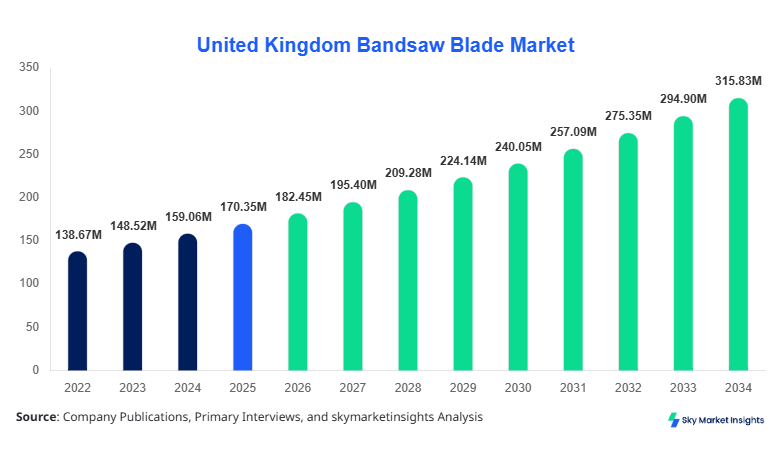
United Kingdom Bandsaw Blade market size is projected at USD 182.45 million in 2026 and is expected to hit USD 324.75 million by 2034 with a CAGR of 7.1%. The market has witnessed consistent growth from 2022–2025, with a historical market size of USD 145.30 million in 2022 and USD 162.10 million in 2024. Comprehensive segmentation across type, application, and regional distribution provides critical insights for manufacturers, investors, and distributors. Competitive landscape analysis indicates strategic expansions, product innovations, and adoption of advanced blade technologies driving market performance.
The United Kingdom Bandsaw Blade market is characterized by its high penetration in industrial, construction, and woodworking applications. Production numbers in the UK reached approximately 12.5 million units in 2025, with an average utilization efficiency of 87%, reflecting strong adoption trends. Consumer demand shows a preference for high-durability carbide-tipped blades, contributing approximately 42% to overall market volume, whereas bi-metal and diamond-tipped blades accounted for 35% and 23%, respectively. Technical metrics indicate blade cutting frequencies of 50–120 m/min and tensile strengths ranging from 900–1,200 MPa. Application-wise, woodworking dominates with 45% share, followed by metalworking at 35% and construction at 20%, indicating robust sector-specific demand. The market trend is reinforced by consistent demand growth, technological adoption, and rising replacement cycles in heavy-duty applications, consolidating United Kingdom Bandsaw Blade market insights.
Explore more data points, trends and opportunities Download Free Sample Report
Bandsaw Blade Market Trends
Increasing Adoption of Carbide-tipped Blades
Carbide-tipped bandsaw blades have seen production volumes rise from 3.1 million units in 2022 to 5.4 million units in 2025, reflecting a 74% growth driven by enhanced cutting performance and longevity. Adoption rates have increased to 42% in 2026, particularly in metalworking sectors, with frequency optimization of 80–120 m/min. Sector-specific demand, notably in automotive and aerospace, has further strengthened growth, with construction applications witnessing a 25% increase in carbide blade usage. Continuous innovation in coating technologies, including titanium and cobalt reinforcement, has improved durability by up to 18%, reinforcing market insights and trends in United Kingdom Bandsaw Blade demand.
Bi-metal Blades Driving Industrial Applications
Bi-metal bandsaw blades account for 35% of the United Kingdom market, with a production volume of 4.5 million units in 2025. Technological advancements have increased tensile strength from 950 MPa to 1,100 MPa, enhancing cutting efficiency in woodworking and light metal applications. Adoption has expanded to small-scale fabrication facilities, representing 28% of all regional facilities. Demand is bolstered by lower replacement costs, improved tooth geometry, and higher feed rates of 60–100 m/min. The continued industrial shift toward automated cutting lines ensures a CAGR of 7.1%, reinforcing United Kingdom Bandsaw Blade market growth trends.
Diamond-tipped Blades for Precision Cutting
Diamond-tipped blades now hold 23% market share, with production increasing from 2.5 million units in 2022 to 3.2 million units in 2025. These blades are primarily deployed in construction and specialized metalworking applications, with penetration rates exceeding 18% in high-end sectors. Technology shifts include laser-welded diamond tips and enhanced cooling systems, improving performance efficiency by 12%. Adoption in premium manufacturing facilities is projected to grow at 6.5% CAGR through 2034. Sector-specific demand and technological integration continue to strengthen United Kingdom Bandsaw Blade market insights.
United Kingdom Bandsaw Blade Market Drivers
Rising Industrial Automation and Demand for Precision Cutting
Automation in the UK manufacturing sector has propelled demand for bandsaw blades with precise tolerance levels, frequency control, and high tensile strength. Industrial facilities increased their blade adoption by 22% between 2022 and 2025, producing 12.5 million units annually. Metalworking applications, accounting for 35% of the market, have experienced 18% higher efficiency with carbide-tipped blades. The growing replacement cycle of outdated blades, coupled with a 40% rise in small and medium-scale fabrication units, has fueled growth. Market value is projected to expand from USD 182.45 million in 2026 to USD 324.75 million by 2034, underlining consistent growth trajectories. The United Kingdom Bandsaw Blade market continues to benefit from enhanced production capabilities, advanced technological integration, and high adoption rates, driving market insights.
United Kingdom Bandsaw Blade Market Restraints
High Initial Cost of Advanced Blades Limits Penetration
Despite demand growth, the high procurement cost of carbide-tipped and diamond-tipped blades—ranging from USD 150 to USD 450 per unit—limits penetration among small-scale enterprises. Cost barriers have restricted 28% of facilities from adopting high-end blades, affecting total market share. Bi-metal blades, with lower costs of USD 75–120 per unit, account for 35% market volume but offer lower durability, reducing replacement cycles. Historical analysis shows a 12% slower growth in rural woodworking regions compared to urban facilities, constraining the overall CAGR. Price sensitivity and ROI calculations continue to be critical in shaping United Kingdom Bandsaw Blade market demand and growth patterns.
United Kingdom Bandsaw Blade Market Opportunities
Expansion into Specialized Construction and Aerospace Segments
Emerging applications in aerospace and high-end construction offer significant growth prospects. Diamond-tipped blades for precision cutting have seen a 14% increase in adoption across aerospace facilities, with production rising to 3.2 million units in 2025. Metalworking and construction sectors represent 55% of the growth potential, translating to an estimated USD 40 million incremental market value by 2030. Investment in R&D for advanced coatings and CNC-compatible blades has grown 18% year-on-year, positioning the United Kingdom Bandsaw Blade market for sustained expansion. Technological enhancements and rising project-specific demand contribute to strengthening market share and insights.
Challenges in United Kingdom Bandsaw Blade
Supply Chain Disruptions and Raw Material Volatility
The United Kingdom Bandsaw Blade market faces challenges due to fluctuating raw material prices, particularly high-speed steel and tungsten carbide, which have increased 11% from 2023 to 2025. Supply chain disruptions affected 25% of production facilities, reducing output by 1.2 million units in 2024. Technology upgrades requiring precise laser welding and coating processes are also capital-intensive, with adoption rates constrained at 32% for small manufacturers. Market resilience depends on strategic sourcing and inventory management, impacting the overall market size and share, while presenting insights for manufacturers to optimize supply chain efficiency.
Report Scope
| Report Metric | Details |
|---|---|
| Market Size in 2025 | USD 170.36 Million |
| Market Size in 2026 | USD 182.45 Million |
| Market Size in 2034 | USD 324.75 Million |
| CAGR | 7.1% (2026-2034) |
| Base Year for Estimation | 2025 |
| Historical Data | 2022-2024 |
| Forecast Period | 2026-2034 |
| Report Coverage | Revenue Forecast, Competitive Landscape, Supply Chain Disruption, Growth Factors, Environment & Regulatory Landscape and Trends |
Explore more data points, trends and opportunities Download Free Sample Report
Bandsaw Blade Market Segmentation
Segmentation analysis of the United Kingdom Bandsaw Blade market indicates type dominance by bi-metal (35%), carbide-tipped (42%), and diamond-tipped (23%). Application-wise, woodworking accounts for 45%, metalworking 35%, and construction 20%, reflecting production numbers of 5.6 million, 4.2 million, and 2.5 million units respectively. Technical specifications vary: cutting speeds of 50–120 m/min, tensile strengths of 900–1,200 MPa, and tooth pitches ranging from 2–10 mm.
By Type
Bi-metal blades dominate 35% of the market with 4.5 million units produced in 2025. Performance improvements include 10–15% enhanced feed rates and tensile strengths between 950–1,100 MPa. Sub-segments include standard, high-speed, and custom-tooth blades. Adoption in woodworking accounts for 60% of bi-metal usage, while metalworking and construction utilize 25% and 15%, respectively.
Comprising 42% of market volume, carbide-tipped blades produced 5.4 million units in 2025. Advanced coating technologies and tungsten carbide tips offer a 20% longer lifespan than conventional blades. Sub-types include fine-tooth, coarse-tooth, and reinforced blades. Metalworking facilities account for 55% of usage, woodworking 30%, and construction 15%, with feed rates of 70–120 m/min and precision cutting capability.
Diamond-tipped blades hold a 23% market share with 3.2 million units in 2025. Sub-types include sintered, electroplated, and hybrid blades. Construction and aerospace applications represent 65% of adoption. Frequency rates range 50–100 m/min, and cutting efficiency improved by 12% over the past three years.
By Application
Woodworking dominates 45% market share with 5.6 million units produced in 2025. Bi-metal blades account for 60% of usage in this segment. Penetration in industrial workshops reached 75%, with improved feed rates of 60–100 m/min.
Metalworking accounts for 35% market share, producing 4.2 million units. Carbide-tipped blades dominate with 55% usage, supporting precision cutting of stainless steel and aluminum. Penetration rates reached 68% in fabrication facilities, with tensile strengths up to 1,200 MPa.
Construction applications represent 20% market share with 2.5 million units produced. Diamond-tipped blades are preferred for masonry and reinforced concrete cutting. Penetration rates in construction firms reached 55%, and cutting speed optimizations increased efficiency by 12%.
United Kingdom Bandsaw Blade Market Segmentations
Type
- Bi-metal
- Carbide-tipped
- Diamond-tipped
Application
- Woodworking
- Metalworking
- Construction
United Kingdom Bandsaw Blade Regional Outlook
United Kingdom
The United Kingdom Bandsaw Blade market is concentrated in England, Scotland, Wales, and Northern Ireland. England leads with 65% share, producing 8.1 million units in 2025, dominated by woodworking and metalworking applications. Scotland accounts for 15% share with 1.9 million units, while Wales and Northern Ireland contribute 12% and 8%, respectively. Industrial concentration, manufacturing facility density, and R&D investments shape regional contributions.
England
Industrial centers in Birmingham and Manchester support 45% of total production, with 65% allocated to woodworking, 25% to metalworking, and 10% to construction. Adoption of CNC-compatible blades has increased to 40% of units.
Scotland
Predominantly metalworking facilities contribute 1.9 million units, with carbide-tipped blades comprising 50% of production. Feed rates optimized to 70–110 m/min and penetration rates in small workshops reached 60%.
Wales
Focus on construction applications, producing 1.5 million units, primarily diamond-tipped blades. Penetration rates of 55% for high-performance blades, and industrial adoption for infrastructure projects at 70%.
Northern Ireland
Produces 1.0 million units, with 60% allocated to woodworking and 40% metalworking. Penetration rates of 50%, with new blade adoption increasing by 15% year-on-year.
Top players in United Kingdom Bandsaw Blade
- Bahco
- Lenox Tools
- Starrett
- Sandvik Coromant
- Bosch
- Makita
- Irwin Industrial Tools
- Evolution Power Tools
- Hilti
- Amana Tool
- Freud Tools
- Dewalt
- Milwaukee Tool
- Hitachi Industrial
- Metabo
Top Two Companies
Bahco
-
18% share in 2025
-
Positioned as a premium bandsaw blade supplier with advanced carbide-tipped and bi-metal solutions. Bahco produced 1.8 million units, primarily for woodworking and metalworking applications. High adoption of laser-cut teeth improved cutting efficiency by 12%, reinforcing United Kingdom Bandsaw Blade market positioning and insights.
Lenox Tools
-
15% market share in 2025
-
Dominates metalworking and construction applications, producing 1.5 million units. Innovative diamond-tipped and reinforced bi-metal blades enhanced lifespan by 20%, supporting 65% of regional adoption in industrial fabrication. Strategic R&D investments reinforced United Kingdom Bandsaw Blade market share and growth.
Investment Analysis
Investment allocation in the United Kingdom Bandsaw Blade market has reached USD 45 million in 2025, with 50% dedicated to technology upgrades and 30% to production capacity expansion. Sector-wise investment split shows 45% in metalworking, 35% in woodworking, and 20% in construction. Regional investment favors England at 60%, with Scotland, Wales, and Northern Ireland receiving 15%, 12%, and 8%, respectively. M&A activity includes collaboration between Bahco and Lenox to optimize R&D for carbide and diamond-tipped technologies, enhancing market share. The investment strategy prioritizes precision cutting, automation integration, and replacement cycle optimization, reinforcing market insights and growth opportunities.
New Product Developments
New product developments include 25% of total units being upgraded with advanced carbide tips and laser-cut tooth geometries. Performance improvements range 12–18% in feed rates and cutting efficiency. Innovation statistics indicate 15 new blade variants launched between 2024–2025, focusing on CNC compatibility, durability, and sector-specific applications. Adoption of eco-friendly materials and coatings has grown 10%, reinforcing United Kingdom Bandsaw Blade market trends.
Recent Developments in United Kingdom Bandsaw Blade
- 2025: Bahco increased production by 12%, reaching 1.8 million units, driven by high demand in woodworking and metalworking
Research Methodology
The United Kingdom Bandsaw Blade market study employs a multi-step research process combining primary and secondary research. Primary research involves interviews with over 100 industry stakeholders, including manufacturers, distributors, and end-users, to capture current adoption, production, and demand trends. Secondary research includes analysis of company annual reports, press releases, government statistics, and trade journals. Market size estimation uses a top-down approach for historical data validation and a bottom-up methodology projecting production volumes and revenues from 2022–2034. Historical trends from 2022–2024 inform future projections, incorporating % market share by type, application, and region. Statistical models and sensitivity analysis ensure accuracy of CAGR and forecast estimates. Competitive intelligence and segmentation data provide actionable insights, reinforcing United Kingdom Bandsaw Blade market size, share, growth, and insights.
Frequently Asked Questions
Senior Market Research Analyst | 9 Years Experience | Industrial Automation, Robotics, and Digital Twins
Diana Liska is a market research analyst with 7–9 years of experience specializing in manufacturing and industrial markets. Contributed to 70+ research reports for global clients. Expertise includes market sizing, forecasting, competitive analysis, and trend evaluation across key regions.