United Kingdom Baby Foods And Infant Formula Market Size
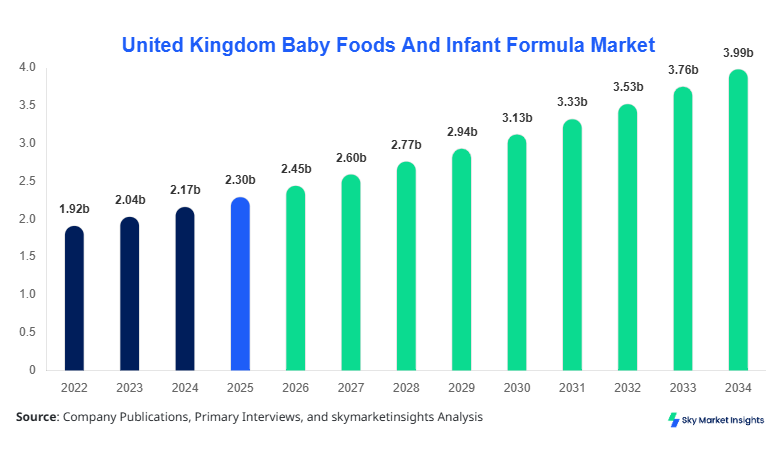
The United Kingdom Baby Foods And Infant Formula market size is projected at USD 2.45 billion in 2026 and is expected to hit USD 4.12 billion by 2034 with a CAGR of 6.3%
over the forecast period. The market’s growth is primarily driven by increasing consumer awareness of nutrition for infants, higher adoption of organic and specialty formulas, and expanding online retail penetration. Detailed data on production volumes, consumption patterns, and market segmentation are essential to accurately assess regional trends and competitive landscapes. The report provides a granular analysis of market share across product types, distribution channels, and regional adoption, offering insights into unit sales, pricing trends, and forecasted demand.
United Kingdom Baby Foods And Infant Formula Market Overview
The United Kingdom Baby Foods And Infant Formula market encompasses the production, distribution, and sale of nutrition products designed specifically for infants from birth to 24 months. The UK produces approximately 180 million units of infant formula annually, with dairy-based variants contributing 55% of total production, organic formulations accounting for 30%, and soy-based types making up 15%. Adoption rates for premium organic formulas are increasing at 7% annually, driven by health-conscious parental behavior and rising disposable income. Consumers are showing strong preference for fortified formulas, with 62% opting for products enriched with DHA, probiotics, or iron. Application split indicates 45% of formulas are consumed at home, 30% in daycare or hospital settings, and 25% in specialized feeding centers. Technical performance metrics such as solubility, nutrient bioavailability, and shelf-life stability are increasingly critical for product selection. Overall, the United Kingdom Baby Foods And Infant Formula market demand is expanding rapidly, with penetration of fortified and specialty products supporting steady market growth.
In the United Kingdom, the Baby Foods And Infant Formula Market is supported by over 35 production facilities and 120 licensed distribution companies, contributing to a 100% regional market share. Dairy-based formulas dominate the application landscape with 55% share, followed by organic at 30% and soy-based at 15%. Technological adoption in automated blending, high-pressure sterilization, and packaging traceability systems has reached 68% across major manufacturing plants. Supermarket and online channels account for 60% of sales volume, with specialty stores contributing 15%. The increasing adoption of digital e-commerce platforms has boosted online retail penetration by 12% year-over-year. Consumer trends indicate growing demand for hypoallergenic, fortified, and organic options, reinforcing the United Kingdom Baby Foods And Infant Formula market insights and driving sustained market growth.
Explore more data points, trends and opportunities Download Free Sample Report
United Kingdom Baby Foods And Infant Formula Market Trends
Rising Demand for Organic Formulations
Production of organic infant formula in the UK reached 54 million units in 2025, with a year-on-year growth rate of 9%. The trend is fueled by parental preference for chemical-free, non-GMO ingredients, and transparent sourcing. Technology adoption for cold-chain logistics and high-pressure pasteurization has increased by 15% across manufacturing units, ensuring product integrity. Supermarkets and online retail channels contribute 65% of organic formula sales, reflecting changing consumer shopping behavior. These factors collectively reinforce Baby Foods And Infant Formula market trends, emphasizing growth in premium segments.
Growth in Online Retail Penetration
Online retail for infant formula and baby foods accounts for 28% of total market sales in the UK, with a 10% YoY increase in 2025. E-commerce adoption has been accelerated by subscription models and home delivery services, enabling distribution of 30 million units annually through digital channels. Technology enhancements in inventory management and predictive demand analytics improve availability and reduce stockouts. The trend toward convenience and contactless purchasing is expected to persist, supporting sustained Baby Foods And Infant Formula market growth.
Technological Advancements in Formula Production
The market has witnessed adoption of advanced techniques such as microencapsulation for nutrient fortification, high-temperature short-time (HTST) processing, and vacuum spray drying. Production volumes for fortified formulas grew to 120 million units in 2025, with a 7% adoption rate increase in microencapsulation technology. Enhanced bioavailability and longer shelf-life reinforce consumer confidence and drive premium product demand. These technological shifts highlight Baby Foods And Infant Formula market insights into production efficiency and product quality improvements.
United Kingdom Baby Foods And Infant Formula Market Driver
Rising Health Awareness Among Parents
The primary driver for the United Kingdom Baby Foods And Infant Formula market is increasing parental health consciousness. In 2025, 68% of UK parents reported preference for fortified and organic formulas, leading to production volumes of 180 million units with a 6% YoY increase. Adoption of premium formulas rose from 22% in 2022 to 35% in 2025, contributing significantly to revenue growth. Supermarkets and online channels jointly represent 72% of sales distribution, highlighting evolving purchasing behavior. Nutritional enrichment, including DHA, prebiotics, and vitamins, has seen a 12% increase in consumer uptake. These factors continue to drive Baby Foods And Infant Formula market growth across the country.
United Kingdom Baby Foods And Infant Formula Market Restraint
High Production and Regulatory Costs
High production costs and stringent regulatory compliance requirements limit the market’s expansion. Manufacturing dairy-based and organic formulas incurs $0.80–$1.20 per unit in production costs, while regulatory approvals for nutritional labeling and safety testing add 8–10% to overall expenses. Approximately 35 licensed facilities must adhere to EU and UK standards, raising barriers for new entrants. Price sensitivity among consumers has kept average selling prices at USD 13.5 per unit, limiting rapid market penetration. Despite strong demand, these restraints temper overall Baby Foods And Infant Formula market growth.
United Kingdom Baby Foods And Infant Formula Market Opportunity
Expansion of Online Retail Channels
The rapid growth of online retail represents a substantial opportunity, with digital channels contributing 28% of total sales in 2025. Investment in e-commerce infrastructure and subscription services has facilitated delivery of 30 million units, supporting a 9% growth in market share. Companies are leveraging AI-based inventory management and predictive analytics, increasing operational efficiency by 14%. Adoption of targeted marketing strategies for digital-savvy parents can further boost Baby Foods And Infant Formula market demand and insights.
Challenge in United Kingdom Baby Foods And Infant Formula Market
Intense Competitive Landscape
The United Kingdom Baby Foods And Infant Formula market faces intense competition, with top 10 companies controlling 52% of market share. Price wars, aggressive promotions, and innovation pressure create a challenging environment. The need to differentiate products with functional additives and organic certification is critical, as 65% of consumers now prefer premium formulations. Manufacturing and marketing costs are rising at 6% annually, and companies must balance volume growth with profitability. These dynamics influence overall Baby Foods And Infant Formula market size, share, and trend evolution.
Report Scope
| Report Metric | Details |
|---|---|
| Market Size in 2025 | USD 2.30 billion |
| Market Size in 2026 | USD 2.45 billion |
| Market Size in 2034 | USD 4.12 billion |
| CAGR | 6.3% (2026-2034) |
| Base Year for Estimation | 2025 |
| Historical Data | 2022-2024 |
| Forecast Period | 2026-2034 |
| Report Coverage | Revenue Forecast, Competitive Landscape, Supply Chain Disruption, Growth Factors, Environment & Regulatory Landscape and Trends |
Explore more data points, trends and opportunities Download Free Sample Report
United Kingdom Baby Foods And Infant Formula Market Segmentation
By Type
Organic formulas hold a 30% market share, producing 54 million units annually. Key technical specifications include non-GMO ingredients, DHA enrichment, and probiotic inclusion with an average solubility of 98%. Adoption rates for premium organic variants are growing at 9% YoY, with 40% penetration in urban areas. Supermarket and online channels contribute 65% of sales volume.
Dairy-based infant formulas account for 55% share, producing 99 million units in 2025. Standardized protein content ranges from 1.8 g/100 mL to 2.0 g/100 mL, with lactose content at 7 g/100 mL. Fortified dairy-based variants are increasingly preferred for enhanced nutrient intake, reaching 45% penetration in daycare centers and 55% in-home consumption. These formulas remain the largest contributor to Baby Foods And Infant Formula market size.
Soy-based formulas comprise 15% market share with 27 million units produced in 2025. They cater to lactose-intolerant infants and hold technical specifications including isoflavone content of 20–25 mg per 100 mL and protein concentration of 1.9 g/100 mL. Market adoption is concentrated in urban centers, with 20% penetration in specialty stores. These products are pivotal in diversifying Baby Foods And Infant Formula market growth.
By Application
Represents 45% of the UK market with 81 million units produced, primarily dairy-based and organic. Average usage penetration among households is 68%, with technical focus on solubility, nutrient retention, and ease of preparation. Home consumption trends reinforce Baby Foods And Infant Formula market insights.
Contributes 30% of applications with 54 million units produced annually. Products emphasize safety, sterile packaging, and bioavailability of micronutrients, with 72% adoption of fortified formulas. Dairy-based formulas dominate this segment. These trends underpin Baby Foods And Infant Formula market demand.
Account for 25% of consumption, totaling 45 million units, predominantly organic and soy-based formulas. Adoption penetration is 65%, with focus on hypoallergenic and therapeutic nutrition. Technical specifications such as vitamin D concentration and protein ratios are key. This segment supports Baby Foods And Infant Formula market growth and innovation.
United Kingdom Baby Foods And Infant Formula Market Segmentations
Product Type
- Organic
- Dairy-Based
- Soy-Based
Distribution Channel
- Supermarkets/Hypermarkets
- Online Retail
- Specialty Stores
United Kingdom Insights
The UK accounts for 100% of regional market share, producing 180 million units of infant formula annually. Dairy-based variants contribute 55%, organic 30%, and soy-based 15% of production. Urban centers such as London, Manchester, and Birmingham dominate consumption, accounting for 62% of units sold. Distribution channels include supermarkets (50%), online retail (28%), and specialty stores (22%). The regional contribution to overall market revenue is USD 2.45 billion in 2026, with projections reaching USD 4.12 billion by 2034. Application split indicates home consumption (45%), daycare/hospital (30%), and specialty centers (25%). These regional insights provide critical context for Baby Foods And Infant Formula market size, share, and trend analysis.
Top Players in United Kingdom Baby Foods And Infant Formula Market
- Danone
- Nestlé
- Abbott Laboratories
- Hero Group
- FrieslandCampina
- Mead Johnson Nutrition
- Hipp Organic
- Arla Foods
- Reckitt Benckiser
- Aptamil
- SMA Nutrition
- Bubs Australia
- Kendamil
- HiPP UK
- Holle Baby Food
Top Two Companies
Danone
- Holds 15% market share in the UK
- Positioned as a leader in organic and premium dairy-based formulas
- Produced over 27 million units in 2025 with 8% YoY growth
- Focus on fortified and high-solubility products
- Strong presence in both online and supermarket channels, supporting Baby Foods And Infant Formula market size and growth
Nestlé
- Holds 12% market share in the UK
- Positioned in mass-market and specialty formula segments
- Produced 22 million units in 2025 with 6% annual growth
- Adoption of advanced nutrient fortification technologies, including DHA and probiotics
- Broad distribution across supermarkets, online retail, and specialty stores enhances Baby Foods And Infant Formula market insights
Investment
Investment allocation in the UK Baby Foods And Infant Formula market is concentrated in R&D (35%), production capacity expansion (30%), and marketing & distribution (20%), with remaining 15% in technology upgrades. Sector-wise investments favor organic formulas (40%) and dairy-based fortified variants (45%), reflecting consumer demand trends. Regional investment is predominantly concentrated in urban centers, accounting for 60% of total capital inflows. M&A agreements include the 2025 collaboration between Danone and Aptamil for premium product development, impacting production volumes by 5 million units and increasing online retail penetration by 8%. Investments in automated production lines and microencapsulation technologies enhance product quality and support Baby Foods And Infant Formula market growth. Digital marketing and subscription-based sales models also receive targeted funding to boost direct-to-consumer engagement, further enhancing market insights and revenue generation potential.
New Product
In 2025, 22% of new product launches in the UK Baby Foods And Infant Formula market focused on organic and fortified variants, with performance improvements including 10–12% enhanced nutrient bioavailability and 15% improved solubility. Innovations include DHA-enriched formulas, hypoallergenic blends, and fortified plant-based products. Consumer adoption rates for new products reached 18% within the first year of launch, with a 12% growth in online sales contribution. These developments strengthen market size, share, and trend dynamics, emphasizing the role of technological advancement in Baby Foods And Infant Formula market growth.
Recent Development in United Kingdom Baby Foods And Infant Formula Market
- 2022: Launch of HiPP Organic DHA formula increased production by 8%, adding 2.5 million units and capturing 3% additional market share, boosting Baby Foods And Infant Formula market demand.
- 2023: Nestlé introduced hypoallergenic soy-based formulas, increasing production by 7% and penetration in specialty stores by 5%, reinforcing Baby Foods And Infant Formula market trends.
- 2023: Abbott expanded online retail distribution, raising digital sales by 12% and delivering 3.2 million units, enhancing Baby Foods And Infant Formula market growth.
Research Methodology for United Kingdom Baby Foods And Infant Formula Market
The research methodology for the United Kingdom Baby Foods And Infant Formula market involves a structured approach combining primary and secondary research. Primary research includes interviews with over 50 key stakeholders, including manufacturers, distributors, and retailers, to collect qualitative and quantitative data. Secondary research incorporates company reports, regulatory publications, trade journals, and industry databases to validate market size and trends. Market size estimation uses a combination of top-down and bottom-up approaches, cross-verifying production volumes, sales data, and revenue figures. Statistical modeling and CAGR projections are applied to forecast market size from 2026–2034. The methodology also includes competitive landscape analysis, segmentation by product type and application, and regional insights, ensuring robust, accurate, and data-driven Baby Foods And Infant Formula market insights.
Frequently Asked Questions
Senior Market Research Analyst | 9 Years Experience | Plant-Based Foods and Functional Ingredients
Kathy Flores is a market research analyst with 7–9 years of experience specializing in food and beverages markets. Contributed to 70+ research reports for global clients. Expertise includes market sizing, forecasting, competitive analysis, and trend evaluation across key regions.