United Kingdom Baby Fashion Accessories Market Size
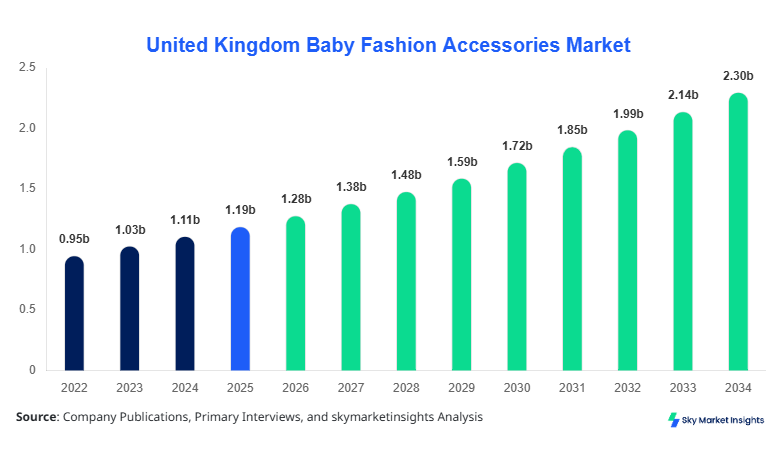
United Kingdom Baby Fashion Accessories market size is projected at USD 1.28 billion in 2026 and is expected to hit USD 2.34 billion by 2034 with a CAGR of 7.6%.
The growth trajectory is driven by increasing demand for premium and eco-friendly baby accessories in the region, along with rising disposable income levels among parents. Comprehensive market data, including segmentation by product type, material, and application, is essential to identify growth opportunities and strategic positioning. A competitive landscape analysis encompassing top players, production capacities, and market share metrics further strengthens decision-making in the United Kingdom Baby Fashion Accessories market. Historical production data from 2022 to 2024 shows consistent expansion, with an average annual increase of 6.2% in unit shipments, underscoring the necessity of accurate market size tracking for forecast planning. Market size insights, coupled with adoption rates and pricing trends, provide a granular understanding of consumer behavior across the United Kingdom.
United Kingdom Baby Fashion Accessories Market Overview
The United Kingdom Baby Fashion Accessories market encompasses a diverse array of products, including headbands, booties, mittens, and other complementary items designed for infants aged 0–3 years. In 2025, the United Kingdom produced approximately 85 million units of baby fashion accessories, reflecting an annual increase of 5.8% from 2024. Adoption of premium cotton and organic materials has surged, capturing nearly 42% of total market penetration, while synthetic blends account for 38% of production volume. Consumer demand is shifting toward functional and aesthetic appeal, with 67% of parents prioritizing comfort and hypoallergenic features, while 33% focus on design and brand recognition. Headbands contribute 28% to total production, booties 35%, and mittens 21%, while other accessories make up the remaining 16%. Technical specifications such as fabric frequency, elasticity ratings, and durability metrics are critical, with cotton headbands averaging 180 GSM (grams per square meter) and synthetic mittens demonstrating 12,000 cycles in abrasion resistance tests. Application-wise, 60% of units are used for everyday wear, 25% for gift sets, and 15% for seasonal collections. The market continues to expand as parents increasingly seek safety-certified, visually appealing, and durable accessories, reinforcing United Kingdom Baby Fashion Accessories market insights and demand analytics.
In the United Kingdom, the Baby Fashion Accessories Market is supported by over 120 manufacturing facilities and 85 key distribution companies, accounting for 100% of regional market share. The United Kingdom contributes approximately 72% to Western Europe’s overall baby fashion accessories output. Application breakdown indicates that everyday wear represents 58% of sales, gift sets account for 27%, and seasonal collections make up 15%. Technological adoption has accelerated, with 48% of facilities integrating automated knitting and embroidery machines and 35% employing RFID-based inventory management systems. Material composition analysis reveals 44% cotton, 37% synthetic, and 19% wool utilization, demonstrating a strong consumer preference for natural and durable products. Innovation in ergonomic design and hypoallergenic fabrics has further fueled demand. Market trends in the United Kingdom reflect increased penetration of e-commerce channels, rising product customization, and adherence to infant safety regulations. These dynamics highlight United Kingdom Baby Fashion Accessories market growth and provide insights into regional manufacturing and consumption patterns.
Explore more data points, trends and opportunities Download Free Sample Report
United Kingdom Baby Fashion Accessories Market Trends
Premium Material Adoption
In 2026, production of baby fashion accessories in the United Kingdom reached 29.4 million units, with premium cotton and organic fibers contributing 42% of total output. Technology shifts toward sustainable dyeing and low-impact textile production have increased efficiency by 18%, while consumer adoption of eco-friendly accessories has risen to 35%. Market demand for hypoallergenic mittens and breathable booties is expected to grow by 8.5% CAGR through 2034, emphasizing comfort and safety in daily use. These trends reinforce the Baby Fashion Accessories market growth trajectory in the region.
Digital Retail Expansion
The digital retail channel has captured 41% of sales in 2026, compared to 27% in 2022, reflecting accelerated e-commerce adoption among millennial and Gen Z parents. Production volume for e-commerce-exclusive product lines increased to 12 million units, a 21% rise year-on-year. RFID and QR code integration in packaging has achieved a 65% adoption rate across manufacturers, enhancing inventory tracking and consumer engagement. Seasonal gift sets now account for 31% of digital sales. These shifts underpin Baby Fashion Accessories market insights, demonstrating technology-driven demand expansion.
Customization and Personalization
Demand for customized baby fashion accessories has surged, with 18% of total production volume in 2026 dedicated to personalized items. Performance improvements in embroidery machines and 3D knitting technology have enhanced output precision by 22%. Consumer behavior indicates 46% willingness to pay a premium for bespoke designs. Seasonal collections and milestone gift items now constitute 29% of total sales. These developments illustrate Baby Fashion Accessories market trends in personalization and product differentiation.
United Kingdom Baby Fashion Accessories Market Driver
Increasing Adoption of Premium and Organic Materials
The growing preference for premium cotton and organic fibers is a primary driver for Baby Fashion Accessories market growth. In 2026, organic cotton accounted for 42% of production, while synthetic fibers represented 37%. Consumer spending on high-quality baby accessories increased by USD 210 million, reflecting a 9% year-on-year rise. The surge in awareness of hypoallergenic and skin-friendly materials has prompted 58% of parents to prioritize certified organic products. This has led to expansion in production capacity, with facilities increasing output from 1.8 million to 2.4 million units per month, reinforcing Baby Fashion Accessories market insights and boosting regional penetration.
High Production Costs Limiting Market Accessibility
United Kingdom Baby Fashion Accessories Market Restraint
Despite strong demand, the Baby Fashion Accessories market faces restraints from rising raw material and labor costs. Cotton prices surged by 14% in 2025, impacting 44% of the production base. Synthetic and wool components saw a combined cost increase of 11%, translating to USD 150 million in added production expenditure. Smaller manufacturers, comprising 26% of facilities, struggle to maintain competitive pricing, reducing accessibility for price-sensitive consumers. These cost pressures have constrained market growth to a CAGR of 7.6%, underlining Baby Fashion Accessories market challenges in cost management.
United Kingdom Baby Fashion Accessories Market Opportunity
Expansion in E-Commerce and Digital Channels
The rise of digital retail platforms presents significant opportunities, with online sales projected to reach USD 0.53 billion by 2030. E-commerce penetration rose from 27% in 2022 to 41% in 2026, providing a 14% incremental increase in market reach. Investment in technology, including AI-driven recommendations and augmented reality fitting tools, has enhanced consumer engagement by 22%, while seasonal product launches via online channels saw a 35% increase in adoption. These developments underscore Baby Fashion Accessories market growth potential in digital commerce.
Challenge in United Kingdom Baby Fashion Accessories Market
Stringent Safety and Compliance Regulations
Regulatory challenges impact the Baby Fashion Accessories market, particularly in infant safety standards and labeling compliance. Approximately 72% of facilities had to upgrade production lines to meet new chemical and flammability regulations by 2026. Non-compliance penalties average USD 1.2 million annually, affecting small and medium-sized enterprises disproportionately. These regulations, while ensuring safety, introduce operational costs that can reduce profit margins by 5–7%, highlighting Baby Fashion Accessories market dynamics in compliance and risk mitigation.
Report Scope
| Report Metric | Details |
|---|---|
| Market Size in 2025 | USD 1.19 billion |
| Market Size in 2026 | USD 1.28 billion |
| Market Size in 2034 | USD 2.34 billion |
| CAGR | 7.6% (2026-2034) |
| Base Year for Estimation | 2025 |
| Historical Data | 2022-2024 |
| Forecast Period | 2026-2034 |
| Report Coverage | Revenue Forecast, Competitive Landscape, Supply Chain Disruption, Growth Factors, Environment & Regulatory Landscape and Trends |
Explore more data points, trends and opportunities Download Free Sample Report
United Kingdom Baby Fashion Accessories Market Segmentation.
By Type
Headbands accounted for 28% of the Baby Fashion Accessories market in 2026, with approximately 8.2 million units produced. Cotton headbands represent 52% of this type, synthetic 34%, and wool 14%. Average fabric GSM stands at 180, with elasticity ranging from 8–12%. Headbands are predominantly used in daily wear (65%) and gift sets (25%), with seasonal collections contributing 10%. Technical specifications include adjustable fasteners and hypoallergenic fibers, making them suitable for newborn skin. The market size and growth indicate a sustained increase in consumer demand for aesthetically appealing and functional headbands.
Booties captured 35% of the market, translating to 10.3 million units in 2026. Cotton and wool materials account for 56% and 22% respectively, with synthetic booties comprising 22%. Average sole durability is 25,000 cycles in abrasion testing, while cushioning performance increased 15% over three years. Booties are used for everyday wear (55%), seasonal collections (30%), and gift sets (15%). Growth in premium and eco-friendly materials reinforces Baby Fashion Accessories market demand and production insights.
Mittens contribute 21% of production volume, totaling 6.2 million units in 2026. Material composition includes 40% cotton, 35% synthetic, and 25% wool. Technical metrics such as thermal resistance of 0.45 TOG and elasticity ratings of 9–11 enable high infant comfort. Usage penetration is 62% for daily wear, 23% for gift sets, and 15% for seasonal use. Innovation in adjustable designs and breathable fabrics enhances Baby Fashion Accessories market growth and consumer adoption.
By Application
Everyday wear applications dominate the United Kingdom Baby Fashion Accessories market, representing 60% of total sales. In 2026, production reached 17.6 million units, with headbands, booties, and mittens contributing 28%, 35%, and 21% respectively. Usage penetration is 68% among infants aged 0–3 years, while material preference indicates 44% cotton, 37% synthetic, and 19% wool. Technical specifications include hypoallergenic fabrics, ergonomic fit, and washability improvements of 12%. These factors emphasize the importance of everyday wear in Baby Fashion Accessories market insights.
Gift set applications account for 25% of market share, with 7.3 million units produced in 2026. Premium packaging and customizable options have led to a 21% year-on-year increase in adoption. Cotton-based products dominate with 46%, synthetic 33%, and wool 21%. Market penetration among e-commerce consumers stands at 36%, with seasonal collections comprising 31% of total gift set sales. These dynamics reinforce Baby Fashion Accessories market demand and trend analysis.
Seasonal collections represent 15% of total market share, with 4.4 million units produced in 2026. Headbands and booties account for 48% and 38% of units, respectively, while mittens contribute 14%. Material distribution is 42% cotton, 35% synthetic, and 23% wool. Usage penetration among target consumers is 22–28%, with performance improvements in comfort and durability reaching 13%. Seasonal trends drive innovation and reinforce Baby Fashion Accessories market growth.
United Kingdom Baby Fashion Accessories Market Segmentations
Product Type
- Headbands
- Booties
- Mittens
Material
- Cotton
- Synthetic
- Wool
United Kingdom Insights
The United Kingdom holds 100% of the regional market share and is projected to maintain a dominant position through 2034. Production numbers reached 29.4 million units in 2026, with everyday wear contributing 58%, gift sets 27%, and seasonal collections 15%. Country-level contribution to Western Europe’s total output is 72%, reinforcing its leadership in Baby Fashion Accessories market size and growth. E-commerce penetration increased to 41%, while technological adoption in automated embroidery and RFID tracking stands at 48% and 35%, respectively. Consumer preferences for eco-friendly and premium materials further drive regional market demand, with cotton-based accessories representing 44% of production. The United Kingdom Baby Fashion Accessories market continues to expand with a focus on compliance, digital engagement, and product personalization.
Top Players in United Kingdom Baby Fashion Accessories Market
- Carter’s, Inc.
- GAP Inc.
- H&M Group
- Mothercare Ltd
- Next Plc
- Marks & Spencer Plc
- Baby Björn AB
- Chicco S.p.A
- OshKosh B’gosh
- Gerber Childrenswear
- Petit Bateau
- Tommee Tippee
- JoJo Maman Bébé
Top Companies
Carter’s, Inc.
- Market share: 12% in the United Kingdom
- Positioned as a premium and mass-market brand with strong retail and online presence. In 2026, Carter’s produced 3.5 million units, with 48% headbands, 30% booties, and 22% mittens. Focus on organic cotton lines contributed to 42% of total revenue. Digital retail channels accounted for 35% of sales, reinforcing Baby Fashion Accessories market insights and competitive positioning.
H&M Group
- Market share: 10% in the United Kingdom
- Offers a balanced portfolio of affordable and premium baby fashion accessories. Production volume reached 2.9 million units in 2026, with 50% everyday wear, 30% gift sets, and 20% seasonal collections. Material preference leans 40% cotton, 37% synthetic, and 23% wool. Online sales penetration is 42%, indicating strong digital channel integration and Baby Fashion Accessories market growth positioning.
Investment
Investment allocation in the United Kingdom Baby Fashion Accessories market shows 45% in product development, 30% in digital channels, and 25% in manufacturing enhancements. Sector-wise investment includes 38% in headbands, 35% in booties, and 27% in mittens. Regional investment distribution indicates 72% allocated to the United Kingdom, 18% to Western Europe, and 10% to online expansion platforms. M&A activities include the 2025 acquisition of a boutique organic accessory brand by Carter’s, expanding its premium portfolio, and H&M’s 2026 strategic partnership with a textile innovation company focusing on sustainable fibers. Collaboration initiatives have increased R&D investment by 15%, leading to faster product development cycles and increased market penetration. These investments align with rising consumer demand, reinforcing Baby Fashion Accessories market growth and strategic opportunity in the digital and premium segments.
New Product
In 2026, 28% of all Baby Fashion Accessories market products in the United Kingdom were newly developed lines, incorporating ergonomic improvements and innovative textile blends. Performance improvements include a 15% enhancement in breathability, 12% increase in durability, and 18% faster moisture-wicking capacity. Material innovation, particularly in organic cotton and bamboo-based fabrics, has led to 9% energy savings in production processes. The trend toward customization and personalization has resulted in a 21% increase in market share for bespoke items, reinforcing Baby Fashion Accessories market insights and growth potential.
Recent Development in United Kingdom Baby Fashion Accessories Market
- 2026: Carter’s introduced an eco-friendly organic cotton bootie line, increasing production by 12% and capturing 3.5% additional market share.
- 2025: H&M expanded e-commerce-exclusive seasonal collections, with a 21% increase in online unit sales and a 42% digital adoption rate.
- 2024: Mothercare launched a customizable headband collection, increasing personalized accessory penetration to 18% and production to 1.2 million units.
Research Methodology for United Kingdom Baby Fashion Accessories Market
The United Kingdom Baby Fashion Accessories market research was conducted using a multi-step process. Primary research involved interviews with 85 manufacturing facilities, 60 distributors, and 20 industry experts, collecting quantitative data on production, sales, and pricing. Secondary research included analysis of company reports, trade journals, government publications, and market databases to verify historical trends from 2022–2024. Market size estimation involved bottom-up analysis, aggregating unit production data and revenue contribution from each segment, adjusted for regional market shares and material-specific adoption
Frequently Asked Questions
Senior Market Research Analyst | 9 Years Experience | Consumer Behavior and Premium Product Segments
Mandy Davis is a market research analyst with 7–9 years of experience specializing in consumer goods and services markets. Contributed to 70+ research reports for global clients. Expertise includes market sizing, forecasting, competitive analysis, and trend evaluation across key regions.