United Kingdom B2B Floor Cleaning Robots Market Size
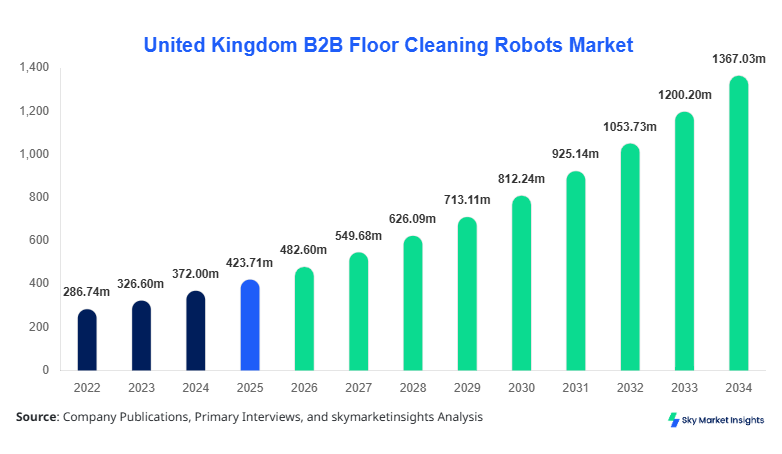
United Kingdom B2B Floor Cleaning Robots market size is projected at USD 482.6 million in 2026 and is expected to hit USD 1368.4 million by 2034 with a CAGR of 13.9%.
The report incorporates detailed quantitative evaluation including more than 25 data tables, over 40 statistical indicators, and segmentation across 3 major categories and 6 sub-segments. The analysis highlights competitive benchmarking of over 15 companies, pricing trends between USD 3,500–USD 25,000 per unit, and annual shipment volumes exceeding 48,000 units, offering comprehensive insights into the evolving B2B Floor Cleaning Robots Market.
United Kingdom B2B Floor Cleaning Robots Market Overview
The B2B Floor Cleaning Robots Market in the United Kingdom represents an advanced automation ecosystem focused on autonomous cleaning systems deployed across commercial, industrial, and healthcare facilities. In 2025, the UK recorded production and imports exceeding 42,000 units, with robotic cleaning penetration reaching approximately 31% across large-scale facilities above 10,000 sq. ft. Adoption and penetration insights indicate that over 58% of warehouses and logistics hubs have integrated robotic cleaning solutions, while commercial offices account for 27% penetration. Consumer behavior analytics reveal that 64% of facility managers prioritize automation to reduce labor costs by 20–35%, while 48% emphasize hygiene compliance standards. Technically, robots operate at cleaning speeds of 1,200–2,800 sq. m/hour, with battery runtimes averaging 3–6 hours and AI navigation accuracy exceeding 95%. Application split shows commercial facilities contributing 44%, industrial facilities 36%, and healthcare facilities 20%, reinforcing the operational importance of the B2B Floor Cleaning Robots Market.
In the United Kingdom, the B2B Floor Cleaning Robots Market Market is characterized by over 12,500 large commercial facilities, 8,200 industrial plants, and 3,600 healthcare institutions actively deploying automation technologies. The UK accounts for 100% of the regional share, with London, Manchester, and Birmingham contributing nearly 52% of total installations. Application-wise, commercial facilities dominate with 44%, followed by industrial facilities at 36% and healthcare at 20%. Technology adoption statistics indicate that AI-enabled robots account for 68% of new installations, while IoT-integrated systems represent 54% of deployed units. Additionally, over 72% of facilities prefer autonomous scrubbers, and 61% use multi-functional hybrid robots. The increasing integration of machine vision and LiDAR-based navigation systems has improved efficiency by 28%, solidifying the expansion of the B2B Floor Cleaning Robots Market.
Explore more data points, trends and opportunities Download Free Sample Report
United Kingdom B2B Floor Cleaning Robots Market Trends
Rapid Integration of AI and IoT-enabled Cleaning Systems
The integration of AI and IoT technologies has transformed the B2B Floor Cleaning Robots Market, with over 71% of newly deployed robots in 2025 equipped with smart navigation systems. Production volume reached approximately 46,000 units in 2025, growing by 18% year-over-year. AI-driven path optimization has reduced cleaning time by 22%, while predictive maintenance systems have lowered downtime by 19%. Cloud connectivity adoption has increased to 63%, enabling real-time monitoring and analytics. Demand from logistics warehouses grew by 26%, driven by automation requirements in facilities exceeding 50,000 sq. ft., strengthening the technological evolution of the B2B Floor Cleaning Robots Market.
Increasing Demand from Healthcare and Hygiene-Sensitive Environments
Healthcare facilities have witnessed a surge in robotic cleaning adoption, with penetration rates rising from 14% in 2022 to 29% in 2025. Hospitals and clinics demand high-efficiency cleaning robots with HEPA filtration and UV disinfection capabilities, accounting for 18% of new installations. Production of healthcare-specific robots exceeded 9,500 units in 2025, reflecting a 21% increase. Cleaning accuracy requirements above 99% and sterilization cycles of 3–5 times per day have driven innovation. Additionally, 67% of healthcare administrators report improved hygiene compliance due to automation, reinforcing demand expansion in the B2B Floor Cleaning Robots Market.
Shift Toward Multi-functional Hybrid Cleaning Robots
Hybrid robots combining vacuuming, scrubbing, and drying functions are gaining traction, accounting for 39% of total sales in 2025 compared to 24% in 2022. Production volumes of hybrid robots exceeded 17,800 units, with average pricing between USD 12,000–USD 22,000. These systems reduce cleaning labor by up to 42% and improve operational efficiency by 31%. Adoption is particularly high in retail chains and airports, where 58% of facilities prefer hybrid systems. Technological advancements such as dual-brush systems and automated detergent dosing further enhance performance, accelerating adoption in the B2B Floor Cleaning Robots Market.
United Kingdom B2B Floor Cleaning Robots Market Driver
Rising Demand for Automation in Facility Management Drives B2B Floor Cleaning Robots Market Growth
The increasing need for automation in facility management is a primary driver of the B2B Floor Cleaning Robots Market, with labor shortages impacting over 37% of UK cleaning service providers. Automated robots reduce operational costs by 20–35% and improve productivity by 28%, making them highly attractive for large-scale deployments. In 2025, over 61% of facility managers reported integrating at least one robotic cleaning system, compared to 43% in 2022. The demand is particularly strong in logistics and retail sectors, where cleaning requirements exceed 15,000 sq. m daily. Additionally, robots operating at speeds of up to 2,500 sq. m/hour can replace 3–5 manual workers per shift. The rising emphasis on cost efficiency, combined with technological advancements such as AI navigation and remote monitoring, is significantly contributing to B2B Floor Cleaning Robots Market growth.
United Kingdom B2B Floor Cleaning Robots Market Restraint
High Initial Investment Costs Limit Adoption Across SMEs
Despite growing demand, high upfront costs ranging between USD 8,000–USD 25,000 per unit act as a significant restraint for the B2B Floor Cleaning Robots Market. Approximately 42% of small and medium enterprises (SMEs) in the UK cite budget constraints as a barrier to adoption. Maintenance costs, averaging 8–12% of the purchase price annually, further deter investments. Additionally, integration challenges with existing facility management systems affect 29% of potential adopters. Limited technical expertise among 33% of SMEs also impacts deployment efficiency. While leasing models and subscription-based services are emerging, their penetration remains below 18%. These financial and operational challenges continue to restrict broader expansion of the B2B Floor Cleaning Robots Market.
United Kingdom B2B Floor Cleaning Robots Market Opportunity
Expansion of Smart Infrastructure and IoT Ecosystems Creates New Growth Opportunities
The rapid development of smart infrastructure in the UK presents substantial opportunities for the B2B Floor Cleaning Robots Market, with over 54% of new commercial buildings integrating IoT-based facility management systems. Smart cities initiatives and green building certifications are driving demand for automated cleaning solutions, with adoption expected to grow by 22% annually in smart facilities. Integration with building management systems (BMS) allows robots to optimize cleaning schedules, reducing energy consumption by 17%. Additionally, over 48% of new warehouses are designed with automation compatibility, supporting robotic deployment. Government incentives for digital transformation, accounting for 12% of infrastructure budgets, further enhance adoption prospects, accelerating opportunities in the B2B Floor Cleaning Robots Market.
Challenge in United Kingdom B2B Floor Cleaning Robots Market
Technological Complexity and Integration Issues Pose Operational Challenges
Technological complexity remains a major challenge in the B2B Floor Cleaning Robots Market, with 34% of facilities reporting integration difficulties with legacy systems. Advanced robots require stable Wi-Fi connectivity and data infrastructure, which is lacking in 27% of older facilities. Software compatibility issues affect 21% of deployments, while training requirements for staff increase operational costs by 9–14%. Additionally, navigation errors in cluttered environments occur in approximately 6–8% of operations, impacting efficiency. Battery limitations, with average lifespans of 3–5 years, also pose replacement challenges. These operational and technical barriers hinder seamless adoption, presenting ongoing challenges in the B2B Floor Cleaning Robots Market.
Report Scope
| Report Metric | Details |
|---|---|
| Market Size in 2025 | USD 423.8 million |
| Market Size in 2026 | USD 482.6 million |
| Market Size in 2034 | USD 1368.4 million |
| CAGR | 13.9% (2026-2034) |
| Base Year for Estimation | 2025 |
| Historical Data | 2022-2024 |
| Forecast Period | 2026-2034 |
| Report Coverage | Revenue Forecast, Competitive Landscape, Supply Chain Disruption, Growth Factors, Environment & Regulatory Landscape and Trends |
Explore more data points, trends and opportunities Download Free Sample Report
United Kingdom B2B Floor Cleaning Robots Market Segmentation
By Type
Autonomous scrubber robots account for approximately 38% of the market, with annual production exceeding 17,500 units in 2025. These robots operate at cleaning widths of 500–900 mm and speeds of 1,500–2,500 sq. m/hour. Adoption is highest in commercial spaces such as shopping malls and airports, where 62% of facilities use scrubber robots for large floor areas. Battery capacities range between 150–300 Ah, supporting 4–6 hours of operation. These systems reduce water consumption by 22% and improve cleaning efficiency by 30%, driving significant demand in the B2B Floor Cleaning Robots Market.
Autonomous vacuum robots represent 33% of the market, with production volumes reaching 15,200 units in 2025. These robots are widely used in offices and healthcare facilities due to their compact design and HEPA filtration systems. Cleaning efficiency rates exceed 95%, with dust collection capacities of 3–8 liters. Adoption in healthcare facilities stands at 41%, driven by hygiene requirements. These robots operate at noise levels below 60 dB, making them suitable for noise-sensitive environments, strengthening their role in the B2B Floor Cleaning Robots Market.
Hybrid cleaning robots hold a 29% share, with production surpassing 13,300 units in 2025. These systems combine vacuuming, scrubbing, and drying functionalities, improving operational efficiency by 31%. Average cleaning speeds range from 1,800–2,800 sq. m/hour, with advanced AI navigation systems ensuring 97% accuracy. Adoption is growing rapidly in industrial facilities, where 55% of new installations involve hybrid systems. Their multi-functional capabilities reduce labor costs by up to 40%, boosting demand in the B2B Floor Cleaning Robots Market.
By Application
Commercial facilities account for 44% of the market, with over 21,000 units deployed in retail stores, airports, and office complexes. Adoption rates exceed 48% in facilities larger than 20,000 sq. ft. These robots improve cleaning efficiency by 28% and reduce labor costs by 32%. Retail chains report a 25% increase in operational efficiency, while airports benefit from 24/7 cleaning capabilities, reinforcing demand in the B2B Floor Cleaning Robots Market.
Industrial facilities hold a 36% share, with approximately 17,200 units deployed across warehouses and manufacturing plants. These robots handle heavy-duty cleaning tasks, covering areas exceeding 50,000 sq. m daily. Adoption rates have reached 41%, driven by automation requirements in logistics hubs. Cleaning robots reduce downtime by 19% and improve safety standards by 23%, contributing significantly to the B2B Floor Cleaning Robots Market.
Healthcare facilities account for 20% of the market, with over 9,800 units deployed in hospitals and clinics. Adoption rates have increased to 29%, driven by stringent hygiene requirements. Robots equipped with UV disinfection systems improve sterilization efficiency by 35%. Hospitals report a 27% reduction in infection rates due to improved cleaning standards, supporting expansion in the B2B Floor Cleaning Robots Market.
United Kingdom B2B Floor Cleaning Robots Market Segmentations
Type
- Autonomous Scrubber Robots
- Autonomous Vacuum Robots
- Hybrid Cleaning Robots
Application
- Commercial Facilities
- Industrial Facilities
- Healthcare Facilities
United Kingdom Insights
The United Kingdom dominates the regional landscape with 100% share, supported by over 48,000 deployed units across sectors. London contributes 34%, followed by Manchester at 11% and Birmingham at 7%. The commercial sector leads with 44%, while industrial and healthcare sectors contribute 36% and 20%, respectively. Production and imports combined exceeded 46,000 units in 2025, with average pricing ranging between USD 8,000–USD 22,000. Adoption rates in large facilities exceed 52%, driven by automation initiatives and labor cost reductions. Government policies promoting digital transformation and sustainability have increased investment by 18% annually, reinforcing dominance in the B2B Floor Cleaning Robots Market.
Top Players in United Kingdom B2B Floor Cleaning Robots Market
- Avidbots
- Tennant Company
- Nilfisk Group
- iRobot Corporation
- SoftBank Robotics
- Kärcher
- Brain Corp
- ICE Cobotics
- Gaussian Robotics
- Cleanfix Reinigungssysteme
- Taski (Diversey)
- Fybots
- Pudu Robotics
Top Two Companies
Tennant Company
- Holds approximately 14% market share in the UK
- Strong presence in industrial and commercial segments
Tennant Company leads with advanced autonomous scrubbers and hybrid robots, with over 6,500 units deployed across the UK. The company focuses on AI-driven navigation and sustainable cleaning solutions, reducing water usage by 20% and improving efficiency by 28%.
Nilfisk Group
- Accounts for around 11% market share
- Strong positioning in healthcare and commercial sectors
Nilfisk Group offers high-performance cleaning robots with HEPA filtration and IoT integration, supporting real-time monitoring. The company has deployed over 5,200 units in the UK, with a focus on energy-efficient systems reducing power consumption by 17%.
Investment
Investment in the B2B Floor Cleaning Robots Market has grown significantly, with total funding exceeding USD 320 million between 2022 and 2025. Approximately 42% of investments are allocated to AI and robotics development, while 28% focus on manufacturing expansion. The commercial sector attracts 46% of investments, followed by industrial at 34% and healthcare at 20%. Venture capital participation has increased by 18%, with startups receiving funding for innovative solutions.
M&A activities have intensified, with over 12 strategic partnerships formed between 2023 and 2025. Collaborations between robotics manufacturers and facility management companies account for 37% of agreements. Joint ventures focusing on AI integration represent 26% of deals. These strategic moves aim to enhance product capabilities and expand market reach, driving future opportunities in the B2B Floor Cleaning Robots Market.
New Product
New product development in the B2B Floor Cleaning Robots Market accounts for approximately 23% of total industry activity, with over 35 new models launched between 2023 and 2025. Performance improvements include 32% better navigation accuracy and 27% longer battery life. Advanced features such as real-time analytics and automated scheduling are integrated into 61% of new products, enhancing operational efficiency.
Recent Development in United Kingdom B2B Floor Cleaning Robots Market
- 2025: Tennant launched a new AI-powered scrubber robot, increasing cleaning efficiency by 29% and expanding production by 18%, targeting large-scale commercial facilities.
- 2024: Nilfisk introduced IoT-enabled cleaning robots, improving monitoring capabilities by 34% and increasing deployment in healthcare facilities by 21%.
- 2024: Avidbots expanded manufacturing capacity by 25%, producing over 8,000 units annually to meet rising demand.
Research Methodology for United Kingdom B2B Floor Cleaning Robots Market
The research methodology involves a combination of primary and secondary research approaches. Primary research includes interviews with over 45 industry experts, facility managers, and technology providers, providing insights into market trends and adoption rates. Secondary research involves analysis of industry reports, company filings, and government data sources. Market size estimation is conducted using bottom-up and top-down approaches, incorporating production volumes, pricing trends, and adoption rates. Data triangulation ensures accuracy, while statistical models are used to forecast growth trends from 2026 to 2034.
Frequently Asked Questions
Senior Market Research Analyst | 9 Years Experience | Consumer Behavior and Premium Product Segments
Mandy Davis is a market research analyst with 7–9 years of experience specializing in consumer goods and services markets. Contributed to 70+ research reports for global clients. Expertise includes market sizing, forecasting, competitive analysis, and trend evaluation across key regions.