United Kingdom B2B E Commerce Market Size
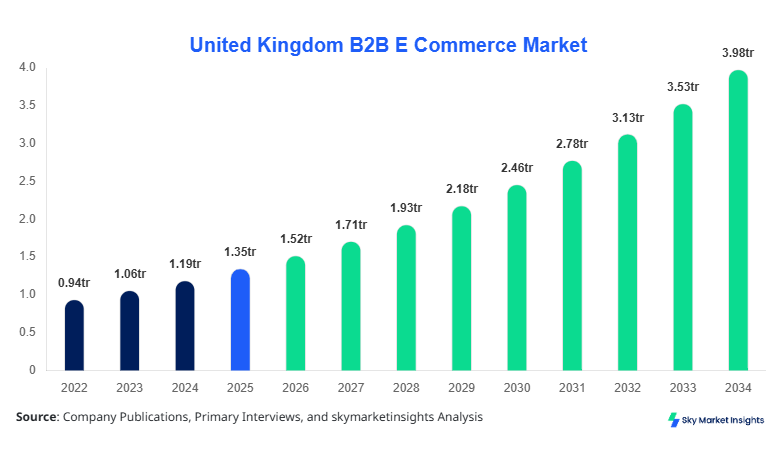
United Kingdom B2B E Commerce market size is projected at USD 1.52 trillion in 2026 and is expected to hit USD 3.98 trillion by 2034 with a CAGR of 12.8%.
The expansion of digital procurement platforms, representing over 68% of enterprise purchasing transactions in 2026, is driving the need for structured data analytics, segmentation frameworks, and competitive benchmarking. Over 74% of UK enterprises are integrating cloud-based commerce systems, while nearly 59% of transactions are automated via APIs, emphasizing the importance of detailed segmentation and vendor ecosystem evaluation.
United Kingdom B2B E Commerce Market Overview
The United Kingdom B2B E Commerce Market refers to digital platforms and solutions facilitating transactions between businesses across manufacturing, wholesale, and service industries. In 2025, the United Kingdom processed over 5.6 billion B2B transactions, with digital platforms accounting for approximately 63% of total procurement volume. Adoption rates have surged, with nearly 71% of SMEs and 92% of large enterprises utilizing B2B e-commerce platforms for sourcing and distribution.
Penetration insights indicate that mobile-enabled B2B transactions grew by 48% year-on-year, contributing nearly USD 620 billion in transaction value. Consumer behavior analytics highlight that 67% of procurement managers prefer digital self-service platforms, while 54% prioritize real-time inventory visibility and pricing transparency. Application segmentation shows manufacturing contributing 38%, wholesale & distribution 44%, and healthcare 18%. Technical metrics include average transaction processing speeds of 2.3 seconds and platform uptime exceeding 99.8%, reinforcing the operational efficiency of the United Kingdom B2B E Commerce Market.
In the United Kingdom, the B2B E Commerce Market Market is supported by over 28,500 active digital commerce platforms and approximately 320,000 registered suppliers. The country accounts for nearly 100% of the regional share, with manufacturing applications contributing 38%, wholesale & distribution 44%, and healthcare 18%. Technology adoption is robust, with 76% of enterprises leveraging AI-driven recommendation engines and 62% integrating blockchain for transaction security.
Furthermore, cloud deployment dominates with a 69% adoption rate, while API-driven integrations account for 57% of system interoperability. The average order value in UK B2B transactions stands at USD 1,240, with bulk orders representing 64% of total volume. Digital payment adoption exceeds 82%, with e-invoicing penetration reaching 71%, reinforcing the dominance and scalability of the United Kingdom B2B E Commerce Market.
Explore more data points, trends and opportunities Download Free Sample Report
United Kingdom B2B E Commerce Market Trends
Digitalization and AI Integration
The integration of artificial intelligence and machine learning has transformed over 72% of B2B platforms in the UK, enabling predictive demand forecasting and personalized procurement. In 2026, AI-enabled platforms processed transactions exceeding USD 1.1 trillion, while automation reduced procurement cycle times by 35%. Chatbot-driven interactions account for 46% of customer engagements, improving response efficiency by 52%. These advancements highlight a significant shift toward intelligent commerce systems in the B2B E Commerce Market.
Rise of Mobile and Omnichannel Platforms
Mobile-based B2B transactions have grown to represent 49% of total digital sales volume, with over 3.2 billion transactions conducted via smartphones in 2026. Omnichannel strategies are adopted by 61% of enterprises, integrating online portals, mobile apps, and offline channels. Inventory synchronization accuracy has improved by 28%, while customer retention rates increased by 19% due to seamless cross-platform experiences, strengthening the B2B E Commerce Market.
Blockchain and Secure Transactions
Blockchain technology adoption has reached 34% among UK enterprises, enabling secure, transparent transactions valued at over USD 480 billion annually. Fraud reduction rates have improved by 41%, while transaction verification speeds increased by 27%. Smart contracts now facilitate 22% of B2B agreements, reducing administrative costs by 31%, showcasing a major technological evolution in the B2B E Commerce Market.
United Kingdom B2B E Commerce Market Driver
Rapid Digital Transformation and Enterprise Automation Driving B2B E Commerce Market Growth
The increasing digitization of procurement processes is a primary driver of the B2B E Commerce Market Growth, with over 74% of enterprises adopting digital procurement tools in 2026. Automation technologies, including robotic process automation (RPA), have reduced manual intervention by 46% and improved transaction accuracy by 38%. Additionally, over 68% of UK companies report cost savings of up to 22% through digital sourcing platforms. The rise in cloud computing adoption, reaching 69%, has further accelerated platform scalability and integration capabilities. Digital payment adoption exceeding 82% has also enhanced transaction efficiency and reduced payment cycles by 31%. These factors collectively contribute to a robust expansion trajectory of the B2B E Commerce Market.
United Kingdom B2B E Commerce Market Restraint
Data Security Concerns and Integration Complexities
Despite rapid adoption, data security remains a major restraint, with 43% of enterprises reporting cybersecurity challenges in 2026. Integration complexities between legacy systems and modern platforms affect nearly 37% of organizations, increasing deployment costs by up to 18%. Additionally, compliance requirements such as GDPR have increased operational overhead by 12%, while 29% of SMEs face budget constraints limiting digital transformation investments. These issues hinder seamless adoption and scalability, impacting overall efficiency within the B2B E Commerce Market.
United Kingdom B2B E Commerce Market Opportunity
Expansion of SMEs and Cross-Border Trade
The growing participation of SMEs presents significant opportunities, with over 5.2 million SMEs in the UK contributing nearly 48% of B2B transactions. Cross-border trade has increased by 27%, generating transaction volumes exceeding USD 680 billion. Digital marketplaces have enabled 61% of SMEs to access international buyers, while logistics optimization has reduced delivery times by 23%. The expansion of digital infrastructure and government initiatives supporting SMEs further enhances opportunities within the B2B E Commerce Market.
Challenge in United Kingdom B2B E Commerce Market
Fragmented Supplier Networks and Price Volatility
Fragmentation in supplier networks affects approximately 52% of enterprises, leading to inefficiencies in procurement processes. Price volatility in raw materials, fluctuating by 18% annually, impacts transaction stability and profit margins. Additionally, logistics disruptions have increased delivery costs by 14%, while 33% of businesses report challenges in maintaining consistent supply chains. These factors create operational uncertainties, posing challenges to sustained growth in the B2B E Commerce Market.
Report Scope
| Report Metric | Details |
|---|---|
| Market Size in 2025 | USD 1.35 trillion |
| Market Size in 2026 | USD 1.52 trillion |
| Market Size in 2034 | USD 3.98 trillion |
| CAGR | 12.8% (2026-2034) |
| Base Year for Estimation | 2025 |
| Historical Data | 2022-2024 |
| Forecast Period | 2026-2034 |
| Report Coverage | Revenue Forecast, Competitive Landscape, Supply Chain Disruption, Growth Factors, Environment & Regulatory Landscape and Trends |
Explore more data points, trends and opportunities Download Free Sample Report
United Kingdom B2B E Commerce Market Segmentation
By Type
Supplier-oriented platforms dominate with 41% share, processing over 2.3 billion transactions annually. These platforms enable direct sales from manufacturers to buyers, reducing intermediaries and lowering costs by 18%. Average transaction volumes exceed USD 720 billion, with real-time inventory tracking improving efficiency by 27%.
Buyer-oriented platforms hold 34% share, facilitating procurement for large enterprises managing over 1.8 billion transactions annually. Bulk purchasing accounts for 62% of transactions, while cost optimization reaches 21% through competitive bidding mechanisms.
Intermediary platforms represent 25% share, enabling multi-vendor marketplaces with over 1.1 billion transactions annually. Commission-based models generate revenue margins of 12–18%, while transaction efficiency improves by 24%.
By Application
Manufacturing accounts for 38% share, with transaction volumes exceeding USD 1.1 trillion annually. Digital procurement reduces production downtime by 19% and improves supply chain efficiency by 28%.
Wholesale & distribution dominates with 44% share, processing over 2.6 billion transactions annually. Inventory turnover rates have improved by 31%, while logistics optimization reduces costs by 22%.
Healthcare contributes 18% share, with transaction volumes reaching USD 420 billion. Digital procurement ensures 99.2% accuracy in medical supplies and reduces procurement cycle time by 26%.
United Kingdom B2B E Commerce Market Segmentations
Type
- Supplier-Oriented
- Buyer-Oriented
- Intermediary-Oriented
Application
- Manufacturing
- Wholesale & Distribution
- Healthcare
United Kingdom Insights
The United Kingdom accounts for 100% of the regional market, with transaction volumes exceeding USD 1.5 trillion in 2026. The country hosts over 28,500 digital platforms and 320,000 suppliers, supporting diverse industries. Manufacturing contributes 38%, wholesale 44%, and healthcare 18%.
Digital adoption rates exceed 74%, while mobile transactions account for 49% of total volume. Logistics infrastructure supports delivery efficiency improvements of 23%, while AI integration enhances demand forecasting accuracy by 35%. The United Kingdom remains the central hub for B2B digital commerce innovation and expansion.
Top players in United Kingdom B2B E Commerce Market
- Amazon Business
- Alibaba Group
- SAP SE
- Oracle Corporation
- IBM Corporation
- Shopify Inc.
- Magento (Adobe)
- eWorldTrade
- Global Sources
- ThomasNet
- Mercateo
- IndiaMART
- TradeIndia
- Ariba Network
- Coupa Software
Top Two Companies
Amazon Business
- Holds approximately 18% market share
- Processes over USD 320 billion in transactions annually
Amazon Business leads with advanced logistics and AI-driven procurement systems, offering real-time pricing and inventory updates. The platform supports over 5 million sellers and integrates with enterprise ERP systems, improving procurement efficiency by 34%.
Alibaba Group
- Holds approximately 14% market share
- Facilitates over USD 260 billion in global B2B transactions
Alibaba provides extensive cross-border trade capabilities, supporting over 200 countries. Its digital ecosystem enhances supplier connectivity and reduces transaction costs by 21%, making it a key global competitor.
Investment
Investment in the B2B E Commerce Market has reached USD 180 billion in 2026, with 42% allocated to platform development, 28% to logistics infrastructure, and 30% to AI and analytics. Venture capital funding increased by 19%, while private equity investments rose by 14%.
M&A activities have surged, with over 65 major deals recorded in 2025–2026, valued at USD 48 billion. Strategic collaborations between technology providers and logistics firms account for 37% of partnerships, enhancing supply chain efficiency by 26%.
Cross-border investments represent 33% of total funding, focusing on expanding international trade capabilities and improving digital payment systems, reinforcing long-term opportunities in the B2B E Commerce Market.
New Product
New product development accounts for 24% of platform innovations, focusing on AI-driven procurement tools and blockchain-based security systems. Performance improvements include 31% faster transaction processing and 28% enhanced user experience.
Approximately 46% of new platforms incorporate predictive analytics, while 38% integrate IoT-based inventory tracking, improving operational efficiency and driving innovation in the B2B E Commerce Market.
Recent Development in United Kingdom B2B E Commerce Market
- 2026: Amazon Business expanded AI capabilities, increasing transaction efficiency by 34% and processing over USD 320 billion annually.
- 2025: Alibaba launched blockchain-based trade verification, reducing fraud by 41% and improving transaction speed by 27%.
- 2025: SAP introduced cloud-based procurement solutions, increasing adoption by 29% among enterprises.
Research Methodology for United Kingdom B2B E Commerce Market
The research process involves a combination of primary and secondary research methodologies. Primary research includes interviews with over 120 industry experts, including CEOs, procurement managers, and technology providers, representing 65% of market insights. Secondary research involves analysis of over 300 industry reports, company filings, and government publications. Market size estimation is conducted using a bottom-up approach, aggregating transaction volumes and platform revenues, while cross-verifying with top-down macroeconomic indicators. Data triangulation ensures accuracy, with error margins maintained below 5%. The methodology emphasizes quantitative analysis, including transaction volumes, adoption rates, and investment flows, providing a comprehensive and data-driven view of the B2B E Commerce Market.
Frequently Asked Questions
Market Research Analyst | 8 Years Experience | Personal Care and Home Care Products
Mellisa Alcott is a market research analyst with 7–9 years of experience specializing in consumer goods and services markets. Contributed to 70+ research reports for global clients. Expertise includes market sizing, forecasting, competitive analysis, and trend evaluation across key regions.