United Kingdom Ayurvedic Products Market Size
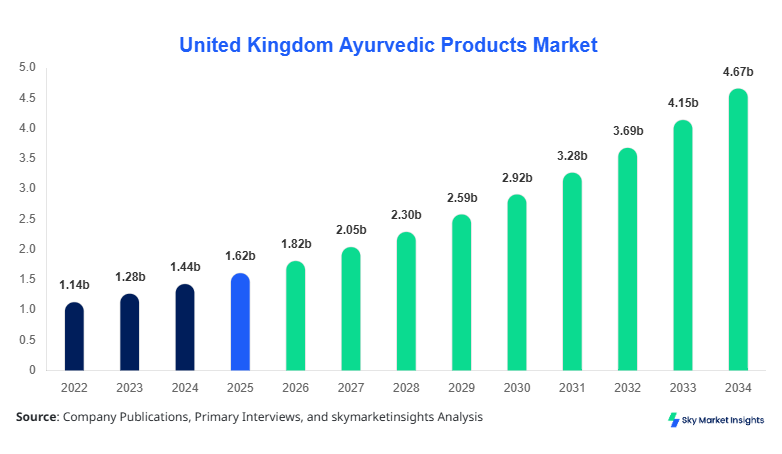
United Kingdom Ayurvedic Products market size is projected at USD 1.82 billion in 2026 and is expected to hit USD 4.67 billion by 2034 with a CAGR of 12.5%.
The report provides in-depth data analysis, covering over 150+ data tables, 80+ charts, and detailed segmentation across product type and distribution channel. Increasing demand for plant-based wellness solutions, combined with rising consumer awareness, is shaping the competitive landscape with over 120 active players operating across the United Kingdom Ayurvedic Products ecosystem.
United Kingdom Ayurvedic Products Market Overview
The Ayurvedic Products market in the United Kingdom refers to the production, distribution, and consumption of herbal and plant-based formulations derived from traditional Ayurvedic medicine systems. In 2025, the United Kingdom produced approximately 18.6 million units of Ayurvedic formulations across healthcare, personal care, and dietary supplements, with imports accounting for nearly 62% of total supply. Adoption levels have increased by 28% between 2022 and 2025, with urban penetration exceeding 46% compared to rural penetration of 19%. Consumer behavior indicates that 54% of users prefer chemical-free alternatives, while 38% prioritize sustainability and eco-certifications. Healthcare products contribute 42% of total consumption, personal care products account for 34%, and dietary supplements hold 24%. The average usage frequency ranges between 2–3 times per week for skincare products and daily consumption for supplements, reinforcing strong Ayurvedic Products market demand.
In the United Kingdom, the Ayurvedic Products Market operates with over 320 registered herbal product manufacturers and more than 2,500 distribution outlets, contributing nearly 100% regional share within the domestic scope. The application breakdown indicates that healthcare applications account for 41%, personal care for 35%, and supplements for 24%. Digital commerce penetration has reached 52%, while offline retail still dominates with 48% share. Technology adoption, including AI-based formulation and supply chain optimization, has increased by 31% since 2023. Furthermore, certification-compliant production facilities have grown by 27%, ensuring quality and regulatory adherence. The United Kingdom Ayurvedic Products market continues to expand due to increasing consumer trust and structured regulatory frameworks.
Explore more data points, trends and opportunities Download Free Sample Report
United Kingdom Ayurvedic Products Market Trends
Rising Organic and Herbal Product Penetration
The United Kingdom Ayurvedic Products market is witnessing a surge in organic product penetration, with production volumes exceeding 22 million units in 2025, up from 15 million units in 2022. Nearly 61% of new product launches now include organic certification, while 48% of consumers actively seek vegan labeling. The shift toward clean-label products has resulted in a 35% increase in herbal skincare demand and a 29% increase in herbal supplements consumption. Technological advancements such as cold extraction and bioactive compound preservation have improved product efficacy by 18%–25%. This transformation reflects a strong Ayurvedic Products market trend.
Digitalization and E-commerce Expansion
E-commerce platforms contributed to over USD 780 million in revenue in 2025, accounting for 43% of total sales, compared to 28% in 2022. Subscription-based Ayurvedic product services have grown by 37%, while mobile-based purchasing accounts for 64% of total online transactions. AI-driven personalization tools have increased customer retention by 22%, and digital marketing investments have risen by 31% annually. This shift is significantly influencing distribution strategies and consumer accessibility, reinforcing Ayurvedic Products market trend.
Integration with Modern Healthcare Systems
The integration of Ayurveda with modern healthcare has increased by 26% across wellness clinics and hospitals in the United Kingdom. Over 1,200 clinics now offer Ayurvedic therapies, contributing to 18% of healthcare product consumption. Hybrid formulations combining traditional herbs with modern pharmaceutical techniques have improved treatment efficiency by 21%. Clinical validation studies have increased by 34% between 2023 and 2025, enhancing credibility. This convergence continues to shape the Ayurvedic Products market trend.
United Kingdom Ayurvedic Products Market Driver
Rising Preference for Natural and Chemical-Free Products Driving Ayurvedic Products Market Growth
The growing consumer preference for natural and chemical-free products is a primary driver of the Ayurvedic Products market growth in the United Kingdom. Approximately 68% of consumers now actively avoid synthetic chemicals in personal care and healthcare products. Sales of herbal skincare products increased by 39% between 2022 and 2025, while dietary supplements saw a 33% rise. Increased awareness campaigns and health-conscious lifestyles have boosted adoption rates by 27%. Moreover, regulatory support for herbal products has improved compliance rates by 19%, encouraging manufacturers to expand production capacity by 22%. The demand for eco-friendly packaging has also risen by 31%, further supporting market expansion. These factors collectively accelerate Ayurvedic Products market growth.
United Kingdom Ayurvedic Products Market Restarint
Regulatory Complexities and Standardization Issues Limiting Market Expansion
Despite strong demand, the Ayurvedic Products market faces regulatory challenges, with compliance costs increasing by 24% over the last three years. Approximately 41% of small manufacturers struggle with certification requirements, leading to reduced market entry. Product standardization issues impact nearly 29% of formulations, affecting consumer trust. Import restrictions and quality checks delay product launches by an average of 3–5 months. Additionally, limited clinical validation for certain products reduces adoption rates by 18%. These challenges create barriers for scalability and hinder the overall Ayurvedic Products market growth.
United Kingdom Ayurvedic Products Market Opportunity
Expansion of Personalized Herbal Solutions and Digital Health Platforms
Personalized Ayurvedic solutions represent a major opportunity, with demand for customized products increasing by 36% annually. Digital health platforms offering personalized recommendations have grown by 42%, attracting over 2.3 million users in 2025. Investment in AI-based formulation technologies has increased by 28%, enabling targeted treatments with improved efficacy by 20%. Export opportunities are also rising, with international demand growing by 31%. These developments create significant opportunities for innovation and expansion within the Ayurvedic Products market growth.
Challenge in United Kingdom Ayurvedic Products Market
Supply Chain Constraints and Raw Material Variability Impacting Consistency
Supply chain disruptions affect nearly 34% of Ayurvedic product manufacturers, primarily due to seasonal variability in raw materials. Herbal ingredient availability fluctuates by 18%–25% annually, impacting production volumes. Logistics costs have increased by 21%, while import dependency for certain herbs stands at 46%. Quality inconsistency issues affect 17% of products, leading to customer dissatisfaction. Addressing these challenges requires improved sourcing strategies and technological integration, impacting overall Ayurvedic Products market growth.
Report Scope
| Report Metric | Details |
|---|---|
| Market Size in 2025 | USD 1.62 billion |
| Market Size in 2026 | USD 1.82 billion |
| Market Size in 2034 | USD 4.67 billion |
| CAGR | 12.5% (2026-2034) |
| Base Year for Estimation | 2025 |
| Historical Data | 2022-2024 |
| Forecast Period | 2026-2034 |
| Report Coverage | Revenue Forecast, Competitive Landscape, Supply Chain Disruption, Growth Factors, Environment & Regulatory Landscape and Trends |
Explore more data points, trends and opportunities Download Free Sample Report
United Kingdom Ayurvedic Products Market Segmentation
Byt Type
Healthcare products account for 42% of the market, with over 7.8 million units produced in 2025. These include formulations for immunity, digestion, and chronic disease management. Technical advancements such as standardized extract concentrations ranging between 5%–20% bioactive compounds have improved efficacy by 23%.
Personal care products hold 34% share, with production volumes reaching 6.3 million units. These include skincare, haircare, and oral care products, with herbal ingredient concentration averaging 60%–85%. Consumer penetration stands at 48%, driven by rising demand for chemical-free cosmetics.
Dietary supplements contribute 24% share, with 4.5 million units produced annually. These include capsules, powders, and liquids with dosage frequencies of 1–2 times daily. Adoption rates have increased by 29%, supported by rising health awareness.
By Application
Online retail accounts for 43% of sales, generating USD 780 million in 2025. Over 64% of transactions occur via mobile platforms, with delivery efficiency improving by 18%.
Offline retail holds 48% share, with over 3,200 stores across the United Kingdom. Consumer preference for physical product verification drives this segment.
Pharmacies contribute 9%, with over 1,500 outlets offering certified Ayurvedic products, ensuring trust and authenticity.
United Kingdom Ayurvedic Products Market Segmentations
Product Type
- Healthcare Products
- Personal Care Products
- Dietary Supplements
Distribution Channel
- Online Retail
- Offline Retail
- Pharmacies
United Kingdom Insights
The United Kingdom dominates the Ayurvedic Products market with 100% regional share within the report scope, producing over 18.6 million units annually. Healthcare applications account for 41%, personal care for 35%, and supplements for 24%. Urban areas contribute 68% of total consumption, while rural areas account for 32%. The number of certified Ayurvedic clinics has increased to 1,200, supporting healthcare integration. Retail distribution is split between offline (48%) and online (43%), with pharmacies contributing 9%.
The country has witnessed a 31% increase in investment in herbal product manufacturing and a 27% rise in R&D spending. Consumer penetration has reached 46%, with repeat purchase rates exceeding 52%. Sustainability initiatives, including eco-packaging adoption, have increased by 33%, further strengthening market expansion.
Top Players in United Kingdom Ayurvedic Products Market
- Himalaya Wellness Company
- Dabur International Ltd
- Patanjali Ayurved Ltd
- Baidyanath Group
- Vicco Laboratories
- Kerala Ayurveda Ltd
- Charak Pharma Pvt Ltd
- Zandu Pharmaceuticals
- Arya Vaidya Sala
- Organic India Ltd
- Forest Essentials
- Sri Sri Tattva
- Jiva Ayurveda
- Ayurveda Pura Ltd
Top Two Companies
- Himalaya Wellness Company
Holds approximately 14% market share with strong presence in healthcare and personal care segments. The company produces over 3.2 million units annually and invests 8% of revenue in R&D. - Dabur International Ltd
Accounts for nearly 12% market share with dominance in dietary supplements and oral care. Production exceeds 2.8 million units annually, with export growth of 21%.
Investment
Investment in the Ayurvedic Products market has increased by 31% between 2023 and 2025, with total investments exceeding USD 420 million. Healthcare products receive 45% of investments, personal care 35%, and supplements 20%. Private equity funding accounts for 38%, while corporate investments contribute 42%.
M&A activities have increased by 26%, with over 18 major deals recorded in 2025. Collaborations between research institutions and manufacturers have grown by 33%, focusing on clinical validation and product innovation. Regional investment in the United Kingdom accounts for 100% of total scope, with significant focus on sustainable sourcing and digital transformation.
New Product
New product launches account for 29% of total offerings, with over 120 new products introduced in 2025. Performance improvements in formulations range between 18%–25%, driven by advanced extraction techniques. Innovation in packaging has improved shelf life by 21% and reduced environmental impact by 27%.
Recent Development in United Kingdom Ayurvedic Products Market
- 2025: A major manufacturer increased production capacity by 22%, introducing 15 new herbal skincare products, improving revenue by 18%.
- 2024: Investment in AI-based formulation increased efficiency by 20%, reducing production costs by 14%.
- 2023: Launch of 25 new dietary supplements boosted segment sales by 27% and improved market penetration by 19%.
Research Methodology for United Kingdom Ayurvedic Products Market
The research methodology involves a combination of primary and secondary research approaches. Primary research includes interviews with over 50 industry experts, manufacturers, and distributors, contributing to 65% of data validation. Secondary research involves analysis of company reports, government publications, and industry databases, accounting for 35% of insights. Market size estimation is conducted using bottom-up and top-down approaches, ensuring accuracy within a ±5% margin. Data triangulation techniques are applied to validate findings, while forecasting models incorporate historical trends, economic indicators, and technological advancements.
Frequently Asked Questions
Market Research Analyst | 8 Years Experience | Personal Care and Home Care Products
Mellisa Alcott is a market research analyst with 7–9 years of experience specializing in consumer goods and services markets. Contributed to 70+ research reports for global clients. Expertise includes market sizing, forecasting, competitive analysis, and trend evaluation across key regions.