United Kingdom Automated Mining Equipment Market Size
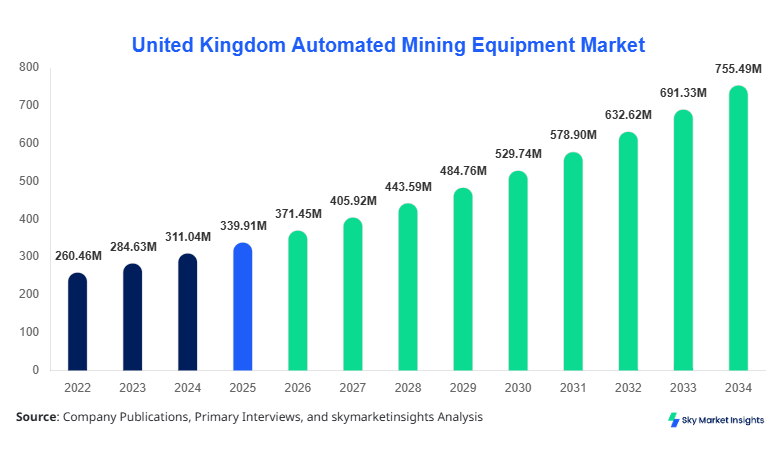
United Kingdom Automated Mining Equipment Market size is projected at USD 371.45 million in 2026 and is expected to hit USD 753.90 million by 2034 with a CAGR of 9.28%." The assessment covers equipment, minerals, deployment, automation levels, software, end users, county demand, and the competitive landscape. The market increased from USD 340.00 million in 2025, representing annual expansion of 9.25%.
Key Takeaways
- England dominates regional demand with an estimated 68.0% share in 2026, while Wales is forecast to record the fastest regional CAGR of approximately 10.1% through 2034.
- Autonomous haul trucks dominate equipment demand with 26.25% of 2026 revenue; autonomous loaders are the fastest-growing category at a 9.77% CAGR.
- Metallic minerals lead mineral-based demand with 40.13% of 2026 revenue, while non-metallic minerals register the fastest CAGR at 9.67%.
- Wales is projected to advance from an estimated USD 45.31 million in 2026 to approximately USD 98.01 million by 2034, supported by quarrying and mineral-processing automation.
- The total opportunity expands by USD 382.45 million between 2026 and 2034, equivalent to an absolute increase of 102.96%.
The market comprises autonomous and remotely operated haulage, drilling, loading, blasting, excavation, crushing, navigation, fleet-control, safety, and maintenance systems deployed across surface and underground operations. UK mineral production is heavily concentrated in construction materials; Great Britain produces more than 150 million tonnes of primary aggregates annually, while reported July–September 2023 coal output included 124,581 tonnes from surface mines and 19,957 tonnes underground. Autonomous haul trucks contribute 26.25% of equipment revenue in 2026, followed by autonomous loaders at 18.57% and drilling rigs at 16.13%. Metallic applications represent 40.13% of mineral-related revenue and non-metallic operations contribute 34.91%.
Explore more data points, trends and opportunities Download Free Sample Report
United Kingdom Automated Mining Equipment Market Trends
AI-Enabled Mixed Fleets and Electrified Autonomy Reshape Mine Operations
Operators are combining LiDAR, machine vision, private wireless networks, edge computing, and AI-based dispatch to coordinate fleets processing millions of tonnes of rock annually. More than 60% of mining professionals surveyed globally reported deploying automation technologies in 2024, while autonomous, autonomous-ready, and tele-remote machines approached 5% of key global mining equipment during 2025. Predictive analytics can monitor thousands of sensor readings per machine and support 24-hour operations across 3 daily shifts.
Technology development is shifting from closed OEM ecosystems toward interoperable retrofit platforms, battery-electric drivetrains, and remote operating centres. Global autonomous haul-truck deployment rose from approximately 2,080 units in July 2024 to 3,832 units in July 2025, an 84.2% increase. UK demand is strongest in aggregates, underground safety, drilling accuracy, collision avoidance, and energy monitoring, where buyers target 10–15% operating-cost reductions and lower personnel exposure in high-risk zones.
United Kingdom Automated Mining Equipment Market Drivers
Safety, Productivity and Mineral-Supply Requirements Accelerate Automation
Automation reduces exposure to blasting areas, unsupported ground, dust, noise, and vehicle interactions while enabling 24/7 utilisation. A single remote operator can supervise as many as 4 semi-autonomous dozers, and mature dispatch platforms indicate potential operating-cost savings of up to 15%. With UK mines and quarries handling more than 150 million tonnes of aggregates annually and autonomous deployments globally rising 84.2% in one year, operators increasingly prioritise collision avoidance, remote drilling, and consistent haul cycles.
United Kingdom Automated Mining Equipment Market Restraints
High Integration Costs and Fragmented Legacy Fleets Limit Conversion
Brownfield automation requires sensors, communications, control rooms, cybersecurity, training, and machine modifications across fleets that may contain 3–5 OEM brands. Capital requirements can exceed 10% of an equipment-replacement programme, while smaller quarries operating fewer than 20 mobile units may lack sufficient scale. Underground signal loss, narrow headings, and sub-centimetre navigation requirements further increase engineering costs, slowing fully autonomous penetration despite potential productivity improvements of 10–20%.
United Kingdom Automated Mining Equipment Market Opportunities
Retrofit Platforms and Low-Carbon Quarry Fleets Expand Addressable Demand
Vendor-neutral kits allow operators to automate existing trucks, loaders, and drills without replacing 100% of installed assets. Battery-ready autonomous haulage, trolley-assist systems, and energy-monitoring software can reduce idle time by 10–15% and support 2030 decarbonisation programmes. Opportunities are developing across hundreds of UK quarry sites, where 65-tonne autonomous-ready trucks, tele-remote loaders, and predictive-maintenance platforms can process millions of tonnes while extending equipment life by 2–5 years.
Challenges in United Kingdom Automated Mining Equipment Market
Connectivity, Cybersecurity and Workforce Readiness Complicate Scaling
Autonomous sites require network availability approaching 99.9%, low-latency machine communication, and continuous verification across thousands of sensor events. A single integration failure can interrupt 3-shift production, while cyber incidents may affect navigation, fleet dispatch, or safety barriers. Operators must retrain technicians, controllers, and engineers over 6–18 months and reconcile autonomous machines with manually operated fleets representing more than 90% of the broader installed global equipment base.
Report Scope
| Report Metric | Details |
|---|---|
| Market Size in 2025 | USD 340.00 Million |
| Market Size in 2026 | USD 371.45 Million |
| Market Size in 2034 | USD 753.9 Million |
| CAGR | 9.28% (2026-2034) |
| Base Year for Estimation | 2025 |
| Historical Data | 2022-2024 |
| Forecast Period | 2026-2034 |
| Report Coverage | Revenue Forecast, Competitive Landscape, Supply Chain Disruption, Growth Factors, Environment & Regulatory Landscape and Trends |
Explore more data points, trends and opportunities Download Free Sample Report
United Kingdom Automated Mining Equipment Market Segmentation
The market is segmented by equipment type, mineral type, deployment mode, automation level, software solution, and end user. Haul trucks account for 26.25% of equipment revenue in 2026, while metallic mining represents 40.13% of mineral-linked demand.
By Equipment Type
Autonomous haul trucks form the largest category, increasing from USD 89.52 million in 2025 to USD 97.50 million in 2026 and USD 192.99 million by 2034 at an 8.91% CAGR. Their 2026 share equals 26.25%, supported by repetitive haul routes, measurable cycle times, and fleet-management integration.
Autonomous loaders are the fastest-growing category, registering a 9.77% CAGR and advancing from USD 68.97 million in 2026 to USD 145.39 million in 2034. Other 2026 categories include drilling rigs at USD 59.90 million, robotic equipment at USD 40.20 million, and dozers and excavators at USD 36.21 million.
By Mineral Type
Metallic minerals lead, rising from USD 136.51 million in 2025 to USD 149.27 million in 2026 and USD 305.16 million by 2034 at a 9.35% CAGR. The segment contributes 40.13% of the mineral-based 2026 total of USD 371.96 million.
Non-metallic minerals are fastest-growing at a 9.67% CAGR, expanding from USD 129.84 million in 2026 to USD 271.71 million in 2034. Coal reaches USD 113.45 million by 2034 at 9.29%, while rare-earth applications reach USD 72.97 million at an 8.82% CAGR.
By Deployment Mode
Retrofit automation leads deployment because UK operators manage mixed-age fleets spanning approximately 3–5 OEM platforms. Fully autonomous sites require comprehensive communications and control infrastructure, while OEM-integrated solutions provide factory-calibrated safety systems and can reduce commissioning periods by an estimated 10–20%.
OEM-integrated solutions are expected to expand fastest as 65-tonne autonomous-ready trucks and battery-electric platforms enter quarry operations. Retrofit solutions nevertheless remain critical for extending asset lives by 2–5 years and avoiding full-fleet replacement.
By Level of Automation
Semi-automated systems dominate due to lower conversion costs and compatibility with existing labour models. They support operator-assist drilling, automated braking, and remote supervision of up to 4 machines while maintaining human control over exceptions.
Fully autonomous systems are expected to grow fastest through 2034 as navigation accuracy, geofencing, and obstacle detection improve. Remote-controlled equipment remains essential underground, where removing personnel from hazardous zones can reduce direct exposure during 8–12-hour shifts.
By Software Solution
Fleet management leads software demand by coordinating dispatch, queues, fuel use, and cycle performance across 10–100-unit fleets. Navigation, collision avoidance, tele-remote operations, predictive maintenance, and emissions monitoring form the integrated software stack.
Predictive maintenance is expected to grow fastest as connected machines generate thousands of readings covering vibration, temperature, pressure, and component wear. Operators target 10–15% lower unplanned downtime and maintenance planning horizons of 30–90 days.
By End-User
Surface mining dominates because open layouts support satellite navigation, stable haul routes, and high-volume movement exceeding millions of tonnes annually. Haul trucks, drills, dozers, and collision-avoidance systems are the principal automation investments.
Underground mining is expected to expand faster as tele-remote loaders and autonomous drills reduce exposure to confined spaces. Systems must maintain near-continuous connectivity, sub-metre positioning, and operational coverage across 2–3 production shifts.
United Kingdom Automated Mining Equipment Market Segmentations
By Equipment Type
- Autonomous Haul Trucks
- Automated Drilling Rigs
- Autonomous Loaders
- Robotic Mining Equipment
- Dozers and Excavators
- Automated Blasting Systems
- Remote-Controlled Equipment
- Others (Grinders, Crushers, Graders)
By Mineral Type
- Metallic (Gold, Copper, Iron, Nickel, etc.)
- Non-Metallic (Limestone, Potash, Phosphate)
- Coal
- Rare Earth Minerals
By Deployment Mode
- On-Site (Fully Autonomous Sites)
- Retrofit Automation
- OEM-Integrated Solutions
By Level of Automation
- Semi-Automated
- Fully Autonomous
- Remote-Controlled
By Software Solution
- Fleet Management
- Navigation and Guidance
- Collision Avoidance and Safety
- Tele-remote Operations
- Predictive Maintenance
- Energy and Emissions Monitoring
By End-User
- Surface Mining
- Underground Mining
United Kingdom Automated Mining Equipment Market Country Outlook
England is estimated to represent 68.0% of 2026 demand, equivalent to USD 252.59 million, reflecting extensive aggregates production and major limestone, salt, and industrial-mineral operations. Surface mining and quarrying account for approximately 80% of regional installations.
Scotland holds an estimated 15.0%, or USD 55.72 million, supported by hard-rock aggregates and remote-site equipment requirements. Wales contributes approximately 12.2%, or USD 45.31 million, and is projected to grow near 10.1% annually, while Northern Ireland represents roughly 4.8%, or USD 17.83 million. These county-level allocations are modelled from the supplied UK total and operating concentration rather than reported market totals.
Top players in the United Kingdom automated mining equipment market
- Caterpillar Inc.
- Komatsu Ltd.
- Sandvik AB
- Epiroc AB
- Hitachi Construction Machinery
- Liebherr Group
- Hexagon AB
- ABB Ltd.
- Siemens AG
- Orica Limited
- ASI Mining
- Wenco International Mining Systems
- SafeAI
- RCT
- Maptek
Top Two Companies
-
Caterpillar Inc. — estimated competitive influence: 18–22%. Caterpillar occupies a leading position through MineStar Command for hauling, drilling, dozing, and underground operations. By September 2024, its autonomous trucks had moved more than 8.6 billion tonnes without reported injuries associated with autonomous operation. Hundreds of trucks operated across dozens of sites on 3 continents, providing a substantial installed-data advantage. Its expansion from ultra-class mining into 65-tonne quarry trucks is particularly relevant to the UK's aggregates-led operating structure.
-
Komatsu Ltd. — estimated competitive influence: 15–19%. Komatsu combines FrontRunner autonomous haulage with DISPATCH fleet management and interoperable operating architecture. In April 2026, the company commissioned its 1,000th autonomous ultra-class truck, following 10 trucks surpassing 100,000 autonomous operating hours each. Its systems can deliver operating-cost savings of up to 15%, while battery-ready electric-drive and trolley-assist development strengthens positioning among operators seeking productivity and emissions improvements. The company's long operating record since its first commercial AHS deployment in 2008 supports lifecycle-service competitiveness.
Recent Developments in United Kingdom Automated Mining Equipment Market
- 2026: Komatsu commissioned its 1,000th FrontRunner-equipped ultra-class autonomous haul truck.
- 2026: Epiroc received an autonomous-haulage order for LinkOA deployment in the aggregates sector.
- 2025: Komatsu demonstrated a battery-ready electric-drive autonomous truck operating on a dynamic trolley line.
- 2025: Caterpillar introduced a 65-tonne Cat 775 engineered for future fully autonomous quarry operation.
Research Methodology
The study applies bottom-up equipment and mineral segmentation, supplier benchmarking, secondary production statistics, and CAGR validation for 2026–2034. Supplied totals and segment values were retained as mandatory inputs; calculated shares use 2026 denominators of USD 371.45 million for equipment and USD 371.96 million for minerals. Regional allocations and company influence ranges are modelling estimates triangulated against production concentration, installed fleets, product portfolios, and developments from 2024–2026.
Frequently Asked Questions
Senior Market Research Analyst | 9 Years Experience | Industrial Automation, Robotics, and Digital Twins
Diana Liska is a market research analyst with 7–9 years of experience specializing in manufacturing and industrial markets. Contributed to 70+ research reports for global clients. Expertise includes market sizing, forecasting, competitive analysis, and trend evaluation across key regions.