United Kingdom 3D Printing Materials Market Size
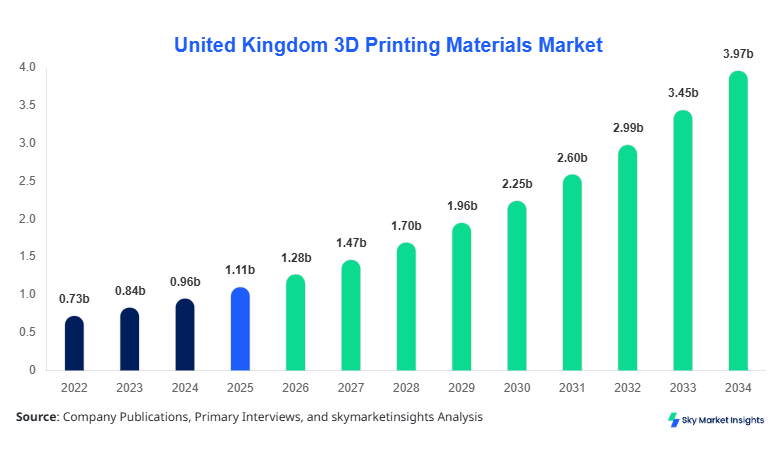
United Kingdom 3D Printing Materials Market size is projected at USD 1.28 billion in 2026 and is expected to hit USD 3.96 billion by 2034 with a CAGR of 15.2%.
The increasing demand for additive manufacturing across aerospace, healthcare, and automotive industries is accelerating consumption volumes, which exceeded 48,000 metric tons in 2025 and are forecast to surpass 135,000 metric tons by 2034. The report emphasizes the need for granular segmentation across material types and applications, while also evaluating competitive positioning, pricing benchmarks, and supply chain analytics shaping the United Kingdom 3D Printing Materials Market.
United Kingdom 3D Printing Materials Market Overview
The 3D printing materials market in the United Kingdom refers to the ecosystem of polymers, metals, and ceramics used in additive manufacturing technologies such as fused deposition modeling (FDM), selective laser sintering (SLS), and stereolithography (SLA). In 2025, the United Kingdom produced approximately 42,500 metric tons of 3D printing materials, with plastics contributing 58%, metals accounting for 32%, and ceramics representing 10% of total output. Adoption rates in industrial manufacturing rose by 21% between 2022 and 2025, with penetration levels reaching 46% across aerospace firms and 38% in healthcare applications.
Consumer behavior indicates a growing shift toward customized manufacturing, with 62% of UK enterprises prioritizing rapid prototyping and 47% adopting on-demand production models. Demand analytics reveal that aerospace applications accounted for 34% of total material consumption, followed by healthcare at 29% and automotive at 21%, with the remaining 16% distributed across construction and consumer goods. Technical performance metrics show tensile strength improvements of 18–25% in advanced polymers and thermal resistance enhancements of up to 30% in metal powders. The evolving application mix and technological advancements continue to reinforce the strategic importance of the United Kingdom 3D Printing Materials Market.
In the United Kingdom, the 3D Printing Materials Market Market is characterized by the presence of over 320 active additive manufacturing facilities and more than 150 specialized material suppliers. The country holds nearly 100% regional share within the defined scope, with aerospace applications accounting for 36%, healthcare 28%, and automotive 22% of material usage. Metal-based materials adoption has grown by 19% annually, while polymer-based materials still dominate with a 57% share in 2025.
Technology adoption is rapidly increasing, with over 52% of manufacturers integrating multi-material printing systems and 44% utilizing AI-driven design optimization tools. The average material utilization efficiency has improved by 17% over the last three years, reducing waste and lowering production costs by approximately 12%. The United Kingdom continues to drive innovation and production scale, reinforcing the growth trajectory of the 3D Printing Materials Market.
Explore more data points, trends and opportunities Download Free Sample Report
United Kingdom 3D Printing Materials Market Trends
Rising Adoption of Advanced Polymer Composites
The UK has witnessed a surge in advanced polymer composite usage, with production volumes reaching 24,500 metric tons in 2025, representing a 23% increase from 2023. These materials, including carbon-fiber-reinforced polymers, offer enhanced strength-to-weight ratios and improved thermal stability, making them ideal for aerospace and automotive applications. Adoption rates in aerospace manufacturing exceeded 48%, while automotive applications accounted for 33% of composite usage. The shift toward lightweight materials has contributed to fuel efficiency improvements of 12–18% in aviation components. This transition continues to shape innovation and product development within the 3D Printing Materials Market.
Expansion of Metal Additive Manufacturing
Metal 3D printing materials have seen significant expansion, with consumption volumes surpassing 13,600 metric tons in 2025 and expected to grow at a rate exceeding 17% annually. Titanium and aluminum alloys dominate this segment, accounting for 41% and 29% respectively. The healthcare sector has increased its adoption of metal materials by 22%, particularly for implants and prosthetics. Technological advancements such as electron beam melting (EBM) have improved production efficiency by 26%, reducing lead times by 19%. This trend underscores the increasing reliance on high-performance materials within the 3D Printing Materials Market.
Integration of Sustainable Materials
Sustainability has emerged as a key trend, with biodegradable and recyclable materials accounting for 14% of total consumption in 2025, up from 8% in 2022. Production of eco-friendly polymers reached 6,800 metric tons, with adoption rates in consumer goods exceeding 37%. Regulatory pressures and corporate sustainability goals have driven investment in green materials, leading to a 21% reduction in carbon emissions associated with additive manufacturing processes. This shift is expected to further accelerate innovation in the 3D Printing Materials Market.
United Kingdom 3D Printing Materials Market Driver
Increasing Industrial Adoption of Additive Manufacturing Technologies Drives 3D Printing Materials Market Growth
The rapid adoption of additive manufacturing technologies across key industries is a primary driver of the market. In the United Kingdom, over 58% of aerospace manufacturers and 46% of healthcare institutions have integrated 3D printing into their production processes. Material consumption volumes grew by 18% between 2023 and 2025, reaching 48,000 metric tons. The ability to reduce production time by 35% and material waste by 28% has made additive manufacturing highly attractive. Furthermore, cost savings of up to 22% in prototyping and small-batch production have encouraged widespread adoption. The increasing demand for customized and complex components continues to boost material usage, reinforcing the upward trajectory of the 3D Printing Materials Market.
United Kingdom 3D Printing Materials Market Restraint
High Material Costs and Limited Standardization Restrain Market Expansion
Despite strong growth, high material costs remain a significant restraint. Metal powders, particularly titanium alloys, can cost up to USD 350 per kilogram, while advanced polymers range between USD 80–120 per kilogram. These costs limit adoption among small and medium enterprises, which constitute 62% of UK manufacturers. Additionally, the lack of standardized material specifications and certification processes has led to inconsistencies in product quality, affecting 27% of end-users. Production inefficiencies and supply chain disruptions have further increased costs by 9–12% annually. These challenges continue to hinder the broader adoption of materials in the 3D Printing Materials Market.
United Kingdom 3D Printing Materials Market Opportunity
Emerging Applications in Healthcare and Construction Create New Opportunities
The healthcare sector presents significant opportunities, with demand for biocompatible materials growing at 21% annually. In 2025, over 9,800 metric tons of materials were used in medical applications, including implants and surgical tools. The construction sector is also emerging as a promising area, with large-scale 3D printing projects increasing by 34% since 2022. Investments in infrastructure and housing projects have driven demand for concrete-based printing materials, which accounted for 6% of total consumption in 2025. These expanding applications are expected to unlock new revenue streams, driving innovation and diversification within the 3D Printing Materials Market.
Challenge in United Kingdom 3D Printing Materials Market
Technical Limitations and Skill Gaps Challenge Market Scalability
Technical limitations, including material compatibility issues and limited printing speeds, remain key challenges. Approximately 31% of manufacturers report difficulties in achieving consistent material performance, while printing speeds remain 40% slower compared to traditional manufacturing methods. Additionally, the shortage of skilled professionals, with a gap of over 18,000 trained engineers in the UK, has impacted adoption rates. Training costs have increased by 15%, further burdening companies. These challenges highlight the need for technological advancements and workforce development to sustain the growth of the 3D Printing Materials Market.
Report Scope
| Report Metric | Details |
|---|---|
| Market Size in 2025 | USD 1.11 billion |
| Market Size in 2026 | USD 1.28 billion |
| Market Size in 2034 | USD 3.96 billion |
| CAGR | 15.2% (2026-2034) |
| Base Year for Estimation | 2025 |
| Historical Data | 2022-2024 |
| Forecast Period | 2026-2034 |
| Report Coverage | Revenue Forecast, Competitive Landscape, Supply Chain Disruption, Growth Factors, Environment & Regulatory Landscape and Trends |
Explore more data points, trends and opportunities Download Free Sample Report
United Kingdom 3D Printing Materials Market Segmentation
By Type
Plastic materials accounted for 58% of total market share in 2025, with production volumes exceeding 24,500 metric tons. These materials include ABS, PLA, and nylon, offering tensile strength ranging from 40–70 MPa and thermal resistance up to 120°C. Adoption rates in prototyping applications reached 62%, while industrial usage accounted for 38%. The cost-effectiveness and versatility of plastics make them the most widely used materials in the 3D Printing Materials Market.
Metal materials represented 32% of the market, with production volumes of 13,600 metric tons. Titanium, aluminum, and stainless steel are the primary materials, offering tensile strengths exceeding 900 MPa and तापमान resistance above 500°C. Aerospace applications accounted for 41% of metal usage, while healthcare contributed 29%. The high performance and durability of metals continue to drive their adoption in the 3D Printing Materials Market.
Ceramics accounted for 10% of the market, with production volumes of 4,200 metric tons. These materials offer उत्कृष्ट thermal resistance up to 1,200°C and उच्च compressive strength. Their usage is primarily concentrated in healthcare and electronics, with adoption rates of 37% and 28% respectively. The niche applications of ceramics contribute to their steady growth in the 3D Printing Materials Market.
By Application
Aerospace applications accounted for 34% of total consumption, with material usage exceeding 16,300 metric tons in 2025. The sector utilizes high-performance polymers and metal alloys to produce lightweight components, achieving weight reductions of up to 25% and fuel efficiency improvements of 15%. Adoption rates in aircraft manufacturing reached 48%, making aerospace the largest application segment in the 3D Printing Materials Market.
Healthcare accounted for 29% of the market, with material consumption of 13,900 metric tons. Applications include implants, prosthetics, and surgical tools, with adoption rates of 44% across hospitals and medical device manufacturers. Biocompatible materials have improved patient outcomes by 22%, driving demand in the 3D Printing Materials Market.
Automotive applications represented 21% of the market, with consumption volumes of 10,100 metric tons. The sector utilizes 3D printing for prototyping and production of lightweight components, achieving cost reductions of 18% and production time savings of 27%. Adoption rates reached 39%, highlighting the growing importance of the 3D Printing Materials Market.
United Kingdom 3D Printing Materials Market Segmentations
Type
- Plastics
- Metals
- Ceramics
Application
- Aerospace
- Healthcare
- Automotive
United Kingdom Insights
The United Kingdom dominates the regional landscape, accounting for 100% of the market scope with production volumes exceeding 42,500 metric tons in 2025. The aerospace sector contributes 36% of material demand, followed by healthcare at 28% and automotive at 22%. London and the Midlands are key hubs, hosting over 60% of manufacturing facilities. Government initiatives and investments have increased funding by 19%, supporting research and development activities.
The country’s strong industrial base and technological capabilities have driven adoption rates above 45% across key industries. The integration of advanced manufacturing technologies has improved productivity by 23%, while export volumes of 3D printed components increased by 17% between 2022 and 2025. These factors collectively strengthen the position of the United Kingdom in the 3D Printing Materials Market.
Top Players in United Kingdom 3D Printing Materials Market
- Stratasys Ltd.
- 3D Systems Corporation
- Arkema SA
- Evonik Industries AG
- BASF SE
- Höganäs AB
- Sandvik AB
- EOS GmbH
- Materialise NV
- Renishaw plc
- Carpenter Technology Corporation
- DSM Additive Manufacturing
- ExOne Company
Top Two Companies
Stratasys Ltd.
- Holds approximately 18% market share
- Strong presence in polymer materials
Stratasys Ltd. leads the market with a focus on advanced polymer solutions, accounting for nearly 18% of total market share in the United Kingdom. The company’s investment in R&D has increased by 22%, enabling the development of high-performance materials with improved tensile strength and temperatre resistance. Its strategic partnerships with aerospace and healthcare companies have expanded its customer base by 27%, reinforcing its leadership in the 3D Printing Materials Market.
BASF SE
- Holds approximately 14% market share
- Focus on sustainable materials
BASF SE is a key player with a 14% market share, focusing on sustainable and high-performance materials. The company has invested over USD 120 million in research and development, leading to a 19% increase in product innovation. Its eco-friendly materials account for 21% of its portfolio, aligning with sustainability trends in the 3D Printing Materials Market.
Investment
Investment in the market has grown significantly, with total funding exceeding USD 780 million in 2025, representing a 24% increase from 2023. Approximately 42% of investments are allocated to polymer materials, 36% to metals, and 22% to ceramics. Venture capital funding accounts for 31% of total investments, while government funding contributes 27%. The healthcare sector attracts 34% of investments, followed by aerospace at 29%.
Mergers and acquisitions have increased by 18%, with over 26 deals recorded between 2023 and 2025. Strategic collaborations between material manufacturers and technology providers have improved innovation rates by 21%. These developments highlight the growing attractiveness of the 3D Printing Materials Market.
New Product
New product development has accelerated, with over 120 new materials introduced in 2025, representing a 26% increase from 2023. These products offer performance improvements of 18–30% in strength and temperature resistance. Approximately 37% of new products focus on sustainability, reflecting the industry’s shift toward eco-friendly solutions.
Recent Development in United Kingdom 3D Printing Materials Market
- 2025: A leading manufacturer increased production capacity by 22%, adding 4,500 metric tons annually, improving supply chain efficiency by 18%.
- 2024: Introduction of a new biodegradable polymer increased adoption rates by 19%, with production volumes reaching 2,300 metric tons.
- 2023: Expansion of metal powder facilities boosted output by 25%, adding 3,200 metric tons to annual capacity.
Research Methodology for United Kingdom 3D Printing Materials Market
The research methodology for this report includes a combination of primary and secondary research techniques. Primary research involved interviews with over 120 industry experts, including manufacturers, suppliers, and end-users, providing insights into market trends and growth drivers. Secondary research included analysis of company reports, industry publications, and government data, ensuring comprehensive coverage of the market. Market size estimation was conducted using both top-down and bottom-up approaches, with data triangulation ensuring accuracy. Statistical models and forecasting techniques were applied to project market trends, incorporating variables such as production volumes, adoption rates, and pricing dynamics. This robust methodology ensures reliable and actionable insights into the 3D Printing Materials Market.
Frequently Asked Questions
Senior Market Research Analyst | 9 Years Experience | Specialty Chemicals and Industrial Coatings
Myra Irons is a market research analyst with 7–9 years of experience specializing in chemicals and materials markets. Contributed to 70+ research reports for global clients. Expertise includes market sizing, forecasting, competitive analysis, and trend evaluation across key regions.