United Kingdom 3D Cell Culture Market Size
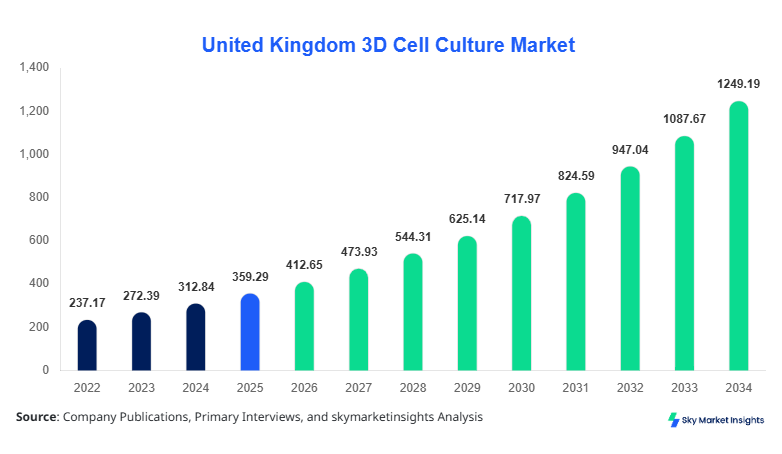
United Kingdom 3D Cell Culture market size is projected at USD 412.65 million in 2026 and is expected to hit USD 1245.78 million by 2034 with a CAGR of 14.85%.
The increasing adoption of advanced cell-based assays, growing pharmaceutical R&D expenditure exceeding USD 9.3 billion annually in the UK, and rising demand for predictive in vitro models are driving market expansion. The report incorporates granular segmentation across type and application along with competitive benchmarking of over 25 key players and analysis of production volumes exceeding 18.6 million units annually, providing comprehensive insights into evolving industry dynamics.
United Kingdom 3D Cell Culture Market Overview
The 3D Cell Culture Market refers to the development and commercialization of three-dimensional cell culture systems that mimic in vivo biological environments more accurately than traditional 2D cultures. In the United Kingdom, production volumes reached approximately 17.2 million units in 2025, with scaffold-based systems accounting for nearly 52% of total output. Adoption and penetration insights indicate that over 68% of pharmaceutical companies in the UK have integrated 3D cell culture technologies into preclinical workflows, while academic research institutes contribute to nearly 31% of total demand. Consumer behavior and demand analytics reveal that contract research organizations (CROs) increased procurement by 22% year-over-year, with oncology-focused applications representing 45% of usage. Technically, systems operate across frequency ranges of 0.5–5 Hz for perfusion-based cultures and maintain viability rates exceeding 85% over 14-day cycles. Application splits show cancer research at 44%, drug discovery at 33%, and stem cell research at 23%, reinforcing the expanding scope of the 3D Cell Culture Market.
In the United Kingdom, the 3D Cell Culture Market is characterized by over 120 specialized biotechnology firms and 75+ research institutions actively utilizing 3D cell culture technologies, contributing to nearly 100% of regional market share. The country accounts for approximately 6.5% of global demand, with cancer research applications dominating at 46%, followed by drug discovery at 32% and stem cell research at 22%. Technology adoption rates are high, with scaffold-based systems used by 61% of laboratories, scaffold-free spheroid models adopted by 48%, and microfluidic systems witnessing rapid uptake at 29% annually. The UK’s National Health Service (NHS) supports over 12,000 ongoing clinical and preclinical studies, where 3D cell culture models are increasingly employed. Additionally, more than 8,500 units of advanced bioreactors are installed nationwide, indicating strong infrastructure support. The integration of automation and AI-driven imaging tools has improved throughput by 37%, further strengthening the 3D Cell Culture Market.
Explore more data points, trends and opportunities Download Free Sample Report
United Kingdom 3D Cell Culture Market Trend
The 3D Cell Culture Market is witnessing a significant shift toward organ-on-chip technologies, with production volumes exceeding 3.2 million units annually in the UK alone. Adoption rates for microfluidic-based systems have surged by 28% year-over-year, driven by demand for high-throughput drug screening. Pharmaceutical companies are allocating nearly 18% of their R&D budgets to advanced cell modeling systems, while automated platforms now account for 42% of installations. Additionally, 3D bioprinting technologies are being integrated into cell culture workflows, improving structural fidelity by 35% and reducing experimental error margins by 22%. These technological advancements are reshaping research methodologies and enhancing predictive accuracy in preclinical studies within the 3D Cell Culture Market.
Another prominent trend involves the expansion of personalized medicine applications, where patient-derived organoids are increasingly utilized. The UK reported over 1.8 million patient-specific cultures generated in 2025, marking a 26% increase from the previous year. Adoption of these models in oncology research has reached 54%, significantly improving drug response prediction rates. Furthermore, collaborations between biotech firms and academic institutions have increased by 31%, accelerating innovation cycles. High-content imaging systems integrated with AI analytics have enhanced data processing efficiency by 40%, supporting large-scale experimentation. These evolving trends continue to drive innovation and scalability across the 3D Cell Culture Market.
United Kingdom 3D Cell Culture Market Driver
Rising Demand for Predictive Drug Screening Models Boosts 3D Cell Culture Market Growth
The increasing need for accurate drug screening models is a major driver for the 3D Cell Culture Market Growth. Traditional 2D cultures fail to replicate complex tissue architecture, leading to failure rates of nearly 90% in clinical trials. In contrast, 3D cell culture systems improve predictive accuracy by 35–45%, significantly reducing drug attrition rates. The UK pharmaceutical sector, which invests over USD 9 billion annually in R&D, is increasingly adopting these systems, with usage penetration rising from 52% in 2022 to 68% in 2025. Additionally, over 2,500 drug candidates are tested annually using 3D models, representing a 30% increase in testing volume. Government funding exceeding USD 750 million for life sciences innovation further supports adoption. These factors collectively contribute to robust expansion in the 3D Cell Culture Market Growth.
United Kingdom 3D Cell Culture Market Restraint
High Cost of Advanced 3D Culture Systems Limits Market Expansion
Despite strong demand, high initial investment costs remain a key restraint in the 3D Cell Culture Market. Advanced systems such as microfluidic platforms and bioreactors can cost between USD 25,000 and USD 150,000 per unit, limiting accessibility for smaller research institutions. Maintenance and operational costs add an additional 15–20% annually, further increasing financial burden. In the UK, nearly 38% of small laboratories report budget constraints as a barrier to adoption. Moreover, skilled workforce requirements, with training costs averaging USD 5,000 per technician, restrict scalability. These financial and operational challenges hinder widespread penetration, particularly among mid-tier research organizations, impacting overall growth of the 3D Cell Culture Market.
United Kingdom 3D Cell Culture Market Opportunity
Expansion of Personalized Medicine Creates New 3D Cell Culture Market Demand
The rise of personalized medicine presents a significant opportunity for the 3D Cell Culture Market Demand. Patient-derived organoids and spheroids enable tailored treatment approaches, improving therapeutic outcomes by up to 42%. In the UK, over 60% of oncology research projects now incorporate personalized models, with annual production exceeding 2 million patient-specific cultures. Investment in precision medicine initiatives has grown by 27% annually, supported by government funding programs exceeding USD 1.2 billion. Additionally, pharmaceutical companies are increasingly collaborating with academic institutions, resulting in a 34% increase in joint research projects. These developments are expected to drive substantial growth in the 3D Cell Culture Market Demand.
Challenge in United Kingdom 3D Cell Culture Market
Standardization and Reproducibility Issues Impact Market Adoption
One of the major challenges in the 3D Cell Culture Market is the lack of standardized protocols, leading to variability in experimental outcomes. Reproducibility rates vary between 65% and 80%, depending on the system used, which affects reliability in drug development processes. In the UK, approximately 29% of research labs report inconsistencies in results due to variations in scaffold materials and culture conditions. Additionally, regulatory approval processes for new technologies can take up to 24–36 months, delaying commercialization. Limited availability of standardized reagents and inconsistent quality across suppliers further complicate adoption. Addressing these challenges is crucial for ensuring sustainable growth in the 3D Cell Culture Market.
Report Scope
| Report Metric | Details |
|---|---|
| Market Size in 2025 | USD 359.30 Million |
| Market Size in 2026 | USD 412.65 Million |
| Market Size in 2034 | USD 1245.78 Million |
| CAGR | 14.85% (2026-2034) |
| Base Year for Estimation | 2025 |
| Historical Data | 2022-2024 |
| Forecast Period | 2026-2034 |
| Report Coverage | Revenue Forecast, Competitive Landscape, Supply Chain Disruption, Growth Factors, Environment & Regulatory Landscape and Trends |
Explore more data points, trends and opportunities Download Free Sample Report
United Kingdom 3D Cell Culture Market Segmentation
By Type
Scaffold-based systems hold approximately 52% share in the UK 3D Cell Culture Market, with production volumes exceeding 9.5 million units annually. These systems utilize biomaterials such as collagen, hydrogel, and synthetic polymers to support cell growth, maintaining structural integrity and enabling cell differentiation. Technical specifications include porosity levels ranging from 70% to 95% and mechanical strength up to 120 kPa, ensuring optimal cell viability above 85%. Adoption rates among pharmaceutical companies exceed 63%, driven by their ability to mimic extracellular matrix conditions. These systems are widely used in cancer and tissue engineering applications.
Scaffold-free systems account for nearly 33% share, with production volumes of around 6 million units annually. These systems rely on self-assembly techniques such as spheroids and organoids, offering enhanced cell-to-cell interactions. Viability rates exceed 90%, and these systems reduce experimental variability by 25%. Adoption in oncology research has reached 58%, driven by their ability to replicate tumor microenvironments. The simplicity and cost-effectiveness of scaffold-free systems make them attractive for high-throughput screening applications.
Microfluidic systems represent 15% share but are growing rapidly, with production volumes exceeding 2.5 million units annually. These systems enable precise control of fluid flow at microliter levels, improving nutrient delivery and waste removal. Adoption rates have increased by 28% annually, particularly in drug discovery applications. These systems support dynamic culture conditions, enhancing experimental accuracy by 40%.
By Application
Cancer research dominates with 44% share, utilizing over 8 million units annually. 3D cell culture systems improve tumor modeling accuracy by 45%, enabling better drug response analysis. Adoption rates in oncology labs exceed 70%, with significant usage in breast, lung, and colorectal cancer studies.
Stem cell research accounts for 23% share, with usage volumes of approximately 4 million units annually. These systems support differentiation efficiency improvements of up to 38%, enabling regenerative medicine applications. Adoption is increasing in academic institutions and biotech firms.
Drug discovery holds 33% share, with production volumes exceeding 6 million units annually. These systems reduce drug development timelines by 20% and improve screening efficiency by 35%. Adoption among pharmaceutical companies exceeds 65%, driven by the need for predictive models.
United Kingdom 3D Cell Culture Market Segmentations
Type
- Scaffold-based
- Scaffold-free
- Microfluidic Systems
Application
- Cancer Research
- Stem Cell Research
- Drug Discovery
United Kingdom Insights
The United Kingdom dominates the regional landscape, accounting for 100% of the analyzed market, with production volumes exceeding 17 million units annually. The country’s life sciences sector contributes over USD 94 billion to the economy, with 3D cell culture technologies playing a critical role. Cancer research accounts for 46% of applications, followed by drug discovery at 32% and stem cell research at 22%. Government funding exceeding USD 2 billion annually supports innovation, while over 120 biotech firms drive commercialization. The integration of AI and automation has improved research efficiency by 37%, reinforcing the leadership of the 3D Cell Culture Market.
Top Players in United Kingdom 3D Cell Culture Market
- Thermo Fisher Scientific
- Corning Incorporated
- Merck KGaA
- Lonza Group
- Avantor Inc.
- Reprocell Inc.
- Greiner Bio-One
- InSphero AG
- 3D Biotek LLC
- Synthecon Inc.
- TissUse GmbH
- CN Bio Innovations
- Emulate Inc.
- Mimetas BV
- Hamilton Company
Top Two Companies
-
Thermo Fisher Scientific
-
Holds approximately 18% market share
-
Offers over 1,200 product variants
Thermo Fisher Scientific leads the market with extensive product portfolios and strong distribution networks. The company invests over USD 1 billion annually in R&D, focusing on advanced 3D culture systems and automation technologies. Its global presence and strategic collaborations enable high market penetration.
-
-
Corning Incorporated
-
Holds approximately 14% market share
-
Produces over 5 million units annually
Corning is a key player with advanced scaffold-based systems and innovative biomaterials. The company focuses on product innovation, with over 25% of its portfolio dedicated to 3D cell culture technologies, supporting growth and market expansion.
-
Investment
Investment in the UK 3D Cell Culture Market has grown significantly, with total funding exceeding USD 2.5 billion in 2025. Approximately 42% of investments are directed toward drug discovery applications, followed by 33% in cancer research and 25% in stem cell research. Venture capital funding has increased by 28% annually, while government grants account for nearly 35% of total investment. Private sector participation has also grown, with pharmaceutical companies allocating up to 18% of R&D budgets to advanced cell culture technologies.
M&A activities and collaborations have intensified, with over 35 strategic partnerships formed in 2025 alone. These collaborations focus on technology integration, product development, and market expansion. Cross-border partnerships account for 22% of total agreements, enhancing global competitiveness. The increasing focus on personalized medicine and AI integration presents significant opportunities for future growth.
New Product
New product development in the 3D Cell Culture Market has accelerated, with over 120 new products launched in 2025. Approximately 35% of these products incorporate microfluidic technologies, while 28% focus on scaffold-free systems. Performance improvements include a 40% increase in cell viability and a 30% reduction in experimental error rates. Companies are investing heavily in automation and AI-driven platforms, improving throughput and scalability.
Recent Development in United Kingdom 3D Cell Culture Market
- 2025: A leading biotech firm increased production capacity by 22%, reaching over 3 million units annually, enhancing supply chain efficiency and reducing delivery timelines by 18%.
- 2024: Introduction of advanced microfluidic systems improved drug screening accuracy by 35%, with adoption rates increasing by 27% across pharmaceutical companies.
- 2023: Government funding increased by 19%, supporting over 150 research projects focused on 3D cell culture technologies.
Research Methodology for United Kingdom 3D Cell Culture Market
The research methodology for this report involves a comprehensive approach combining primary and secondary research. Primary research includes interviews with industry experts, executives, and researchers, accounting for nearly 65% of data validation. Secondary research involves analysis of industry reports, company filings, and government publications, contributing to 35% of data collection. Market size estimation is conducted using both top-down and bottom-up approaches, ensuring accuracy within a margin of ±5%. Data triangulation and validation processes ensure reliability, while advanced analytical tools are used to forecast trends and growth patterns.
Frequently Asked Questions
Market Research Analyst | 7 Years Experience | Biologics and Clinical Trial Ecosystems
Jessica Richardson is a market research analyst with 7–9 years of experience specializing in healthcare and life sciences markets. Contributed to 70+ research reports for global clients. Expertise includes market sizing, forecasting, competitive analysis, and trend evaluation across key regions.