South Korea Veterinary Antibiotics Market Size
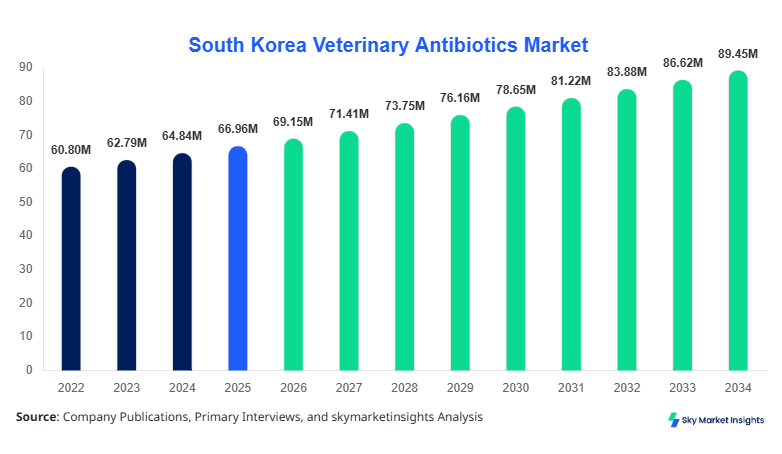
South Korea Veterinary Antibiotics Market size is projected at USD 69.15 million in 2026 and is expected to hit USD 89.81 million by 2034 with a CAGR of 3.27%. The industry expands from USD 66.92 million in the 2025 base year, adding approximately USD 22.89 million through 2034. Market assessment requires product-class, administration-route, animal-type, delivery-mode, end-user, and distribution-channel data alongside analysis of antimicrobial stewardship and the competitive landscape.
Key Takeaways
- Penicillins dominate product type with USD 17.68 million in 2026, equivalent to approximately 25.57% of the product-type total, and reach USD 23.08 million by 2034 at 3.39% CAGR.
- Macrolides are the fastest-growing listed product class at 3.50% CAGR, increasing from USD 7.41 million in 2026 to USD 9.76 million in 2034.
- Oral administration dominates routes with USD 27.64 million in 2026, approximately 40.02% of the route-based total; in-feed/in-water medication records the fastest 3.59% CAGR.
- The market adds approximately 29.88% between 2026 and 2034 based on the supplied product-type totals, while South Korea's livestock base included 10.796 million pigs and 93.958 million broilers in Q1 2025.
- South Korea is the forecast country market, progressing from USD 69.15 million in 2026 to USD 89.81 million in 2034 at 3.27% CAGR.
The market covers antibacterial pharmaceutical products used to prevent, control, and treat susceptible bacterial infections in livestock and companion animals. In 2026, penicillins contribute approximately 25.57%, tetracyclines 25.02%, sulfonamides 12.25%, and macrolides 10.72% of the USD 69.15 million product-type total. Oral products account for approximately 40.02% of the separately supplied route total of USD 69.06 million. South Korea's Q1 2025 livestock population included 3.348 million Korean/native beef cattle, 377,000 dairy cattle, 10.796 million pigs, 77.995 million laying hens, 93.958 million broilers, and 6.295 million ducks, sustaining a broad veterinary-treatment base.
Explore more data points, trends and opportunities Download Free Sample Report
South Korea Veterinary Antibiotics Market Trends
Antimicrobial Stewardship and Precision Treatment Are Reshaping Veterinary Prescribing
South Korea's veterinary sector is increasingly influenced by susceptibility-guided prescribing, residue management, digital farm records, diagnostics, vaccination, and antimicrobial stewardship. The scale of the livestock system remains substantial: Q1 2025 inventories exceeded 170 million laying hens and broilers combined, alongside 10.796 million pigs and more than 3.7 million beef and dairy cattle. Year over year, broiler numbers increased 0.1% and laying hens 2.6%, while pig and Korean/native beef cattle populations declined 1.8% and 5.1%, respectively.
Technology is shifting treatment toward targeted dosing, long-acting formulations, rapid diagnostics, farm-level disease surveillance, and alternatives capable of lowering unnecessary exposure. Internationally, newer veterinary formulations demonstrate the direction of innovation: Merck Animal Health's 2025 single-dose canine otic therapy combines gentamicin with posaconazole and mometasone, while next-generation antimicrobial research increasingly evaluates highly specific alternatives to conventional broad-spectrum drugs.
South Korea Veterinary Antibiotics Market Drivers
Large Commercial Livestock Population Sustains Therapeutic Requirements
Commercial animal production remains the principal volume driver. South Korea recorded 10.796 million pigs, 77.995 million laying hens, 93.958 million broilers and 6.295 million ducks in Q1 2025. Poultry inventories increased 2.6% for layers and 0.1% for broilers year over year, supporting continued requirements for bacterial-disease diagnosis and veterinary treatment. Conversely, cattle numbers contracted 5.1% and pigs 1.8%, reinforcing the importance of productivity per animal and efficient disease management.
South Korea Veterinary Antibiotics Market Restraints
Antimicrobial Resistance and Stewardship Limit Indiscriminate Antibiotic Utilization
Antimicrobial resistance is accelerating pressure for narrower treatment protocols, veterinary supervision, diagnostics, vaccination and preventive husbandry. With more than 93.958 million broilers, 77.995 million laying hens and 10.796 million pigs in Q1 2025, even small percentage reductions in routine antibiotic exposure can affect substantial treatment volumes. The 5.1% decline in beef-cattle inventories and 1.8% decline in pigs also constrain volume-led expansion.
South Korea Veterinary Antibiotics Market Opportunities
Precision Medication and High-Compliance Formulations Expand Value Creation
Opportunity is shifting toward high-compliance oral, injectable, topical and intramammary products supported by diagnostics. Long-acting and simplified regimens can reduce handling requirements across livestock populations measured in millions of animals. International product innovation illustrates this direction: some cattle antimicrobials reach infection sites within 30 minutes, while intramammary systems use 10-mL ready-to-use syringes and treatment intervals as short as 12 hours.
Challenges in South Korea Veterinary Antibiotics Market
Balancing Animal Productivity With Responsible Antimicrobial Use
The core challenge is maintaining disease control while reducing unnecessary antimicrobial exposure across a heterogeneous animal population. In Q1 2025, South Korea simultaneously managed 10.796 million pigs, 3.348 million Korean/native beef cattle and more than 171 million laying hens and broilers. Annual population changes ranged from -5.1% for Korean/native beef cattle to +4.1% for ducks, requiring species-specific inventory planning, surveillance and treatment protocols.
Report Scope
| Report Metric | Details |
|---|---|
| Market Size in 2025 | USD 66.96 Million |
| Market Size in 2026 | USD 69.15 Million |
| Market Size in 2034 | USD 89.81 Million |
| CAGR | 3.27% (2026-2034) |
| Base Year for Estimation | 2025 |
| Historical Data | 2022-2024 |
| Forecast Period | 2026-2034 |
| Report Coverage | Revenue Forecast, Competitive Landscape, Supply Chain Disruption, Growth Factors, Environment & Regulatory Landscape and Trends |
Explore more data points, trends and opportunities Download Free Sample Report
South Korea Veterinary Antibiotics Market Segmentation
The industry is segmented by product type, route of administration, animal type, mode of delivery, end user and distribution channel. Among quantified product classes, penicillins represent approximately 25.57% of 2026 revenue, narrowly ahead of tetracyclines at approximately 25.02%. Oral administration accounts for approximately 40.02% of the supplied route-based 2026 total.
By Product Type
Penicillins are the largest product category, increasing from USD 17.10 million in 2025 to USD 17.68 million in 2026 and USD 23.08 million in 2034 at 3.39% CAGR. Tetracyclines follow at USD 17.30 million in 2026 and USD 22.46 million by 2034, representing approximately one-quarter of revenue.
Macrolides are the fastest-growing listed class at 3.50% CAGR, advancing from USD 7.41 million to USD 9.76 million. Sulfonamides grow at 3.49%, fluoroquinolones at 3.34%, other antibiotics at 3.16%, and cephalosporins and aminoglycosides each at 2.98%.
By Route of Administration
Oral administration leads with USD 27.64 million in 2026 and reaches USD 35.26 million in 2034 at 3.09% CAGR. Topical products rank second at USD 15.93 million in 2026, followed by injectables at USD 13.85 million.
In-feed/in-water medication is the fastest-growing route at 3.59% CAGR, increasing from USD 4.58 million in 2026 to USD 6.07 million by 2034. Injectable products record 3.41% CAGR, intramammary products 3.19%, oral products 3.09%, and topical products 3.07%.
By Animal Type
Livestock—cattle, poultry, swine, sheep and goats, and other production animals—represents a structurally important treatment base because South Korea maintained 10.796 million pigs, 77.995 million layers and 93.958 million broilers in Q1 2025. Companion-animal applications span dogs, cats, horses, rabbits and exotic animals.
No mandatory revenue/CAGR table was supplied for animal type; therefore, unsupported segment values are not substituted for the provided numerical dataset.
By Mode of Delivery
Prescription-based antibiotics are supported by veterinary diagnosis, antimicrobial stewardship and controlled therapeutic protocols, while OTC availability depends on product and regulatory status. The overall quantified market advances at 3.27% CAGR over 2026–2034.
No separate prescription/OTC revenue or CAGR values were supplied, preventing numerical allocation without introducing unsupported estimates.
By End User
Veterinary hospitals and clinics, animal farms, retail pharmacies, online veterinary pharmacies, and research or academic settings constitute the principal end-user categories. South Korea counted approximately 1.242 million farm households in the preliminary 2025 agricultural census, representing 5.5% of total households.
Revenue and CAGR figures by end user were not included in the mandatory dataset and are therefore not independently fabricated.
By Distribution Channel
Direct veterinary sales representatives, distributors/wholesalers and online platforms connect manufacturers with clinics, pharmacies and farms. Digital ordering is increasingly complementary to established wholesale and professional channels.
The supplied dataset does not allocate the USD 69.15 million 2026 total or 3.27% overall CAGR among these three channels, so channel-specific values are intentionally not inferred.
South Korea Veterinary Antibiotics Market Segmentations
By Product Type
- Tetracyclines
- Penicillins
- Sulfonamides
- Macrolides
- Cephalosporins
- Fluoroquinolones
- Aminoglycosides
- Others (e.g., Lincosamides, Carbapenems)
By Route of Administration
- Oral
- Injectable
- Topical
- Intramammary
- In-feed / In-water Medication
By Animal Type
-
Livestock
- Cattle
- Poultry
- Swine
- Sheep and Goats
- Others
-
Companion Animals
- Dogs
- Cats
- Horses
- Others (e.g., Rabbits, Exotic Animals)
By Mode of Delivery
- Prescription-based
- Over-the-Counter (OTC)
By End User
- Veterinary Hospitals and Clinics
- Animal Farms
- Retail Pharmacies and Drug Stores
- Online Veterinary Pharmacies
- Research Institutes and Academic Settings
By Distribution Channel
- Direct Sales (Veterinary Sales Representatives)
- Distributors / Wholesalers
- Online Platforms
South Korea Veterinary Antibiotics Market Outlook
South Korea constitutes the complete geographic scope, with the quantified national market rising from USD 66.92 million in 2025 to USD 69.15 million in 2026 and USD 89.81 million in 2034. Agricultural demand is geographically linked to livestock-producing provinces, while metropolitan areas concentrate companion-animal clinics and pharmacies. National Q1 2025 inventories included 3.348 million Korean/native beef cattle, 377,000 dairy cattle and 10.796 million pigs.
The national livestock mix also contained 77.995 million laying hens, 93.958 million broilers and 6.295 million ducks. County/province revenue shares were not supplied in the mandatory dataset; consequently, regional percentage shares are not fabricated. Nationally, the market expands approximately 29.88% between 2026 and 2034 based on the supplied product-type totals.
Top players in South Korea Veterinary Antibiotics Market
- Zoetis
- MSD Animal Health
- Boehringer Ingelheim Animal Health
- Elanco Animal Health
- Ceva Santé Animale
- Virbac
- Vetoquinol
- Dechra Pharmaceuticals
- Norbrook Laboratories
- Bimeda
- Calier
- Biogénesis Bagó
Major international veterinary anti-infective competitors include Zoetis, Boehringer Ingelheim, Merck/MSD, Elanco, Ceva, Virbac, Vetoquinol and others.
Top Two Companies
- Zoetis
Zoetis maintains broad positioning across companion and livestock health, including established anti-infective brands. Its 2025 portfolio included Clavamox/Synulox broad-spectrum antibiotics for dogs and cats and Convenia injectable anti-infective therapy. Products/product lines individually representing approximately 1% or more of company revenue collectively generated around 71% of Zoetis' 2025 revenue, illustrating portfolio depth. A verified South Korea-specific antibiotic revenue percentage is not publicly established in the sources reviewed, so no unsupported company market-share percentage is assigned.
- MSD Animal Health
MSD Animal Health competes through prescription therapeutics, anti-infectives, vaccines and companion-animal products. In May 2025, its U.S. business received approval for MOMETAMAX SINGLE, a single-dose canine otic product containing gentamicin, extending its antibacterial treatment portfolio. The formulation addresses multiple pathogens through one in-clinic dose, supporting convenience-oriented positioning. As with Zoetis, a verified percentage share specifically for South Korean veterinary antibiotics was not identified; assigning an estimated percentage would conflict with the mandatory-data requirement.
Recent Developments in South Korea Veterinary Antibiotics Market
- 2026: Elanco received U.S. emergency authorization for Negasunt Powder containing sulfanilamide alongside other actives for New World screwworm management in livestock, demonstrating continued investment in treatment readiness.
- 2026: Elanco launched Befrena for canine allergic and atopic dermatitis with a 6–8-week dosing interval, highlighting broader veterinary pharmaceutical innovation beyond conventional antibiotics.
- 2025: MSD Animal Health obtained FDA approval for single-dose MOMETAMAX SINGLE for canine otitis externa, incorporating gentamicin antibacterial therapy.
- 2025: MSD Animal Health reported BRAVECTO QUANTUM approval in more than 50 countries following its U.S. authorization, illustrating increasing international adoption of extended-duration veterinary formulations.
Research Methodology
The analysis uses the supplied mandatory market tables as the primary quantitative source for 2025, 2026 and 2034 revenue, segment contribution and CAGR calculations. Product-type totals of USD 66.92 million, USD 69.15 million and USD 89.81 million underpin headline sizing. The separately supplied route table reports USD 69.06 million for 2026 and USD 88.81 million for 2034; this discrepancy is retained rather than altered. Secondary validation uses South Korean official livestock and agricultural statistics plus corporate disclosures for competitive and development context. Percentage contributions were calculated directly from supplied totals, while unavailable animal-type, end-user, delivery-mode, distribution-channel, province and company-share values were not fabricated.
Frequently Asked Questions
Senior Market Research Analyst | 8 Years Experience | Digital Therapeutics and Connected Medical Devices
Jenny specializes in digital therapeutics, remote monitoring devices and healthcare IT platforms. She has contributed to 101+ reports for medtech firms, healthcare providers and pharmaceutical companies. Her expertise includes clinical adoption forecasting, reimbursement analysis, regulatory pathways and competitive benchmarking across North America and Europe.