South Korea Veterinary Analgesics Anti-Inflammatory Market Size
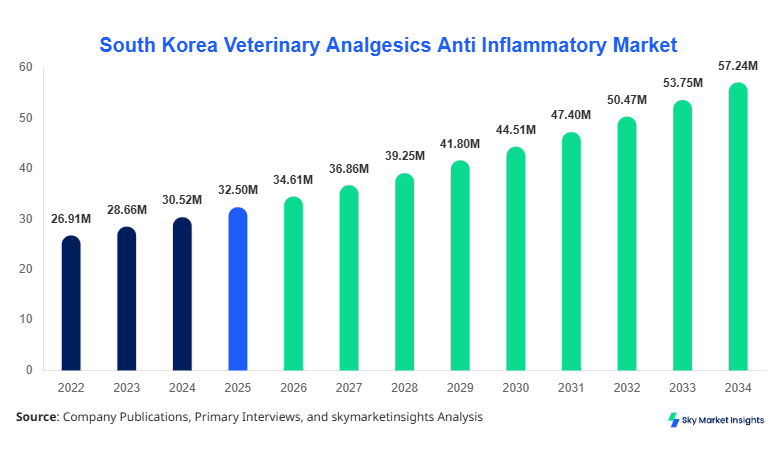
South Korea Veterinary Analgesics Anti Inflammatory Market size is projected at USD 34.61 million in 2026 and is expected to hit USD 57.52 million by 2034 with a CAGR of 6.49%. The industry encompasses pharmaceutical pain relief and inflammation-control products used across companion and livestock animals. Market assessment requires detailed evaluation of drug classes, animal types, administration routes, indications, distribution channels, end users, and the competitive landscape.
Key Takeaways
- South Korea represents 100% of the geographic scope, with nationwide veterinary care infrastructure supporting a 6.49% overall forecast CAGR during 2026–2034.
- NSAIDs dominate drug classes with USD 17.91 million in 2026, equivalent to approximately 51.75% of the drug-class total, and record the fastest listed CAGR of 6.70%.
- Companion animals dominate animal type with USD 19.99 million in 2026, approximately 57.79% of the animal-type total, and expand at a 6.62% CAGR.
- Livestock animals account for approximately 42.21% in 2026, reaching USD 23.92 million by 2034 at a 6.36% CAGR.
- Within the single-country geographic scope, South Korea is forecast to reach approximately USD 57.5 million by 2034 at a 6.49% CAGR.
The market covers prescription and veterinary-directed analgesic and anti-inflammatory medicines administered to dogs, cats, cattle, swine, poultry, horses and other animals. In 2026, NSAIDs contribute approximately 51.75%, opioids 32.82%, and adjunctive analgesics 15.43% of the drug-class total. Companion animals contribute approximately 57.79% of the animal-type total compared with 42.21% for livestock. The supplied dataset does not quantify South Korean pharmaceutical production volumes or nationwide treatment penetration, so no unsupported production or penetration figure is assigned.
Explore more data points, trends and opportunities Download Free Sample Report
South Korea Veterinary Analgesics and Anti-Inflammatory Market Trends
Shift Toward Multimodal Pain Management and Convenient Administration
Veterinary pain management is increasingly structured around multimodal protocols combining anti-inflammatory therapy with opioid or adjunctive analgesia where clinically appropriate. The supplied quantitative dataset covers USD 34.6 million of 2026 drug-class revenue but provides no production-volume series in millions or billions of doses; consequently, a fabricated volume figure is avoided. Technology shifts center on more convenient oral formulations, targeted dosing, transdermal delivery, and improved clinical monitoring.
Companion-animal demand is strengthening the emphasis on chronic musculoskeletal pain, postoperative treatment and owner-administered therapies, while livestock demand remains associated with inflammation, procedures, infectious disease-related pain and herd health. Three principal pharmacological classes and 16 specifically identified active ingredients or delivery forms demonstrate substantial therapeutic diversity, alongside 4 administration categories and 5 indication groups.
South Korea Veterinary Analgesics Anti-Inflammatory Market Drivers
Expansion of Companion-Animal Pain Management
Growth is supported by broader recognition of animal pain, expanding veterinary intervention and increasing emphasis on postoperative and chronic musculoskeletal management. The supplied dataset identifies 3 major drug classes, 2 animal categories, 4 administration-route categories and 5 indication groups. Companion animals form the larger demand pool, while NSAIDs remain central to inflammatory and musculoskeletal treatment. Across the forecast horizon, the overall industry advances at 6.49%, indicating sustained rather than short-cycle demand expansion.
South Korea Veterinary Analgesics Anti-Inflammatory Market Restraints
Safety Monitoring and Prescription Constraints Limit Unrestricted Utilization
Veterinary analgesics require species-specific dosing and monitoring because adverse gastrointestinal, renal, hepatic or central nervous system effects can restrict treatment selection. The market spans at least 16 specified active ingredients or delivery forms across 3 drug classes, increasing clinical decision complexity. Opioid prescribing also faces tighter handling requirements than routine therapies. With 2 fundamentally different animal groups and 5 major indications, differences in physiology, treatment duration and economic value can constrain uniform adoption.
South Korea Veterinary Analgesics Anti-Inflammatory Market Opportunities
Long-Term Pain Control and Advanced Delivery Formats Create White Space
Opportunities are developing around chronic osteoarthritis management, postoperative protocols, multimodal analgesia and easier owner-administered formulations. The segmentation identifies 3 oral formats, 2 topical/transdermal formats and injectable delivery, creating multiple formulation pathways. Eight NSAID molecules, 3 opioid therapies and 3 adjunctive analgesics are explicitly represented, allowing manufacturers to address both acute and chronic requirements while improving dosing convenience and adherence across companion and production animals.
Challenges in South Korea Veterinary Analgesics Anti Inflammatory Market
Balancing Clinical Efficacy, Animal Safety and Treatment Economics
Manufacturers and veterinary providers must balance therapeutic performance with affordability, dosing precision and species-specific safety. The commercial environment encompasses 4 distribution-channel groups and 4 end-user groups, while clinical demand spans 5 indication categories. Treatment economics differ substantially between individual companion animals and commercial herds, creating divergent purchasing priorities. Sustaining the industry's 6.49% forecast expansion therefore requires products capable of meeting both clinical and economic thresholds.
Report Scope
| Report Metric | Details |
|---|---|
| Market Size in 2025 | USD 32.50 Million |
| Market Size in 2026 | USD 34.61 Million |
| Market Size in 2034 | USD 57.52 Million |
| CAGR | 6.49% (2026-2034) |
| Base Year for Estimation | 2025 |
| Historical Data | 2022-2024 |
| Forecast Period | 2026-2034 |
| Report Coverage | Revenue Forecast, Competitive Landscape, Supply Chain Disruption, Growth Factors, Environment & Regulatory Landscape and Trends |
Explore more data points, trends and opportunities Download Free Sample Report
South Korea Veterinary Analgesics Anti-Inflammatory Market Segmentation
The industry is segmented by drug class, animal type, route of administration, indication, distribution channel and end user. Among quantified categories, NSAIDs account for approximately 51.75% of 2026 drug-class revenue, while companion animals represent approximately 57.79% of animal-type revenue.
By Drug Class
NSAIDs are the largest drug class, valued at USD 17.91 million in 2026 and projected to reach USD 30.10 million by 2034, registering a 6.70% CAGR. Their approximately 51.75% 2026 contribution reflects extensive use in inflammatory and musculoskeletal conditions. Products include carprofen, meloxicam, firocoxib, deracoxib, robenacoxib, ketoprofen, flunixin meglumine and tolfenamic acid.
NSAIDs are also the fastest-growing listed drug class at 6.70%, compared with 6.42% for opioids and 6.35% for adjunctive analgesics. Opioids comprise buprenorphine, butorphanol and fentanyl patches, while adjunctive therapies include gabapentin, amantadine and tramadol.
By Animal Type
Companion animals constitute the largest animal category at USD 19.99 million in 2026 and are projected to reach USD 33.38 million in 2034 at a 6.62% CAGR. Their approximately 57.79% contribution in 2026 is associated with veterinary treatment across dogs, cats and other companion species.
Companion animals are additionally the fastest-growing quantified animal segment at 6.62%, versus 6.36% for livestock. Livestock demand covers cattle, swine, poultry, sheep and goats, and horses, with the segment projected to reach USD 23.92 million by 2034.
By Route of Administration
The market comprises oral, injectable, topical/transdermal and other routes. Oral products include tablets, chewables and liquids/suspensions, while topical/transdermal delivery includes patches and creams/gels. The supplied tables do not provide route-specific revenue or CAGR; therefore, no unsupported market-size allocation is introduced.
Oral formulations benefit from administration convenience in long-duration companion-animal treatment, whereas injectables remain relevant to veterinary procedures and livestock settings. Across 4 route categories and at least 5 specified formulation formats, product selection depends on indication, species, onset requirements and dosing practicality.
By Indication
Five major indications are covered: postoperative pain, musculoskeletal disorders, equine colic, fever and inflammation management, and infectious disease-associated pain. The supplied dataset does not assign indication-level revenue or CAGR, preventing a defensible numerical ranking of the largest or fastest-growing indication.
Musculoskeletal and postoperative treatment nevertheless represent central clinical use cases for NSAIDs, opioids and adjunctive analgesics. The presence of 5 indication categories across 3 pharmacological classes highlights demand for both acute and longer-term pain-management protocols.
By Distribution Channel
Distribution comprises veterinary clinics and hospitals, retail pharmacies, online pharmacies, and feed stores/agricultural cooperatives. Four distinct channels serve prescription dispensing, owner purchasing and livestock procurement. No channel-level revenue or CAGR is included in the mandatory tables.
Veterinary clinics and hospitals remain clinically important because analgesic selection often requires diagnosis, prescription and monitoring, while online and retail channels improve refill accessibility. Feed stores and agricultural cooperatives provide a livestock-oriented route within the 4-channel structure.
By End User
End users comprise veterinarians, pet owners, livestock owners/farmers and animal welfare organizations. These 4 groups generate different purchasing and administration requirements, ranging from professional clinical use to continuing home treatment.
Veterinarians influence prescription selection and treatment protocols, while pet owners represent an important administration point for chronic therapy. Farmers emphasize scalable treatment economics across 5 listed livestock categories. The supplied tables contain no end-user revenue or CAGR, so numerical dominance is not inferred.
South Korea Veterinary Analgesics Anti Inflammatory Market Segmentations
By Drug Class
-
NSAIDs (Non-Steroidal Anti-Inflammatory Drugs)
- Carprofen
- Meloxicam
- Firocoxib
- Deracoxib
- Robenacoxib
- Ketoprofen
- Flunixin Meglumine
- Tolfenamic Acid
-
Opioids
- Buprenorphine
- Butorphanol
- Fentanyl (patches)
-
Adjunctive Analgesics
- Gabapentin
- Amantadine
- Tramadol
By Animal Type
-
Companion Animals
- Dogs
- Cats
- Others (rabbits, ferrets, etc.)
-
Livestock Animals
- Cattle
- Swine
- Poultry
- Sheep and Goats
- Horses
By Route of Administration
-
Oral
- Tablets
- Chewables
- Liquids/Suspensions
- Injectable
-
Topical / Transdermal
- Patches
- Creams/Gels
- Others
By Indication
- Post-operative Pain
- Musculoskeletal Disorders (e.g., osteoarthritis)
- Colic Pain (horses)
- Fever and Inflammation Management
- Infectious Disease–associated Pain
By Distribution Channel
- Veterinary Clinics and Hospitals
- Retail Pharmacies
- Online Pharmacies
- Feed Stores / Agricultural Cooperatives
By End User
- Veterinarians
- Pet Owners
- Livestock Owners / Farmers
- Animal Welfare Organizations
South Korea Veterinary Analgesics Anti-Inflammatory Market Outlook
South Korea accounts for 100% of the report's geographic market scope. Using the drug-class totals, national revenue rises from USD 32.48 million in 2025 to USD 34.61 million in 2026 and USD 57.52 million in 2034. The corresponding forecast CAGR is 6.49%. The supplied dataset does not provide province-level production, sales or county contribution figures.
At the national level, 2026 drug-class allocation is approximately 51.75% NSAIDs, 32.82% opioids and 15.43% adjunctive analgesics. The separate animal-type table places companion animals at approximately 57.79% and livestock animals at 42.21% in 2026. Province-level splits for Seoul, Gyeonggi, Busan and other areas are not supplied and therefore are not fabricated.
Top players in South Korea Veterinary Analgesics Anti-Inflammatory Market
- Zoetis Inc.
- Boehringer Ingelheim
- Elanco Animal Health Incorporated
- Merck & Co., Inc.
- Ceva Santé Animale
- Dechra Pharmaceuticals
- Vetoquinol S.A.
- Virbac
- Norbrook Laboratories
- Chanelle Pharma
- KRKA
- Bimeda
- HIPRA
- Orion Corporation
- Zydus Animal Health
Top Two Companies
-
Zoetis Inc.
The company holds a prominent global position in animal health through an extensive portfolio spanning companion and livestock animal therapeutics. Its positioning in veterinary pain management is supported by established veterinary relationships, pharmaceutical development capabilities and broad commercial reach. The supplied mandatory tables do not contain company-level revenue or percentage shares; consequently, assigning a numerical South Korean company share would be unsupported. Competitive positioning instead reflects participation across a market serving 2 major animal categories, 5 indication groups and multiple delivery formats.
-
Boehringer Ingelheim
Boehringer Ingelheim maintains a significant animal-health presence across companion and production animal care, supported by pharmaceutical expertise and veterinary distribution capabilities. Its positioning aligns with increasing requirements for inflammation and pain management across acute and chronic conditions. No company-level percentage share is contained in the supplied data, so a fabricated share is excluded. Competitive opportunity spans 3 major drug classes, 4 route categories, 4 distribution channels and 4 end-user categories, creating multiple points for portfolio differentiation.
Recent Developments in South Korea Veterinary Analgesics Anti-Inflammatory Market
- 2026: The market enters the forecast period at approximately USD 34.61 million, establishing the current-year benchmark for subsequent expansion.
- 2026: NSAIDs reach USD 17.91 million, reinforcing their position as the largest quantified drug class and placing the category on a 6.70% forecast CAGR trajectory.
- 2026: Companion-animal therapeutics reach USD 19.99 million, representing approximately 57.79% of the quantified animal-type market.
Research Methodology
The assessment applies a structured market-research framework covering historical years 2022–2024, base year 2025, current year 2026 and forecast period 2026–2034. Mandatory supplied numerical tables form the primary quantitative basis for market valuation, segment contribution and CAGR calculations. Drug-class totals of USD 32.48 million in 2025, USD 34.61 million in 2026 and USD 57.52 million in 2034 underpin the headline forecast, while animal-type data are analyzed separately because their supplied totals differ slightly. Percentage contributions are mathematically derived from the provided values, while unavailable province, production, penetration, route, indication, channel, end-user and company-share figures are not fabricated.
Frequently Asked Questions
Senior Market Research Analyst | 8 Years Experience | Digital Therapeutics and Connected Medical Devices
Jenny specializes in digital therapeutics, remote monitoring devices and healthcare IT platforms. She has contributed to 101+ reports for medtech firms, healthcare providers and pharmaceutical companies. Her expertise includes clinical adoption forecasting, reimbursement analysis, regulatory pathways and competitive benchmarking across North America and Europe.