South Korea Automated Mining Equipment Market Size
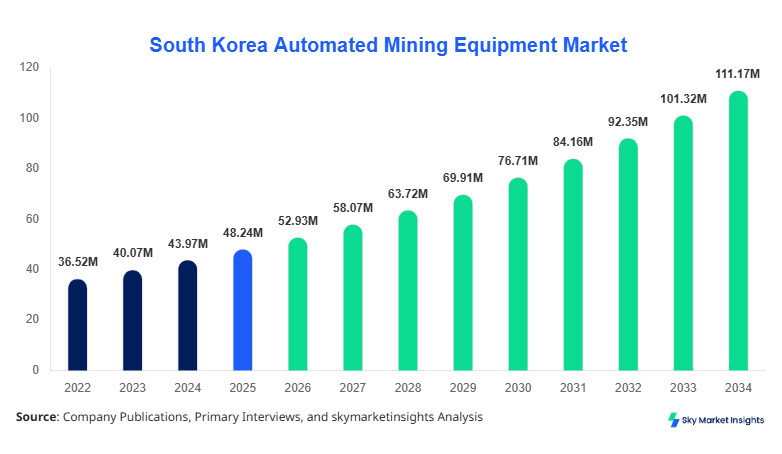
South Korea Automated Mining Equipment Market size is projected at USD 52.93 million in 2026 and is expected to hit USD 110.73 million by 2034 with a CAGR of 9.72%. The assessment evaluates 8 equipment categories, 4 mineral groups, deployment architecture, automation levels, software solutions, and 2 principal end-user environments. It also examines technology adoption, operating economics, procurement priorities, and the competitive positioning of domestic and international suppliers.
Key Takeaways
- Autonomous haul trucks dominate equipment revenue with a 29.51% share in 2026, while dozers and excavators record the fastest CAGR of 10.20% through 2034.
- Metallic minerals lead mineral applications with a 49.40% share in 2026; non-metallic minerals are the fastest-growing mineral category at a 9.88% CAGR.
- The Seoul–Gyeonggi–Incheon commercial corridor is estimated to influence approximately 38% of equipment procurement, software contracting, financing, and systems integration.
- Gangwon and Gyeongsang mining corridors collectively account for an estimated 47% of operational deployment activity, supported by limestone, coal-replacement, aggregate, and metallic-mineral operations.
- South Korea is forecast to reach USD 110.73 million by 2034, adding USD 57.80 million between 2026 and 2034.
The market covers autonomous and remotely operated machinery, embedded sensors, artificial intelligence, fleet orchestration, collision prevention, navigation, maintenance analytics, and emissions-monitoring platforms used in surface and underground mines. South Korea's 2026 equipment revenue includes USD 15.62 million from autonomous haul trucks, USD 8.69 million from automated drilling rigs, and USD 6.56 million from autonomous loaders. These categories contribute 29.51%, 16.42%, and 12.39%, respectively. Metallic-mineral applications represent USD 26.16 million, equivalent to 49.40% of mineral-based revenue, while non-metallic applications contribute USD 13.31 million or 25.13%.
Explore more data points, trends and opportunities Download Free Sample Report
South Korea Automated Mining Equipment Market Trends
AI-Enabled Fleet Orchestration and Electrified Automation
South Korean operators are moving from isolated machine control toward interoperable fleets combining 5G connectivity, edge computing, machine vision, and high-precision positioning. A medium-sized automated operation can generate several million equipment-status records per day, while modern haulage platforms may monitor more than 100 operating parameters per machine. Pilot programs increasingly target 15%–25% improvements in equipment utilization, 10%–20% reductions in idle time, and navigation accuracy measured in centimeters rather than meters.
Electrification is also reshaping automation requirements. Battery monitoring, regenerative braking, autonomous charging, and energy-optimization software are becoming procurement criteria for fleets operating across 2 or 3 shifts. Industry deployment targets commonly seek 20%–30% lower fuel consumption, 15% fewer unplanned stoppages, and safety-zone compliance above 95%. Underground mines particularly favor tele-remote loading and drilling because removing personnel from active headings can reduce direct exposure hours by thousands annually.
South Korea Automated Mining Equipment Market Drivers
Worker Safety, Productivity, and Digital-Mine Investment
Automation investment is being driven by workforce aging, hazardous operating conditions, and pressure to raise output without proportionally increasing headcount. Autonomous haulage can support continuous 20–24-hour operation, while automated drilling can improve hole-placement consistency by 10%–25%. Collision-avoidance platforms monitoring 360-degree proximity zones can reduce operator-response delays measured in seconds, and predictive-maintenance applications frequently target 15%–30% lower unplanned downtime. South Korea's high broadband penetration and extensive 5G infrastructure further support low-latency control, real-time video, and multi-machine coordination.
South Korea Automated Mining Equipment Market Restraints
High Capital Requirements and Legacy-Fleet Integration
A fully automated fleet requires machinery, positioning infrastructure, communications networks, control rooms, cybersecurity, and workforce training. Retrofitting can involve 5–15 major hardware and software interfaces per machine, with integration costs potentially adding 10%–25% to project expenditure. Smaller operators may manage fewer than 20 heavy machines and therefore face longer payback periods than sites operating 50–100 units. Fragmented equipment brands, confined mine layouts, and limited interoperability can also extend commissioning schedules by 6–18 months.
South Korea Automated Mining Equipment Market Opportunities
Brownfield Retrofits and Software-Led Modernization
Brownfield mines offer substantial potential because operators can automate selected workflows without replacing an entire fleet. Retrofit packages covering guidance, obstacle detection, remote operation, and condition monitoring may reduce initial expenditure by 20%–40% compared with full fleet replacement. Software subscriptions, private 5G networks, and modular sensor kits enable phased implementation across 3–5 operational stages. Predictive maintenance can identify component degradation days or weeks before failure, while energy analytics may support 5%–15% reductions in avoidable consumption.
Challenges in South Korea Automated Mining Equipment Market
Cybersecurity, Skills Availability, and System Reliability
Connected mines must protect hundreds of sensors, vehicle controllers, cameras, and operational databases. A communications interruption lasting only 5–10 seconds can trigger controlled equipment stops, affecting cycle time and throughput. Operators also need multidisciplinary teams spanning mining engineering, robotics, data science, and operational technology security. Achieving system availability above 99% requires redundant networks, frequent software validation, and response procedures capable of supporting 24-hour operations across surface and underground environments.
Report Scope
| Report Metric | Details |
|---|---|
| Market Size in 2025 | USD 48.24 Million |
| Market Size in 2026 | USD 52.93 Million |
| Market Size in 2034 | USD 110.73 Million |
| CAGR | 9.72% (2026-2034) |
| Base Year for Estimation | 2025 |
| Historical Data | 2022-2024 |
| Forecast Period | 2026-2034 |
| Report Coverage | Revenue Forecast, Competitive Landscape, Supply Chain Disruption, Growth Factors, Environment & Regulatory Landscape and Trends |
Explore more data points, trends and opportunities Download Free Sample Report
South Korea Automated Mining Equipment Market Segmentation
In 2026, autonomous haul trucks account for 29.51% of equipment revenue, followed by automated drilling rigs at 16.42% and autonomous loaders at 12.39%. Metallic applications represent 49.40% of mineral revenue, whereas non-metallic minerals contribute 25.13%. Deployment, automation, software, and end-user categories reflect the transition from operator-assistance functions to coordinated, site-wide autonomy.
By Equipment Type
Autonomous haul trucks are the largest category, increasing from USD 14.27 million in 2025 to USD 15.62 million in 2026 and USD 32.11 million by 2034 at a 9.43% CAGR. Their scale reflects repetitive haul cycles, measurable fuel savings, centralized dispatching, and the ability to operate across multiple shifts.
Dozers and excavators are the fastest-growing category at a 10.20% CAGR, narrowly ahead of autonomous loaders at 10.19%. Automated blasting systems advance at 10.06%, remote-controlled equipment at 9.76%, automated drilling rigs at 9.50%, robotic equipment at 9.31%, and other equipment at 9.30%.
By Mineral Type
Metallic minerals lead with USD 23.83 million in 2025, USD 26.16 million in 2026, and USD 55.19 million in 2034, representing a 9.78% CAGR. Gold, copper, iron, and nickel operations benefit from high equipment utilization, grade-control requirements, and precise drilling and haulage workflows.
Non-metallic minerals are the fastest-growing application at a 9.88% CAGR, reaching USD 28.28 million by 2034. Rare-earth minerals follow at 9.85%, while coal expands at 9.37% to USD 16.66 million.
By Deployment Mode
OEM-integrated solutions lead deployment because factory-installed controls provide unified warranties, validated interfaces, and shorter commissioning periods. On-site fully autonomous systems are concentrated in larger operations capable of supporting 24-hour control rooms and private communications networks.
Retrofit automation is the fastest-expanding deployment approach, with projects commonly implemented in 3 phases: sensing, remote control, and coordinated autonomy. Operators can initially automate 10%–30% of a fleet before expanding coverage.
By Level of Automation
Semi-automated equipment remains the largest installed category, combining operator control with guidance, braking, drilling, and safety assistance. These systems can automate 1–3 critical functions while retaining human supervision.
Fully autonomous systems are expanding fastest as positioning reliability exceeds 95% in controlled operating zones. Remote-controlled equipment remains important underground, where a single operator may supervise multiple machines from a protected location.
By Software Solution
Fleet management leads software adoption by coordinating dispatch, payload, routing, fuel use, and queue times across fleets of 10–100 machines. Navigation and collision-avoidance systems form the principal real-time control layer.
Predictive maintenance is the fastest-growing software field, targeting 15%–30% lower downtime. Tele-remote operations, safety analytics, and energy monitoring are gaining importance as operators pursue 5%–20% efficiency improvements.
By End-User
Surface mining dominates because haul trucks, drills, loaders, dozers, and excavators operate within repeatable routes and geofenced areas. Large sites can process millions of tonnes annually and support continuous fleet dispatch.
Underground mining is expected to expand faster as tele-remote systems reduce worker exposure and enable operations during ventilation or blasting-clearance periods. Automated loaders and drills can recover 1–3 additional productive hours per shift.
South Korea Automated Mining Equipment Market Segmentations
By Equipment Type
- Autonomous Haul Trucks
- Automated Drilling Rigs
- Autonomous Loaders
- Robotic Mining Equipment
- Dozers and Excavators
- Automated Blasting Systems
- Remote-Controlled Equipment
- Others (Grinders, Crushers, Graders)
By Mineral Type
- Metallic (Gold, Copper, Iron, Nickel, etc.)
- Non-Metallic (Limestone, Potash, Phosphate)
- Coal
- Rare Earth Minerals
By Deployment Mode
- On-Site (Fully Autonomous Sites)
- Retrofit Automation
- OEM-Integrated Solutions
By Level of Automation
- Semi-Automated
- Fully Autonomous
- Remote-Controlled
By Software Solution
- Fleet Management
- Navigation and Guidance
- Collision Avoidance and Safety
- Tele-remote Operations
- Predictive Maintenance
- Energy and Emissions Monitoring
By End-User
- Surface Mining
- Underground Mining
South Korea Automated Mining Equipment Market Country Outlook
The Seoul–Gyeonggi–Incheon corridor is estimated to influence 38% of national commercial activity, equal to approximately USD 20.11 million of the 2026 total when allocated proportionally. The region concentrates corporate headquarters, software developers, telecommunications providers, research institutions, and equipment-distribution functions rather than primary extraction volume.
Gangwon is estimated to represent 27%, or approximately USD 14.29 million, supported by limestone, cement minerals, aggregates, and legacy mining districts. Gyeongsang accounts for an estimated 20%, or USD 10.59 million, reflecting industrial-mineral demand, machinery supply chains, and port-linked processing. Chungcheong and Jeolla collectively represent the remaining 15%, or about USD 7.94 million. Nationally, metallic and non-metallic applications contribute 49.40% and 25.13%, respectively.
Top players in South Korea Automated Mining Equipment Market
- Caterpillar Inc.
- Komatsu Ltd.
- Sandvik AB
- Epiroc AB
- Hitachi Construction Machinery Co., Ltd.
- Liebherr Group
- Hexagon AB
- ABB Ltd.
- Siemens AG
- Volvo Construction Equipment
- Hyundai Construction Equipment
- HD Hyundai Infracore
- Rockwell Automation, Inc.
- Autonomous Solutions, Inc.
- SafeAI, Inc.
Top Two Companies
-
Caterpillar Inc. — estimated competitive presence: 18%–22%. Caterpillar is positioned strongly through autonomous haulage, MineStar fleet management, collision awareness, equipment health monitoring, and a broad installed base of large mining trucks. Its integrated model combines machinery, autonomy software, dealer support, and lifecycle services. The company's experience operating autonomous fleets across billions of tonnes of hauled material strengthens its suitability for South Korean operators seeking proven 24-hour dispatch, standardized safety controls, and scalable deployment.
-
Komatsu Ltd. — estimated competitive presence: 15%–19%. Komatsu holds a leading position through its FrontRunner autonomous haulage system, mining trucks, intelligent-machine controls, and regional proximity to South Korea. Its solutions integrate dispatch, navigation, obstacle detection, and centralized supervision. The company benefits from Asian supply-chain coverage and experience managing fleets containing hundreds of autonomous trucks globally. This positioning supports both greenfield projects and staged automation programs requiring measurable improvements of 10%–25% in utilization or cycle consistency.
Research Methodology
The assessment combines equipment-level and mineral-level revenue triangulation for 2025, 2026, and 2034. The equipment dataset totals USD 48.26 million in 2025, USD 52.93 million in 2026, and USD 110.73 million in 2034, while the mineral dataset totals USD 48.25 million, USD 52.96 million, and USD 111.47 million. Minor differences of USD 0.01 million, USD 0.03 million, and USD 0.74 million reflect independent segment rounding. Forecast validation applies the supplied 9.72% CAGR, supplier benchmarking, adoption-stage analysis, and top-down and bottom-up reconciliation across 8 equipment types and 4 mineral categories.
Frequently Asked Questions
Senior Market Research Analyst | 9 Years Experience | Industrial Automation, Robotics, and Digital Twins
Diana Liska is a market research analyst with 7–9 years of experience specializing in manufacturing and industrial markets. Contributed to 70+ research reports for global clients. Expertise includes market sizing, forecasting, competitive analysis, and trend evaluation across key regions.