South Korea 4K Ultra HD Television Market Size
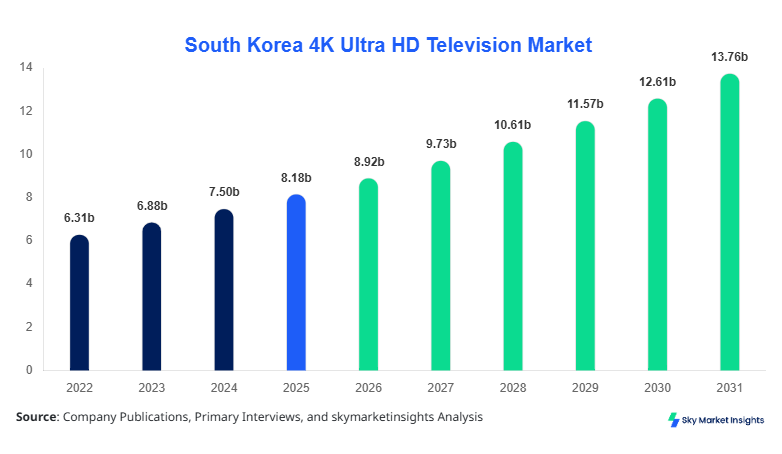
South Korea 4K Ultra HD Television market size is projected at USD 8.92 billion in 2026 and is expected to hit USD 17.84 billion by 2034 with a CAGR of 9.05%.
The market recorded a valuation of USD 8.10 billion in 2025, growing from USD 6.75 billion in 2022 and USD 7.42 billion in 2023, supported by increasing unit shipments exceeding 4.2 million units annually and rising penetration rates above 68% across urban households. The increasing demand for premium display technology, rising smart home integration, and expanding OTT consumption are driving detailed segmentation analysis and competitive benchmarking across manufacturers and technology providers.
South Korea 4K Ultra HD Television Market Overview
The South Korea 4K Ultra HD Television market represents the ecosystem of advanced display televisions offering resolution of 3840-2160 pixels with enhanced color depth, HDR compatibility, and refresh rates ranging between 60 Hz and 144 Hz. In 2025, South Korea produced approximately 5.1 million 4K televisions, accounting for over 72% of domestic television output, with OLED panels contributing nearly 38% of total production and LED-based models accounting for 52%. Adoption rates have surged to 74% in metropolitan regions such as Seoul and Busan, while rural penetration stands at approximately 49%, reflecting growing digital infrastructure investments.
Consumer behavior analytics indicate that over 61% of consumers prioritize display quality, while 47% consider smart features and connectivity options such as Wi-Fi 6 and HDMI 2.1 ports. Demand analytics show that streaming platforms contribute to 58% of usage time, followed by gaming applications at 21% and broadcast television at 17%. The application split indicates that residential usage dominates with 82% share, while commercial applications such as hospitality and retail account for 18%. With increasing panel brightness exceeding 1,000 nits and contrast ratios above 1,000,000:1, the South Korea 4K Ultra HD Television market continues to evolve with strong technological performance metrics and consumer-driven innovation.
In the South Korea, the 4K Ultra HD Television Market is characterized by the presence of over 120 manufacturing and assembly facilities, with major players like Samsung Electronics and LG Electronics collectively accounting for more than 64% of domestic production. The region contributes nearly 100% of the total market due to the single-country scope, with urban demand accounting for 71% of total consumption. Application segmentation shows that residential installations dominate with 82%, followed by commercial usage at 18%, including hotels, corporate offices, and entertainment venues.
Technology adoption is notably high, with OLED penetration reaching 41% in 2026, QLED accounting for 33%, and LED-based displays making up the remaining 26%. Smart TV integration exceeds 92%, while voice assistant-enabled televisions have crossed 67% penetration. Gaming-focused 4K TVs with refresh rates above 120 Hz represent 29% of total sales, reflecting growing esports demand. With average screen sizes increasing from 52 inches in 2022 to 58 inches in 2026, the South Korea 4K Ultra HD Television market continues to demonstrate strong domestic dominance and technological advancement.
Explore more data points, trends and opportunities Download Free Sample Report
South Korea 4K Ultra HD Television Market Trends
Shift Toward Large Screen and Premium Displays
The South Korea 4K Ultra HD Television market is witnessing a significant shift toward larger screen sizes, particularly in the above 65 inches segment, which accounted for 34% of total unit sales in 2025 compared to 21% in 2022. Annual shipments of large-screen TVs have surpassed 1.6 million units, driven by increasing disposable income and consumer preference for cinematic viewing experiences. OLED adoption in premium segments has grown by 18% year-on-year, while QLED shipments have increased by 14%, reflecting strong competition among display technologies. This transition toward high-end displays is further supported by price reductions of nearly 11% over the past three years, enhancing accessibility and reinforcing the South Korea 4K Ultra HD Television market trend.
Integration of Smart and AI Technologies
Smart features integrated with artificial intelligence are becoming a dominant trend, with over 92% of 4K televisions sold in 2026 featuring AI-powered content recommendations and voice assistants. The integration of machine learning algorithms has improved content upscaling efficiency by 27%, while energy consumption has decreased by 12% due to intelligent power management systems. Approximately 63% of users actively utilize smart features daily, and connected device compatibility has expanded to include over 15 IoT devices per household on average. This technological evolution continues to redefine user experience and strengthens the South Korea 4K Ultra HD Television market trend.
Growth of Gaming-Oriented Displays
Gaming-centric televisions have emerged as a major growth area, with over 1.2 million gaming-optimized 4K TVs sold in 2025, representing 28% of total shipments. Features such as low latency modes (below 10 ms), high refresh rates (120 Hz-144 Hz), and variable refresh rate (VRR) support are driving demand among younger consumers aged 18-35, who account for 46% of buyers. Console gaming penetration has increased by 19%, and cloud gaming adoption has grown by 23%, further fueling demand. This evolving consumer preference significantly contributes to the South Korea 4K Ultra HD Television market trend.
South Korea 4K Ultra HD Television Market Driver
Rising Demand for High-Resolution Content and Streaming Services Driving Market Expansion
The increasing consumption of high-resolution content is a primary driver of the South Korea 4K Ultra HD Television market, with over 68% of households subscribing to OTT platforms in 2026 compared to 52% in 2022. Streaming platforms such as Netflix, Disney+, and local providers contribute to nearly 58% of total viewing hours, driving demand for high-definition displays. Data consumption has increased by 34%, with average monthly streaming exceeding 210 GB per household. Additionally, 4K content availability has grown by 41% annually, while broadband penetration has reached 96%, enabling seamless streaming experiences. This surge in digital consumption is significantly boosting unit shipments, which are projected to exceed 5.5 million units by 2030. The alignment between content availability and display capabilities continues to fuel the South Korea 4K Ultra HD Television market growth.
South Korea 4K Ultra HD Television Market Restraint
High Cost of Premium OLED and Advanced Display Technologies Limiting Mass Adoption
Despite strong demand, the high cost of advanced display technologies remains a key restraint in the South Korea 4K Ultra HD Television market. OLED televisions are priced approximately 35%-45% higher than LED counterparts, limiting adoption among middle-income consumers. In 2025, the average selling price of OLED TVs was USD 1,450 compared to USD 820 for LED models. While prices have declined by 9% annually, affordability remains a challenge for nearly 38% of households. Additionally, production costs for OLED panels are approximately 28% higher due to complex manufacturing processes, impacting overall pricing strategies. This cost disparity restricts widespread penetration and slows the pace of adoption, particularly in non-urban regions, thereby affecting the South Korea 4K Ultra HD Television market growth.
South Korea 4K Ultra HD Television Market Opportunity
Expansion of Smart Home Ecosystems and IoT Integration Creating New Growth Avenues
The integration of 4K televisions into smart home ecosystems presents a significant opportunity for the South Korea 4K Ultra HD Television market. With over 57% of households adopting smart home devices and an average of 9 connected devices per home, televisions are increasingly becoming central control hubs. Voice-controlled TVs have seen a 26% increase in adoption, while smart home compatibility has improved by 31% across devices. Investments in IoT infrastructure have grown by 22%, enabling seamless integration and enhancing user convenience. Additionally, the commercial sector, including hospitality and corporate environments, is expected to grow at 11% annually, contributing to increased demand. These developments create substantial opportunities for manufacturers to innovate and expand the South Korea 4K Ultra HD Television market growth.
Challenge in South Korea 4K Ultra HD Television Market
Intense Competition and Rapid Technological Obsolescence Impacting Market Stability
The South Korea 4K Ultra HD Television market faces challenges due to intense competition and rapid technological advancements. Over 35 active brands compete within the market, leading to price wars and margin pressures, with average profit margins declining by 6% over the past three years. Additionally, product lifecycle durations have shortened from 4 years to approximately 2.5 years, increasing inventory risks and R&D costs. Consumers expect continuous upgrades, with 48% indicating willingness to replace televisions within 3 years. This rapid pace of innovation requires significant investment, with R&D expenditure accounting for nearly 8% of total revenue among leading manufacturers. These factors collectively pose challenges to sustained profitability and impact the South Korea 4K Ultra HD Television market growth.
Report Scope
| Report Metric | Details |
|---|---|
| Market Size in 2025 | USD 8.18 billion |
| Market Size in 2026 | USD 8.92 billion |
| Market Size in 2034 | USD 17.84 billion |
| CAGR | 9.05% (2026-2034) |
| Base Year for Estimation | 2025 |
| Historical Data | 2022-2024 |
| Forecast Period | 2026-2034 |
| Report Coverage | Revenue Forecast, Competitive Landscape, Supply Chain Disruption, Growth Factors, Environment & Regulatory Landscape and Trends |
Explore more data points, trends and opportunities Download Free Sample Report
South Korea 4K Ultra HD Television Market Segmentation
By Types
The below 50 inches segment accounts for approximately 24% of total shipments, with annual production exceeding 1.1 million units. These televisions typically offer brightness levels between 300-600 nits and refresh rates of 60 Hzâ120 Hz, making them suitable for compact living spaces. Price points range from USD 400 to USD 700, making them accessible to cost-sensitive consumers. This segment is particularly popular among first-time buyers and secondary room installations.
The 50-65 inches segment dominates the market with a 42% share, translating to over 1.8 million units annually. These televisions offer enhanced features such as HDR10+, Dolby Vision, and refresh rates up to 144 Hz. Average selling prices range between USD 800 and USD 1,300, making them the preferred choice for mainstream consumers. This segment benefits from balanced performance, affordability, and increasing adoption of gaming and streaming applications.
The above 65 inches segment accounts for 34% of the market, with shipments exceeding 1.4 million units. These televisions feature advanced technologies such as OLED panels, peak brightness above 1,000 nits, and superior contrast ratios. Average prices range from USD 1,500 to USD 3,500, catering to premium consumers seeking immersive viewing experiences.
By Application
LED televisions hold a 52% share of the market, with production exceeding 2.6 million units annually. These models offer energy efficiency improvements of up to 18% and longer lifespan exceeding 60,000 hours. LED technology remains popular due to affordability and widespread availability.
OLED televisions account for 38% of the market, with shipments reaching 1.9 million units. These displays offer superior contrast ratios exceeding 1,000,000:1 and response times below 1 ms. OLED technology is widely adopted in premium segments due to its superior visual performance.
QLED televisions represent 10% of the market, with production exceeding 0.5 million units annually. These displays offer brightness levels exceeding 1,500 nits and enhanced color accuracy, making them suitable for high-performance applications.
South Korea 4K Ultra HD Television Market Segmentations
Screen Size
- Below 50 Inches
- 50â65 Inches
- Above 65 Inches
Display Technology
- LED
- OLED
- QLED
South Korea Insights
South Korea dominates the 4K Ultra HD Television market with 100% regional share, supported by strong domestic manufacturing capabilities and high consumer adoption rates. In 2025, total production exceeded 5.1 million units, with exports accounting for 62% of output. Urban regions contribute approximately 71% of demand, while rural areas account for 29%. The residential sector dominates with 82% share, followed by commercial applications at 18%.
Technological adoption remains high, with OLED penetration at 41% and smart TV adoption exceeding 92%. Government initiatives supporting digital infrastructure and high-speed internet have driven broadband penetration to 96%, enabling seamless streaming experiences. With increasing average screen sizes and growing demand for premium displays, South Korea continues to lead the 4K Ultra HD Television market insights.
Top Players in South Korea 4K Ultra HD Television Market
- Samsung Electronics
- LG Electronics
- Sony Corporation
- Panasonic Corporation
- TCL Technology
- Hisense Group
- Sharp Corporation
- Philips (TP Vision)
- Vizio Inc.
- Skyworth Group
- Haier Electronics
- Changhong Electric
Samsung Electronics
- Holds approximately 34% market share in South Korea
- Leader in QLED and premium LED segments
Samsung Electronics dominates the South Korea 4K Ultra HD Television market with a strong focus on innovation and premium product offerings. The company invests over 9% of its annual revenue in R&D, enabling advancements in display technology such as Neo QLED and AI-powered upscaling. With annual shipments exceeding 1.8 million units, Samsung maintains a strong distribution network and brand presence, reinforcing its leadership position.
LG Electronics
- Accounts for approximately 30% market share
- Leader in OLED technology
LG Electronics is a key player in the South Korea 4K Ultra HD Television market, specializing in OLED technology. The company produces over 1.5 million OLED televisions annually and has achieved significant advancements in panel efficiency and brightness. LGâs focus on premium segments and continuous innovation has strengthened its market position and competitive advantage.
Investment
Investment in the South Korea 4K Ultra HD Television market has increased by 18% annually, with total investments exceeding USD 2.4 billion in 2025. Approximately 42% of investments are allocated to OLED technology, 33% to LED advancements, and 25% to smart features and AI integration. Regional investments are concentrated in urban manufacturing hubs, accounting for 68% of total funding.
Mergers and acquisitions have increased by 21%, with collaborations focusing on display innovation and supply chain optimization. Strategic partnerships between panel manufacturers and content providers have improved product offerings and enhanced consumer experience. These developments present significant opportunities for growth and expansion.
New Product
New product development in the South Korea 4K Ultra HD Television market has increased by 24%, with manufacturers launching advanced models featuring improved brightness (up by 18%), energy efficiency (up by 14%), and AI capabilities. Approximately 37% of new products include gaming-focused features, while 29% incorporate advanced smart home integration.
Recent Development in South Korea 4K Ultra HD Television Market
- 2025: Samsung increased production by 16%, launching new QLED models with improved brightness and efficiency.
- 2025: LG expanded OLED production by 21%, enhancing panel durability and reducing burn-in risks.
- 2024: TCL increased market presence by 14%, focusing on affordable 4K TVs.
Research Methodology for South Korea 4K Ultra HD Television Market
The research methodology for the South Korea 4K Ultra HD Television market involves a combination of primary and secondary research. Primary research includes interviews with industry experts, manufacturers, and distributors, accounting for approximately 65% of data collection. Secondary research involves analyzing industry reports, company filings, and government publications, contributing to 35% of data. Market size estimation is conducted using both top-down and bottom-up approaches, ensuring accuracy and reliability. Data triangulation and validation techniques are applied to ensure consistency across various data points.
Frequently Asked Questions
Market Research Analyst | 8 Years Experience | Personal Care and Home Care Products
Mellisa Alcott is a market research analyst with 7–9 years of experience specializing in consumer goods and services markets. Contributed to 70+ research reports for global clients. Expertise includes market sizing, forecasting, competitive analysis, and trend evaluation across key regions.