North America Veterinary Analgesics Anti-Inflammatory Market Size
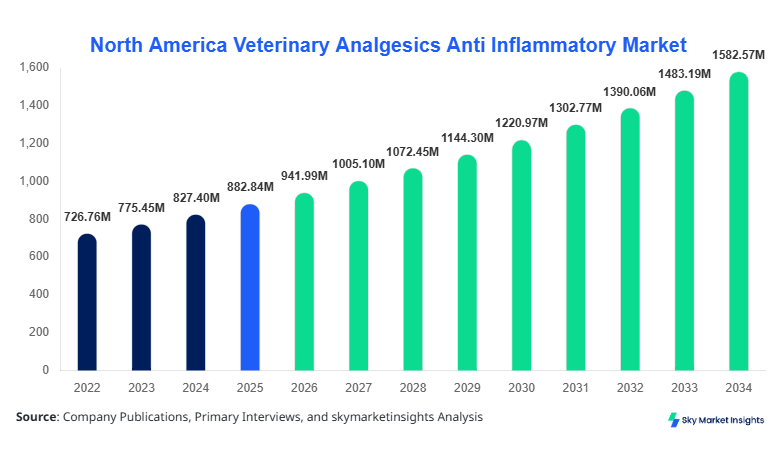
North America Veterinary Analgesics Anti Inflammatory Market size is projected at USD 941.99 million in 2026 and is expected to hit USD 1,590.44 million by 2034 with a CAGR of 6.7%. The 2025 base-year valuation stood at USD 882.29 million, indicating an absolute forecast-period addition of USD 648.45 million. Assessment of drug classes, animal types, administration routes, indications, distribution channels, end users, country performance, and the competitive landscape is essential for identifying commercial opportunities across veterinary pain-management applications.
Key Takeaways
- The United States dominates geographically, accounting for approximately 75.59% of 2026 revenue, while Canada represents 24.41%.
- NSAIDs dominate drug classes, contributing approximately 52.54% of classified 2026 revenue.
- Opioids are the fastest-growing reported drug class, expanding at a 6.88% CAGR through 2034.
- The United States is forecast to reach USD 1,206.18 million by 2034, expanding at 6.81% CAGR.
- Canada is projected to increase from USD 229.93 million in 2026 to USD 384.26 million in 2034, registering 6.63% CAGR.
The North American veterinary analgesics and anti-inflammatory industry comprises prescription medicines used to control acute and chronic pain, inflammation, postoperative discomfort, musculoskeletal disorders, fever, and disease-associated pain in companion and livestock animals. In 2026, NSAIDs contribute USD 494.80 million, or 52.54%, of classified revenues, compared with USD 302.61 million, or 32.13%, for opioids and USD 144.29 million, or 15.32%, for adjunctive analgesics. Country-level revenue increases from USD 882.29 million in 2025 to USD 941.99 million in 2026, reflecting widening therapeutic penetration and adoption of prescription pain-management protocols.
Explore more data points, trends and opportunities Download Free Sample Report
North America Veterinary Analgesics Anti-Inflammatory Market Trends
Shift Toward Targeted and Multimodal Pain Management
Veterinary pain management is shifting from single-agent therapy toward multimodal protocols combining NSAIDs, opioids, adjunctive medicines and newer targeted therapeutics. FDA guidance identifies NSAIDs as a mainstay of canine and feline pain management and lists 6 principal active NSAID ingredients currently marketed for dogs and/or cats, while only 2 NSAIDs are approved for short-term postoperative use in cats. Robenacoxib, for example, is limited to a maximum 3-day course in cats.
Technology is simultaneously moving toward biologics and longer-duration administration. Librela, an anti-NGF monoclonal antibody for canine osteoarthritis pain, is administered once monthly, and Zoetis reported that more than 1 million U.S. dogs had been treated since its October 2023 launch by February 2025. These treatment models reduce daily dosing requirements while strengthening demand for veterinarian-supervised, species-specific pain protocols.
North America Veterinary Analgesics Anti-Inflammatory Market Drivers
Growing Clinical Emphasis on Osteoarthritis and Postoperative Pain Control
Longer companion-animal lifespans, greater orthopedic intervention and heightened recognition of chronic pain are increasing pharmaceutical utilization. FDA documentation identifies multiple approved NSAIDs for osteoarthritis and postoperative indications, including carprofen, deracoxib, firocoxib, meloxicam and robenacoxib. Cats remain more restricted: only 2 NSAIDs have short-term postoperative approvals, robenacoxib treatment is capped at 3 days, and repeated meloxicam dosing is not approved. These differences reinforce demand for diversified analgesic protocols and veterinarian-led monitoring.
North America Veterinary Analgesics Anti-Inflammatory Market Restraints
Safety Monitoring and Species-Specific Restrictions Limit Treatment Flexibility
Adverse-event concerns, prescription requirements and narrow species-specific labels constrain unrestricted analgesic utilization. FDA guidance states that 0 over-the-counter NSAIDs for dogs and cats are FDA-approved, while feline robenacoxib therapy is restricted to 3 days and meloxicam to a single subcutaneous injection for approved feline postoperative use. In February 2025, Librela labeling was also revised with additional post-approval safety information and client communication requirements, increasing pharmacovigilance responsibilities for clinics.
North America Veterinary Analgesics Anti-Inflammatory Market Opportunities
Generic Medicines and New Pain-Management Modalities Expand Treatment Access
Generic launches can broaden therapeutic availability while reducing dependence on individual branded products. On March 9, 2026, FDA approved the first generic injectable robenacoxib for postoperative pain and inflammation in dogs and cats; dosing is permitted once daily for up to 3 days. On May 12, 2026, FDA conditionally approved pregabalin chewable tablets for pain associated with Chiari-like malformation and syringomyelia in dogs, illustrating continuing diversification beyond conventional NSAID pathways.
Challenges in North America Veterinary Analgesics Anti-Inflammatory Market
Balancing Long-Term Pain Relief With Pharmacovigilance Requirements
Manufacturers and veterinarians must balance efficacy, convenient dosing and chronic-treatment requirements against adverse-event surveillance. Librela provides pain control for approximately 1 month per injection, but FDA's 2025 labeling changes strengthened owner communication and post-approval safety information. Conventional feline NSAID options remain particularly constrained, with only 2 approved short-term agents and a maximum 3-day robenacoxib regimen, creating continuing unmet need for durable and well-tolerated therapies.
Report Scope
| Report Metric | Details |
|---|---|
| Market Size in 2025 | USD 882.67 Million |
| Market Size in 2026 | USD 941.99 Million |
| Market Size in 2034 | USD 1590.44 Million |
| CAGR | 6.7% (2026-2034) |
| Base Year for Estimation | 2025 |
| Historical Data | 2022-2024 |
| Forecast Period | 2026-2034 |
| Report Coverage | Revenue Forecast, Competitive Landscape, Supply Chain Disruption, Growth Factors, Environment & Regulatory Landscape and Trends |
Explore more data points, trends and opportunities Download Free Sample Report
North America Veterinary Analgesics Anti-Inflammatory Market Segmentation
The market is segmented by drug class, animal type, route of administration, indication, distribution channel and end user. Among quantified drug classes, NSAIDs dominate with 52.54% of 2026 classified revenue, followed by opioids at 32.13% and adjunctive analgesics at 15.32%.
By Drug Class
NSAIDs are the largest quantified category, increasing from USD 494.80 million in 2026 to USD 830.04 million by 2034, at a 6.68% CAGR. The category includes carprofen, meloxicam, firocoxib, deracoxib, robenacoxib, ketoprofen, flunixin meglumine and tolfenamic acid.
Opioids, including buprenorphine, butorphanol and fentanyl patches, are the fastest-growing reported class at 6.88% CAGR, reaching USD 515.29 million in 2034 from USD 302.61 million in 2026. Adjunctive analgesics, including gabapentin, amantadine and tramadol, register 6.61% CAGR.
By Animal Type
Companion animals comprise dogs, cats and other pets, while livestock includes cattle, swine, poultry, sheep and goats, and horses. Demand spans chronic osteoarthritis treatment, postoperative care and acute inflammatory conditions.
Dogs represent a central therapeutic population because of broad availability of prescription NSAIDs and chronic osteoarthritis treatments, while cattle and horses support livestock and large-animal demand. No separate numerical animal-type forecast was supplied.
By Route of Administration
Oral products include tablets, chewables and liquids/suspensions, complemented by injectable, topical/transdermal and other formulations. Oral therapies support recurring home administration, whereas injectables remain important in clinical and perioperative settings.
Topical/transdermal delivery includes patches and creams/gels and provides alternatives where oral administration is unsuitable. No route-specific revenue or CAGR was supplied in the mandatory dataset.
By Indication
Applications include postoperative pain, musculoskeletal disorders, equine colic, fever and inflammation management, and infectious disease-associated pain. Musculoskeletal disorders are commercially significant because chronic treatment can require repeated medication.
Postoperative pain supports short-duration NSAID and opioid use across veterinary hospitals, while fever and inflammatory conditions extend application into production animals. No indication-level numerical forecast was provided.
By Distribution Channel
Veterinary clinics and hospitals, retail pharmacies, online pharmacies and feed stores/agricultural cooperatives constitute the principal channels. Prescription-dependent medicines reinforce the role of veterinarian-directed dispensing.
Online pharmacies improve refill accessibility for recurring therapies, whereas agricultural cooperatives support livestock-oriented distribution. No channel-level CAGR or market value was supplied.
By End User
Veterinarians, pet owners, livestock owners/farmers and animal-welfare organizations form the end-user base. Veterinarians influence prescribing and treatment selection, particularly for prescription-only NSAIDs and opioids.
Pet owners represent the downstream user group for companion-animal oral therapies, while farmers require scalable pain and inflammation management across livestock populations. No end-user-specific revenue forecast was supplied.
North America Veterinary Analgesics Anti Inflammatory Market Segmentations
By Drug Class
-
NSAIDs (Non-Steroidal Anti-Inflammatory Drugs)
- Carprofen
- Meloxicam
- Firocoxib
- Deracoxib
- Robenacoxib
- Ketoprofen
- Flunixin Meglumine
- Tolfenamic Acid
-
Opioids
- Buprenorphine
- Butorphanol
- Fentanyl (patches)
-
Adjunctive Analgesics
- Gabapentin
- Amantadine
- Tramadol
By Animal Type
-
Companion Animals
- Dogs
- Cats
- Others (rabbits, ferrets, etc.)
-
Livestock Animals
- Cattle
- Swine
- Poultry
- Sheep and Goats
- Horses
By Route of Administration
-
Oral
- Tablets
- Chewables
- Liquids/Suspensions
- Injectable
-
Topical / Transdermal
- Patches
- Creams/Gels
- Others
By Indication
- Post-operative Pain
- Musculoskeletal Disorders (e.g., osteoarthritis)
- Colic Pain (horses)
- Fever and Inflammation Management
- Infectious Disease–associated Pain
By Distribution Channel
- Veterinary Clinics and Hospitals
- Retail Pharmacies
- Online Pharmacies
- Feed Stores / Agricultural Cooperatives
By End User
- Veterinarians
- Pet Owners
- Livestock Owners / Farmers
- Animal Welfare Organizations
North America Veterinary Analgesics Anti-Inflammatory Market Countries Outlook
1. U.S.
The United States contributes approximately 75.59% of North American 2026 revenue, with value rising from USD 666.66 million in 2025 to USD 712.06 million in 2026. It is forecast to reach USD 1,206.18 million by 2034, representing a 6.81% CAGR and maintaining the largest country contribution.
The country benefits from extensive companion-animal pharmaceutical utilization, veterinary hospitals and prescription pain-management infrastructure. Its 2034 contribution remains approximately 75.84% of the supplied regional country total.
2. Canada
Canada accounts for approximately 24.41% of 2026 regional revenue. Value increases from USD 215.63 million in 2025 to USD 229.93 million in 2026 and is projected to reach USD 384.26 million by 2034, representing a 6.63% CAGR.
Canada consequently adds approximately USD 154.33 million between 2026 and 2034. Companion-animal care and livestock applications support its diversified demand base, while the country retains approximately 24.16% of the supplied 2034 regional total.
Top players in North America Veterinary Analgesics Anti-Inflammatory Market
- Zoetis Inc.
- Elanco Animal Health Incorporated
- Boehringer Ingelheim
- Merck Animal Health
- Dechra Pharmaceuticals
- Ceva Santé Animale
- Vetoquinol
- Virbac
- Norbrook Laboratories
- Bimeda
- Chanelle Pharma
- Cronus Pharma
- ZyVet Animal Health
Top Two Companies
-
Zoetis Inc. Positioning
Zoetis maintains a prominent position in companion-animal pain management through established and newer therapeutic modalities, including Librela for canine osteoarthritis. By February 2025, the company reported treatment of more than 1 million U.S. dogs with Librela since its October 2023 launch. The product's once-monthly administration differentiates it from daily oral pain medicines. The February 2025 U.S. label update also illustrates the importance of post-market pharmacovigilance and veterinarian-owner communication. A verified company-specific percentage revenue share for this defined market was not publicly disclosed in the reviewed sources and is therefore not fabricated.
-
Elanco Animal Health Positioning
Elanco participates in veterinary osteoarthritis pain management through Galliprant, a prescription canine therapy based on grapiprant. FDA identifies grapiprant among currently marketed approved veterinary NSAIDs and specifies its use for controlling pain and inflammation associated with osteoarthritis in dogs. This places Elanco within the commercially important chronic canine pain-management segment alongside established NSAID competitors and emerging biologic approaches. A reliable percentage company share for the narrowly defined North American market is not disclosed in the supplied data or reviewed authoritative materials; accordingly, no unsupported share estimate is assigned.
Recent Developments in North America Veterinary Analgesics Anti-Inflammatory Market
- 2026: FDA approved the first generic robenacoxib injectable on March 9, providing a bioequivalent alternative to Onsior for postoperative pain and inflammation in dogs and cats.
- 2026: On May 12, FDA conditionally approved Liavium-CA1 pregabalin chewable tablets for management of pain and clinical signs associated with Chiari-like malformation and syringomyelia in dogs.
- 2026: On June 22, FDA recorded approval of ZyVet Animal Health's meloxicam oral suspension for control of osteoarthritis-associated pain and inflammation in dogs.
- 2025: FDA implemented safety-related labeling changes for Librela on February 18, including post-approval experience and additional client information concerning adverse events.
- 2025: Zoetis announced its U.S. Librela label update on February 4, reporting that more than 1 million dogs in the United States had received the treatment since launch.
Research Methodology
The analysis uses 2025 as the base year, 2026 as the current year, historical assessment covering 2022–2024, and forecasts through 2034. Mandatory supplied country and drug-class tables serve as the primary quantitative dataset; percentage contributions are calculated directly from those values without changing reported figures. Secondary validation uses FDA regulatory information and manufacturer disclosures for therapeutic indications, approvals and recent developments. The framework evaluates 6 segmentation dimensions, 2 North American countries, 3 quantified drug classes, and forecast CAGRs spanning 6.61%–6.88% across reported drug categories.
Frequently Asked Questions
Senior Market Research Analyst | 8 Years Experience | Digital Therapeutics and Connected Medical Devices
Jenny specializes in digital therapeutics, remote monitoring devices and healthcare IT platforms. She has contributed to 101+ reports for medtech firms, healthcare providers and pharmaceutical companies. Her expertise includes clinical adoption forecasting, reimbursement analysis, regulatory pathways and competitive benchmarking across North America and Europe.