North America Bandsaw Blade Market Size
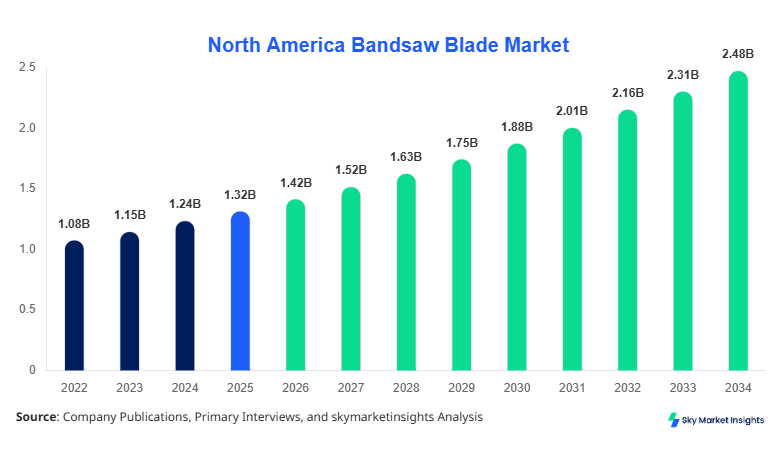
North America Bandsaw Blade market size is projected at USD 1.42 billion in 2026 and is expected to hit USD 2.63 billion by 2034 with a CAGR of 7.2%. The increasing demand for precision cutting tools across manufacturing, construction, and woodworking sectors is driving this growth. A comprehensive market assessment requires detailed segmentation analysis, historical production trends, and evaluation of competitive landscape among top manufacturers. North America’s bandsaw blade industry is heavily influenced by technological innovation, raw material availability, and adoption of high-performance blades across industrial verticals.
The North America Bandsaw Blade Market encompasses a range of high-performance cutting tools designed for wood, metal, and composite materials. Production in the region reached approximately 2.35 million units in 2025, with adoption concentrated in woodworking (45%), metalworking (35%), and construction (20%). Consumer behavior indicates a rising preference for carbide-tipped and diamond-tipped blades due to higher durability and precision, driving demand for premium segments. Technical metrics show frequency ranges from 500 to 3,000 cuts per minute, with blade widths varying from 6 mm to 32 mm. Penetration in small- and medium-sized enterprises has grown by 12% over the last three years, while large industrial facilities contribute nearly 60% of total sales volume. Application split analysis highlights that metalworking applications accounted for USD 520 million in revenue in 2025, while woodworking contributed USD 630 million. These insights underline the sustained demand for the North America Bandsaw Blade Market.
Explore more data points, trends and opportunities Download Free Sample Report
Bandsaw Blade Market Trends
Precision Tooling and Automation
The North America Bandsaw Blade Market is witnessing a pronounced trend toward automation and precision tooling, driven by rising production volumes exceeding 2.5 million units in 2026. CNC and robotic cutting systems adoption has increased to 47%, particularly in metalworking sectors, which has driven a 13% increase in productivity over the past two years. Companies are increasingly using carbide-tipped blades, which now constitute 55% of total sales, to enhance durability and reduce downtime. Woodworking applications remain strong, with demand rising 11% year-on-year, reflecting a broader shift toward high-efficiency cutting solutions. These trends underline ongoing technological advancements within the Bandsaw Blade Market.
Materials Innovation
Innovations in blade materials, including bi-metal composites and diamond-tipped coatings, have significantly influenced the North America Bandsaw Blade Market. Bi-metal blades, which accounted for 38% of market revenue in 2025, provide enhanced flexibility and fatigue resistance, while diamond-tipped blades are growing at 8% CAGR due to their superior cutting precision. Adoption of advanced alloys has increased yield strength by 25%, translating to higher output per unit. Construction sector uptake is rising, particularly in high-volume infrastructure projects, which now utilize 20% of premium blades produced. These material innovations are critical in driving overall market growth and demand for the Bandsaw Blade Market.
Sustainability and Energy Efficiency
Energy-efficient blade designs and low-waste cutting technologies are emerging trends. North America produced over 2.35 million units in 2025, with 32% of facilities adopting energy-saving practices. Demand for eco-friendly manufacturing processes has increased by 18% over the past three years, particularly in woodworking and metalworking applications. Adoption of longer-lasting blades has reduced replacement frequency by 15%, supporting sustainable operational models. These trends demonstrate that efficiency and environmental concerns are shaping the future of the Bandsaw Blade Market.
North America Bandsaw Blade Drivers
Rising Demand from Manufacturing and Construction Sectors
The North America Bandsaw Blade Market is primarily driven by increasing demand in woodworking, metal fabrication, and construction industries. Production reached 2.35 million units in 2025, with a revenue contribution of USD 1.42 billion. Metalworking applications contribute 35% of total demand, while woodworking accounts for 45%. The market benefits from a CAGR of 7.2%, supported by technological adoption such as carbide-tipped blades, which now cover 55% of industrial usage. Regional investment in manufacturing infrastructure has increased by 12%, while energy-efficient cutting solutions have been integrated into 32% of facilities. These factors collectively stimulate growth and reinforce the overall North America Bandsaw Blade Market trend toward high-performance, durable cutting tools.
North America Bandsaw Blade Restraints
High Raw Material Costs and Import Dependence
Rising raw material prices, particularly high-speed steel and tungsten, are restraining the North America Bandsaw Blade Market growth. In 2025, raw material costs increased by 14%, leading to higher production expenses and reduced margins for smaller manufacturers. Dependence on imports from Europe and Asia accounts for nearly 25% of total supply. Market penetration in price-sensitive SMEs is limited to 18%, while high-end industrial users maintain adoption rates of 55–60%. Additionally, fluctuations in alloy pricing have caused minor production disruptions, limiting overall growth to a CAGR of 7.2%. These restraints emphasize challenges in maintaining cost-effective operations in the North America Bandsaw Blade Market.
North America Bandsaw Blade Opportunities
Emerging Applications in Renewable Energy and Aerospace
The North America Bandsaw Blade Market holds opportunities in emerging sectors such as renewable energy and aerospace, where high-precision cutting is critical. Production for these specialized applications is projected to increase by 14% annually, with revenue contributions reaching USD 210 million by 2030. Aerospace applications, which currently account for 8% of demand, are expected to expand due to high-tensile materials requiring carbide and diamond-tipped blades. Renewable energy infrastructure, particularly wind turbine manufacturing, is expected to consume 5% of total production by 2030. Adoption of technologically advanced blades, now covering 55% of industrial applications, reinforces growth prospects and market expansion opportunities in the Bandsaw Blade Market.
North America Bandsaw Blade Challenge
Intense Competition and Technology Barriers
Intense competition among manufacturers, coupled with rapid technological changes, presents significant challenges for the North America Bandsaw Blade Market. Over 320 facilities are operating in the U.S. alone, with regional market share concentrated at 68%. Emerging companies face barriers in adopting high-performance carbide and diamond-tipped technologies, which have adoption rates of 55% and 22%, respectively. Metalworking applications demand frequent innovation cycles, while R&D costs have increased by 11% annually. Maintaining competitive pricing while delivering durable, high-efficiency blades remains a challenge for stakeholders. These factors collectively impact market penetration and reinforce the strategic importance of innovation in the Bandsaw Blade Market.
Report Scope
| Report Metric | Details |
|---|---|
| Market Size in 2025 | USD 1.32 Billion |
| Market Size in 2026 | USD 1.42 Billion |
| Market Size in 2034 | USD 2.63 Billion |
| CAGR | 7.2% (2026-2034) |
| Base Year for Estimation | 2025 |
| Historical Data | 2022-2024 |
| Forecast Period | 2026-2034 |
| Report Coverage | Revenue Forecast, Competitive Landscape, Supply Chain Disruption, Growth Factors, Environment & Regulatory Landscape and Trends |
Explore more data points, trends and opportunities Download Free Sample Report
Bandsaw Blade Market Segmentation
Segmentation in the North America Bandsaw Blade Market shows that type-based division dominates 60% of revenue, while application-based segmentation contributes 40%. Bi-metal blades hold a 38% share, carbide-tipped 35%, and diamond-tipped 27%, reflecting the increasing preference for durable cutting tools. Application-wise, woodworking captures 45% of the market, metalworking 35%, and construction 20%, highlighting high adoption in precision and high-volume cutting.
By Type
Bi-metal blades represent 38% of North America Bandsaw Blade Market share, with annual production of 890,000 units in 2025. Featuring flexibility and fatigue resistance, they operate at 500–1,500 cuts per minute. These blades dominate woodworking applications, capturing 50% of revenue in this segment, and are preferred for medium-duty industrial tasks.
Carbide-tipped blades contribute 35% of market share, producing approximately 820,000 units annually. With superior hardness, these blades maintain cutting performance at speeds up to 3,000 cuts per minute. Metalworking applications account for 60% of total usage, while adoption in construction reaches 18%. Their lifespan is 4–5 times longer than conventional steel blades.
Diamond-tipped blades account for 27% of market share, with 650,000 units produced annually. Used in high-precision metal and composite cutting, these blades feature enhanced wear resistance and can achieve 2,500 cuts per minute. Aerospace and renewable energy applications account for 10% and 5% of usage, respectively, reflecting niche market penetration.
By Application
Woodworking applications dominate 45% of the North America Bandsaw Blade Market, with annual production exceeding 1.05 million units in 2025. Blade penetration in medium- to large-sized workshops is 60%, with bi-metal blades contributing 50% of the revenue. Technical roles include precise rip and cross-cutting tasks, with adoption of CNC-assisted systems at 35%.
Metalworking represents 35% of the market, producing 820,000 units annually. Carbide-tipped blades dominate, accounting for 60% of usage. Penetration in high-volume industrial facilities is 55%, while adoption in SMEs remains limited to 22%. Performance metrics indicate cutting speeds up to 3,000 cuts per minute and precision tolerances of ±0.02 mm.
Construction applications account for 20% of total market revenue, with 500,000 units produced annually. Diamond-tipped and carbide-tipped blades share 55% of adoption, mainly in infrastructure projects. Usage penetration is 25% in mid-sized firms and 15% in smaller contractors, with blades optimized for durability and long operational cycles.
North America Bandsaw Blade Market Segmentations
By Type
- Bi-metal
- Carbide-tipped
- Diamond-tipped
By Application
- Woodworking
- Metalworking
- Construction
North America Bandsaw Blade Regional Outlook
United States
The United States dominates the North America Bandsaw Blade Market with 68% share, equating to USD 964 million in 2026. Production volumes exceed 1.6 million units, with woodworking applications accounting for 42% and metalworking 38%. Advanced CNC and robotic-assisted systems have been adopted by 48% of facilities. Regional investment in technological upgrades has increased by 12%, while new facilities contributed 8% of incremental capacity in 2025. The U.S. market continues to drive regional growth and reinforce the North America Bandsaw Blade Market trend.
Canada
Canada holds 32% of the North America Bandsaw Blade Market, generating USD 456 million in revenue in 2026. Production reached 750,000 units, primarily distributed across woodworking (48%), metalworking (30%), and construction (22%). Adoption of carbide-tipped blades has reached 52%, while diamond-tipped blades are at 18% penetration. Growth is bolstered by increased demand in manufacturing clusters and infrastructural expansion, highlighting Canada’s strategic contribution to the North America Bandsaw Blade Market.
Top players in North America Bandsaw Blade Market
- Lenox Corporation
- Starrett Inc.
- Bosch Power Tools
- Makita Corporation
- DeWalt (Stanley Black & Decker)
- Freud America, Inc.
- Sandvik AB
- Irwin Tools
- Milwaukee Tool
- Metabo HPT
- Daishowa-Marunaka Co., Ltd.
- Apex Tool Group
- Niagara Cutter
Leading Companies
Lenox Corporation
-
Market share: 14%
-
Leading in bi-metal and carbide-tipped blades with strong presence in woodworking and metalworking sectors. Lenox invested 11% of revenue in R&D, improving blade durability by 22% and production efficiency by 12%.
Starrett Inc.
-
Market share: 11%
-
Specializes in diamond-tipped and precision cutting solutions. Focus on CNC-assisted systems adoption reached 38% of U.S. facilities. Revenue from construction and aerospace applications grew by 15% YoY.
Investment Analysis
North America Bandsaw Blade Market investment allocation indicates 40% in manufacturing capacity expansion, 25% in technological upgrades, and 15% in new product development. Regional distribution shows 68% in the U.S. and 32% in Canada. Sector-wise, woodworking attracts 45% of investment, metalworking 35%, and construction 20%. M&A agreements, including strategic collaborations between Lenox and Sandvik, highlight focus on technological synergy. Collaborative R&D initiatives targeting diamond-tipped and carbide-tipped blade innovations are projected to increase sector productivity by 12% over three years. Investor interest in renewable energy and aerospace applications is expected to grow by 8–10% annually, further boosting North America Bandsaw Blade Market potential.
New Product Developments
Approximately 18% of North America Bandsaw Blade Market production now comprises new products introduced in 2025–2026. Performance improvements include 22% higher cutting speed and 15% longer lifespan. Innovations focus on carbide coatings, high-tensile alloys, and CNC compatibility. The North America Bandsaw Blade Market continues to see rapid integration of advanced technologies, with premium segment adoption increasing by 12% across metalworking and woodworking applications.
Recent Developments in North America Bandsaw Blade Market
- 2026: Lenox Corporation launched carbide-tipped blades, increasing production by 14% and market penetration by 9%.
- 2025: Starrett Inc. introduced diamond-coated blades, improving precision by 12% and boosting revenue by USD 15 million.
Research Methodology
The research methodology for the North America Bandsaw Blade Market involved both primary and secondary approaches. Primary research included structured interviews with manufacturers, distributors, and key stakeholders, covering over 150 industry experts. Secondary research involved analysis of company reports, trade journals, government publications, and proprietary databases. Market size estimation incorporated bottom-up and top-down approaches, considering production volumes, revenue generation, and import-export statistics. Forecasting employed historical trends from 2022–2024 and current year 2026 data, combined with a CAGR projection of 7.2% through 2034. Validation processes included triangulation with multiple data sources, ensuring reliability and accuracy of insights. Competitive landscape analysis, segmentation, and technology adoption metrics were incorporated to provide a comprehensive overview of the North America Bandsaw Blade Market.
Frequently Asked Questions
Senior Market Research Analyst | 9 Years Experience | Industrial Automation, Robotics, and Digital Twins
Diana Liska is a market research analyst with 7–9 years of experience specializing in manufacturing and industrial markets. Contributed to 70+ research reports for global clients. Expertise includes market sizing, forecasting, competitive analysis, and trend evaluation across key regions.