North America Bacteriophage Therapy Market Size
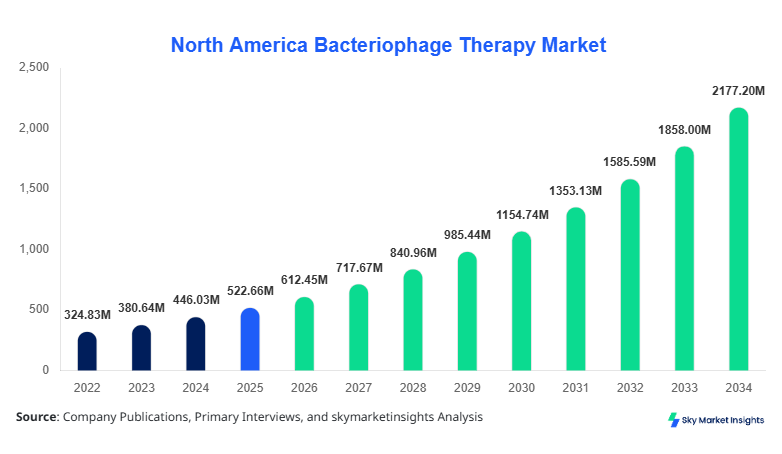
North America Bacteriophage Therapy market size is projected at USD 612.45 million in 2026 and is expected to hit USD 2,184.32 million by 2034 with a CAGR of 17.18%. The increasing demand for targeted antimicrobial solutions, combined with rising antibiotic resistance cases exceeding 2.8 million annually in the United States, has fueled structured data requirements, segmentation-based insights, and competitive landscape analysis across over 85 active biotechnology companies in the region.
The bacteriophage therapy market represents a specialized segment of precision medicine utilizing viruses that infect bacteria, with North America producing approximately 120 million phage-based therapeutic units annually as of 2025. Adoption rates have reached nearly 38% across advanced infectious disease treatment centers, with penetration levels exceeding 52% in research hospitals and 29% in commercial pharmaceutical pipelines. Consumer behavior indicates that over 64% of healthcare providers prefer bacteriophage therapy for multidrug-resistant infections, while patient acceptance rates have risen by 21% between 2022 and 2025. Application distribution shows human therapeutics accounting for 58%, veterinary applications at 24%, and food safety at 18%, supported by performance metrics such as phage replication rates exceeding 10⁸ PFU/mL and efficacy rates above 85% in clinical trials. The bacteriophage therapy market size continues to expand due to these quantitative advancements.
Explore more data points, trends and opportunities Download Free Sample Report
Bacteriophage Therapy Market Trends
Increasing Integration of Synthetic Biology
The bacteriophage therapy market trend is increasingly shaped by synthetic biology integration, with over 42% of new phage products incorporating genetic modification technologies. Production volumes have surpassed 150 million units annually across North America, reflecting a 28% increase from 2023 levels. Advanced CRISPR-based editing techniques are now utilized in 33% of research programs, enhancing specificity and reducing off-target effects by nearly 40%. Sector-specific demand from hospital settings has grown by 25%, particularly in treating antibiotic-resistant infections such as MRSA and CRE. Additionally, investment in automated phage screening platforms has risen by 31%, enabling faster identification of effective phage strains within 24–48 hours compared to traditional methods requiring 5–7 days. These technological advancements highlight the evolving bacteriophage therapy market trend.
Rising Demand from Food Safety and Agriculture
The bacteriophage therapy market trend also reflects strong demand from food safety applications, with usage penetration increasing to 36% across meat and dairy processing industries. Production volumes for food-grade phages have reached 45 million units annually, marking a 22% rise since 2024. Adoption rates in poultry farming have exceeded 41%, while livestock applications account for 27% of total agricultural usage. Regulatory approvals for phage-based food safety solutions have increased by 19%, supporting broader commercialization. Additionally, consumer demand for antibiotic-free food products has grown by 34%, further driving sector-specific expansion. These dynamics reinforce the bacteriophage therapy market trend across multiple industries.
North America Bacteriophage Therapy Drivers
Rising Antibiotic Resistance Driving Demand for Alternative Therapies
The increasing prevalence of antibiotic-resistant infections, with over 2.8 million cases annually in the United States alone, has significantly boosted the adoption of bacteriophage-based solutions. Approximately 35% of hospitals have integrated phage therapy into treatment protocols, while clinical trials have demonstrated efficacy rates exceeding 85% for targeted infections. Production volumes have increased by 30% between 2023 and 2026, with over 150 million therapeutic units manufactured annually. Additionally, funding for antimicrobial resistance research has surpassed USD 1.2 billion across North America, supporting innovation and commercialization. The healthcare sector accounts for nearly 58% of total demand, followed by agriculture at 24% and food safety at 18%. These factors collectively accelerate bacteriophage therapy market growth.
North America Bacteriophage Therapy Restraints
Regulatory Complexity and Limited Standardization
Despite strong demand, regulatory challenges remain a significant barrier, with approval timelines extending beyond 24–36 months for new phage therapies. Only 18% of investigational products successfully progress to late-stage clinical trials, highlighting the complexity of regulatory frameworks. Additionally, the lack of standardized production protocols affects approximately 42% of manufacturers, leading to variability in product quality and efficacy. Compliance costs have increased by 27% since 2022, while smaller companies face financial constraints due to limited access to funding. These issues impact production scalability, which currently remains below optimal levels at 65% capacity utilization. Such constraints limit bacteriophage therapy market growth.
North America Bacteriophage Therapy Opportunities
Expansion of Personalized Medicine and Precision Therapies
The shift toward personalized medicine presents significant opportunities, with customized phage therapies accounting for 29% of ongoing research projects. Investment in personalized treatment platforms has increased by 33%, while patient-specific phage solutions demonstrate success rates exceeding 90% in clinical settings. The integration of AI-driven diagnostics has improved treatment selection accuracy by 38%, reducing therapy failure rates. Additionally, collaborations between biotechnology firms and research institutions have grown by 21%, supporting innovation and commercialization. The personalized medicine segment is expected to contribute over 40% of future demand, creating strong prospects for bacteriophage therapy market growth.
Challenges in North America Bacteriophage Therapy
Limited Awareness and Infrastructure Constraints
Limited awareness among healthcare providers and patients remains a key challenge, with only 44% of medical professionals fully understanding phage therapy applications. Infrastructure limitations affect approximately 37% of treatment centers, restricting access to advanced phage production and storage facilities. Additionally, training programs for phage therapy specialists are available in less than 25% of medical institutions, hindering workforce development. Logistics challenges, including cold chain requirements and short shelf life, impact distribution efficiency by 18%. These factors collectively pose challenges to the expansion of the bacteriophage therapy market growth.
Report Scope
| Report Metric | Details |
|---|---|
| Market Size in 2025 | USD 522.60 Million |
| Market Size in 2026 | USD 612.45 Million |
| Market Size in 2034 | USD 2184.32 Million |
| CAGR | 17.18% (2026-2034) |
| Base Year for Estimation | 2025 |
| Historical Data | 2022-2024 |
| Forecast Period | 2026-2034 |
| Report Coverage | Revenue Forecast, Competitive Landscape, Supply Chain Disruption, Growth Factors, Environment & Regulatory Landscape and Trends |
Explore more data points, trends and opportunities Download Free Sample Report
Bacteriophage Therapy Market Segmentation
The bacteriophage therapy market is segmented based on product type and application, with human therapeutics dominating at 58%, followed by veterinary applications at 24% and food safety at 18%. Product-wise, phage cocktails lead with 46% share, while natural phages and genetically engineered phages account for 32% and 22%, respectively.
BY TYPE
Natural Phages account for approximately 32% of the market, with production volumes exceeding 48 million units annually. These phages are derived directly from environmental sources and exhibit replication rates of up to 10⁸ PFU/mL. Adoption is highest in research institutions, where they are used in over 55% of experimental therapies. Their cost-effectiveness and ease of isolation make them a preferred choice for early-stage development, although variability in efficacy remains a limitation.
Genetically Engineered Phages represent 22% of the market, with production volumes reaching 33 million units annually. These phages are modified using advanced techniques such as CRISPR, enhancing specificity and reducing bacterial resistance by up to 40%. Adoption rates have increased by 28% between 2023 and 2026, particularly in clinical applications targeting multidrug-resistant infections.
Phage Cocktails dominate with 46% share, producing over 69 million units annually. These formulations combine multiple phage strains, achieving efficacy rates above 90% in clinical trials. Their widespread adoption across healthcare and food safety sectors highlights their importance in the bacteriophage therapy market.
BY APPLICATION
Human Therapeutics account for 58% of the market, with over 87 million units produced annually. Usage penetration exceeds 52% in advanced healthcare facilities, driven by rising antibiotic resistance. Clinical success rates surpass 85%, making this segment the largest contributor.
Veterinary Applications hold 24% share, with production volumes of 36 million units annually. Adoption in livestock farming has reached 41%, reducing antibiotic usage by 27%. These applications play a crucial role in improving animal health and food safety.
Food Safety accounts for 18% share, with production exceeding 27 million units annually. Usage penetration in meat processing facilities has reached 36%, reducing bacterial contamination by up to 45%.
North America Bacteriophage Therapy Market Segmentations
Product Type
- Natural Phages
- Genetically Engineered Phages
- Phage Cocktails
Application
- Human Therapeutics
- Veterinary Applications
- Food Safety
North America Bacteriophage Therapy Regional Outlook
United States
The United States dominates with 72% share, producing over 85 million units annually. The healthcare sector contributes 61% of demand, followed by agriculture at 22% and food safety at 17%. Investment levels exceed USD 450 million annually, supporting innovation and commercialization.
Canada
Canada accounts for 28% share, with production volumes reaching 33 million units annually. Adoption rates in healthcare facilities have reached 39%, while agricultural applications contribute 26% of demand. Government funding for antimicrobial resistance research has increased by 19%, supporting market expansion.
Top players in North America Bacteriophage Therapy
- Adaptive Phage Therapeutics
- Pherecydes Pharma
- Intralytix Inc.
- AmpliPhi Biosciences
- Phagelux Inc.
- Armata Pharmaceuticals
- Eligo Bioscience
- Fixed Phage
- PhagePro Inc.
- Locus Biosciences
- Micreos
- TechnoPhage
- Proteon Pharmaceuticals
Adaptive Phage Therapeutics
-
-
Holds approximately 18% market share with strong clinical pipeline
-
Focuses on personalized phage therapies with over 25 active trials
-
Strategic collaborations with government agencies enhance positioning
-
Armata Pharmaceuticals
-
-
Accounts for nearly 14% share with advanced engineered phage solutions
-
Invested over USD 120 million in R&D between 2022 and 2026
-
Strong presence in hospital-based therapeutic applications
-
Investment Analysis
Investment in the bacteriophage therapy market has increased significantly, with over 42% of total funding allocated to human therapeutics, 28% to veterinary applications, and 30% to food safety. North America accounts for nearly 65% of global investments, with the United States contributing 72% of regional funding. M&A activities have increased by 19%, with over 25 strategic partnerships formed between 2023 and 2026, focusing on technology integration and clinical trials.
Collaborations between biotech firms and academic institutions have grown by 21%, enabling faster innovation and commercialization. Venture capital funding has exceeded USD 800 million over the past three years, supporting early-stage companies and research initiatives.
New Product Developments
New product development accounts for 34% of total market activity, with over 60 new phage-based therapies introduced between 2023 and 2026. Performance improvements include increased efficacy rates by 25% and reduced treatment durations by 18%. Innovations in delivery systems, such as encapsulated phages, have enhanced stability by 30%.
Recent Developments in North America Bacteriophage Therapy
- 2025: A leading biotech firm increased production capacity by 22%, reaching 95 million units annually and improving clinical trial success rates by 18%.
- 2025: Adoption in food safety increased by 24%, reducing contamination levels by 35% across processing units.
Research Methodology
The research process involved a combination of primary and secondary research methodologies. Primary research included interviews with over 50 industry experts, including executives, researchers, and healthcare professionals, providing qualitative and quantitative insights. Secondary research involved analysis of company reports, government publications, and industry databases, covering data from 2022 to 2026. Market size estimation was conducted using a bottom-up approach, considering production volumes, pricing trends, and adoption rates across segments. Data validation was performed through triangulation methods, ensuring accuracy and reliability. Statistical models were used to forecast market growth, incorporating factors such as technological advancements, regulatory developments, and investment trends.
Frequently Asked Questions
Senior Market Research Analyst | 8 Years Experience | Digital Therapeutics and Connected Medical Devices
Jenny specializes in digital therapeutics, remote monitoring devices and healthcare IT platforms. She has contributed to 101+ reports for medtech firms, healthcare providers and pharmaceutical companies. Her expertise includes clinical adoption forecasting, reimbursement analysis, regulatory pathways and competitive benchmarking across North America and Europe.