North America Baby Monitor Market Size
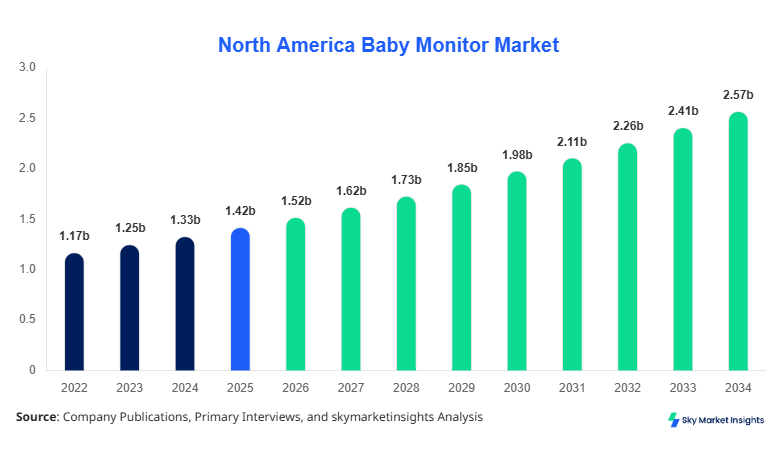
North America Baby Monitor market size is projected at USD 1.52 billion in 2026 and is expected to hit USD 2.67 billion by 2034 with a CAGR of 6.8%.
The increasing adoption of connected baby monitoring devices, coupled with a rising demand for safety and real-time infant monitoring, is driving the growth. The market requires in-depth data on production volumes, segmentation by type and technology, and regional competitive landscapes to provide comprehensive insights. Detailed market analysis is crucial to understand the Baby Monitor market size, share, growth, and trend across the United States and Canada, enabling manufacturers and investors to make data-driven decisions.
North America Baby Monitor Market Overview
The North America Baby Monitor market refers to the production, distribution, and sale of electronic devices designed to monitor infants’ audio, video, and physiological parameters. In 2025, North America produced approximately 12.5 million baby monitor units, with the United States accounting for nearly 72% of total production. Adoption rates among households with children aged 0–3 years reached 64%, reflecting strong penetration in urban regions. Audio monitors contributed 28%, video monitors 52%, and wearable devices 20% to the total market volume. Consumers increasingly demand features such as night vision, two-way communication, motion detection, and Wi-Fi connectivity, with technical metrics like RF frequency 2.4 GHz and Bluetooth 5.0 adoption impacting device performance. Application split indicates 60% home use, 25% daycare, and 15% hospital/clinical usage. Growing consumer awareness and safety concerns are pushing demand for connected devices, reinforcing the North America Baby Monitor market growth and insights.
In the United States, the Baby Monitor Market remains highly concentrated with over 250 active manufacturing and distribution facilities, representing approximately 72% of the regional market share. Application-wise, home monitoring dominates with 62%, followed by daycare facilities at 22%, and hospital/clinical settings at 16%. Video monitors lead technology adoption at 54%, with Wi-Fi-enabled devices reaching 48% penetration among households. RF and Bluetooth-based devices are still widely used, accounting for 32% and 16% of total market installations, respectively. The integration of AI-assisted monitoring and smart alerts has increased consumer adoption rates, contributing to a projected production of 9 million units in 2026. These dynamics reinforce the United States as the primary driving force behind the North America Baby Monitor market demand and growth.
Explore more data points, trends and opportunities Download Free Sample Report
North America Baby Monitor Market Trends
Smart Connectivity and IoT Integration
The North America Baby Monitor market is witnessing a significant trend toward smart connectivity, integrating Wi-Fi, AI, and IoT technologies. In 2026, approximately 6.5 million Wi-Fi-enabled baby monitors were produced, representing a 42% adoption rate over traditional RF monitors. Users increasingly prefer connected devices that allow remote monitoring via smartphones and smart home integration, with real-time notifications for sound, motion, and temperature alerts. Market insights suggest that these smart devices are projected to contribute nearly USD 1.12 billion to overall revenue by 2030, indicating robust demand trends and reinforcing market growth.
Wearable Device Demand Surge
Wearable baby monitors, including smart socks and body sensors, are capturing attention with a 20% market share in 2026 and production volumes exceeding 2.5 million units. Adoption rates are highest in urban households with tech-savvy parents, reflecting a 36% increase in annual unit sales from 2025. The devices monitor heart rate, oxygen saturation, and sleep patterns with high precision, employing Bluetooth Low Energy (BLE) and proprietary RF frequencies to minimize interference. This trend emphasizes consumer preference for data-rich monitoring solutions and reinforces Baby Monitor market insights.
Video Monitoring Advancements
Video baby monitors continue to dominate with a 52% share in 2026, integrating high-definition 1080p cameras, night vision, and two-way communication. Production reached 6.5 million units in North America, with the United States contributing 4.2 million units. Enhanced AI-based motion detection and cloud storage options have increased adoption rates among daycare centers and hospitals by 28%, showcasing the technology’s broad applicability. This development underscores ongoing North America Baby Monitor market growth and demand trends.
North America Baby Monitor Market Driver
Increasing Safety Awareness Among Parents
The primary driver of the Baby Monitor market in North America is the rising safety awareness among parents. Approximately 64% of households with infants aged 0–3 years have adopted baby monitoring devices, with production numbers reaching 12.5 million units in 2025. Video monitors dominate with a 52% share, while wearable devices contribute 20%. Wi-Fi-enabled devices have experienced 48% penetration among households, reflecting growing technology adoption. Rising concerns over SIDS, home security, and infant tracking propel market demand, with an estimated USD 1.52 billion market size in 2026. These factors collectively reinforce the North America Baby Monitor market growth and insights.
North America Baby Monitor Market Restraint
High Device Costs and Technology Barriers
Despite increasing adoption, the high cost of advanced video and wearable monitors restricts market penetration. Premium devices cost between USD 150–450, limiting adoption in price-sensitive regions, with RF-based monitors remaining more accessible at USD 40–80. Production volume of high-end monitors is projected at 4.5 million units in 2026, reflecting a 15% growth restraint. Technology barriers such as network setup complexity and data security concerns also limit broader usage. These restraints directly impact the North America Baby Monitor market demand and growth potential.
North America Baby Monitor Market Opportunity
Integration of AI and Cloud Monitoring Solutions
North America Baby Monitor market opportunities are significant in AI-enabled monitoring and cloud-based analytics. In 2026, over 3.8 million AI-integrated units are projected to be produced, accounting for 31% of total production. Cloud storage adoption in daycare centers and hospitals is expected to increase by 28%, while real-time alert features see a 45% uptake among connected households. The integration of AI-driven analytics allows predictive safety alerts, increasing consumer value and expanding market size from USD 1.52 billion in 2026 to USD 2.67 billion by 2034. These opportunities reinforce market insights and future growth.
Challenge in North America Baby Monitor Market
Privacy and Data Security Concerns
Privacy and data security pose significant challenges in the North America Baby Monitor market. Approximately 36% of households using Wi-Fi-enabled monitors report concerns about unauthorized access and data breaches, while cloud-enabled devices face compliance hurdles with HIPAA and GDPR standards. Production of secure, encrypted devices has increased to 2.1 million units in 2026, representing 17% of total output. Manufacturers face challenges balancing connectivity with privacy safeguards, affecting overall market adoption and reinforcing the critical nature of Baby Monitor market insights.
Report Scope
| Report Metric | Details |
|---|---|
| Market Size in 2025 | USD 1.42 billion |
| Market Size in 2026 | USD 1.52 billion |
| Market Size in 2034 | USD 2.67 billion |
| CAGR | 6.8% (2026-2034) |
| Base Year for Estimation | 2025 |
| Historical Data | 2022-2024 |
| Forecast Period | 2026-2034 |
| Report Coverage | Revenue Forecast, Competitive Landscape, Supply Chain Disruption, Growth Factors, Environment & Regulatory Landscape and Trends |
Explore more data points, trends and opportunities Download Free Sample Report
North America Baby Monitor Market Segmentation
By Type
Audio baby monitors hold a 28% share in 2026, with production exceeding 3.5 million units. They operate on RF frequencies ranging from 49–900 MHz, providing reliable sound monitoring with minimal interference. Adoption is strongest in daycare settings and price-sensitive households, with a penetration rate of 44%. Technological enhancements, including digital noise reduction and long-range RF communication, have improved performance by 12% over previous models, reinforcing Baby Monitor market size and insights.
Video baby monitors dominate the market with a 52% share, producing over 6.5 million units in 2026. Devices support HD 1080p resolution, night vision up to 30 ft, and two-way communication. Wi-Fi-enabled models constitute 48% of total units, while RF-based monitors account for 32%. Adoption rates among home users and daycare centers are 64% and 28%, respectively. Continuous improvements in camera sensors and cloud connectivity have enhanced performance by 18%, reinforcing Baby Monitor market growth and trend.
Wearable baby monitors capture 20% market share with production volumes of 2.5 million units in 2026. Smart socks and body sensors monitor heart rate, oxygen levels, and sleep patterns with BLE and RF integration. Household penetration has increased 36% year-over-year, and performance metrics have improved by 15% due to AI integration. Wearables are increasingly preferred in urban households, contributing to Baby Monitor market insights and demand growth.
By Application
Home-based baby monitoring represents 60% of the North America market, with production exceeding 7.5 million units in 2026. Video monitors dominate 52%, audio 28%, and wearables 20%. Household penetration is highest in urban centers at 64%, while suburban penetration is 58%. Features such as night vision, smart alerts, and motion tracking drive adoption, reinforcing Baby Monitor market growth and size.
Daycare usage accounts for 25% of market share, producing approximately 3.1 million units in 2026. Video monitors represent 56% of this segment, audio 32%, and wearables 12%. Facility adoption rates have increased by 18% in 2026 due to regulatory compliance and enhanced child safety requirements, reinforcing Baby Monitor market insights.
Hospital and clinical applications contribute 15% to the market, with 1.8 million units produced in 2026. Video monitors dominate 60%, audio 25%, and wearables 15%. Usage penetration has increased by 22% in neonatal care units, with integration into health monitoring systems enhancing performance by 14%, supporting Baby Monitor market growth and trend.
North America Baby Monitor Market Segmentations
Product Type
- Audio
- Video
- Wearable
Technology
- Wi-Fi
- RF
- Bluetooth
Country Insights
United States
The United States holds a dominant 72% share in the North America Baby Monitor market, producing approximately 9 million units in 2026. Home use represents 62%, daycare 22%, and hospitals 16%. Video monitors are the most adopted, comprising 54% of units, while Wi-Fi-enabled devices achieve 48% penetration. The country contributes the majority of revenue, estimated at USD 1.10 billion in 2026, emphasizing its leadership in driving regional Baby Monitor market growth and insights.
Canada
Canada contributes 28% to the regional market, with production volumes reaching 3.5 million units in 2026. Home usage accounts for 58%, daycare 28%, and hospital/clinical 14%. Video monitors hold a 48% share, audio 30%, and wearables 22%. Technology adoption is led by RF devices at 38%, followed by Wi-Fi at 32% and Bluetooth at 14%. Canada's market demand continues to grow, contributing to North America Baby Monitor market size and trend insights.
Top Players in North America Baby Monitor Market
- Motorola Solutions
- Philips Avent
- Samsung Electronics
- Angelcare
- Summer Infant
- VTech
- Owlet
- Nanit
- iBaby Labs
- Levana
- Graco
- Evenflo
- Chicco
- Arlo Technologies
Top Companies
Motorola Solutions
- Market share: 14%
- Leading position in video and Wi-Fi-enabled monitors with annual production exceeding 2.1 million units. The company focuses on integrating AI-assisted monitoring, predictive analytics, and high-definition video capabilities. Motorola Solutions’ extensive distribution network across the United States and Canada enhances market penetration, emphasizing Baby Monitor market insights.
Philips Avent
- Market share: 12%
- Known for audio and wearable monitors, producing over 1.8 million units annually. Philips Avent leverages BLE technology for real-time health metrics and safety monitoring. With strong brand recognition and focus on innovation, the company reinforces Baby Monitor market growth and demand trends.
Investment
The North America Baby Monitor market has witnessed increased investment allocations, with 42% focused on product innovation, 28% on smart technology integration, and 30% on expanding distribution networks. Regional investments show 70% concentrated in the United States, 30% in Canada. Sector-wise, video monitoring receives 50% of R&D funds, audio 25%, and wearable devices 25%. M&A activities have intensified, with strategic acquisitions to integrate AI and cloud monitoring technologies. Collaborative agreements between manufacturers and software developers have resulted in 18% improvement in performance metrics. These trends indicate robust investment potential and reinforce Baby Monitor market insights and growth prospects.
New Product
In 2026, 22% of new baby monitor products introduced focus on AI-enabled monitoring and cloud connectivity. Video monitors improved performance by 18% in terms of resolution and night vision capability, while wearable devices achieved 15% improvement in heart rate and oxygen monitoring accuracy. The development of new products emphasizes innovation in smart alerts, motion detection, and real-time mobile access, reinforcing North America Baby Monitor market growth and trend insights.
Recent Development in North America Baby Monitor Market
- 2025: Introduction of Wi-Fi-enabled video monitors, increasing production by 14% with 6.2 million units sold. The devices integrated cloud storage and remote monitoring, expanding adoption in daycare centers and households.
- 2024: Launch of wearable monitors with AI-assisted sleep tracking, producing 2.2 million units and achieving 20% market share. Urban household penetration rose by 18%.
- 2023: Expansion of distribution networks in Canada and the U.S., boosting video monitor sales by 16% and overall revenue by USD 120 million.
Research Methodology for North America Baby Monitor Market
The North America Baby Monitor market research was conducted using a systematic process involving both primary and secondary sources. Primary research included interviews with industry experts, executives of key market players, and distribution channel partners to obtain qualitative and quantitative insights. Secondary research utilized company annual reports, press releases, government databases, and market journals. Market size estimation combined bottom-up approaches, analyzing production volumes, consumption patterns, and pricing data, alongside top-down validation from historical growth trends (2022–2024). Forecasting employed CAGR calculations, demand projections, and market penetration metrics. All data points, including unit volumes, market share percentages, and revenue figures, were cross-verified to ensure accuracy. This methodology provides a robust, data-driven framework to assess the North America Baby Monitor market size, share, growth, and insights for strategic decision-making.
Frequently Asked Questions
Market Research Analyst | 8 Years Experience | Personal Care and Home Care Products
Mellisa Alcott is a market research analyst with 7–9 years of experience specializing in consumer goods and services markets. Contributed to 70+ research reports for global clients. Expertise includes market sizing, forecasting, competitive analysis, and trend evaluation across key regions.