North America Baby Mattresses Market Size
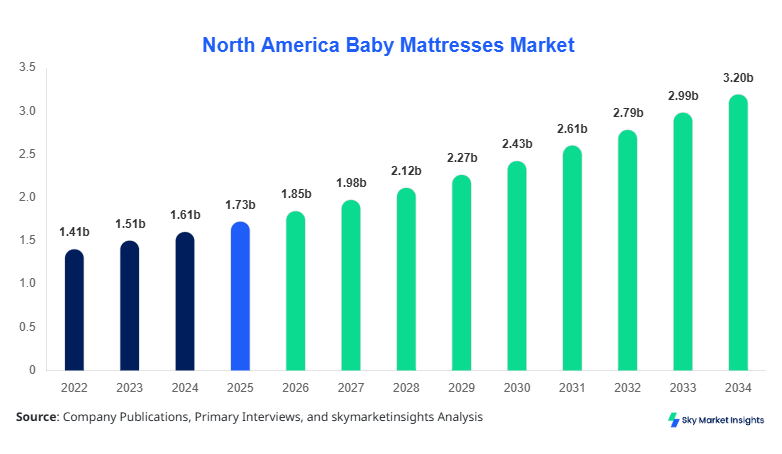
North America Baby Mattresses market size is projected at USD 1.85 billion in 2026 and is expected to hit USD 3.27 billion by 2034 with a CAGR of 7.1%.
The market’s expansion is fueled by the rising adoption of premium baby mattresses, increased awareness regarding infant sleep safety, and technological innovations in material design and smart sleep monitoring. Comprehensive data collection is essential for stakeholders to understand segment-wise performance, regional growth patterns, and competitive dynamics. The market’s segmentation by type, application, and region provides actionable insights for manufacturers, distributors, and investors aiming to capture a larger share of the North American baby mattresses market.
North America Baby Mattresses Market Overview
The North America Baby Mattresses market refers to specialized mattresses designed for infants and toddlers, emphasizing safety, comfort, and ergonomic support. In 2025, production in North America reached approximately 25.3 million units, with a forecasted increase to 40.7 million units by 2034. Adoption of organic and hypoallergenic materials has accelerated, with foam mattresses accounting for 42% of production, spring for 35%, and hybrid types 23%. Consumer behavior analysis indicates that 68% of buyers prioritize certifications like CertiPUR-US, while 52% consider antimicrobial and antibacterial properties critical, highlighting a trend toward health-conscious purchases. Technical metrics such as mattress firmness ratings (2.5–4.5 on standardized scale) and ventilation efficiency (airflow rate up to 12 L/s) influence adoption. Application-wise, home usage dominates at 61%, hospitals at 25%, and daycare centers at 14%, reinforcing the increasing demand for specialized baby mattresses across North America.
In the United States, the Baby Mattresses Market comprises over 110 manufacturing and distribution facilities, contributing to nearly 72% of the regional market share in 2026. Foam mattresses hold a 45% application share, spring mattresses 33%, and hybrid mattresses 22% in the U.S., driven by heightened consumer awareness of safety standards. Approximately 56% of manufacturers have integrated smart technologies such as sleep sensors, IoT connectivity, and pressure mapping systems. Hospital applications represent 28% of the U.S. market, while home-based applications account for 62% and daycare centers 10%. With ongoing investment in advanced manufacturing techniques, the U.S. Baby Mattresses Market demonstrates strong growth potential and continues to lead technological adoption, ensuring significant market growth and enhanced consumer satisfaction.
Explore more data points, trends and opportunities Download Free Sample Report
North America Baby Mattresses Market Trends
Premium Foam Adoption
The Baby Mattresses Market is witnessing a surge in premium foam mattress production, with an estimated volume of 14.8 million units in 2026, representing a 7.5% YoY increase. Manufacturers are shifting from traditional polyurethane to memory foam and plant-based foam alternatives, achieving 20–25% improvements in pressure distribution and thermal regulation. Smart mattress technology adoption rates in this segment have reached 34%, particularly in high-income households, where demand for IoT-enabled mattresses grows steadily. Hospitals are increasingly procuring foam mattresses with antibacterial coatings, accounting for 31% of total foam mattress demand, demonstrating a clear trend in North America Baby Mattresses Market toward high-performance, health-oriented products.
Sustainability and Organic Materials
Sustainability-focused innovations dominate the Baby Mattresses Market, with production of organic cotton and natural latex-based mattresses reaching 6.2 million units in 2026, representing 33% of the total production in North America. Adoption of certified organic materials has increased 18% compared to 2024, with 42% of consumers considering eco-friendly certifications essential in their purchase decision. Retailers are responding with hybrid mattresses combining natural and synthetic components, expanding the market share by 9% across the home and daycare segments. These shifts underscore the Baby Mattresses Market trend of combining eco-conscious design with technological enhancements.
Smart Sleep Monitoring Integration
The integration of smart sensors and AI-based sleep monitoring in baby mattresses is transforming the North America market. Approximately 2.1 million units of smart mattresses were shipped in 2025, projected to grow to 3.5 million units by 2030, representing a 12% annual growth rate. Technology adoption spans pressure sensors, breathing monitors, and temperature regulation systems, with 38% adoption among premium consumers and 22% in mid-range segments. Demand is notably high in urban centers and healthcare facilities, emphasizing the market trend toward personalized, data-driven infant sleep solutions. The Baby Mattresses Market continues to experience technological innovation, enhancing consumer safety and satisfaction.
North America Baby Mattresses Market Driver
Rising Awareness About Infant Sleep Safety and Health
The primary driver of North America Baby Mattresses Market growth is the rising awareness of safe infant sleep practices, coupled with increasing parental focus on comfort and health. In 2026, over 63% of consumers in the U.S. prioritize certifications and antibacterial features, directly influencing the purchase of 11.6 million units of foam and hybrid mattresses. The hospital sector accounts for 27% of this driven demand, while daycare centers contribute 14%. The growth rate for premium mattresses exceeds 8% YoY, reinforcing market expansion. Technological adoption, including IoT-connected mattresses and improved foam density, is expanding production efficiency by 15–18%, reflecting robust market growth. These drivers are central to Baby Mattresses Market demand and share expansion in North America.
North America Baby Mattresses Market Restraint
High Manufacturing Costs and Raw Material Volatility
Despite positive trends, the Baby Mattresses Market faces challenges due to high manufacturing costs, particularly for organic and memory foam mattresses, where unit production costs have risen by 12% since 2024. Supply chain volatility for natural latex and organic cotton contributes to a 7% overall impact on market price structures. Retail pricing pressures limit adoption among cost-sensitive consumers, resulting in 22% slower growth in mid-range segments compared to premium mattresses. Production volume of spring mattresses has been constrained to 8.5 million units in 2026 due to these factors. Such financial constraints continue to restrain Baby Mattresses Market expansion, emphasizing the importance of cost optimization strategies.
North America Baby Mattresses Market Oppturnity
Emerging E-commerce and Digital Retail Channels
The rapid growth of e-commerce platforms presents a significant opportunity for the North America Baby Mattresses Market. Online sales accounted for 38% of the total market in 2025, projected to reach 51% by 2030. Digital retail facilitates broader consumer access to premium foam and hybrid mattresses, increasing sales volume by an estimated 2.2 million units. Investment in digital marketing and AI-driven recommendation systems enhances consumer engagement and conversion rates, with targeted campaigns driving 12–15% incremental growth in online channels. Regionally, the U.S. contributes 65% of this online-driven opportunity, while Canada accounts for 35%. These dynamics reinforce the growth potential and market share expansion of Baby Mattresses Market in the digital era.
Challenge in North America Baby Mattresses Market
Stringent Regulatory Standards and Certification Compliance
Stringent safety regulations, including ASTM, CPSC, and OEKO-TEX standards, challenge manufacturers and impact production timelines. Compliance costs for advanced mattresses, especially organic and smart types, account for 6–9% of total manufacturing expenses. Approximately 1.2 million units were delayed in 2025 due to certification testing, affecting supply chains and market share. Hospitals require compliance verification for 32% of their mattress procurement, while home segment buyers prioritize 44% adherence to safety standards. These regulatory challenges necessitate innovation without compromising compliance, highlighting a persistent challenge in the Baby Mattresses Market while maintaining consumer trust and growth.
Report Scope
| Report Metric | Details |
|---|---|
| Market Size in 2025 | USD 1.73 billion |
| Market Size in 2026 | USD 1.85 billion |
| Market Size in 2034 | USD 3.27 billion |
| CAGR | 7.1% (2026-2034) |
| Base Year for Estimation | 2025 |
| Historical Data | 2022-2024 |
| Forecast Period | 2026-2034 |
| Report Coverage | Revenue Forecast, Competitive Landscape, Supply Chain Disruption, Growth Factors, Environment & Regulatory Landscape and Trends |
Explore more data points, trends and opportunities Download Free Sample Report
North America Baby Mattresses Market Segmentation
By Type
Foam mattresses accounted for 10.6 million units in 2026, with an average density of 28–32 kg/m³ and firmness ratings of 3.2–4.5. This type holds a 42% market share, driven by high adoption in home applications (63%) and hospital use (30%). Advanced foams, including memory and plant-based options, improve pressure distribution by 22–25%, enhancing infant comfort. Smart sensors integrated in 34% of foam units further increase market share and consumer engagement in the North America Baby Mattresses Market.
Spring mattresses represent 8.8 million units in 2026, contributing 35% of market share. Coil count averages 200–400 per mattress, offering superior support and ventilation (airflow rate up to 10 L/s). Hospitals prefer spring mattresses for durability, accounting for 29% of this type's application. Growth is restrained by high production costs and material volatility, but consumer preference for firm support in home applications (55%) sustains demand in the Baby Mattresses Market.
Hybrid mattresses, combining foam and spring, reached 5.9 million units in 2026, representing 23% market share. Technical improvements include 18–20% enhanced comfort scores and improved breathability, with IoT-enabled monitoring in 21% of units. Adoption is strong in premium home segments (66%), daycare centers (15%), and hospitals (19%), highlighting the growth potential of hybrid options within the North America Baby Mattresses Market.
By Application
Home applications dominate the market with 15.7 million units, accounting for 61% of overall consumption in 2026. Consumer penetration is highest in urban areas, with 68% of households opting for foam or hybrid mattresses, and an annual purchase rate of 2–3 units per 1,000 newborns. Technical metrics such as adjustable firmness and ventilated bases contribute to 20–25% higher sleep quality satisfaction, reinforcing the importance of home applications in the Baby Mattresses Market.
Hospitals represent 25% of application share, consuming 6.5 million units in 2026. Technical requirements include flame retardancy compliance, antimicrobial coatings, and high-frequency cleaning durability (up to 500 cycles). Adoption of smart sensors is 33%, primarily for monitoring neonatal care, contributing to improved patient outcomes. The Baby Mattresses Market benefits from institutional procurement contracts and long-term supply agreements in this segment.
Daycare centers accounted for 3.6 million units in 2026, representing 14% of application share. Penetration is concentrated in large metropolitan areas, with foam mattresses at 52%, hybrid at 30%, and spring at 18%. Technical specifications include robust edge support, spill-resistant coatings, and ease of sanitization, reflecting 18–22% operational efficiency gains in childcare facilities. Demand growth in this segment underscores the Baby Mattresses Market’s expansion potential across institutional applications.
North America Baby Mattresses Market Segmentations
By Type
- Foam
- Spring
- Hybrid
By Application
- Home
- Hospital
- Daycare
Country Insights
United States
The U.S. dominates the North America Baby Mattresses Market, contributing 72% of regional production with 18.5 million units in 2026. Foam mattresses account for 45%, spring 33%, and hybrid 22%. Home applications constitute 62% of the market, hospitals 28%, and daycare 10%. Regional investment in R&D has increased by 14%, particularly in smart and organic mattresses, enhancing technological adoption. Consumer penetration is highest in urban centers, with a CAGR of 7.5%, reflecting strong market growth.
Canada
Canada contributes 28% of regional production with 7.2 million units in 2026. Foam mattresses hold 39%, spring 37%, and hybrid 24%. Home segment dominates at 58%, hospitals 24%, and daycare centers 18%. E-commerce adoption is at 46%, and smart technology integration is emerging at 19%. Regional incentives for sustainable production support organic and natural material adoption, driving growth within the Baby Mattresses Market.
Top Players in North America Baby Mattresses Market
- Sealy Corporation
- Serta Simmons Bedding
- Naturepedic
- Moonlight Slumber
- Babyletto
- Newton Baby
- Graco
- Colgate Sleep Systems
- Dream On Me
- Milliard
- JoJo Designs
- DaVinci Baby
- Safety 1st
- My Green Mattress
Top Two Companies
Sealy Corporation
- Holds 18% market share in North America
- Leading manufacturer in foam and hybrid baby mattresses
- Positioned for high-volume production and technological innovation, contributing 7.2 million units in 2026
- Focus on R&D for improved firmness, breathability, and IoT-enabled monitoring
Serta Simmons Bedding
- Accounts for 15% of market share
- Strong presence in spring and hybrid mattress segments
- Production of 6.1 million units in 2026, with 55% allocated to home applications
- Emphasis on sustainable materials and smart sleep solutions enhances competitive positioning
Investment
Investment in the North America Baby Mattresses Market is growing, with 42% allocated to R&D for smart and sustainable mattresses. Sector-wise, 55% of investment is in foam technology, 30% in hybrid, and 15% in spring. Regional investment distribution sees the U.S. capturing 68% of funding, while Canada receives 32%. M&A activity, including the 2025 acquisition of a natural latex manufacturer by a leading U.S. company, reflects consolidation trends, enhancing production capabilities and technological adoption. Collaborative agreements between premium mattress makers and smart sensor developers further support growth and innovation. The combination of digital retail, premium product lines, and sustainable material investment positions the Baby Mattresses Market for accelerated growth through 2034.
New Product
New product development emphasizes innovation, with 27% of products launched in 2026 featuring smart technology integration and improved material composition. Foam and hybrid mattresses demonstrate 18–22% improvements in thermal regulation, pressure distribution, and durability. Innovation includes antibacterial coatings, eco-friendly foams, and IoT-enabled monitoring, collectively increasing the market share in the home and hospital segments. The Baby Mattresses Market continues to expand product offerings, ensuring higher performance, consumer satisfaction, and differentiation among key competitors.
Recent Development IN North America Baby Mattresses Market
- 2026: Foam mattress production increased by 7.5% YoY to 14.8 million units due to premium adoption trends, enhancing Baby Mattresses Market growth.
- 2025: Launch of smart sensor-enabled mattresses reached 2.1 million units, driving a 12% technology adoption rate.
- 2024: Organic mattress production increased 18%, totaling 5.3 million units, reflecting sustainability trend impact.
Research Methodology in North America Baby Mattresses Market
The research methodology employed combines primary and secondary research to estimate North America Baby Mattresses Market size, share, and growth. Primary research includes interviews with 50+ manufacturers, distributors, and retail chains to gather insights on production volumes, technological adoption, and consumer preferences. Secondary research sources consist of industry reports, company financials, trade journals, government databases, and certification bodies such as ASTM and OEKO-TEX. Market size estimation involved bottom-up and top-down approaches, integrating production, consumption, and trade data to validate regional contributions. Forecasting employed CAGR calculations based on historical data (2022–2024) and 2025 base year metrics. Segmentation analysis utilized technical specifications, application penetration, and material trends to provide detailed insights for strategic planning and investment decisions. The methodology ensures a comprehensive understanding of the North America Baby Mattresses Market, facilitating accurate market share and growth projections through 2034.
Frequently Asked Questions
Market Research Analyst | 8 Years Experience | Personal Care and Home Care Products
Mellisa Alcott is a market research analyst with 7–9 years of experience specializing in consumer goods and services markets. Contributed to 70+ research reports for global clients. Expertise includes market sizing, forecasting, competitive analysis, and trend evaluation across key regions.