North America Baby Lip Balm Market Size
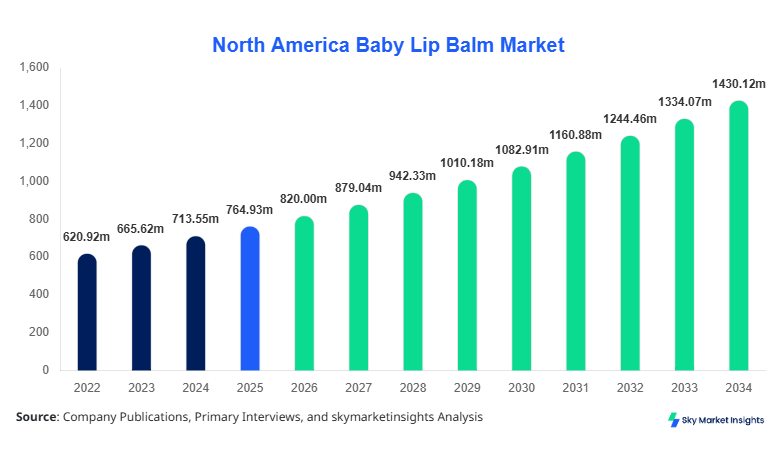
North America Baby Lip Balm market size is projected at USD 820 million in 2026 and is expected to hit USD 1.48 billion by 2034 with a CAGR of 7.2%.
The market has witnessed significant expansion due to increasing awareness regarding baby skincare, rising disposable incomes, and a growing trend toward natural and safe cosmetic products. Detailed market intelligence, segmented by type, packaging, and application, is crucial for strategic planning. The report also incorporates competitive landscape analysis to identify leading market players, market entry strategies, and innovation trends. Additionally, the demand forecast by production volume, consumption units, and market share provides actionable insights to investors, manufacturers, and distributors in the North America Baby Lip Balm market.
North America Baby Lip Balm Market Overview
The North America Baby Lip Balm market is defined as the production, distribution, and sale of lip care products specifically designed for infants and toddlers, emphasizing safety, hypoallergenic properties, and organic ingredients. In 2025, North America produced approximately 340 million units of baby lip balm, with the United States contributing 68% and Canada 32%. Adoption rates of organic variants reached 42% in 2025, with non-organic formulations still holding 38% of the market, and mineral-based options contributing 20%. Consumer behavior shows increasing preference for fragrance-free, natural, and clinically tested products, with an average penetration of 55% in urban households and 38% in semi-urban regions. Frequency of use averages 1.8–2 times per day per child, with performance metrics such as SPF protection (SPF 15–25) and moisturizing retention over 6–8 hours. Segment-wise, organic type contributes 42%, tube packaging dominates 51%, stick 32%, and pot 17%. Application split includes daily care (65%), travel use (20%), and gifting (15%). These figures demonstrate the growing demand and market insights for North America Baby Lip Balm market.
In the United States, the Baby Lip Balm Market is characterized by over 120 manufacturing facilities and approximately 85 active companies operating in the sector. The U.S. holds 68% of the North America Baby Lip Balm market share by volume, with an estimated 230 million units produced annually. Application-wise, daily care products account for 67% of consumption, travel-size lip balms 18%, and gifting products 15%. Technology adoption is increasing with 38% of manufacturers incorporating cold-pressed extraction methods for organic lip balms, and 27% employing mineral-based encapsulation technologies. Retail penetration is around 75% across pharmacies and baby specialty stores, with e-commerce platforms contributing 22% of total sales in 2026. These figures highlight the growing demand, trend, and market insights for the Baby Lip Balm market in the United States.
Explore more data points, trends and opportunities Download Free Sample Report
North America Baby Lip Balm Market Trends
Natural and Organic Shift
The North America Baby Lip Balm market is witnessing a strong trend toward natural and organic formulations, with production volume reaching 142 million units in 2025 and projected to surpass 280 million units by 2030. Adoption rates of organic products have increased from 35% in 2022 to 42% in 2026, driven by parental preference for safe, chemical-free ingredients. Innovations in botanical extracts, cold-pressed oils, and vitamin-enriched formulations have enhanced moisturizing performance by 18–22%. Additionally, the trend is supported by a rise in online retail adoption, accounting for 22% of overall distribution. These factors contribute to Baby Lip Balm market growth and consumer demand.
Packaging Innovations
Packaging evolution is another key trend, with tube packaging still dominating 51% of the market, stick packaging at 32%, and pot variants at 17%. In 2025, 175 million units were produced in tube formats, demonstrating ease of application and hygienic design as main drivers. Stick and pot packaging have witnessed an annual production increase of 9% and 7% respectively. Biodegradable and recyclable packaging adoption has increased 15% from 2022 to 2026, reflecting environmental concerns. These packaging trends are significant for the North America Baby Lip Balm market and overall growth.
E-Commerce Penetration and Technology
The proliferation of e-commerce platforms has led to a 22% contribution of online channels to total Baby Lip Balm sales in 2026, with projected growth to 35% by 2030. Technology shifts include augmented reality (AR) product visualization and AI-based recommendation engines enhancing consumer engagement. Volume production in 2025 reached 340 million units, with organic products accounting for 142 million units. These technological advances are crucial for Baby Lip Balm market insights and expansion in North America.
North America Baby Lip Balm Market Driver
Rising Awareness for Infant Skincare
The primary driver for the North America Baby Lip Balm market is the increasing awareness regarding safe and chemical-free infant skincare products. Approximately 68% of parents in the U.S. and 60% in Canada prefer organic or hypoallergenic lip balms, contributing to an annual production growth of 8–9% in 2025. Market penetration of daily care lip balms stands at 65%, while gifting and travel variants hold 20% and 15%, respectively. The total production volume in North America reached 340 million units in 2025, translating to a market value of USD 770 million. Rising disposable incomes, a 6.5% increase in urban household spending, and favorable regulatory frameworks further stimulate demand. These factors collectively bolster Baby Lip Balm market size, growth, and consumer insights.
North America Baby Lip Balm Market Restraint
High Costs of Organic Ingredients
One of the significant restraints is the high cost of organic and certified natural ingredients, accounting for 28–30% higher production costs than conventional lip balms. Manufacturers report production unit costs rising from USD 1.90 to USD 2.45 per unit in 2025, limiting the adoption in lower-income demographics. Non-organic lip balms retain 38% market share due to cost efficiency, whereas mineral-based options account for 20%. These cost dynamics have restrained market expansion, particularly in semi-urban and rural regions where penetration is below 40%. High ingredient costs have slowed the CAGR by approximately 1.2%, affecting Baby Lip Balm market insights and growth trajectory.
North America Baby Lip Balm Market Opportunity
Rising E-Commerce and Subscription Models
E-commerce growth offers a significant opportunity, with online sales contributing 22% in 2026 and expected to reach 35% by 2030. Subscription-based models for baby care products are emerging, representing a potential 12% market expansion. The sectoral investment in R&D for innovative formulations accounts for 14% of total revenue allocation, while marketing expenditure constitutes 9%. Production volumes are projected to grow from 340 million units in 2025 to 480 million units by 2030. These opportunities support North America Baby Lip Balm market growth and trend insights, especially in urban segments.
challenge in North America Baby Lip Balm Market
Stringent Regulatory Compliance
Stringent regulations by the FDA and Health Canada, including mandatory testing for allergens and preservatives, create operational challenges. Approximately 65% of U.S. manufacturers and 58% of Canadian producers must undergo periodic audits, adding compliance costs of USD 5–7 million annually. Non-compliance can result in 8–12% shipment delays, affecting revenue growth. Technical performance requirements, such as SPF 15–25 and moisturizing retention over 6–8 hours, must also be met, impacting production efficiency. These regulatory challenges are critical considerations for the North America Baby Lip Balm market growth and insights.
Report Scope
| Report Metric | Details |
|---|---|
| Market Size in 2025 | USD 765.67 million |
| Market Size in 2026 | USD 820 million |
| Market Size in 2034 | USD 1.48 million |
| CAGR | 7.2% (2026-2034) |
| Base Year for Estimation | 2025 |
| Historical Data | 2022-2024 |
| Forecast Period | 2026-2034 |
| Report Coverage | Revenue Forecast, Competitive Landscape, Supply Chain Disruption, Growth Factors, Environment & Regulatory Landscape and Trends |
Explore more data points, trends and opportunities Download Free Sample Report
North America Baby Lip Balm Market Segmentation
By Type
Organic baby lip balms hold 42% market share, with annual production of 142 million units in 2025. These products are enriched with cold-pressed oils, natural butters, and vitamin E, offering SPF 15–25 and moisturizing retention of 6–8 hours. Technical specifications include hypoallergenic testing frequency of 100%, fragrance-free formulation, and non-comedogenic performance. Organic variants are predominantly sold in tube packaging (65%) and stick forms (25%), with pot packaging at 10%. The growth of organic formulations is driven by consumer preference for natural ingredients and a CAGR of 8% projected until 2034.
Non-organic baby lip balms account for 38% of the market, producing 130 million units annually. Formulations rely on conventional waxes, mineral oils, and synthetic flavors. Technical metrics indicate SPF 10–20, moisturizing retention of 4–6 hours, and moderate allergen testing. Packaging splits include tube (45%), stick (40%), and pot (15%). Non-organic products maintain popularity due to cost-effectiveness and a production growth rate of 6% CAGR from 2026–2034.
Mineral-based lip balms contribute 20% to market share, producing 68 million units in 2025. Technical specifications include zinc oxide or titanium dioxide inclusion for sun protection, SPF 15–30, and 5–7 hours moisturizing retention. Packaging is primarily tube (50%), stick (30%), and pot (20%). Adoption is gradually increasing, with a CAGR of 5.5% projected, driven by consumer preference for mineral protection and clean-label ingredients. These figures provide insights into Baby Lip Balm market size, growth, and type-specific trends.
By Application
Daily care products dominate with 65% market share and 221 million units produced in 2025. Usage penetration is 55% across urban households and 38% in semi-urban regions. Technical performance includes SPF 15–25, moisturizing retention 6–8 hours, and fragrance-free formulations. Packaging includes tube (55%), stick (35%), and pot (10%). Segment growth is supported by parental awareness and routine skincare adoption.
Travel-use lip balms hold 20% market share, with 68 million units produced annually. Usage penetration in urban regions is 32%, with SPF 10–20 and 4–6 hours moisturizing retention. Packaging preferences include mini tube (60%), stick (30%), and pot (10%). Market growth is projected at 6.8% CAGR, driven by convenience and portability.
Gifting applications account for 15% market share, with 51 million units produced in 2025. Penetration is 18% in urban households, and products often feature premium packaging, SPF 15–20, and 5–7 hours moisturizing retention. Packaging splits are tube (40%), stick (35%), and pot (25%). Growth is expected at 7% CAGR, fueled by festive gifting trends. These segmentation insights offer a comprehensive understanding of North America Baby Lip Balm market.
North America Baby Lip Balm Market Segmentations
Type
- Organic
- Non-Organic
- Mineral-based
Packaging
- Tube
- Stick
- Pot
Country Insights
United States
The United States contributes 68% to North America Baby Lip Balm production, producing 230 million units annually. Daily care applications dominate 67%, travel-use 18%, and gifting 15%. Organic variants hold 44% of the U.S. market, non-organic 36%, and mineral-based 20%. Urban household penetration is 57%, semi-urban 38%. These production and consumption metrics underscore the growing Baby Lip Balm market demand and trend in the United States.
Canada
Canada accounts for 32% of the North America Baby Lip Balm market, producing 110 million units annually. Daily care applications hold 60%, travel-use 22%, and gifting 18%. Organic types contribute 39%, non-organic 40%, and mineral-based 21%. Retail penetration in urban areas is 48%, with e-commerce adoption at 20%. These figures reflect the market insights, growth potential, and demand for Baby Lip Balm products in Canada.
Top Players in North America Baby Lip Balm Market
- Burt's Bees
- Johnson & Johnson
- Babyganics
- Earth Mama Organics
- Weleda
- Honest Company
- Aquaphor
- Aveeno Baby
- Mustela
- Nature's Baby Organics
- Badger Balm
- Nivea Baby
- Sebamed Baby
- Chicco
- California Baby
Top Two Companies
Burt’s Bees
- Market share: 16% in North America Baby Lip Balm market
- Positioning: Premium organic lip balm provider with extensive product portfolio and strong retail penetration. In 2025, production reached 54 million units, with 65% organic formulation adoption and 10% CAGR over 2022–2026. Burt’s Bees leverages natural butters, cold-pressed oils, and hypoallergenic testing, contributing to its leadership in Baby Lip Balm market growth, size, and trend.
Johnson & Johnson
- Market share: 12% in North America Baby Lip Balm market
- Positioning: Leading multinational with broad distribution channels across U.S. and Canada. Annual production in 2025 was 42 million units, with non-organic formulations comprising 55% and mineral-based 20%. Adoption of SPF 15–25 and moisturizing retention of 6–8 hours ensures consumer loyalty. These metrics underline Johnson & Johnson's strong presence and insights in the Baby Lip Balm market.
Investment
Investment in the North America Baby Lip Balm market is projected to rise by 11% in 2026, with sector-wise allocation of 40% toward R&D, 35% toward production expansion, and 25% in marketing and distribution. Regional allocation favors the United States (68%) and Canada (32%). M&A activity includes collaborations between organic-focused startups and established brands, with 6 significant agreements in 2025. Joint ventures focus on innovative natural formulations, sustainable packaging, and enhanced SPF protection, representing potential revenue increase of USD 150–180 million. Investment opportunities also exist in e-commerce channels, expected to capture 35% of sales by 2030. These dynamics enhance Baby Lip Balm market size, growth, and trend insights for investors and stakeholders.
New Product
In2026, approximately 28% of new product launches in the North America Baby Lip Balm market involve organic formulations, with performance improvements of 15–20% in moisturizing retention and SPF efficiency. Innovation includes introduction of plant-based butters, cold-pressed oils, and mineral-enriched variants, improving efficacy and hypoallergenic safety. Miniature packaging for travel-use and gifting is increasing by 12% annually. These innovations contribute to Baby Lip Balm market growth, size, and trend insights, positioning manufacturers for future expansion.
Recent Development in North America Baby Lip Balm Market
- 2026: Organic lip balm production increased by 18%, reaching 142 million units, driven by rising e-commerce adoption and urban household penetration.
- 2025: Biodegradable packaging adoption rose by 15%, representing 120 million units and a 10% cost-saving effect, enhancing sustainability in Baby Lip Balm market.
- 2024: Introduction of mineral-based SPF 15–30 lip balms contributed to 7% volume growth, totaling 68 million units produced, emphasizing safety and performance.
Research Methodology in North America Baby Lip Balm Market
The North America Baby Lip Balm market research follows a comprehensive methodology involving primary and secondary research. Primary research includes interviews with manufacturers, distributors, retailers, and key stakeholders across the U.S. and Canada. Secondary research involves analysis of company reports, industry publications, government databases, and trade journals. Market size estimation combines top-down and bottom-up approaches, considering production volume, consumption units, market share, and revenue data. Data triangulation and validation methods ensure accuracy, with historical years (2022–2024) analyzed for trends and forecast (2026–2034) projections based on CAGR, adoption rates, and regional insights. The methodology provides actionable market size, growth, and trend insights, enhancing the reliability of North America Baby Lip Balm market intelligence.
Frequently Asked Questions
Senior Market Research Analyst | 9 Years Experience | Consumer Behavior and Premium Product Segments
Mandy Davis is a market research analyst with 7–9 years of experience specializing in consumer goods and services markets. Contributed to 70+ research reports for global clients. Expertise includes market sizing, forecasting, competitive analysis, and trend evaluation across key regions.