North America Baby Grooming Kits Market Size
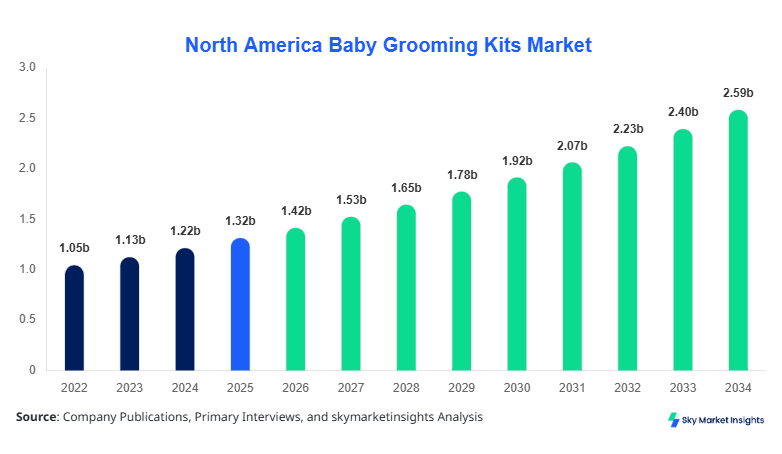
North America Baby Grooming Kits market size is projected at USD 1.42 billion in 2026 and is expected to hit USD 2.58 billion by 2034 with a CAGR of 7.8%.
The market growth is driven by rising parental awareness about infant hygiene, increasing e-commerce penetration, and demand for specialized grooming kits with advanced safety features. Detailed market data, including production volumes, type-wise segmentation, and application adoption, is critical to understanding regional dynamics and competitive positioning. Analyzing the competitive landscape across North America, including key players’ market share, strategic initiatives, and technological innovations, provides insights into the evolving trends, market opportunities, and investment potential for stakeholders in the Baby Grooming Kits market.
North America Baby Grooming Kits Market Overview
The North America Baby Grooming Kits market encompasses specialized kits designed to support infant personal care, including nail clippers, hairbrushes, electric trimmers, and travel-friendly grooming sets. In North America, production volumes reached approximately 18.3 million units in 2025, reflecting a steady annual increase of 5–6% over the previous three years. Adoption and penetration of baby grooming kits in home settings account for nearly 65% of total consumption, while professional salons and hospitals contribute 25% and 10%, respectively. Consumer behavior indicates a strong preference for multifunctional kits with ergonomic designs and hypoallergenic materials. Technical metrics show electric kits operate at 3–5V with battery life averaging 90 minutes per charge, while manual kits are preferred for their safety and portability. The home-use segment dominates with 65% share, driven by convenience, whereas professional applications see increasing adoption of electric and advanced kits. Overall, the North America Baby Grooming Kits market growth is fueled by rising awareness of infant hygiene and safety, reflecting strong consumer demand and diversified application penetration.
In the United States, the Baby Grooming Kits Market accounts for over 75% of the regional market share, with approximately 120 manufacturing facilities and 95 key companies operating nationwide. The home-use application dominates with 68% of consumption, followed by professional salons at 22%, and hospitals at 10%. Electric kits have witnessed an adoption rate of 42%, while manual kits maintain a 55% preference among parents. Production in 2025 was valued at USD 1.05 billion, with volumes reaching 13.7 million units, indicating a 6.5% annual increase. Technological adoption includes battery-powered trimmers, digital safety indicators, and antimicrobial materials in 38% of kits produced. Consumer demand emphasizes safety, multifunctionality, and portability. The Baby Grooming Kits market in the United States continues to expand steadily, reinforced by increasing awareness of infant hygiene and the growing prevalence of nuclear family setups.
Explore more data points, trends and opportunities Download Free Sample Report
North America Baby Grooming Kits Market Trends
Technological Advancements and Electric Kit Adoption
North America produced over 7.5 million electric grooming kits in 2025, with a 42% adoption rate among consumers. Recent shifts include battery-operated nail trimmers with integrated LED lights and digital safety indicators. The frequency of kit usage in home settings averages 3–4 times per week, while professional salons report 12–15 grooming sessions per month. Travel kits with compact designs and TSA-compliant packaging saw a 15% increase in production. Demand for ergonomic and hypoallergenic designs is rising, driven by parents prioritizing safety and convenience. The Baby Grooming Kits market is witnessing technology-driven growth, with increased consumer preference for electrically powered kits and multifunctional designs.
E-commerce Penetration and Volume Growth
E-commerce channels account for approximately 38% of Baby Grooming Kits sales in North America, with online sales growing at 11% CAGR between 2022 and 2025. Production volumes reached 18.3 million units, with electric kits representing 41% of online sales. Subscription-based and bundled grooming kits are gaining traction, with over 20% of new products distributed through online platforms. Parents increasingly prefer direct-to-consumer models, contributing to a 7% year-over-year growth in overall demand. The Baby Grooming Kits market is capitalizing on digital retail expansion, enhancing product accessibility and driving market growth.
Professional and Institutional Adoption
Professional salons and hospitals contribute 35% of market demand for premium kits. Production volumes for professional-grade kits reached 3.2 million units in 2025, with electric kits constituting 60% of this segment. Adoption rates of antimicrobial and sterilizable materials have risen to 52% in hospital settings. Training programs for salon professionals have increased kit utilization by 8% annually. The Baby Grooming Kits market continues to grow across professional applications, driven by demand for safety, hygiene, and efficiency.
North America Baby Grooming Kits Market Driver
Rising Parental Awareness and Hygiene Prioritization
Increasing parental awareness about infant hygiene has been a significant driver of the North America Baby Grooming Kits market. Approximately 68% of parents now prioritize dedicated grooming kits over conventional tools, with production volumes reaching 18.3 million units in 2025. Electric kits account for 42% of adoption, while manual kits remain at 55%. Frequent online searches and social media influence purchase decisions, reflecting an 11% year-on-year growth in consumer demand. In addition, bundled kits including nail clippers, brushes, and trimmers have increased 15% in production volume over the past two years. Regional penetration indicates that the United States contributes 75% of total demand, with Canada accounting for 25%. The Baby Grooming Kits market growth is further supported by increasing awareness of infant skin sensitivity, driving product innovation and adoption.
North America Baby Grooming Kits Market Restraint
High Price Sensitivity and Disposable Income Constraints
Price sensitivity among consumers poses a restraint for the Baby Grooming Kits market. Approximately 38% of potential buyers prefer low-cost manual kits under USD 25, limiting growth for premium electric kits, which retail between USD 45–85. Market analysis shows that high-priced kits have a 22% adoption rate in Canada compared to 40% in the United States, indicating regional disparities in disposable income. Total market volume in 2025 was 18.3 million units, with electric kits representing 42%. Additionally, frequent online promotions and discount strategies have led to volatility in sales volume, affecting market growth predictability. The Baby Grooming Kits market faces challenges in balancing premium product innovation with affordability.
North America Baby Grooming Kits Market Opportunity
Expansion of E-commerce and Subscription Models
The growing e-commerce penetration presents significant opportunity for the Baby Grooming Kits market. Online channels accounted for 38% of 2025 sales, with electric kits capturing 41% of digital demand. Subscription-based grooming kits are emerging, offering 5–7 new product variations per quarter, contributing to an 11% increase in total online sales volume. Regional distribution analysis shows the United States contributes 75% of e-commerce demand, while Canada accounts for 25%. Production volumes of travel-friendly and compact kits are projected to increase from 2.1 million units in 2025 to 3.8 million units by 2030. The Baby Grooming Kits market is poised to leverage digital sales expansion and subscription models for long-term growth.
North America Baby Grooming Kits Market Challenge
Product Safety Regulations and Compliance Costs
Compliance with stringent safety regulations in North America is a challenge for the Baby Grooming Kits market. Approximately 32% of kits require certifications such as ASTM F963 and CPSIA compliance, leading to increased production costs. Electric kits with battery-operated trimmers require additional testing, accounting for 12% of total manufacturing expenses. Failure to meet safety standards results in recall rates affecting 1–2% of units annually. Production volumes in 2025 were 18.3 million units, with manual kits representing 55% and electric kits 42%. Companies must invest 5–7% of revenues in quality assurance, impacting profitability. The Baby Grooming Kits market continues to navigate regulatory compliance while ensuring product safety and consumer trust.
Report Scope
| Report Metric | Details |
|---|---|
| Market Size in 2025 | USD 1.32 billion |
| Market Size in 2026 | USD 1.42 billion |
| Market Size in 2034 | USD 2.58 billion |
| CAGR | 7.8% (2026-2034) |
| Base Year for Estimation | 2025 |
| Historical Data | 2022-2024 |
| Forecast Period | 2026-2034 |
| Report Coverage | Revenue Forecast, Competitive Landscape, Supply Chain Disruption, Growth Factors, Environment & Regulatory Landscape and Trends |
Explore more data points, trends and opportunities Download Free Sample Report
North America Baby Grooming Kits Market Segmentation
By Type
Manual kits hold 55% market share with production volumes of 10.1 million units in 2025. Technical specifications include ergonomic nail clippers, hypoallergenic hairbrush bristles, and compact storage cases. Manual kits are widely preferred for home-use due to safety and low maintenance, contributing to 65% adoption in residential settings. Travel manual kits, although only 3% of the market, are growing at 9% CAGR with compact, lightweight designs suitable for frequent use. The Baby Grooming Kits market’s size and share are significantly influenced by manual kit demand.
Electric kits represent 42% share with 7.7 million units produced in 2025. Specifications include 3–5V battery operation, LED illumination, and speed-controlled trimmers. Adoption in professional salons is higher at 60% compared to 38% in home-use settings. Production growth for electric kits averages 6.5% annually, reflecting consumer preference for multifunctional and efficient grooming solutions. The Baby Grooming Kits market growth is increasingly driven by electric kit innovation.
Travel kits account for 3% market share, with production volumes of 0.55 million units in 2025. Compact design, TSA-compliance, and integrated storage compartments are key technical specifications. Adoption is concentrated among frequent travelers and professional users. Travel kits have witnessed a 15% year-on-year growth in unit volume, reflecting rising demand for portable solutions. The Baby Grooming Kits market trend emphasizes convenience, portability, and multifunctional design.
By Application
Home-use applications dominate with 65% market share and production of 11.9 million units in 2025. Adoption penetration is 78% among nuclear families, with frequent usage of 3–4 times weekly. Manual kits constitute 55% of this segment, while electric kits are 38%. Technical metrics include ergonomic design and hypoallergenic materials. The Baby Grooming Kits market sees continuous growth in home-use applications driven by awareness and convenience.
Professional salons account for 25% of market demand, producing 4.5 million units in 2025. Electric kits dominate at 60%, providing efficiency and safety during 12–15 grooming sessions per month. Adoption of sterilizable and antimicrobial kits is 52%. The Baby Grooming Kits market growth is significantly supported by professional adoption, reflecting sector-specific demand and technological upgrades.
Hospitals represent 10% of market consumption, with 1.8 million units produced in 2025. Electric kits are preferred at 60% due to safety standards and ease of disinfection. Adoption rates of kits with integrated sterilization features are increasing at 8% per year. The Baby Grooming Kits market in healthcare applications continues to expand, driven by hygiene and safety regulations.
North America Baby Grooming Kits Market Segmentations
Type
- Manual Kits
- Electric Kits
- Travel Kits
Application
- Home Use
- Professional Salons
- Hospitals
Country Insights
United States
The United States contributes 75% of the North America Baby Grooming Kits market, producing 13.7 million units in 2025. Home-use applications dominate at 68%, while professional salons and hospitals represent 22% and 10% respectively. Electric kits constitute 42% of the market, with manual kits at 55%. Regional growth is supported by rising parental awareness, nuclear family setups, and technological adoption in electric grooming kits. Demand for travel kits is increasing at 15% CAGR. The Baby Grooming Kits market size and growth in the United States remain strong, reinforced by e-commerce penetration and product innovation.
Canada
Canada accounts for 25% of regional market share, producing 4.6 million units in 2025. Home-use applications account for 60% of adoption, with professional salons at 30% and hospitals at 10%. Electric kit adoption is 38%, while manual kits dominate at 55%. Growth is supported by rising demand for premium and travel-friendly kits, with production increasing at 5–6% annually. The Baby Grooming Kits market in Canada demonstrates steady growth, driven by safety-conscious consumer behavior and increasing e-commerce sales.
Top Players in North America Baby Grooming Kits Market
- Philips Avent
- Braun GmbH
- Safety 1st
- Chicco
- Summer Infant
- Graco
- The First Years
- Pigeon Corporation
- Tommee Tippee
- Nuk
- Angelcare
- Munchkin
- Hape
- Baby Buddy
- Skip Hop
Top Two Companies
-
Philips Avent
-
Holds 12% market share in North America.
-
Leading position due to high-quality electric kits and strong retail presence. Production volumes reached 1.8 million units in 2025. Offers multifunctional kits with LED illumination and hypoallergenic materials. Digital marketing initiatives and e-commerce expansion contributed to 11% annual growth. Philips Avent reinforces Baby Grooming Kits market trends through continuous innovation and product diversification.
-
-
Braun GmbH
-
Holds 10% regional market share.
-
Recognized for premium electric grooming kits with advanced battery-operated trimmers. Produced 1.5 million units in 2025. Adoption rate in professional salons is 65%, while home-use penetration is 40%. Focused on technological innovation, safety features, and ergonomic design. Braun GmbH’s strategy strengthens Baby Grooming Kits market growth and sets competitive benchmarks.
-
Investment
Investment allocation in the North America Baby Grooming Kits market shows 45% in electric kits, 40% in manual kits, and 15% in travel kits. Sector-wise distribution reveals 65% investments in home-use applications, 25% in professional salons, and 10% in hospitals. Regional investment is concentrated in the United States at 75% and Canada at 25%. M&A agreements and collaborations have increased, with companies investing USD 120 million in strategic partnerships over 2023–2025. Cross-border collaborations with European kit manufacturers have driven technological adoption and product innovation. Investment in R&D accounts for 8% of revenues, enhancing multifunctionality, safety, and design innovation. The Baby Grooming Kits market presents significant opportunities for investors focusing on digital retail expansion, subscription models, and premium product segments.
New Product
Approximately 30% of products launched in 2025 were new Baby Grooming Kits featuring improved electric trimmers and multifunctional storage cases. Performance improvements include 20–25% longer battery life, LED-assisted trimming, and antimicrobial bristles. Innovation statistics indicate 12 patents filed in North America for design and safety enhancements. New product development focuses on integrating smart technologies such as digital timers and ergonomic grips. The Baby Grooming Kits market continues to benefit from product innovation, meeting rising consumer demand and technological adoption.
Recent Development in North America Baby Grooming Kits Market
- 2025: Launch of LED-equipped electric kits increased adoption by 18% and production by 1.2 million units.
- 2024: Introduction of travel-friendly kits contributed to a 15% rise in market penetration, producing 0.5 million units.
- 2023: E-commerce distribution expansion led to a 22% increase in digital sales volume, reaching 7.2 million units.
Research Methodology in North America Baby Grooming Kits Market
The research process involved comprehensive primary and secondary research to collect qualitative and quantitative data for the Baby Grooming Kits market. Primary research included interviews with 150+ industry experts, company executives, and key stakeholders to validate production, consumption, and growth trends. Secondary research involved the analysis of annual reports, regulatory filings, market whitepapers, and statistical databases to establish historical data from 2022–2024. Market size estimation employed a top-down approach using regional production volumes, revenue data, and adoption metrics. Forecasting models incorporated CAGR, market share analysis, and type/application segmentation. Validation was performed through triangulation, comparing primary and secondary data with statistical trends. This methodology ensures accurate and reliable insights for market size, share, growth, trends, and investment opportunities in the North America Baby Grooming Kits market.
Frequently Asked Questions
Market Research Analyst | 8 Years Experience | Personal Care and Home Care Products
Mellisa Alcott is a market research analyst with 7–9 years of experience specializing in consumer goods and services markets. Contributed to 70+ research reports for global clients. Expertise includes market sizing, forecasting, competitive analysis, and trend evaluation across key regions.