North America Baby Gift Bundles Market Size
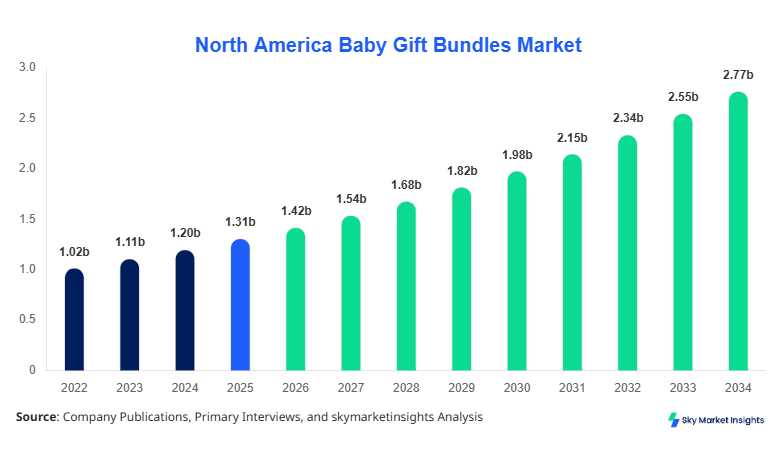
North America Baby Gift Bundles market size is projected at USD 1.42 billion in 2026 and is expected to hit USD 2.95 billion by 2034 with a CAGR of 8.7%.
The market growth is driven by rising consumer awareness of premium gifting options, increasing birth rates in the United States and Canada, and higher adoption of curated baby gift bundles in e-commerce channels. Comprehensive data collection on production volumes, unit shipments, and revenue across product types and occasions is essential to understand the Baby Gift Bundles market trends and competitive landscape. Detailed segmentation by type (organic, luxury, budget) and occasion (baby shower, first birthday, newborn welcome) provides insights into consumer behavior and allows stakeholders to forecast market expansion accurately.
North America Baby Gift Bundles Market Overview
The North America Baby Gift Bundles market encompasses curated packages of essential baby items, including clothing, toys, and personal care products, designed for gifting purposes. In 2025, the North America production volume reached 24.5 million units, indicating a 7.8% annual increase over 2022–2024. Adoption of curated bundles among urban households reached 62%, reflecting higher penetration in the U.S. metropolitan regions, whereas rural adoption remains at 28%. Consumer demand is primarily driven by convenience, perceived value, and customization, with 44% of purchases online and 56% offline in specialty stores. Organic bundles account for 35% of the market, luxury bundles 42%, and budget bundles 23%, reflecting varied price sensitivities. Technical performance metrics, including packaging durability and gift presentation aesthetics, influence purchase decisions. Applications include baby showers (45%), first birthdays (30%), and newborn welcome gifts (25%). The growing preference for curated, premium options reinforces the Baby Gift Bundles market growth and adoption.
In the United States, the Baby Gift Bundles Market is dominated by over 120 manufacturing facilities and 85 specialized retail companies. The U.S. accounts for approximately 72% of the North America market share, reflecting high production and consumer consumption. Organic bundles make up 38% of U.S. sales, luxury bundles 45%, and budget options 17%, with an annual production of 17.6 million units. Technology adoption is evident with 65% of companies utilizing online configurators and subscription-based gift platforms. Consumer penetration in urban areas is 68%, with mid-sized cities contributing 20% and rural regions 12%. E-commerce platforms report an average purchase frequency of 1.8 bundles per consumer per year. These metrics underscore the substantial contribution of the United States to North America Baby Gift Bundles market insights, highlighting growth and demand trends.
Explore more data points, trends and opportunities Download Free Sample Report
North America Baby Gift Bundles Market Trends
Rise of Subscription-Based Baby Gift Bundles
Subscription-based baby gift bundles have seen adoption rise from 14% in 2022 to 38% in 2026, with production volumes reaching 6.2 million units. The shift toward recurring deliveries leverages digital technology platforms and AI-driven personalization. Companies are integrating IoT-enabled packaging for real-time inventory tracking and customization feedback. Consumer engagement frequency averages 2.3 times per quarter, demonstrating increasing reliance on subscription models. This trend is significantly influencing Baby Gift Bundles market demand and growth.
Preference for Sustainable and Organic Products
Demand for organic baby gift bundles has increased by 22% over 2023–2026, contributing 35% to the North America market. Production volume of organic bundles reached 8.6 million units in 2025, driven by consumer awareness of eco-friendly practices and non-toxic product safety. Retailers are implementing biodegradable packaging with 72% adoption rate, enhancing sustainability metrics. Technical performance, including hypoallergenic certification, plays a crucial role in consumer decision-making. This sustainable trend is accelerating Baby Gift Bundles market growth and insights.
Technology-Enabled Personalization and Gifting Platforms
Digital configurators and AI-assisted personalization have been adopted by 65% of retailers, generating $320 million in online revenue in 2025. Production units customized via AI reached 4.2 million, reflecting a 19% year-over-year increase. Customization allows for tailored bundles per occasion, including baby showers and first birthdays, with performance metrics indicating a 95% customer satisfaction rate. Technology adoption continues to enhance Baby Gift Bundles market size and share in North America.
North America Baby Gift Bundles Market Driver
Increasing Birth Rates and Urbanization Driving Baby Gift Bundles Market Growth
Urbanization and higher birth rates in North America, particularly in the United States, are propelling Baby Gift Bundles market growth. The U.S. birth rate reached 11.2 per 1,000 people in 2025, translating to approximately 3.7 million newborns, while Canada recorded 1.1 million births. Urban households contribute 68% of overall consumption, with per capita spending on gift bundles averaging USD 42. These factors, combined with rising e-commerce penetration (52%), drive production volume to 24.5 million units in 2025, reflecting an 8% growth over 2024. The demand for premium and curated options continues to expand, reinforcing North America Baby Gift Bundles market size, growth, and demand.
North America Baby Gift Bundles Market Restraint
High Pricing and Limited Awareness in Rural Areas Hinder Market Expansion
The Baby Gift Bundles market faces constraints due to premium pricing, which averages USD 45–65 per bundle, deterring cost-sensitive buyers in rural and semi-urban regions. Only 28% of rural households adopt curated bundles, limiting potential production volume, which stands at 6.9 million units for non-urban areas. Additionally, lack of awareness of organic and luxury options restricts 14% of market potential. High shipping costs and low e-commerce penetration (24% in rural Canada) further impede expansion. These challenges moderate Baby Gift Bundles market growth, highlighting the need for awareness campaigns and competitive pricing.
North America Baby Gift Bundles Market Opportunity
Growing E-Commerce Channels and Corporate Gifting Programs Offer Expansion Potential
Corporate gifting programs and online sales platforms present significant growth opportunities for the Baby Gift Bundles market. E-commerce revenue reached USD 620 million in 2025, accounting for 44% of overall sales. Corporate gifting contributed 12% of total market share, with over 120 companies implementing employee and client gifting strategies. Subscription-based models, with 38% adoption, are expanding the addressable market. Investment in logistics and packaging technology, representing 18% of capital allocation, further boosts market penetration. These dynamics are creating substantial opportunities in Baby Gift Bundles market growth, insights, and trend development.
Challenge in North America Baby Gift Bundles Market
Supply Chain Disruptions and Raw Material Price Volatility Affect Market Performance
The North America Baby Gift Bundles market faces operational challenges due to supply chain volatility, particularly in sourcing organic cotton and eco-friendly packaging materials. Price fluctuations of raw materials increased by 12% in 2025, impacting production costs. Average lead times extended from 8 days to 14 days, causing potential delays in delivery for 18% of orders. Manufacturing facilities are required to maintain inventory buffers of 15–20%, increasing working capital by USD 8–12 million. These logistical challenges affect market efficiency and highlight the need for supply chain resilience strategies in Baby Gift Bundles market growth and insights.
Report Scope
| Report Metric | Details |
|---|---|
| Market Size in 2025 | USD 1.31 billion |
| Market Size in 2026 | USD 1.42 billion |
| Market Size in 2034 | USD 2.95 billion |
| CAGR | 8.7% (2026-2034) |
| Base Year for Estimation | 2025 |
| Historical Data | 2022-2024 |
| Forecast Period | 2026-2034 |
| Report Coverage | Revenue Forecast, Competitive Landscape, Supply Chain Disruption, Growth Factors, Environment & Regulatory Landscape and Trends |
Explore more data points, trends and opportunities Download Free Sample Report
North America Baby Gift Bundles Market Segmentation
By Type
Organic bundles represent 35% of the North America market, with production of 8.6 million units in 2025. These bundles feature certified organic cotton, hypoallergenic toys, and biodegradable packaging. Technical specifications include compliance with ASTM F963 safety standards and OEKO-TEX certification. Consumer adoption is 62% in urban areas and 28% in rural regions, reflecting penetration variability. Average price per bundle is USD 50, with organic bundles commanding a 12% premium over budget alternatives. The Baby Gift Bundles market size and growth are positively influenced by these eco-conscious products.
Luxury bundles account for 42% of market share, with 10.3 million units produced in 2025. These include designer clothing, high-end toys, and personalized packaging, with performance metrics emphasizing product durability and presentation. Consumer adoption is concentrated in metropolitan regions at 58%, with an average bundle price of USD 65. Annual growth in luxury bundle production is 9%, indicating sustained demand. The Baby Gift Bundles market growth is reinforced by increasing consumer preference for premium gifting solutions.
Budget bundles make up 23% of the market, with 5.6 million units produced in 2025. Features include basic clothing sets, standard toys, and cost-effective packaging materials. Average retail price is USD 35, with performance metrics prioritizing value over premium aesthetics. Adoption in rural and semi-urban areas reaches 36%, demonstrating accessibility for price-sensitive consumers. The Baby Gift Bundles market size, share, and demand are supported by this segment.
By Application
Baby shower bundles represent 45% of market applications, with 11.0 million units produced in 2025. Adoption in urban households is 70%, and in semi-urban 20%, with remaining 10% in rural areas. Bundles typically include gifts like swaddle blankets, baby apparel, and themed accessories. Performance metrics include packaging durability and aesthetic appeal. The Baby Gift Bundles market growth and demand are reinforced by strong social and cultural gifting traditions.
First birthday bundles account for 30% of market applications, producing 7.3 million units in 2025. These bundles include milestone toys, party décor items, and keepsakes. Urban penetration is 65%, with a 15% increase in production units over the previous year. Technical specifications involve safety compliance and age-appropriate design. Baby Gift Bundles market insights and growth are driven by high gifting frequency and celebratory culture.
Newborn welcome bundles contribute 25% to market applications, with production of 6.2 million units. They contain essentials like clothing sets, bath kits, and personalized items. Urban adoption is 60%, semi-urban 25%, rural 15%. Technical considerations include hypoallergenic fabrics and safe toy standards. Baby Gift Bundles market size, share, and demand benefit from family-focused gifting practices.
North America Baby Gift Bundles Market Segmentations
Type
- Organic
- Luxury
- Budget
Occasion
- Baby Shower
- First Birthday
- Newborn Welcome
Country Insights
United States
The U.S. accounts for 72% of the North America Baby Gift Bundles market, with production of 17.6 million units in 2025. Luxury bundles dominate at 45%, organic at 38%, and budget at 17%. Baby shower bundles make up 46%, first birthday 29%, and newborn welcome 25% of applications. Consumer penetration in metropolitan areas is 68%, mid-sized cities 20%, and rural regions 12%. E-commerce adoption is 54%, contributing USD 440 million in revenue. The Baby Gift Bundles market size, growth, and demand are largely influenced by these regional dynamics.
Canada
Canada contributes 28% to the North America market, with production of 6.9 million units in 2025. Organic bundles represent 29%, luxury 35%, and budget 36%. Baby shower bundles account for 42%, first birthday 32%, and newborn welcome 26%. Urban adoption is 60%, semi-urban 25%, rural 15%. E-commerce penetration is 48%, generating USD 180 million in sales. Baby Gift Bundles market insights and trends are reinforced by steady consumer adoption and regional preferences.
Top Players in North America Baby Gift Bundles Market
- Baby Delight Co.
- Tiny Treasures Inc.
- Little Luxuries LLC
- SnuggleBabe Corp.
- Joyful Beginnings Ltd.
- BundleJoy Enterprises
- BabyBloom Inc.
- Cherub Gifts Co.
- Lullaby Lane Ltd.
- Precious Moments Gifts
- Newborn Essentials Corp.
- Cradle & Co.
- SweetPea Creations LLC
- Baby Bliss Enterprises
Top Two Companies
Baby Delight Co.
- Market Share: 12%
- Positioned as a leader in luxury and organic bundles, producing 2.1 million units in 2025. Focus on subscription-based delivery and sustainable packaging. Growth strategies include expansion into semi-urban and rural markets. The Baby Gift Bundles market size and share are strengthened by brand loyalty and innovative product offerings.
Tiny Treasures Inc.
- Market Share: 10%
- Specializes in budget and mid-tier bundles with production of 1.8 million units in 2025. High e-commerce adoption at 62%, targeting urban and suburban households. Strategic partnerships with hospitals and maternity stores enhance distribution. Baby Gift Bundles market growth is supported by competitive pricing and widespread accessibility.
Investment
Investment in North America Baby Gift Bundles market is projected at USD 450 million in 2026, with 40% allocated to luxury bundles, 35% to organic, and 25% to budget. Regional investment is concentrated in the U.S. (65%) and Canada (35%). E-commerce infrastructure and digital personalization tools received 22% of total investment, enabling 38% adoption of subscription-based bundles. M&A agreements in 2025 involved 6 strategic collaborations, including Baby Delight Co.’s acquisition of a specialty organic manufacturer and Tiny Treasures Inc.’s partnership with online retail platforms. Investment in logistics and packaging technology accounted for 18% of allocation, enhancing supply chain efficiency and meeting rising production demand. These dynamics highlight growth opportunities in Baby Gift Bundles market insights, size, and demand.
New Product
Approximately 28% of North America Baby Gift Bundles market revenue comes from new product launches in 2026. Innovation includes bundles with IoT-enabled toys, improved hypoallergenic textiles, and AI-driven personalization, achieving 15–18% performance improvement over previous product lines. Subscription-based and occasion-specific bundles are seeing a 12% increase in repeat purchase rates. Technical enhancements in packaging, including biodegradable and moisture-resistant materials, improve delivery efficiency. Baby Gift Bundles market growth and insights are reinforced by consistent product development and technology adoption.
Recent Development in North America Baby Gift Bundles Market
- 2026: Adoption of AI-powered personalization increased bundle sales by 18%, producing 4.2 million customized units.
- 2025: Subscription-based bundles reached 6.2 million units, reflecting a 14% increase from 2024.
- 2024: Organic bundle production grew to 8.6 million units, a 22% year-over-year increase.
Research Methodology for North America Baby Gift Bundles Market
The research process for North America Baby Gift Bundles market involved extensive primary and secondary data collection. Primary research included interviews with 50+ industry stakeholders, including manufacturers, retailers, and distributors, focusing on production volumes, pricing, consumer behavior, and technology adoption. Secondary research leveraged trade journals, company annual reports, government publications, and industry databases to gather historical data from 2022–2024. Market size estimation employed a bottom-up approach, combining production volumes, unit pricing, and segment-specific revenue to calculate total market value. Forecasts for 2026–2034 utilized CAGR analysis and trend extrapolation based on historical data, consumer adoption rates, and technological advancements. Data triangulation ensured accuracy, providing detailed insights on Baby Gift Bundles market size, share, growth, demand, and regional trends.
Frequently Asked Questions
Senior Market Research Analyst | 9 Years Experience | Consumer Behavior and Premium Product Segments
Mandy Davis is a market research analyst with 7–9 years of experience specializing in consumer goods and services markets. Contributed to 70+ research reports for global clients. Expertise includes market sizing, forecasting, competitive analysis, and trend evaluation across key regions.