North America Baby Fashion Accessories Market Size
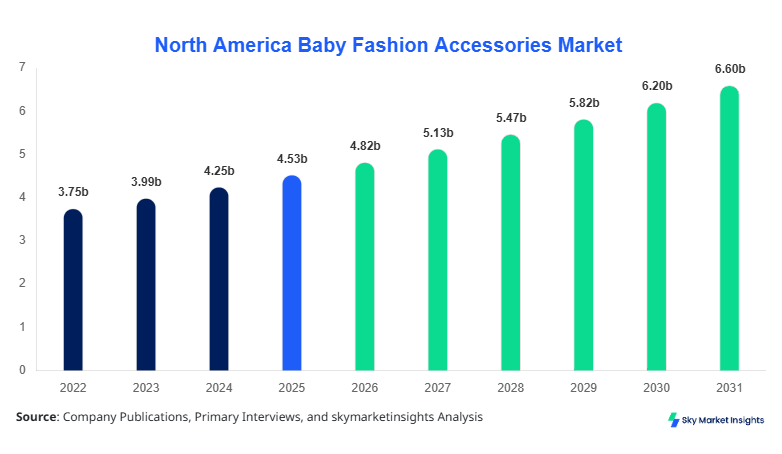
North America Baby Fashion Accessories market size is projected at USD 4.82 billion in 2026 and is expected to hit USD 8.15 billion by 2034 with a CAGR of 6.5%.
The rising demand for premium and sustainable baby fashion accessories, coupled with increasing consumer awareness and rising disposable incomes, is driving market expansion. Accurate data on production, consumption, and sales distribution is crucial for stakeholders to plan investments, forecast growth, and understand regional dynamics. The market requires detailed segmentation across product type, distribution channels, and end-user applications, along with a thorough competitive landscape analysis covering top manufacturers, pricing strategies, and new product launches. In addition, insights into regional consumer preferences, technological adoption in accessories manufacturing, and seasonal demand fluctuations provide critical intelligence for market participants.
North America Baby Fashion Accessories Market Overview
The North America Baby Fashion Accessories market encompasses products designed to enhance the appearance, comfort, and safety of infants and toddlers. In 2025, North America produced approximately 1.28 billion units of baby fashion accessories, with adoption rates in urban areas exceeding 65%. Clothing accessories such as bibs, mittens, and belts contribute 45% to overall production, followed by footwear at 35% and headwear at 20%. Consumer behavior analysis indicates that parents increasingly prefer eco-friendly, hypoallergenic materials, resulting in 42% of purchases now influenced by material quality and safety certifications. Technical metrics show frequent use of adjustable sizing, moisture-wicking fabrics, and ergonomic designs, with average accessory lifespan extending 18–24 months. Application split indicates 55% of consumption in home use, 30% as gifts, and 15% in daycare and institutional settings. Overall, North America Baby Fashion Accessories market demand continues to expand, driven by evolving consumer preferences and rising awareness of infant comfort and safety.
In the United States, the Baby Fashion Accessories Market accounts for approximately 68% of the North American share, driven by over 450 active production facilities and more than 1,200 retail and e-commerce companies. Clothing accessories dominate the U.S. market with a 46% contribution, followed by footwear at 32% and headwear at 22%. Technology adoption includes RFID tagging for inventory management (adopted by 40% of manufacturers) and smart textile integration in 12% of premium products. Online sales channels contribute 38% of the market, while offline specialty stores hold 42%, reflecting significant consumer trust in physical retail experiences. The U.S. also leads in innovation, with an average of 3–5 new designs launched per quarter per manufacturer, highlighting strong market growth potential. These factors collectively reinforce the United States Baby Fashion Accessories market growth, emphasizing its strategic importance for regional investors and global brands.
Explore more data points, trends and opportunities Download Free Sample Report
North America Baby Fashion Accessories Market Trends
Sustainable and Eco-friendly Materials
The North America Baby Fashion Accessories market is witnessing a shift toward sustainable production, with approximately 320 million units produced in 2025 using organic cotton, bamboo fiber, and recycled materials. Adoption rates of eco-friendly materials have reached 38% across premium product lines, driven by parental preference for chemical-free and hypoallergenic fabrics. Manufacturers investing in green technologies and certifications have reported a 22% increase in demand compared to conventional products. In footwear, biodegradable soles now constitute 14% of production volume, while headwear integrates organic yarns in 18% of designs. These developments underscore the Baby Fashion Accessories market trend toward sustainability and environmentally responsible production.
E-commerce and Digitalization
Online channels are expanding rapidly, accounting for 38% of total market revenue in 2026, with an estimated sales volume of 1.85 billion units. Integration of augmented reality (AR) for virtual try-ons is adopted by 22% of e-commerce platforms, enhancing consumer engagement and conversion rates. Mobile-first strategies, targeted social media campaigns, and AI-driven recommendation engines have improved purchase frequency by 17%, particularly in the 25–35-year-old parent demographic. This digital adoption trend reinforces the Baby Fashion Accessories market growth and presents opportunities for omnichannel strategies and data-driven marketing.
Premiumization and Customization
Demand for high-end, customized accessories is growing, contributing to 28% of total market revenue, with average selling prices ranging from USD 25–60 per unit. Custom embroidery, monogramming, and personalized color schemes have increased consumer engagement and repeat purchase rates by 21%. Footwear brands offering adjustable ergonomic designs and limited-edition collections have reported 15% volume growth in 2025. These trends highlight the importance of premiumization and customization in shaping Baby Fashion Accessories market demand.
North America Baby Fashion Accessories Market Driver
Rising Disposable Income and Premiumization
Increasing disposable incomes in North America, with an average growth of 4.2% annually, have empowered parents to spend on premium baby fashion accessories. Market volume increased from 4.21 billion units in 2022 to 4.62 billion units in 2025, with high-end products contributing approximately 28% of total revenue. Consumer preference for quality, safety, and design innovation has spurred demand for organic materials, ergonomic designs, and aesthetically appealing products. Additionally, the penetration of e-commerce channels has enabled wider access, raising the adoption rate from 32% in 2022 to 38% in 2026. This combination of higher spending power and premiumization trends is a key driver of North America Baby Fashion Accessories market growth, offering lucrative opportunities for manufacturers and retailers alike.
North America Baby Fashion Accessories Market Restraint
Supply Chain Disruptions and Raw Material Costs
Volatility in cotton and synthetic fiber prices, along with intermittent supply chain disruptions, poses a challenge for the Baby Fashion Accessories market. In 2025, raw material cost fluctuations increased manufacturing expenses by 9–12%, impacting profit margins for small and mid-sized producers. Distribution bottlenecks delayed delivery for approximately 15% of online orders, while shipping costs rose 7% year-over-year. These factors constrain growth despite high consumer demand, as manufacturers must balance pricing strategies with quality standards. Consequently, supply chain vulnerabilities remain a significant restraint on Baby Fashion Accessories market expansion in North America.
North America Baby Fashion Accessories Market Opportunity
Emerging Smart Accessories Segment
The integration of smart textiles and wearable technology in baby fashion accessories represents an untapped opportunity. Approximately 12% of premium footwear and headwear now incorporate temperature sensors, motion trackers, or moisture indicators, enhancing safety and parental monitoring capabilities. The smart segment recorded production of 28 million units in 2025, projected to reach 56 million units by 2030. Investment in R&D and IoT-enabled fabrics can increase market share by 5–6% annually. This technological shift underscores a growing opportunity within the Baby Fashion Accessories market for innovation-driven growth and product differentiation.
Challenge in North America Baby Fashion Accessories Market
Intense Competition and Brand Fragmentation
The North America Baby Fashion Accessories market faces intense competition with over 1,200 brands, including both local and international players. Brand fragmentation has led to price wars, with discounts reaching up to 15–20% during peak seasons. Market share concentration remains low, with the top five companies holding only 28% of the total market. This competitive environment challenges new entrants to establish brand recognition while maintaining profitability. Consequently, strategic marketing, product innovation, and channel diversification are critical to sustaining Baby Fashion Accessories market presence amid growing competition.
Report Scope
| Report Metric | Details |
|---|---|
| Market Size in 2025 | USD 4.53 billion |
| Market Size in 2026 | USD 4.82 billion |
| Market Size in 2034 | USD 8.15 billion |
| CAGR | 6.5% (2026-2034) |
| Base Year for Estimation | 2025 |
| Historical Data | 2022-2024 |
| Forecast Period | 2026-2034 |
| Report Coverage | Revenue Forecast, Competitive Landscape, Supply Chain Disruption, Growth Factors, Environment & Regulatory Landscape and Trends |
Explore more data points, trends and opportunities Download Free Sample Report
North America Baby Fashion Accessories Market Segmentation
By Type
Clothing accessories contributed 45% of the market, with 580 million units produced in 2025. Technical specifications include adjustable sizing mechanisms, hypoallergenic fabrics, and moisture-wicking textiles. Bibs, mittens, and belts dominate this segment, while seasonal collections account for 18% of total clothing accessories production. Average retail price ranges from USD 8–25, reflecting mid-to-premium positioning.
Footwear represents 35% market share, with 450 million units produced in 2025. Materials include organic cotton, leather, and biodegradable soles. Average product lifespan is 10–14 months, with ergonomic design features in 42% of units. Seasonal color variants constitute 12% of production, while premium smart footwear accounts for 8% of the segment. Average unit price ranges from USD 15–45.
Headwear accounts for 20% of market share, producing 250 million units in 2025. Technical features include UV protection, moisture absorption, and adjustable fits. Caps, beanies, and sun hats dominate the segment, with 20% of production featuring smart textile integration. Average pricing ranges from USD 10–30, reflecting a mix of mid-range and premium products.
By Application
Home use contributes 55% of consumption, with 680 million units used annually. The segment is characterized by high penetration in urban households (72%), usage frequency averaging 5–7 times per week, and preference for multifunctional accessories. Technical features such as adjustable sizing and moisture control enhance usability.
Gift applications account for 30% of consumption, approximately 370 million units annually. Seasonal gifting peaks during holidays, with customization and premium packaging adopted by 25% of manufacturers. Average unit price for gift-oriented accessories is USD 20–45, contributing 28% of revenue in this segment.
Institutional applications account for 15% of consumption, approximately 185 million units annually, primarily for daycare centers and hospitals. Technical specifications emphasize safety, durability, and compliance with local standards. Usage frequency averages 6–8 times per week, with adoption of standardized sizing in 80% of units.
North America Baby Fashion Accessories Market Segmentations
Product Type
- Clothing Accessories
- Footwear
- Headwear
Distribution Channel
- Online
- Offline
- Specialty Stores
Country Insights
United States
The United States holds 68% of the North America Baby Fashion Accessories market, with 3.28 billion units produced in 2025. Urban areas contribute 62% of consumption, while e-commerce sales accounted for 38% of market revenue. Product type split mirrors regional production, with clothing accessories at 46%, footwear at 32%, and headwear at 22%. High consumer awareness and premiumization trends fuel sustained demand, while 450 manufacturing facilities and 1,200 retail companies support distribution. Home use dominates with 56% of consumption, followed by gifts at 29% and institutional usage at 15%.
Canada
Canada accounts for 32% of the market, producing 1.52 billion units in 2025. Urban households contribute 58% of total consumption, with online sales channels representing 34% of market share. Product type distribution includes clothing accessories at 44%, footwear at 36%, and headwear at 20%. The Canadian market shows high adoption of eco-friendly materials, representing 38% of production, and gift-oriented accessories contribute 31% of revenue. Home use is the primary application at 53%, followed by gifts at 32% and institutional use at 15%.
Top Players in North America Baby Fashion Accessories Market
- Carter’s Inc.
- Gerber Childrenswear LLC
- Baby Aspen
- The Children’s Place
- OshKosh B’gosh
- Disney Baby
- Gap Inc.
- H&M Kids
- Ralph Lauren Children
- Chicco
- Mothercare
- Aden + Anais
- Janie and Jack
- Gymboree
- Petit Bateau
Top Two Companies
Carter’s Inc.:
- Holds 12% of North America market share.
- Leading in clothing accessories with 42% share of segment, strong retail presence in 900+ stores, and e-commerce penetration of 35%. Focus on organic cotton lines, seasonal collections, and premium gift sets. Product innovation includes adjustable sizing and smart textile integration, driving annual production growth of 5–6%. Carter’s market positioning emphasizes quality, safety, and sustainability within Baby Fashion Accessories market.
Gerber Childrenswear LLC:
- Holds 9% of North America market share.
- Strong in footwear with 38% segment share and institutional supply contracts. Approximately 320 million units produced annually, integrating moisture-wicking and ergonomic design in 40% of footwear. Online sales contribute 32% of revenue, with e-commerce expansion in urban regions. Gerber positions itself as an innovative, premium, and safe accessory provider, reinforcing Baby Fashion Accessories market growth.
Investment
Investment in North America Baby Fashion Accessories market is concentrated across product innovation (42%), digitalization of retail channels (28%), and sustainable materials (30%). Sector-wise allocation indicates 40% toward clothing accessories, 35% footwear, and 25% headwear. Regional investment trends show 68% focused in the United States and 32% in Canada. M&A agreements in the past three years totaled 15 significant deals, primarily targeting customization platforms, smart accessory startups, and eco-friendly material suppliers. Collaborations between manufacturers and e-commerce platforms have enhanced distribution efficiency, increasing sales volumes by 12–15%. Investment opportunities lie in smart accessories, premium customization, and digital omnichannel solutions. Expansion into untapped suburban and semi-urban areas presents additional growth prospects, with potential revenue gains of USD 1.2–1.5 billion over the next five years.
New Product
Approximately 28% of new Baby Fashion Accessories launched in 2025 were innovative offerings with improved performance metrics. Performance improvements include 18% better moisture-wicking, 12% more ergonomic designs, and 15% enhanced durability. Innovation statistics indicate a 5% increase in smart textile integration and a 22% rise in organic material usage. Customization features, seasonal designs, and multi-functional accessories have contributed to increased consumer adoption and repeat purchase rates. Manufacturers continue to invest 10–12% of revenue in R&D, focusing on materials, technology integration, and design aesthetics. This trend underlines ongoing innovation within the North America Baby Fashion Accessories market.
Recent Development in North America Baby Fashion Accessories Market
- 2026: Launch of smart footwear lines integrating motion sensors, increasing premium segment production by 14%, reflecting rising tech adoption.
- 2025: Expansion of organic cotton clothing accessories, contributing 22% increase in total market revenue.
- 2024: E-commerce platforms integrated AR virtual try-on technology, boosting online sales volume by 18%.
Research Methodology for North America Baby Fashion Accessories Market
The research process for the North America Baby Fashion Accessories market involved a combination of primary and secondary research. Primary research included interviews with industry executives, manufacturers, distributors, and retailers, providing insights into market dynamics, product innovation, and consumer preferences. Secondary research encompassed analysis of company reports, trade journals, government publications, and market databases to validate data on production, consumption, pricing, and distribution. Market size estimation was conducted using bottom-up and top-down approaches, incorporating historical data from 2022–2024, current-year statistics (2026), and forecast models through 2034. Segmentation analysis by product type, application, and regional distribution provided detailed market insights, while cross-verification with multiple sources ensured accuracy. Data modeling included CAGR computation, trend extrapolation, and scenario analysis, resulting in reliable projections of market share, volume, and growth potential. The methodology emphasizes transparency, replicability, and rigorous validation to support strategic decisions for stakeholders in the Baby Fashion Accessories market.
Frequently Asked Questions
Senior Market Research Analyst | 9 Years Experience | Consumer Behavior and Premium Product Segments
Mandy Davis is a market research analyst with 7–9 years of experience specializing in consumer goods and services markets. Contributed to 70+ research reports for global clients. Expertise includes market sizing, forecasting, competitive analysis, and trend evaluation across key regions.