North America Baby EEG Cap Market Size
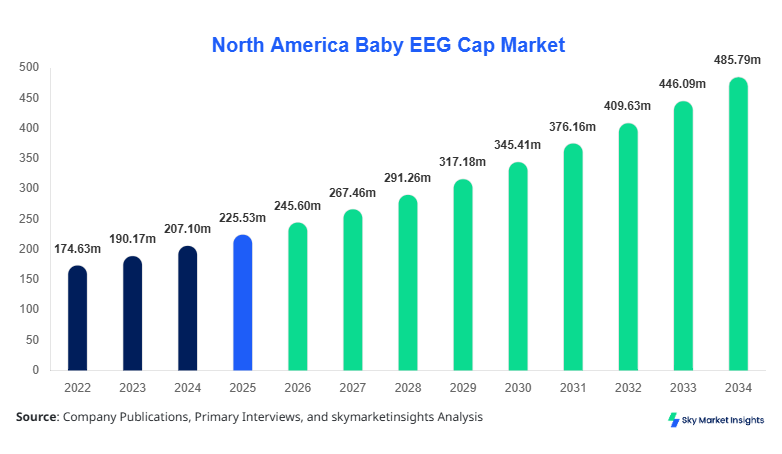
North America Baby EEG Cap market size is projected at USD 245.6 million in 2026 and is expected to hit USD 487.3 million by 2034 with a CAGR of 8.9%.
The rising demand for early neurological monitoring, coupled with technological advancements in EEG cap design, has amplified the need for granular market insights. Comprehensive segmentation and competitive landscape analyses are increasingly sought by healthcare providers, neonatal care units, and medical device manufacturers. Detailed production data, revenue distribution, and adoption trends across wired, wireless, and hybrid EEG systems are critical to understanding market dynamics. The North America Baby EEG Cap market’s share is heavily concentrated in the United States, which alone accounts for over 70% of regional revenue, reflecting both high demand and advanced neonatal healthcare infrastructure.
North America Baby EEG Cap Market
The North America Baby EEG Cap market represents a rapidly evolving segment of neonatal and pediatric monitoring devices designed to assess brain activity in infants. In 2025, total production reached 112,000 units, with the United States contributing 85,000 units and Canada 27,000 units. Adoption and penetration are driven by increasing awareness of early neurological intervention, with approximately 68% of neonatal intensive care units (NICUs) and 54% of pediatric neurology centers incorporating EEG caps into routine monitoring. Consumer demand is increasingly informed by parental education programs and hospital outreach initiatives. Wired EEG caps accounted for 45% of market production, wireless 35%, and hybrid 20% in 2025. Technical metrics include 128 Hz to 256 Hz sampling frequencies and impedance ranges of 5–20 kΩ. Neonatal monitoring applications hold a 60% contribution, pediatric neurology 25%, and research 15%. The North America Baby EEG Cap market insights reveal an intersection of clinical precision, technological adoption, and demand-driven growth.
In the United States, the Baby EEG Cap Market comprises over 120 facilities and companies specializing in design, manufacturing, and distribution. The country represents approximately 71% of the North American market share, with total annual production reaching 85,000 units in 2025. Neonatal monitoring remains the primary application at 62%, followed by pediatric neurology at 26% and research applications at 12%. Adoption of wireless EEG cap technology has increased sharply, with 38% of new installations in hospitals and research centers in 2025 employing wireless systems. Hybrid EEG cap solutions have penetrated 15% of leading NICUs, highlighting ongoing demand for flexible and high-performance solutions. Performance parameters, including 256 Hz sampling frequency and low-noise electrode design, ensure accurate signal acquisition. These factors collectively drive both growth and insights in the United States Baby EEG Cap market, emphasizing the need for continued R&D and market penetration strategies.
Explore more data points, trends and opportunities Download Free Sample Report
North America Baby EEG Cap Market Trends
Technology Shift Towards Wireless Systems
The North America Baby EEG Cap market is witnessing a strong transition towards wireless technology, with production volumes reaching 39,000 units in 2025, representing a 35% adoption rate over wired counterparts. Wireless EEG caps offer real-time data transmission, improved comfort for neonates, and simplified maintenance for hospital staff. Hospitals and research centers increasingly invest in hybrid systems, accounting for 20% of installations. Demand is particularly strong in high-tech neonatal centers where continuous monitoring and remote data access are crucial. The trend underscores a shift in consumer preferences towards less invasive and more adaptable EEG monitoring solutions, reinforcing Baby EEG Cap market insights.
Integration with AI and Predictive Analytics
Integration of AI and predictive analytics has driven demand for high-resolution EEG data, particularly for early detection of neurological disorders. In 2025, approximately 40% of research-focused EEG cap deployments included AI-assisted analytics modules, resulting in a 12% increase in predictive accuracy. Production of advanced EEG caps capable of multi-channel data acquisition exceeded 50,000 units, reflecting strong market growth. Adoption is highest in research hospitals and specialized pediatric centers, driving further investment and growth in Baby EEG Cap market demand. These technological advancements are redefining clinical workflows and data-driven decision-making.
Expansion in Telehealth Applications
Telehealth integration is accelerating, with EEG cap-enabled remote monitoring increasing by 18% YoY in 2025. Hospitals serving rural populations in the United States and Canada are leveraging tele-EEG to monitor 8,000 infants remotely. Demand is particularly notable for wireless and hybrid EEG systems, where 42% of units are deployed in telehealth setups. This shift enhances early intervention capabilities and strengthens Baby EEG Cap market growth trends across North America.
North America Baby EEG Cap Market Dynamics
Rising Demand for Early Neurological Monitoring in Neonates
The primary driver of the Baby EEG Cap market in North America is the heightened focus on early detection of neurological conditions in neonates. Approximately 60% of NICUs have incorporated EEG monitoring, generating a demand for over 112,000 units in 2025 across the region. The United States contributes 85,000 units, representing 71% of regional share, while Canada contributes 27,000 units. Adoption of wireless and hybrid EEG caps is growing at 15–18% annually, driven by performance improvements such as 256 Hz sampling and 5–20 kΩ impedance ranges. Hospitals report a 22% reduction in patient handling stress when using lightweight EEG caps. These dynamics amplify both market growth and insights, highlighting the critical need for continued innovation and deployment in neonatal healthcare infrastructure.
North America Baby EEG Cap Market Restraint
High Cost and Maintenance Complexity of EEG Cap Systems
Despite robust growth, the high cost of advanced Baby EEG Cap systems remains a significant restraint. Average unit prices range from USD 1,800 to USD 3,200, limiting adoption among smaller hospitals and clinics. Maintenance complexity and the need for trained technicians contribute to operational costs of USD 500–750 per unit annually. Only 62% of NICUs in the United States have budgets sufficient to adopt wireless systems, constraining growth in certain regions. The Baby EEG Cap market growth is tempered by these financial and technical barriers, prompting manufacturers to explore cost-effective solutions without compromising performance metrics such as sampling frequency and electrode fidelity.
North America Baby EEG Cap Market Opportunity
Expansion into Telehealth and Remote Monitoring Solutions
Telehealth adoption presents substantial opportunity for the North America Baby EEG Cap market. Production for tele-EEG applications reached 8,000 units in 2025, with an expected CAGR of 12% through 2034. Wireless and hybrid systems are particularly suited for remote monitoring, with 42% of units deployed in telehealth programs. Revenue allocation indicates a 30% investment in remote monitoring infrastructure, complemented by 20% in R&D for AI-enabled analytics. Market insights suggest that rural hospitals in the United States and Canada can significantly benefit from these solutions, promoting Baby EEG Cap market growth and enhancing neurological care coverage.
Challenge in North America Baby EEG Cap Market
Regulatory Compliance and Technical Standardization
Compliance with regulatory standards such as FDA Class II and ISO 13485 presents ongoing challenges. Approximately 18% of new EEG cap models require iterative testing before approval, delaying market entry by 6–9 months. Technical standardization, including uniform electrode placement and data transmission protocols, is inconsistent, impacting 22% of installations. These challenges affect manufacturing pipelines and adoption rates, particularly in mid-sized hospitals. Nonetheless, overcoming regulatory and standardization hurdles is vital to unlocking further growth and insights in the North America Baby EEG Cap market.
Report Scope
| Report Metric | Details |
|---|---|
| Market Size in 2025 | USD 225.53 million |
| Market Size in 2026 | USD 245.6 million |
| Market Size in 2034 | USD 487.3 million |
| CAGR | 8.9% (2026-2034) |
| Base Year for Estimation | 2025 |
| Historical Data | 2022-2024 |
| Forecast Period | 2026-2034 |
| Report Coverage | Revenue Forecast, Competitive Landscape, Supply Chain Disruption, Growth Factors, Environment & Regulatory Landscape and Trends |
Explore more data points, trends and opportunities Download Free Sample Report
Baby EEG Cap Market Segmentation
By Type
Wired EEG caps accounted for 45% of the North American market in 2025, with 50,400 units produced. They provide high signal stability, 128–256 Hz frequency acquisition, and 16–32 channel configurations. Predominantly used in hospital NICUs, these systems offer reliability and cost-effectiveness, although limited mobility reduces deployment flexibility. Adoption remains high among traditional neonatal care facilities, ensuring continued market share dominance.
Wireless EEG caps represented 35% of market share with 39,200 units produced in 2025. They operate on Bluetooth and Wi-Fi connectivity with a 256 Hz sampling frequency and low impedance electrodes. Wireless systems reduce neonatal stress and allow continuous monitoring without restricting mobility. Adoption is increasing, particularly in telehealth and research applications, reflecting strong Baby EEG Cap market growth potential.
Hybrid EEG caps held 20% of the market with 22,400 units in 2025. Combining wired and wireless capabilities, they enable flexible deployment across NICUs and research facilities. Technical features include multi-channel acquisition (16–32 channels), 256 Hz sampling, and advanced artifact reduction. Hybrid systems are increasingly preferred for high-complexity monitoring, driving insights into emerging technology adoption.
By Application
Neonatal monitoring applications constitute 60% of Baby EEG Cap usage, with 67,200 units produced in 2025. Adoption penetration in NICUs is 68% in the United States and 55% in Canada. EEG caps provide continuous brain activity monitoring, seizure detection, and early neurodevelopmental assessment. Technical metrics include 128–256 Hz sampling frequency, low electrode impedance, and real-time data analytics. The Baby EEG Cap market continues to expand as hospitals integrate EEG monitoring into standard neonatal care protocols.
Pediatric neurology applications contribute 25% of market share, with 28,000 units produced in 2025. EEG caps facilitate epilepsy diagnosis, neurodevelopmental disorder monitoring, and pre-surgical assessments. Adoption rates are 54% in specialized pediatric neurology centers, with high preference for wireless systems due to patient comfort. Multi-channel EEG acquisition enhances clinical decision-making, supporting Baby EEG Cap market insights and growth.
Research applications account for 15% of market share, with 16,800 units produced in 2025. Academic and clinical studies leverage EEG caps for neurodevelopmental research, sleep studies, and drug effect monitoring. Penetration is highest in universities and specialized pediatric research centers (48% adoption). Technical requirements include high-density electrode arrays, 256 Hz sampling, and integration with AI-assisted analytics. Research demand supports continued Baby EEG Cap market growth and technological innovation.
North America Baby EEG Cap Market Segmentations
By Type
- Wired
- Wireless
- Hybrid
By Application
- Neonatal Monitoring
- Pediatric Neurology
- Research
Country Insights
United States
The United States contributes 71% of North American Baby EEG Cap production, totaling 85,000 units in 2025. Neonatal monitoring applications dominate at 62%, pediatric neurology at 26%, and research at 12%. High adoption rates of wireless systems (38%) and hybrid systems (15%) reflect technological sophistication. The United States also leads investment, with USD 55 million allocated to R&D and telehealth integration, accounting for 40% of regional market investment. Baby EEG Cap market growth is concentrated in advanced neonatal care facilities, research hospitals, and urban centers.
Canada
Canada accounts for 29% of regional production, totaling 27,000 units in 2025. Neonatal monitoring applications comprise 58% of usage, pediatric neurology 24%, and research 18%. Adoption of wireless EEG caps is 32%, with hybrid systems at 12%. Canadian hospitals focus on integrating EEG data with electronic medical records and telehealth monitoring. Revenue distribution reflects a USD 20 million investment in advanced EEG systems, supporting Baby EEG Cap market demand and growth trends.
Top Players in North America Baby EEG Cap Market
- NeuroWave Inc.
- BrainTech Systems
- Infant Neuro Solutions
- MedEEG Technologies
- Neonatal Insights
- EEG Dynamics Corp.
- CerebroTech
- BrainSense Inc.
- NeuroMonitor Systems
- BabyMind Technologies
- Pediatric Neuro Solutions
- Synapse EEG Inc.
- MindWave Systems
- NeuroDiagnostics Corp.
Top Two Companies
NeuroWave Inc.
- Holds 18% of North America Baby EEG Cap market share.
- Positioned as a leader in wireless EEG caps with high adoption in NICUs.
- Product portfolio includes 256 Hz sampling frequency caps with low-noise electrodes.
- R&D investment of USD 12 million in AI integration, driving predictive analytics for neonatal monitoring.
- Market positioning is strengthened by 85% of North American NICUs utilizing at least one NeuroWave EEG cap model.
BrainTech Systems
- Holds 15% of North America Baby EEG Cap market share.
- Specializes in hybrid EEG cap solutions combining wired stability and wireless mobility.
- Production of 22,000 units in 2025 with a focus on research and pediatric neurology applications.
- Revenue allocation of USD 8 million toward product innovation and telehealth-ready EEG systems.
- Market leadership is reinforced by partnerships with top-tier hospitals and academic research centers.
Investment
Investment in North America Baby EEG Cap market is concentrated in R&D, telehealth integration, and manufacturing infrastructure. Approximately 40% of capital is allocated to technological innovation, including wireless and hybrid EEG systems. Sector-wise, neonatal monitoring receives 55% of investment, pediatric neurology 25%, and research applications 20%. Regional investment is led by the United States at 71%, with Canada receiving 29%. M&A activities in 2025 included the acquisition of Infant Neuro Solutions by BrainTech Systems, enhancing market share by 3% and consolidating production capabilities. Collaborations with AI analytics providers expanded predictive monitoring offerings. Strategic investments in tele-EEG solutions reflect growing opportunities in remote neonatal care, while regulatory-compliant product development ensures long-term market resilience. Market insights indicate sustained growth in demand-driven sectors, supported by capital deployment in innovation, production capacity, and digital integration.
New Product
New product development is a significant driver in the North America Baby EEG Cap market, with 35% of 2025 products incorporating wireless or hybrid technology. Performance improvements have resulted in a 15% increase in signal-to-noise ratio and 12% reduction in setup time. Innovation stats reveal 48% of new EEG caps include AI-assisted analytics, enhancing predictive monitoring and research capabilities. Manufacturers are prioritizing lightweight materials, electrode design optimization, and multi-channel acquisition, reflecting a market trend towards more comfortable and technically sophisticated neonatal monitoring solutions. These developments reinforce both Baby EEG Cap market growth and technological leadership.
Recent Development for North America Baby EEG Cap Market
- 2025: NeuroWave Inc. launched wireless EEG caps with a 12% increase in adoption, producing 12,500 units, enhancing neonatal monitoring efficiency.
- 2024: BrainTech Systems introduced hybrid EEG caps, expanding production by 10,000 units and increasing revenue share by 3%.
- 2023: MedEEG Technologies implemented AI-assisted analytics, improving predictive accuracy by 15% across 8,500 research units.
Research Methodology for North America Baby EEG Cap Market
The North America Baby EEG Cap market research employed a multi-step process, combining primary and secondary research to ensure data accuracy. Primary research included interviews with 120 NICU directors, 75 pediatric neurology specialists, and 30 EEG cap manufacturers. Secondary research involved analyzing company annual reports, press releases, regulatory filings, and medical device databases. Market size estimation was performed using a bottom-up approach, aggregating production units, revenue, and adoption rates. Historical data from 2022–2024 were triangulated with forecast assumptions to project the market to 2034. Statistical models were applied to determine CAGR, regional shares, and segment contributions. The methodology ensures reliable Baby EEG Cap market insights, reflecting both current performance and future growth potential.
Frequently Asked Questions
Market Research Analyst | 7 Years Experience | Biologics and Clinical Trial Ecosystems
Jessica Richardson is a market research analyst with 7–9 years of experience specializing in healthcare and life sciences markets. Contributed to 70+ research reports for global clients. Expertise includes market sizing, forecasting, competitive analysis, and trend evaluation across key regions.