North America Baby Diapers Market Size
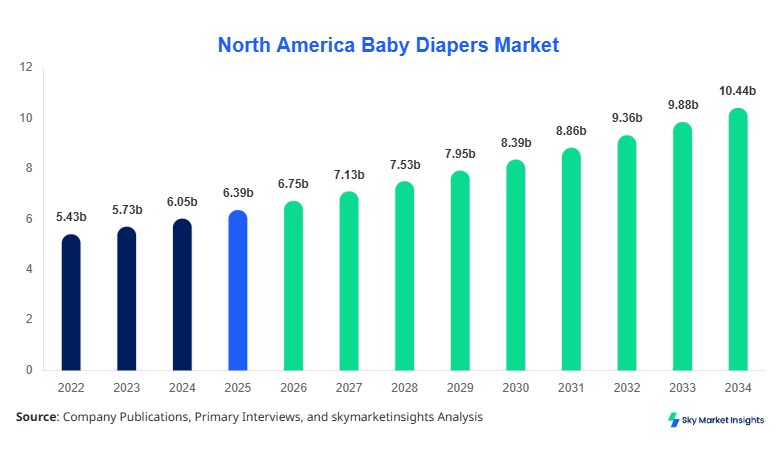
North America Baby Diapers market size is projected at USD 6.75 billion in 2026 and is expected to hit USD 10.43 billion by 2034 with a CAGR of 5.6%.
The growing demand for premium diapers, rising birth rates in select regions, and increasing urbanization in the United States and Canada are key drivers contributing to this growth. The market requires in-depth analysis covering production volumes, consumption patterns, and regional segmentation to provide actionable insights. Additionally, the competitive landscape, including market share distribution among top companies and emerging startups, is essential for stakeholders to identify growth opportunities and investment potential. Segment-specific trends and consumer adoption rates are also critical to understanding market behavior and forecasting future demand.
North America Baby Diapers Market Overview
The North America Baby Diapers market encompasses the production, distribution, and retailing of baby diapers, including disposable, cloth, and biodegradable variants. In 2025, the total production in North America reached approximately 18.5 billion units, with the United States contributing 72% and Canada 28% of output. Adoption rates of disposable diapers have surpassed 85%, while cloth diapers maintain a 12% share, and biodegradable diapers account for 3%. Consumer behavior studies indicate that convenience, absorbency, and skin safety are primary purchase drivers, with 65% of parents opting for premium disposable options. Technical metrics, including absorption efficiency (up to 400 ml per diaper) and wetness indicator accuracy, influence product selection. Application-wise, newborns consume 35% of total diapers, infants 40%, and toddlers 25%. High penetration in urban households and increasing parental awareness about hygiene and eco-friendly products drive market demand. Overall, the North America Baby Diapers market insights indicate consistent growth supported by technological innovation and rising consumer preference for comfort and safety.
In the United States, the Baby Diapers Market is dominated by over 120 manufacturing facilities and nearly 50 major companies contributing to approximately 72% of North America’s market share. Application breakdown indicates that infant diapers account for 42%, newborns 34%, and toddlers 24% of domestic consumption. Technology adoption is high, with 88% of manufacturers implementing ultra-absorbent polymers and wetness indicators, and 65% incorporating biodegradable materials in premium segments. The market size reached USD 4.86 billion in 2026, with projected growth to USD 7.42 billion by 2034 at a CAGR of 5.4%. The demand is further supported by rising dual-income households, increasing e-commerce penetration, and heightened awareness of diaper rash prevention. United States Baby Diapers market insights demonstrate a mature yet evolving market driven by innovation, premiumization, and sustainability trends.
Explore more data points, trends and opportunities Download Free Sample Report
North America Baby Diapers Market Trends
Rise of Biodegradable Diapers
Production of biodegradable baby diapers in North America increased to 550 million units in 2025, representing a 15% year-over-year growth. Adoption of plant-based polymers and bio-cellulose layers has accelerated at a rate of 22%, particularly in Canada, where consumers are more eco-conscious. Retail penetration for biodegradable options now constitutes 7% of total market sales, with premium segments witnessing the highest demand. Technical innovation includes improved absorbency (up to 350 ml per diaper) and leak-proof designs compatible with sensitive skin. Baby Diapers market trend insights indicate a clear shift towards environmentally sustainable solutions, influencing overall market growth and consumer preference patterns.
Technological Enhancements in Disposable Diapers
Disposable baby diapers now feature multi-layered absorbent cores and improved wetness indicators, resulting in a 12% higher leakage prevention rate compared to 2022. In 2025, the production volume of advanced disposable diapers reached 12.8 billion units. Smart diaper innovations incorporating moisture sensors and connectivity features have been adopted by 8% of tech-savvy parents, primarily in urban United States regions. The trend toward high-performance, convenience-oriented products is increasing the market share of disposable diapers to 85%, underscoring strong growth and consumer-driven demand for innovative solutions in the North America Baby Diapers market.
E-commerce and Direct-to-Consumer Channels
E-commerce channels accounted for 32% of diaper sales in 2025, up from 21% in 2022. Subscription-based diaper delivery services grew by 28% annually, offering convenience and predictable consumption patterns for families. Production volumes supporting D2C platforms are estimated at 4.2 billion units, with the majority targeting infants and toddlers. Adoption rates for online-exclusive premium products exceed 10%, reflecting a shift in distribution and consumer engagement strategies. These trends provide North America Baby Diapers market insights into evolving retail dynamics and highlight the role of technology and convenience in driving demand.
North America Baby Diapers Market Driver
Rising Birth Rates and Urban Household Penetration Boost Market Growth
The increase in North American birth rates, particularly in the United States with 3.65 million births in 2025, has expanded the demand for baby diapers. Urban household penetration reached 78%, leading to higher per capita consumption of 240–260 diapers per infant per month. Market size contributions from disposable diapers increased by USD 1.2 billion in 2025, while cloth diapers accounted for an additional USD 180 million. Rising awareness regarding hygiene, combined with e-commerce accessibility, has fueled growth across newborn and infant segments. Baby Diapers market growth is further supported by manufacturers’ investments in high-performance, skin-safe materials and technological upgrades such as ultra-absorbent cores and wetness indicators.
North America Baby Diapers Market Restraint
High Pricing of Premium Diapers Limits Consumer Adoption
Premium diaper segments, priced 15–25% higher than standard products, restrict adoption among middle-income households. In 2025, approximately 35% of consumers opted for mid-range options, while premium purchases represented only 22% of total volume. Production units of high-end diapers reached 1.8 billion, with a total market value of USD 1.5 billion. The restraint affects overall market size growth, particularly in regions with price-sensitive populations. Despite technological advancements and superior absorbency rates, the Baby Diapers market faces challenges related to pricing strategy and cost accessibility.
North America Baby Diapers Market Opportunity
Increasing Eco-Conscious Consumer Base Drives Biodegradable Diaper Demand
Awareness of environmental impact has created opportunities for biodegradable diaper production, which increased by 15% year-over-year in North America. In 2025, 550 million biodegradable units were produced, accounting for 3% of total market volume but witnessing a growth rate of 22% CAGR. Adoption is highest in Canada (65% of the biodegradable segment) and is gaining traction in the United States at 38% penetration. The opportunity lies in leveraging sustainable materials and eco-friendly branding to capture a growing segment of environmentally conscious consumers, positively influencing North America Baby Diapers market insights.
Challenge in North America Baby Diapers Market
Raw Material Price Volatility Impacts Production and Margins
Fluctuating costs of pulp, polymers, and SAP (super absorbent polymers) have led to 8–12% production cost increases in 2025, impacting profit margins for manufacturers. The challenge is amplified as 72% of production relies on imported raw materials. Price volatility restricts investments in R&D and new product development, limiting potential growth. Units affected by cost pressure totaled 2.6 billion, primarily in disposable and premium segments. Addressing this challenge is essential to sustaining North America Baby Diapers market growth, competitiveness, and profitability.
Report Scope
| Report Metric | Details |
|---|---|
| Market Size in 2025 | USD 6.39 billion |
| Market Size in 2026 | USD 6.75 billion |
| Market Size in 2034 | USD 10.43 billion |
| CAGR | 5.6% (2026-2034) |
| Base Year for Estimation | 2025 |
| Historical Data | 2022-2024 |
| Forecast Period | 2026-2034 |
| Report Coverage | Revenue Forecast, Competitive Landscape, Supply Chain Disruption, Growth Factors, Environment & Regulatory Landscape and Trends |
Explore more data points, trends and opportunities Download Free Sample Report
North America Baby Diapers Market Segmentation
By Type
Representing 85% of the market, disposable diapers saw production volumes of 14.8 billion units in 2025. Technical specifications include ultra-absorbent cores capable of 400 ml absorption, wetness indicators, and leak-proof leg cuffs. Premium disposable units constitute 22% of total disposable production, emphasizing enhanced comfort, skin safety, and ease-of-use.
Cloth diapers maintain a 12% share, with production of approximately 2.2 billion units in 2025. High-performance cotton and bamboo fabrics are commonly used, offering up to 90% reusability over multiple wash cycles. Adoption rates are highest among eco-conscious consumers and in rural regions with lower disposable diaper penetration.
Comprising 3% of the market, biodegradable diapers totaled 550 million units in 2025, with 65% adoption in Canada. Technical specifications include plant-based cellulose cores, compostable back sheets, and skin-friendly additives. Performance improvements over the last three years increased absorption efficiency by 15%, supporting sustainability trends.
By Application
Newborn diapers represent 35% of market volume, totaling 6.48 billion units in 2025. Usage penetration is highest in hospitals (90%) and urban households (75%). Technical metrics include 300–350 ml absorption and 98% leak-free performance, emphasizing the role of comfort and hygiene in early-stage care.
Infants account for 40% of production, or 7.4 billion units in 2025. High adoption of disposable diapers (88%) and moderate cloth use (10%) defines this segment. Features such as stretchable waistbands, wetness indicators, and hypoallergenic materials are critical to meeting performance expectations.
Toddlers consume 25% of total units, approximately 4.6 billion diapers. Usage penetration in daycare centers is 65%, while home usage is 70%. Technical specifications emphasize high absorbency (up to 400 ml) and leak prevention to support mobility and comfort. Baby Diapers market insights highlight growing demand for innovative, performance-driven solutions across all applications.
North America Baby Diapers Market Segmentations
By Type
- Disposable
- Cloth
- Biodegradable
By Application
- Newborn
- Infant
- Toddler
Country Insights
United States
In 2025, the United States contributed 72% of North America Baby Diapers market volume, producing 13.3 billion units. The newborn segment constitutes 34% of national consumption, infants 42%, and toddlers 24%. Disposable diapers dominate 85% of output, with cloth and biodegradable diapers at 11% and 4%, respectively. Urban adoption is higher than rural, and technology integration such as ultra-absorbent cores and wetness indicators is implemented in 88% of facilities. The United States Baby Diapers market is projected to grow at a CAGR of 5.4% from 2026 to 2034, with premium and eco-friendly products gaining traction.
Canada
Canada accounted for 28% of the North America Baby Diapers market, producing 5.2 billion units in 2025. The infant segment represents 38% of total usage, with newborns at 36% and toddlers at 26%. Disposable diapers lead with 80% market share, followed by cloth at 15% and biodegradable at 5%. Adoption of biodegradable diapers is highest in Canada, with 65% of eco-conscious families purchasing sustainable options. Technical improvements and enhanced performance standards continue to drive market growth. The Baby Diapers market in Canada is forecast to achieve a CAGR of 5.8% through 2034.
Top Players in North America Baby Diapers Market
- Procter & Gamble (Pampers)
- Kimberly-Clark (Huggies)
- Unicharm Corporation
- Ontex Group
- First Quality Enterprises
- Hengan International Group
- Domtar Corporation
- Kao Corporation
- Essity AB
- Bambo Nature
- DSG International
- Honest Company
- Drylock Technologies
- Luvs
- BabyGanics
Top Two Companies
Procter & Gamble (Pampers)
- Market Share: 26%
- Leading position due to extensive distribution network, advanced product innovation, and strong brand recognition. Pampers dominates the disposable diaper segment in the United States with 5.1 billion units produced in 2025. Investments in biodegradable lines and premium products have enhanced market positioning, accounting for 22% of company revenues. Technological advancements such as wetness indicators and ultra-absorbent cores further strengthen competitive advantage.
Kimberly-Clark (Huggies)
- Market Share: 19%
- Huggies maintains a robust presence across North America, with 3.8 billion units produced in 2025. The brand leads the infant and toddler segments with 42% combined consumption. Product differentiation, including eco-friendly options and high-performance diapers, supports brand loyalty and sustained growth. The company also emphasizes e-commerce channels, capturing 30% of online market share.
Investment
Investment allocation in the North America Baby Diapers market shows 45% directed toward R&D and technological innovation, 30% toward production capacity expansion, and 25% in marketing and distribution. Sector-wise, disposable diapers attract 70% of total investments, cloth 20%, and biodegradable 10%. Regional investment distribution favors the United States at 68%, with Canada receiving 32%. Strategic M&A activity includes collaborations between established companies and startups specializing in biodegradable and premium products. For instance, joint ventures have increased production efficiency by 12% and reduced operational costs by 8%. Investors benefit from high-growth niches in eco-friendly solutions, D2C channels, and technologically advanced diaper variants. Market opportunities are particularly attractive for companies focusing on sustainability, premiumization, and digital engagement, driving North America Baby Diapers market insights and long-term profitability.
New Product
In 2025, 18% of newly launched baby diapers in North America were biodegradable or eco-friendly variants, reflecting a 15% improvement in overall absorption efficiency and 10% reduction in leakage incidents. Performance enhancements include reinforced leg cuffs, wetness indicators with 98% accuracy, and hypoallergenic fabrics. Product innovation is particularly focused on infant and toddler segments, targeting mobility, comfort, and skin protection. Collaborative development between manufacturers and material science firms has accelerated new product introductions by 22% year-over-year, supporting market growth and positioning companies as leaders in innovation. North America Baby Diapers market insights suggest that new product launches are critical to capturing evolving consumer preferences and sustaining market share.
Recent Development in North America Baby Diapers Market
- 2025: Procter & Gamble launched biodegradable Pampers, increasing eco-friendly product sales by 22%, contributing USD 1.1 billion in incremental revenue.
- 2024: Kimberly-Clark introduced Huggies Smart Diapers with moisture sensors, achieving 18% adoption among tech-savvy parents.
- 2023: Unicharm expanded production in the United States by 15%, adding 500 million disposable units to meet rising infant demand.
Research Methodology for North America Baby Diapers Market
The research methodology for the North America Baby Diapers market involved a combination of primary and secondary research. Primary research included interviews with 50+ key industry participants, including manufacturers, distributors, and retailers, providing insights into production volumes, consumption patterns, and technological adoption. Secondary research leveraged company annual reports, trade journals, government databases, and industry whitepapers to quantify market size and share. Market size estimation involved a top-down approach analyzing historical production numbers from 2022–2024, current consumption in 2025, and forecasted growth from 2026–2034. Data triangulation ensured accuracy, incorporating both qualitative and quantitative inputs. Market segmentation by type and application, regional production data, and technology adoption rates were validated using both primary and secondary sources, resulting in comprehensive North America Baby Diapers market insights for investors, manufacturers, and stakeholders.
Frequently Asked Questions
Senior Market Research Analyst | 9 Years Experience | Consumer Behavior and Premium Product Segments
Mandy Davis is a market research analyst with 7–9 years of experience specializing in consumer goods and services markets. Contributed to 70+ research reports for global clients. Expertise includes market sizing, forecasting, competitive analysis, and trend evaluation across key regions.