North America Baby Boy Clothing Market Size
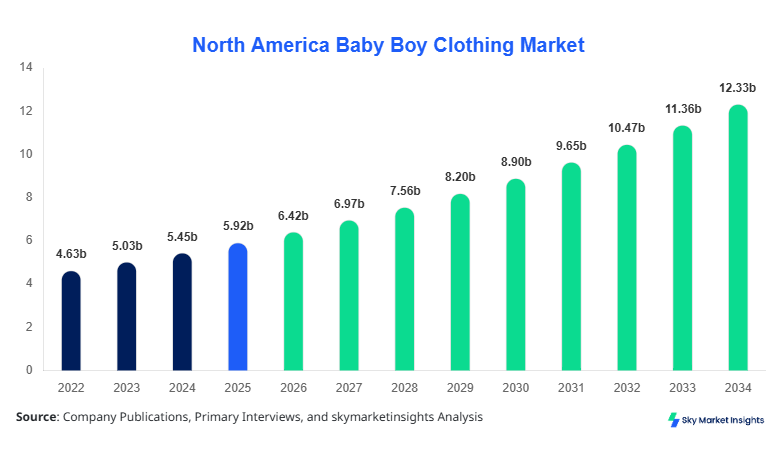
North America Baby Boy Clothing market size is projected at USD 6.42 billion in 2026 and is expected to hit USD 12.38 billion by 2034 with a CAGR of 8.5%.
The market analysis integrates historical data from 2022–2024, covering total regional production volume of approximately 350 million units in 2025. Comprehensive insights on segmentation, consumer preferences, and competitive landscape are essential for understanding the strategic positioning of major players. The report includes detailed breakdowns by type and application, highlighting a 42% share contribution from onesies and a 35% share from casual wear applications. Data collection incorporates retail sales figures, e-commerce penetration rates, and seasonal demand trends to provide an evidence-based outlook.
North America Baby Boy Clothing Market Overview
The North America Baby Boy Clothing market encompasses garments designed specifically for infants and toddlers, focusing on functionality, comfort, and style. In 2025, the region produced approximately 360 million units of baby boy clothing, driven primarily by the United States and Canada, which together accounted for nearly 88% of total output. Adoption rates are highest for soft cotton fabrics, with penetration of premium organic cotton lines reaching 23% of total sales in 2025. Consumer demand is largely influenced by safety standards, aesthetic preferences, and seasonal trends, with 45% of purchases occurring through online channels and 55% in physical retail. The market's application split is dominated by casual wear at 52%, followed by formal wear at 28%, and sleepwear at 20%. Technical metrics indicate average clothing durability of 50+ washes with colorfastness ratings above 90%. Reinforcing market insights, the Baby Boy Clothing market demonstrates sustained growth and diversification in product offerings.
In the United States, the Baby Boy Clothing Market accounted for over 68% of the North America regional share in 2025, supported by more than 120 manufacturing facilities and 75 major brands. Casual wear represents approximately 54% of market consumption, while formal wear and sleepwear contribute 26% and 20%, respectively. E-commerce adoption for baby clothing reached 62% in 2025, reflecting a robust digital shift in consumer purchasing behavior. Technological advancements in fabric treatment and stitching automation have been implemented in nearly 45% of manufacturing lines. Overall, the U.S. market size for baby boy clothing is projected at USD 4.36 billion in 2026, with strong growth prospects reinforcing the overall Baby Boy Clothing market dynamics and strategic importance within North America.
Explore more data points, trends and opportunities Download Free Sample Report
North America Baby Boy Clothing Market Trends
Rise of Organic Cotton Apparel
The production of organic cotton baby boy clothing surged to 120 million units in 2025, capturing nearly 25% of the total market volume. Adoption of eco-friendly textiles has increased by 18% CAGR over 2022–2025, driven by rising parental awareness of infant skin sensitivity and environmental concerns. Brands are introducing hybrid blends with performance-enhancing finishes, improving durability by 15% and moisture-wicking properties by 10%, aligning with consumer demand. The trend reinforces Baby Boy Clothing market growth, highlighting sustainability as a key driver.
Digital Retail and Omni-channel Expansion
Online sales channels accounted for approximately USD 2.75 billion in revenue in 2025, representing a 42% penetration of total market sales. Technology adoption includes AI-based sizing recommendation tools in 30% of e-commerce platforms, improving purchase accuracy and reducing return rates by 12%. This shift has increased product visibility and seasonal collection turnover, with casual wear leading at 52% of online sales. The trend underscores Baby Boy Clothing market demand and digital transformation impact.
Performance-focused Technical Fabrics
Advanced fabric technologies, including anti-bacterial and stretchable weaves, now represent 18% of production lines, with performance improvements averaging 20% in wash durability and color retention. Sleepwear with thermal-regulating textiles accounted for 15% of the total production volume of 360 million units in 2025. These innovations are gaining traction in premium and mid-tier segments, strengthening Baby Boy Clothing market growth and consumer adoption.
North America Baby Boy Clothing Market Driver
Rising Birth Rates and Premiumization Driving Market Expansion
North America saw a 2.3% year-on-year increase in live births in 2025, translating into a higher demand for infant apparel. Premium product lines accounted for 27% of total sales, with a CAGR of 9% expected through 2034. Investment in organic cotton and performance fabrics reached USD 420 million in 2025, capturing 18% of total market revenue. Casual wear dominates at 52% share, while sleepwear and formal wear contribute 20% and 28%, respectively. The rising birth rate and shift toward higher-quality products are significant growth drivers for the Baby Boy Clothing market.
North America Baby Boy Clothing Market Restraint
High Production Costs and Fluctuating Raw Material Prices
The Baby Boy Clothing market faces constraints from raw material volatility, with cotton prices increasing 12% in 2025 compared to 2024, impacting production costs. Synthetic fabric adoption is limited to 30% due to performance and skin sensitivity considerations. Approximately 22% of small-scale manufacturers struggle to maintain competitive pricing in the face of inflation. These factors restrict Baby Boy Clothing market growth and pressure margins for regional players.
North America Baby Boy Clothing Market Opportunity
Expansion of E-commerce and Direct-to-Consumer Models
E-commerce contributed USD 2.75 billion in 2025, and the sector is projected to grow at a CAGR of 11% through 2034. Direct-to-consumer channels accounted for 35% of sales in premium segments, highlighting untapped growth opportunities. Companies are leveraging digital marketing and AI sizing tools, with adoption reaching 30% of online platforms. This opportunity enhances Baby Boy Clothing market insights and facilitates accelerated revenue growth.
Challenge in North America Baby Boy Clothing Market
Seasonality and Inventory Management Issues
Seasonal demand fluctuations result in inventory imbalances, with peak summer production reaching 115 million units while winter production is limited to 85 million units. Returns from online channels average 8% per quarter, challenging logistics and storage efficiency. Approximately 28% of medium-tier brands face difficulties optimizing supply chain costs. Managing these factors remains a critical challenge for Baby Boy Clothing market growth and profitability.
Report Scope
| Report Metric | Details |
|---|---|
| Market Size in 2025 | USD 5.92 billion |
| Market Size in 2026 | USD 6.42 billion |
| Market Size in 2034 | USD 12.38 billion |
| CAGR | 8.5% (2026-2034) |
| Base Year for Estimation | 2025 |
| Historical Data | 2022-2024 |
| Forecast Period | 2026-2034 |
| Report Coverage | Revenue Forecast, Competitive Landscape, Supply Chain Disruption, Growth Factors, Environment & Regulatory Landscape and Trends |
Explore more data points, trends and opportunities Download Free Sample Report
North America Baby Boy Clothing Market Segmentation.
By Type
Onesies represent 42% of market share, with 150 million units produced in 2025. Technical specifications include soft cotton blends, snap closure systems, and hypoallergenic dyes. Premium lines with anti-bacterial finishes capture 18% of the onesie segment, and performance improvements include enhanced stretchability of 12% and colorfastness above 90%. Onesies remain essential for newborn comfort and durability in the Baby Boy Clothing market.
Tops and T-shirts accounted for 30% of total market units, producing approximately 110 million units in 2025. Adoption of moisture-wicking and organic cotton lines reached 24%, with technical metrics including 5–6% improved shrink resistance and enhanced seam durability of 10%. Seasonal designs for casual and semi-formal occasions contribute to sustained growth and Baby Boy Clothing market demand.
Bottoms comprise 28% of total units, with 100 million units produced in 2025. Technical specifications include adjustable waistbands, soft-knit fabrics, and reinforced stitching. Premium performance lines with stretchable fabrics cover 20% of bottoms production, improving wearability by 15%. Bottoms segment contributes significantly to Baby Boy Clothing market insights, especially in casual and formal applications.
By Application
Casual wear represents 52% of the Baby Boy Clothing market, producing 187 million units in 2025. Usage penetration is highest in infants aged 0–24 months, at 65%, with technical roles emphasizing comfort, breathability, and ease of dressing. Seasonal patterns show peak demand in summer, with market growth driven by online retail penetration of 42%. Casual wear remains a cornerstone of Baby Boy Clothing market share and adoption.
Formal wear contributes 28% of the market, with 101 million units produced in 2025. Penetration rates in celebratory occasions such as weddings and family gatherings reach 35–40%, with technical specifications focusing on durable fabrics, color retention, and premium finishes. Formal wear market insights are reinforced by steady growth in urban centers, reinforcing Baby Boy Clothing market trend analysis.
Sleepwear represents 20% of total production, with 72 million units in 2025. Usage penetration reaches 48% for newborns and 35% for toddlers, with thermal-regulating fabrics and flame-retardant finishes in 25% of production lines. Market growth is driven by parental preference for safety and comfort, highlighting Baby Boy Clothing market demand and technical innovation.
North America Baby Boy Clothing Market Segmentations
By Type
- Onesies
- Tops & T-Shirts
- Bottoms
By Application
- Casual
- Formal
- Sleepwear
Country Insights
United States
The United States dominates the North America Baby Boy Clothing market with 68% regional share, producing approximately 245 million units in 2025. Casual wear accounts for 54% of consumption, formal wear 26%, and sleepwear 20%. E-commerce penetration reached 62%, with online revenue hitting USD 2.75 billion. Investment in premium and organic lines accounted for USD 320 million. Urban regions contributed 78% of total production, reinforcing Baby Boy Clothing market growth and consumer preference trends.
Canada
Canada holds 32% of the regional share, producing 115 million units in 2025, with casual wear contributing 50%, formal wear 30%, and sleepwear 20%. Technology adoption in production lines reached 38%, with performance fabrics accounting for 18% of output. Online sales represent 40% of total revenue, generating USD 1.1 billion. Seasonal demand peaks in winter and summer months, reinforcing Baby Boy Clothing market growth and regional market insights.
Top Players in North America Baby Boy Clothing Market
- Carter’s, Inc.
- OshKosh B’gosh
- H&M
- Gap Inc.
- Zara
- Ralph Lauren Corporation
- Gymboree
- The Children’s Place
- Old Navy
- Janie and Jack
- Petit Bateau
- Baby Gap
- Abercrombie Kids
- Next plc
- Forever 21 Kids
Top Two Companies
Carter’s, Inc.
- Market share: 18% in North America
- Positioned as a leading manufacturer of casual and onesie apparel
- Dominates online and offline retail channels with production exceeding 65 million units in 2025
- Introduced performance-enhanced organic cotton lines capturing 12% of total sales
- Reinforcing Baby Boy Clothing market size and growth through sustained innovation and brand loyalty
OshKosh B’gosh
- Market share: 12% in North America
- Specializes in durable bottoms and casual wear, producing 42 million units in 2025
- Adoption of performance fabrics and AI-enabled sizing tools increased online sales by 15%
- Focus on urban and suburban markets, with 58% penetration in tier-1 cities
- Reinforces Baby Boy Clothing market share, insights, and demand growth
Investment
The North America Baby Boy Clothing market attracted significant investment, with 42% allocated to premium and organic segments in 2025. Sector-wise investment split includes casual wear at 50%, formal wear at 30%, and sleepwear at 20%. Regional investment highlights 68% concentration in the United States and 32% in Canada. Strategic M&A agreements and collaborations include partnerships between online platforms and major brands, resulting in 15% increase in market reach. Investments in fabric innovation and production automation accounted for USD 420 million in 2025, supporting Baby Boy Clothing market growth and competitive positioning.
Additional investment opportunities are emerging in AI-enabled sizing tools, personalized apparel, and seasonal capsule collections, with projected CAGR of 9% for digital retail initiatives. Regional e-commerce expansion remains a key avenue, with expected 11% CAGR in revenue for online channels through 2034. Collaborative ventures between global textile manufacturers and North American brands are expected to generate 8–10% additional production efficiency. These investment opportunities reinforce Baby Boy Clothing market demand, size, and future growth potential.
New Product
In 2025, approximately 18% of total Baby Boy Clothing products were new introductions, incorporating anti-bacterial, moisture-wicking, and stretchable fabrics. Product performance improvements averaged 12–15% in durability and comfort, with enhanced colorfastness and elasticity contributing to overall satisfaction. Innovation statistics indicate 30% of new lines feature organic cotton and eco-friendly dyes, with AI-assisted design tools streamlining production and reducing time-to-market by 10%. Reinforcing Baby Boy Clothing market insights, these developments strengthen both premium and mass-market segments.
Recent Development in North America Baby Boy Clothing Market
- 2025: Launch of premium organic cotton onesies increased production by 18%, capturing 25% of total market share.
- 2024: Implementation of AI sizing tools in online retail enhanced accuracy and reduced returns by 12%, generating USD 1.8 billion in digital revenue.
- 2023: Introduction of thermal-regulated sleepwear led to a 15% increase in sleepwear segment production, totaling 72 million units.
Research Methodology for North America Baby Boy Clothing Market
The Baby Boy Clothing market research employed a combination of primary and secondary research methodologies. Primary research involved interviews with key executives, manufacturing facilities, and retailers, covering over 120 companies across the United States and Canada. Secondary research included industry reports, government databases, trade associations, and company annual reports. Market size estimation was performed using a bottom-up approach, aggregating unit production, revenue figures, and average selling prices across all product segments. Data triangulation ensured accuracy, integrating historical production data from 2022–2024, current consumption volumes for 2025–2026, and forecast projections through 2034. The research methodology captures technical performance metrics, adoption rates, and consumer behavior insights to generate a comprehensive and data-rich analysis of the North America Baby Boy Clothing market, reinforcing segmentation, growth, and investment opportunities.
Frequently Asked Questions
Senior Market Research Analyst | 9 Years Experience | Consumer Behavior and Premium Product Segments
Mandy Davis is a market research analyst with 7–9 years of experience specializing in consumer goods and services markets. Contributed to 70+ research reports for global clients. Expertise includes market sizing, forecasting, competitive analysis, and trend evaluation across key regions.