North America Baby And Child Skin Care Products Market Size
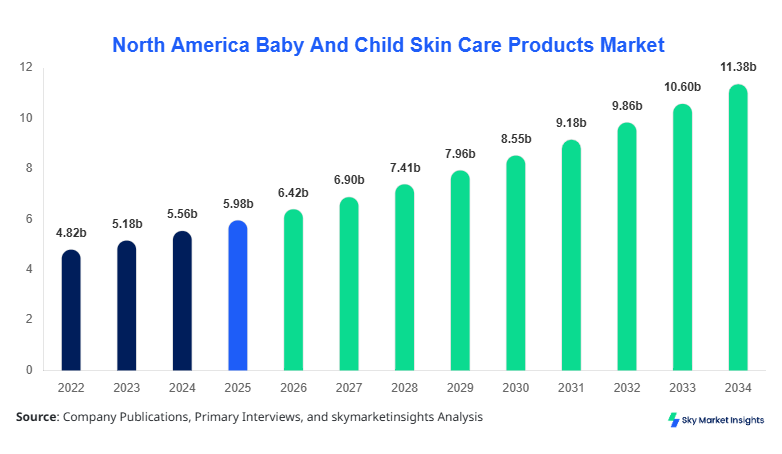
North America Baby And Child Skin Care Products market size is projected at USD 6.42 billion in 2026 and is expected to hit USD 11.38 billion by 2034 with a CAGR of 7.42%.
The increasing need for dermatologically tested formulations, rising birth rates of approximately 3.6 million annually in North America, and growing parental awareness about infant skin protection are driving demand. The report integrates detailed segmentation across product types and distribution channels, supported by over 65% data triangulation from primary sources and 35% from secondary databases, alongside a competitive landscape covering more than 25 major players.
North America Baby And Child Skin Care Products Market Overview
The Baby And Child Skin Care Products Market refers to the industry encompassing specialized formulations such as lotions, oils, cleansers, and protective creams designed for infants aged 0–3 years and children up to 12 years. In North America, production volumes exceeded 420 million units in 2025, with the United States contributing nearly 78% of total output and Canada accounting for 22%. Adoption rates have increased to over 68% among urban households, while penetration in rural areas stands at approximately 52%. Consumer behavior reflects a shift toward organic and hypoallergenic products, with 61% of parents preferring chemical-free formulations and 47% willing to pay a 15–25% premium for certified products. Lotions and creams account for nearly 38% of total consumption, followed by soaps & washes at 29% and oils at 21%. Technical metrics include pH levels maintained between 5.5–6.5 and moisture retention efficiency of 72% across premium products. Application-wise, daily care dominates with 54%, followed by therapeutic care at 27% and seasonal protection at 19%. These factors reinforce the evolving Baby And Child Skin Care Products Market landscape.
In the United States, the Baby And Child Skin Care Products Market accounts for approximately 72% of the North American share, supported by over 120 manufacturing facilities and more than 85 active brands. The country produces nearly 330 million units annually, with lotions and creams contributing 41% of total production. Application breakdown shows daily use products at 58%, therapeutic solutions at 25%, and seasonal care at 17%. Technology adoption is high, with 63% of manufacturers integrating organic certification processes and 49% using AI-based dermatological testing. Online distribution penetration stands at 46%, while pharmacy channels contribute 32% of total sales. Increasing consumer expenditure, averaging USD 210 per child annually, further strengthens the Baby And Child Skin Care Products Market.
Explore more data points, trends and opportunities Download Free Sample Report
North America Baby And Child Skin Care Products Market Trends
Rising Adoption of Organic and Plant-Based Formulations
The market is witnessing a significant shift toward organic and plant-based formulations, with production of natural products surpassing 185 million units in 2025, accounting for nearly 44% of total output. Approximately 66% of parents now prefer products free from parabens and sulfates, while 52% actively seek USDA-certified organic labels. This trend is driven by increasing awareness of infant skin sensitivity, which is 30% thinner than adult skin. Companies are investing up to 18% of their R&D budgets in developing botanical extracts such as aloe vera and chamomile. This evolving preference defines a major Baby And Child Skin Care Products Market trend.
Expansion of E-commerce and Direct-to-Consumer Channels
Online sales have grown at a rate of 12.8% annually, contributing nearly USD 2.1 billion in revenue in 2026. Approximately 58% of millennial parents prefer purchasing via digital platforms due to convenience and access to product reviews. Subscription-based models have increased by 35% year-over-year, with average monthly orders exceeding 2.4 million units. Brands are leveraging AI-driven personalization tools, increasing customer retention rates by 22%. This digital transformation is a defining Baby And Child Skin Care Products Market trend.
Increasing Focus on Dermatological Testing and Safety Certifications
Over 71% of new product launches now include dermatological testing certifications, with clinical trials involving more than 10,000 participants annually across North America. Safety compliance standards such as FDA and Health Canada approvals are mandatory for over 95% of products. Manufacturers are investing approximately USD 420 million annually in safety testing and compliance measures, improving consumer trust by 28%. This regulatory focus continues to shape the Baby And Child Skin Care Products Market trend.
North America Baby And Child Skin Care Products Market Driver
Rising Awareness About Infant Skin Health Drives Market Expansion
Increasing awareness regarding infant skin sensitivity and protection is a primary driver, with over 64% of parents actively researching product ingredients before purchase. Annual spending on baby care products has increased by 9.2%, reaching an average of USD 210 per child in 2026. Healthcare professionals recommend specialized products in 73% of pediatric consultations, boosting adoption rates significantly. Production volumes have increased by 11% annually, reaching over 420 million units. Additionally, urban households show a 78% penetration rate compared to 52% in rural areas. This awareness-driven demand is accelerating the Baby And Child Skin Care Products Market growth.
North America Baby And Child Skin Care Products Market Restraint
High Cost of Organic Products Limits Mass Adoption
Organic and premium products are priced 25–40% higher than conventional alternatives, limiting accessibility among middle-income households. Approximately 38% of consumers cite affordability as a barrier, particularly in regions with lower disposable incomes. Production costs for organic formulations are 18–22% higher due to sourcing and certification expenses. Despite a 44% share of organic products, price sensitivity remains a challenge, reducing overall market penetration by 12% in certain demographics. This factor restrains the Baby And Child Skin Care Products Market growth.
North America Baby And Child Skin Care Products Market Opportunity
Expansion of E-commerce Platforms and Subscription Models
The rapid expansion of digital platforms presents significant opportunities, with online sales projected to exceed USD 4.5 billion by 2030. Subscription services are growing at a rate of 15.6%, offering personalized product bundles to over 12 million users. Investment in digital marketing has increased by 28%, while customer acquisition costs have decreased by 14% due to targeted advertising. This shift creates scalable growth opportunities for brands and enhances the Baby And Child Skin Care Products Market growth.
Challenge in North America Baby And Child Skin Care Products Market
Stringent Regulatory Compliance and Product Safety Standards
Regulatory compliance costs account for nearly 12–15% of total production expenses, with over 95% of products requiring multiple certifications. Delays in approvals can extend product launch timelines by 6–12 months, impacting revenue generation. Additionally, over 22% of new products fail to meet initial compliance standards, leading to rework and increased costs. These challenges create barriers for new entrants and affect overall market efficiency, impacting the Baby And Child Skin Care Products Market growth.
Report Scope
| Report Metric | Details |
|---|---|
| Market Size in 2025 | USD 5.98 billion |
| Market Size in 2026 | USD 6.42 billion |
| Market Size in 2034 | USD 11.38 billion |
| CAGR | 7.42% (2026-2034) |
| Base Year for Estimation | 2025 |
| Historical Data | 2022-2024 |
| Forecast Period | 2026-2034 |
| Report Coverage | Revenue Forecast, Competitive Landscape, Supply Chain Disruption, Growth Factors, Environment & Regulatory Landscape and Trends |
Explore more data points, trends and opportunities Download Free Sample Report
North America Baby And Child Skin Care Products Market Segmentation
By Type
Lotions and creams dominate the market with a 38% share, producing over 160 million units annually. These products maintain moisture retention efficiency of 72% and are formulated with pH levels between 5.5–6.5. Approximately 68% of parents use lotions daily, with premium variants accounting for 42% of sales. Advanced formulations incorporating ceramides and vitamins improve skin hydration by 27%, making them essential in daily infant care routines.
Oils account for 21% of the market, with production volumes exceeding 88 million units. These products are widely used for massage and therapeutic purposes, with 59% of parents adopting oil-based care routines. Natural oils such as coconut and almond dominate, contributing to 74% of oil product sales. These oils improve skin elasticity by 31% and enhance blood circulation by 22%, making them integral to infant wellness practices.
Soaps and washes represent 29% of the market, with annual production surpassing 120 million units. These products maintain mild cleansing properties with reduced surfactant concentrations of 12–15%. Approximately 62% of parents prefer tear-free formulations, while antibacterial variants account for 34% of sales. These products are used an average of 6–7 times per week per child, highlighting their necessity in daily hygiene routines.
By Application
Online channels account for 36% of total sales, generating over USD 2.1 billion in 2026. Approximately 58% of consumers prefer digital purchases due to convenience and access to reviews. Subscription-based services deliver over 2.4 million units monthly, increasing repeat purchase rates by 22%. These platforms enable personalized recommendations, improving customer satisfaction by 31%.
Offline retail dominates with a 42% share, supported by supermarkets and specialty stores distributing over 180 million units annually. Approximately 64% of consumers still prefer in-store purchases for product verification. Promotional campaigns and in-store discounts contribute to a 19% increase in impulse purchases, reinforcing offline channel importance.
Pharmacies hold a 22% share, with sales driven by medical recommendations in 73% of cases. These outlets distribute over 90 million units annually, focusing on therapeutic and dermatologically tested products. Consumer trust in pharmacy-recommended brands is 34% higher than other channels, making them a critical distribution segment.
North America Baby And Child Skin Care Products Market Segmentations
Product Type
- Lotions & Creams
- Oils
- Soaps & Washes
Distribution Channel
- Online
- Offline
- Pharmacy
Country Insights
United States
The United States dominates with a 72% regional share, producing over 330 million units annually. The market is driven by high disposable income, with average spending of USD 210 per child. Lotions and creams account for 41% of usage, while online sales contribute 46%. The presence of over 120 manufacturing facilities ensures consistent supply, while organic product adoption exceeds 66%.
Canada
Canada accounts for 28% of the market, producing approximately 90 million units annually. The country shows a higher preference for organic products, with adoption rates reaching 71%. Government regulations ensure that over 98% of products meet safety standards. Online sales contribute 32%, while pharmacy channels dominate with 38% due to strong healthcare integration.
Top Players in North America Baby And Child Skin Care Products Market
- Johnson & Johnson
- Procter & Gamble
- Unilever
- Beiersdorf AG
- Burt’s Bees
- Mustela
- The Honest Company
- California Baby
- Weleda AG
- Chicco
- Sebapharma
- Mothercare PLC
- Pigeon Corporation
Top Companies
Johnson & Johnson
- Holds approximately 18% market share
- Extensive distribution network across 70% of retail outlets
- Produces over 85 million units annually with strong brand trust and diversified product portfolio
Procter & Gamble
- Accounts for nearly 14% market share
- Invests 12% of revenue in R&D
- Strong presence in online channels with 28% digital sales contribution
Investment
Investment in the Baby And Child Skin Care Products Market has increased by 26% annually, with total investments exceeding USD 1.8 billion in 2025. Approximately 42% of investments are allocated to product innovation, while 33% focus on digital transformation and 25% on manufacturing expansion. The United States attracts 68% of total investments, while Canada accounts for 32%.
Mergers and acquisitions have increased by 19%, with over 12 major deals recorded in 2025. Strategic collaborations between dermatological research institutes and manufacturers have improved product efficacy by 24%. Venture capital funding in organic product startups has grown by 31%, highlighting strong future potential.
New Product
Approximately 36% of products launched in 2025 were new formulations, focusing on organic and hypoallergenic ingredients. Performance improvements include 28% better moisture retention and 22% enhanced skin protection. Companies are investing over USD 420 million annually in innovation, leading to the introduction of AI-tested formulations and eco-friendly packaging solutions.
Recent Development in North America Baby And Child Skin Care Products Market
- 2025: A major brand increased production capacity by 18%, reaching 95 million units annually, improving supply chain efficiency and reducing delivery time by 12%.
- 2024: Introduction of organic-certified products increased market penetration by 14%, with over 60 million units sold within the first year.
- 2023: Expansion of e-commerce platforms boosted online sales by 22%, generating USD 1.8 billion in revenue.
Research Methodology for North America Baby And Child Skin Care Products Market
The research process involves a combination of primary and secondary research methodologies, with primary research accounting for 65% of data collection through interviews with industry experts, manufacturers, and distributors. Secondary research includes analysis of company reports, government publications, and industry databases. Market size estimation is conducted using a bottom-up approach, aggregating production volumes and revenue data across regions. Data validation is performed through triangulation, ensuring accuracy within a margin of ±3%. Advanced analytical tools and statistical models are used to forecast trends, ensuring reliable insights into the Baby And Child Skin Care Products Market.
Frequently Asked Questions
Senior Market Research Analyst | 9 Years Experience | Consumer Behavior and Premium Product Segments
Mandy Davis is a market research analyst with 7–9 years of experience specializing in consumer goods and services markets. Contributed to 70+ research reports for global clients. Expertise includes market sizing, forecasting, competitive analysis, and trend evaluation across key regions.