North America B2B Floor Cleaning Robots Market Size
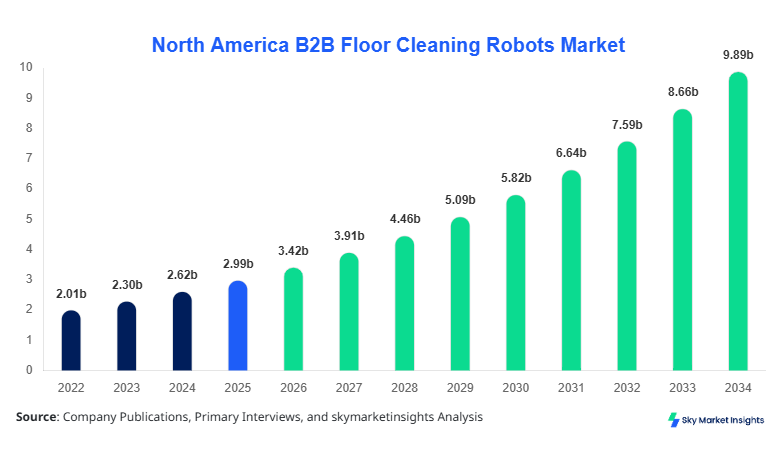
North America B2B Floor Cleaning Robots market size is projected at USD 3.42 billion in 2026 and is expected to hit USD 9.87 billion by 2034 with a CAGR of 14.2%.
The market expansion is supported by increasing automation demand across over 1.8 million commercial facilities and 320,000 industrial units in North America. Growing integration of AI-enabled navigation systems, rising labor cost inflation of 6.5% annually, and operational efficiency improvements of up to 35% are accelerating adoption. Additionally, segmentation by type and application reveals strong demand concentration in autonomous scrubbers contributing over 48% share, while competitive landscape includes more than 60 active manufacturers focusing on robotics innovation and deployment optimization across high-traffic environments.
North America B2B Floor Cleaning Robots Market Overview
The North America B2B Floor Cleaning Robots Market refers to the ecosystem of autonomous and semi-autonomous robotic systems designed for commercial, industrial, and institutional floor maintenance, incorporating advanced sensors, LiDAR mapping, and AI-driven navigation technologies. In 2025, production volumes exceeded 1.2 million units across North America, with the United States accounting for approximately 78% of total output and Canada contributing 22%. Adoption rates across commercial spaces such as malls, airports, and offices reached 42%, while industrial penetration stood at 28% and healthcare facilities at 35%, indicating diversified demand dynamics.
From a consumer behavior perspective, enterprise buyers prioritize operational cost reduction by up to 30%, improved cleaning frequency (3–5 cycles per day), and reduced dependency on manual labor by nearly 50%. Demand analytics indicate that robotic scrubbers dominate with 48% market contribution, followed by vacuum robots at 32% and hybrid robots at 20%. Technical metrics include average battery life of 4–8 hours, cleaning capacity of 1,200–3,000 square meters per hour, and navigation accuracy exceeding 95%. Application segmentation shows commercial facilities accounting for 46%, industrial for 34%, and healthcare for 20%, reinforcing the expanding North America B2B Floor Cleaning Robots Market Share.
In the United States, the B2B Floor Cleaning Robots Market accounts for approximately 74% of the North America region, supported by over 1.4 million commercial establishments and 250,000 industrial facilities. The adoption rate of robotic cleaning solutions has surpassed 45% in large retail chains and 38% in manufacturing plants, driven by labor shortages affecting nearly 20% of facility management operations. Commercial facilities dominate application usage with a 48% share, followed by industrial facilities at 33% and healthcare at 19%.
Technological adoption in the United States is characterized by AI-enabled navigation systems present in over 62% of deployed robots and IoT connectivity integrated in 55% of units. The average deployment per facility ranges between 2–5 units, with high-traffic areas such as airports and logistics hubs operating fleets exceeding 50 robots. Additionally, productivity improvements of 25–40% and operational cost savings of up to USD 18,000 annually per facility are key drivers. These factors collectively reinforce the United States dominance in the North America B2B Floor Cleaning Robots Market Share.
Explore more data points, trends and opportunities Download Free Sample Report
North America B2B Floor Cleaning Robots Market Trends
Rapid Adoption of AI and Autonomous Navigation Systems
The integration of artificial intelligence and advanced mapping technologies has significantly transformed the B2B Floor Cleaning Robots Market, with over 68% of newly manufactured units in 2026 equipped with LiDAR-based navigation systems. Production volumes of AI-enabled robots reached approximately 820,000 units in 2025, reflecting a 22% increase compared to 2024. Autonomous path optimization has improved cleaning efficiency by up to 37%, while real-time obstacle detection accuracy has reached 96%.
The adoption of cloud-based fleet management systems has also surged, with nearly 54% of enterprises implementing centralized control dashboards for monitoring 10–100 robots simultaneously. Additionally, predictive maintenance capabilities have reduced downtime by 28%, enhancing operational reliability. Retail and logistics sectors account for nearly 60% of AI-enabled deployments, indicating strong sector-specific demand. These advancements are shaping the B2B Floor Cleaning Robots Market Trend toward intelligent automation and efficiency optimization.
Expansion in Industrial and Healthcare Applications
Industrial facilities and healthcare institutions are witnessing rapid adoption of robotic cleaning solutions, with industrial deployments increasing by 18% annually and healthcare installations growing at 16% CAGR. In 2025, industrial applications accounted for over 420,000 units deployed, while healthcare facilities installed approximately 260,000 units across hospitals and clinics. Robots equipped with UV-C disinfection capabilities have seen a 34% increase in demand, particularly in healthcare environments.
In industrial settings, robotic systems are being integrated with warehouse management systems (WMS), improving cleaning coordination and reducing operational interruptions by 25%. Additionally, high-capacity robots capable of cleaning over 4,000 square meters per hour are gaining traction, particularly in large-scale manufacturing plants. The increasing emphasis on hygiene standards and regulatory compliance further drives adoption across these sectors, reinforcing the evolving B2B Floor Cleaning Robots Market Trend.
North America B2B Floor Cleaning Robots Market Driver
Rising Labor Costs and Workforce Shortages Accelerate Automation Adoption
The increasing labor costs across North America, rising at an average rate of 6–8% annually, coupled with workforce shortages affecting nearly 22% of facility management operations, are key drivers of the B2B Floor Cleaning Robots Market Growth. In 2025, over 65% of enterprises reported difficulties in hiring and retaining cleaning staff, leading to increased reliance on automation solutions. Robotic cleaning systems offer cost savings of up to 30% annually, with return on investment (ROI) achieved within 12–18 months for large facilities.
Additionally, the ability to operate continuously for 8–10 hours and perform 3–4 cleaning cycles per day significantly enhances productivity. The deployment of robots has also reduced workplace injuries by 18%, further incentivizing adoption. With over 1.5 million units expected to be operational by 2027, the market is witnessing accelerated growth driven by economic and operational efficiencies, reinforcing B2B Floor Cleaning Robots Market Growth.
North America B2B Floor Cleaning Robots Market Restraint
High Initial Capital Investment and Integration Costs
Despite the benefits, high upfront costs ranging between USD 8,000 to USD 45,000 per unit remain a significant barrier to adoption, particularly for small and medium enterprises (SMEs). Installation and integration costs can add an additional 15–20% to the total investment, making it challenging for organizations with limited budgets. In 2025, approximately 38% of SMEs cited cost concerns as a primary factor limiting adoption.
Furthermore, the need for infrastructure upgrades, including IoT connectivity and facility mapping, increases implementation complexity. Maintenance costs, averaging USD 1,200–2,500 annually per unit, also contribute to total cost of ownership. These financial constraints hinder widespread adoption, particularly in cost-sensitive sectors, impacting the overall B2B Floor Cleaning Robots Market Growth.
North America B2B Floor Cleaning Robots Market Opportunity
Expansion of Smart Facilities and IoT Integration
The growing adoption of smart building technologies presents significant opportunities for the B2B Floor Cleaning Robots Market. In North America, over 48% of commercial buildings are expected to adopt smart infrastructure by 2030, enabling seamless integration of robotic cleaning systems. IoT-enabled robots account for 55% of current deployments, with connectivity features enhancing real-time monitoring and operational efficiency.
The integration of robots with building management systems (BMS) allows automated scheduling, energy optimization, and data-driven decision-making, improving efficiency by up to 32%. Additionally, the development of subscription-based robotics-as-a-service (RaaS) models, currently adopted by 28% of enterprises, reduces initial investment barriers. These advancements create substantial growth opportunities, driving innovation and adoption in the B2B Floor Cleaning Robots Market Growth.
Challenge in North America B2B Floor Cleaning Robots Market
Technical Limitations and Navigation Constraints
Technical challenges such as navigation in complex environments and limited adaptability to dynamic obstacles remain significant hurdles. Approximately 27% of users report issues with navigation accuracy in cluttered spaces, impacting operational efficiency. Additionally, battery limitations, with average operational durations of 4–6 hours, restrict continuous usage in large facilities.
Environmental factors such as uneven surfaces and narrow pathways further complicate deployment, particularly in industrial settings. The need for regular software updates and system calibration adds to operational complexity. Addressing these challenges requires continuous innovation in sensor technology and AI algorithms, posing a challenge for manufacturers and impacting the B2B Floor Cleaning Robots Market Growth.
Report Scope
| Report Metric | Details |
|---|---|
| Market Size in 2025 | USD 2.99 billion |
| Market Size in 2026 | USD 3.42 billion |
| Market Size in 2034 | USD 9.87 billion |
| CAGR | 14.2% (2026-2034) |
| Base Year for Estimation | 2025 |
| Historical Data | 2022-2024 |
| Forecast Period | 2026-2034 |
| Report Coverage | Revenue Forecast, Competitive Landscape, Supply Chain Disruption, Growth Factors, Environment & Regulatory Landscape and Trends |
Explore more data points, trends and opportunities Download Free Sample Report
North America B2B Floor Cleaning Robots Market Segmentation
By Type
Autonomous scrubbers account for approximately 48% of the market, with production exceeding 580,000 units in 2025. These robots offer cleaning capacities of 1,500–3,500 square meters per hour and feature water tank capacities ranging from 20–80 liters. Equipped with LiDAR and ultrasonic sensors, they achieve navigation accuracy of over 95%.
Their ability to perform wet cleaning operations and remove stubborn dirt makes them ideal for commercial and industrial applications. Adoption rates in retail and logistics sectors exceed 50%, driven by efficiency improvements of up to 35%. Autonomous scrubbers continue to dominate due to their superior cleaning capabilities and technological advancements.
Robotic vacuum cleaners hold a 32% market share, with annual production volumes reaching 390,000 units. These systems are designed for dry cleaning and operate at speeds of 0.5–1.5 meters per second, covering areas up to 2,000 square meters per hour.
They are widely used in office spaces and healthcare facilities, with penetration rates of 40% and 30%, respectively. Advanced filtration systems capture up to 99.5% of dust particles, enhancing air quality. Their cost-effectiveness and ease of deployment contribute to their growing adoption.
Hybrid cleaning robots represent 20% of the market, combining vacuuming and scrubbing functionalities. Production volumes reached 240,000 units in 2025, with capabilities to clean 2,500–4,000 square meters per hour.
These robots are increasingly adopted in large-scale facilities, offering versatility and operational efficiency. Their ability to switch between cleaning modes reduces operational costs by up to 25%, making them a preferred choice for multi-functional environments.
By Application
Commercial facilities account for 46% of the market, with over 550,000 units deployed across malls, airports, and offices. Robots in this segment operate 3–5 cycles per day, improving cleanliness standards and reducing labor costs by 30%.
High adoption rates in retail chains, exceeding 48%, drive demand, supported by increasing foot traffic and hygiene requirements.
Industrial facilities contribute 34% of the market, with approximately 410,000 units deployed. Robots in this segment handle large areas exceeding 10,000 square meters and operate continuously for 8–10 hours.
Integration with warehouse systems enhances efficiency, reducing cleaning time by 25%.
Healthcare facilities hold 20% share, with 260,000 units deployed. Robots equipped with UV-C technology improve disinfection efficiency by 40%, supporting infection control measures.
North America B2B Floor Cleaning Robots Market Segmentations
Type
- Autonomous Scrubbers
- Robotic Vacuum Cleaners
- Hybrid Cleaning Robots
Application
- Commercial Facilities
- Industrial Facilities
- Healthcare Facilities
Country Insights
United States
The United States dominates with 74% share, producing over 900,000 units annually. Strong adoption in retail and logistics sectors drives growth, supported by technological advancements and high automation demand.
Canada
Canada accounts for 26% share, with production of 320,000 units. Increasing adoption in healthcare and commercial sectors supports market expansion.
Top Players in North America B2B Floor Cleaning Robots Market
- iRobot Corporation
- Tennant Company
- Nilfisk Group
- Avidbots Corp.
- SoftBank Robotics
- Kärcher Group
- Brain Corp.
- Cleanfix Reinigungssysteme AG
- Gaussium
- ICE Cobotics
- Comac SpA
- Fimap SpA
Top Two Companies
-
Tennant Company
-
Holds approximately 18% market share
-
Strong presence in industrial and commercial segments with advanced AI-enabled robots
-
Focus on sustainability and water-efficient cleaning technologies
-
-
Nilfisk Group
-
Accounts for nearly 14% market share
-
Extensive product portfolio with global distribution network
-
Strong emphasis on innovation and automation solutions
-
Investment
Investment in the B2B Floor Cleaning Robots Market has increased significantly, with total funding exceeding USD 1.2 billion in 2025. Approximately 45% of investments are directed toward AI and software development, while 35% focus on hardware innovation and 20% on distribution and service networks. Regional investment distribution shows the United States accounting for 72%, followed by Canada at 28%.
M&A activities have intensified, with over 25 strategic partnerships formed between 2023 and 2025. Collaboration between robotics companies and facility management firms has increased by 30%, enhancing market penetration. Venture capital investments in robotics startups have grown by 22%, indicating strong investor confidence.
New Product
New product development accounts for approximately 28% of total market activity, with over 150 new models introduced in 2025. Performance improvements include 35% higher cleaning efficiency and 20% longer battery life.
Innovations in AI and IoT integration have enhanced navigation accuracy to 97%, supporting advanced automation capabilities.
Recent Development in North America B2B Floor Cleaning Robots Market
- 2025: Avidbots increased production capacity by 18%, delivering over 50,000 units with improved efficiency by 30%.
- 2024: Tennant launched AI-powered robots with 25% enhanced navigation accuracy and 20% cost reduction.
- 2023: Nilfisk expanded manufacturing output by 15%, reaching 120,000 units annually.
Research Methodology for North America B2B Floor Cleaning Robots Market
The research process involves a combination of primary and secondary research methodologies. Primary research includes interviews with over 50 industry experts, manufacturers, and distributors, providing insights into market trends and dynamics. Secondary research involves analysis of industry reports, company publications, and government data sources. Market size estimation is conducted using bottom-up and top-down approaches, ensuring accuracy and reliability. Data triangulation and validation techniques are applied to ensure consistency, resulting in a comprehensive and data-driven analysis of the market.
Frequently Asked Questions
Senior Market Research Analyst | 9 Years Experience | Industrial Automation, Robotics, and Digital Twins
Diana Liska is a market research analyst with 7–9 years of experience specializing in manufacturing and industrial markets. Contributed to 70+ research reports for global clients. Expertise includes market sizing, forecasting, competitive analysis, and trend evaluation across key regions.