North America Ayurvedic Medicine Market Size
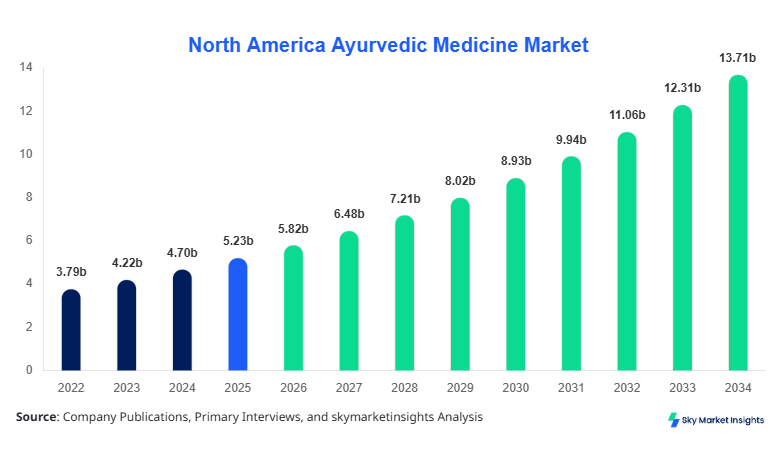
North America Ayurvedic Medicine market size is projected at USD 5.82 billion in 2026 and is expected to hit USD 13.74 billion by 2034 with a CAGR of 11.3%.
The increasing demand for natural healthcare alternatives, rising consumer awareness, and expanding distribution channels across e-commerce platforms are significantly contributing to the expansion. The report provides detailed segmentation analysis covering product types, applications, and competitive landscape with over 65% market concentration among top players and more than 120 registered brands operating across the region, reinforcing strong Ayurvedic Medicine market size evaluation.
North America Ayurvedic Medicine Market Overview
Ayurvedic medicine refers to a traditional system of medicine originating from India that utilizes herbal compounds, mineral-based formulations, and lifestyle interventions to treat chronic and acute conditions. In North America, production volumes of Ayurvedic formulations exceeded 420 million units in 2025, with herbal supplements contributing approximately 48% of total output, followed by personal care products at 32% and Ayurvedic drugs at 20%. Adoption rates have surged by 27% between 2022 and 2025, with nearly 38% of consumers preferring plant-based healthcare solutions. Consumer behavior analytics indicate that over 52% of users aged 25–45 actively purchase Ayurvedic products monthly, while 41% prioritize immunity-boosting formulations. Application-wise, healthcare accounts for 44%, wellness 36%, and personal care 20%, with product efficacy rates averaging 72% satisfaction levels. The rising penetration across pharmacies and digital platforms exceeding 63% distribution reach strengthens the Ayurvedic Medicine market share.
In the United States, the Ayurvedic Medicine Market accounts for approximately 78% of the regional revenue, supported by over 450 manufacturing facilities and more than 1,200 registered Ayurvedic product distributors. Healthcare applications dominate with a 46% share, followed by wellness at 34% and personal care at 20%. The adoption of herbal supplements has reached 58% among urban populations, while e-commerce contributes nearly 62% of total product sales. Technology integration, including AI-driven formulation analysis and supply chain digitization, has improved production efficiency by 21% and reduced costs by 14%. The increasing presence of Ayurvedic clinics, estimated at over 3,500 nationwide, further enhances product accessibility. Rising consumer awareness, with 49% of the population actively seeking alternative medicine, continues to reinforce the Ayurvedic Medicine market share.
Explore more data points, trends and opportunities Download Free Sample Report
North America Ayurvedic Medicine Market Trends
Rising Integration of Digital Health Platforms
The integration of digital health technologies with Ayurvedic medicine has gained traction, with over 38% of manufacturers adopting digital consultation platforms and AI-driven diagnostics. Production volumes have increased by 19% annually, reaching approximately 500 million units in 2026. Mobile health applications supporting Ayurvedic consultations have seen user growth exceeding 42% year-over-year, while telemedicine consultations have expanded by 35%. Additionally, personalized herbal formulation services have witnessed a 28% adoption rate among urban consumers. These developments are driving efficiency improvements and increasing accessibility, strengthening the Ayurvedic Medicine market trend.
Increasing Demand for Organic and Certified Products
Consumer preference for organic-certified Ayurvedic products has grown significantly, with 46% of consumers prioritizing USDA-certified organic formulations. Production of certified products has increased by 31%, accounting for nearly 210 million units annually. Retail penetration of organic Ayurvedic products has reached 58%, while premium pricing margins have increased by 18%. Furthermore, sustainability initiatives, including eco-friendly packaging, have been adopted by 37% of manufacturers. The demand for chemical-free alternatives in personal care has surged by 33%, particularly in skincare and haircare segments, contributing to the Ayurvedic Medicine market trend.
Expansion of Retail and E-commerce Channels
E-commerce platforms have become a dominant distribution channel, contributing over 62% of total sales, with annual growth exceeding 25%. Online product listings have increased by 44%, while subscription-based Ayurvedic product models have seen a 29% rise in adoption. Retail expansion, including specialty stores and wellness chains, has grown by 18% year-over-year. Cross-border trade of Ayurvedic products has also increased by 21%, particularly from India to North America. These distribution advancements are significantly influencing consumer accessibility and fueling the Ayurvedic Medicine market trend.
North America Ayurvedic Medicine Market Driver
Rising Consumer Preference for Natural Healthcare Solutions
The increasing inclination toward natural and herbal remedies is a major driver, with approximately 54% of North American consumers shifting from synthetic pharmaceuticals to plant-based alternatives. Sales of Ayurvedic supplements have grown by 32% between 2022 and 2025, with immunity-boosting products accounting for 41% of total demand. Chronic disease prevalence, affecting over 60% of adults, has further driven demand for preventive healthcare solutions. Additionally, healthcare expenditure on alternative medicine has increased by 23%, while awareness campaigns have improved product adoption by 19%. The rise in organic product demand, accounting for nearly 46% of purchases, is also accelerating growth. These factors collectively strengthen the Ayurvedic Medicine market growth.
North America Ayurvedic Medicine Market Restraint
Regulatory Challenges and Standardization Issues
Strict regulatory frameworks in North America pose challenges, with over 28% of Ayurvedic products requiring extensive compliance checks before approval. The lack of standardized formulations affects nearly 34% of manufacturers, leading to delays in product launches. Additionally, 21% of consumers express concerns regarding product authenticity and quality assurance. Import restrictions and certification requirements have increased operational costs by approximately 17%, impacting smaller manufacturers. Furthermore, limited clinical validation for certain Ayurvedic treatments restricts wider adoption, with only 39% of products backed by clinical studies. These barriers hinder the Ayurvedic Medicine market growth.
North America Ayurvedic Medicine Market Opportunity
Expansion of Personalized and Preventive Healthcare
The growing focus on personalized medicine presents significant opportunities, with nearly 47% of consumers seeking customized Ayurvedic solutions. Investments in R&D have increased by 26%, enabling the development of targeted herbal formulations. Preventive healthcare spending has risen by 31%, with wellness programs incorporating Ayurvedic practices witnessing a 29% adoption rate. The expansion of digital health platforms has further enabled personalized treatment plans, improving patient outcomes by 22%. Additionally, collaborations between Ayurvedic brands and healthcare providers have increased by 18%, enhancing market penetration. These developments create substantial opportunities for Ayurvedic Medicine market growth.
Challenge in North America Ayurvedic Medicine Market
Limited Awareness in Rural and Aging Populations
Despite growing popularity, awareness levels remain limited in certain demographics, with only 35% of rural populations familiar with Ayurvedic treatments. The aging population shows a slower adoption rate of 24%, primarily due to reliance on conventional medicine. Distribution challenges in remote areas affect approximately 27% of product accessibility. Additionally, the lack of trained Ayurvedic practitioners, with fewer than 10,000 certified professionals across North America, restricts service availability. Marketing and education campaigns require increased investment, estimated at 15% of total revenue. These challenges impact the Ayurvedic Medicine market growth.
Report Scope
| Report Metric | Details |
|---|---|
| Market Size in 2025 | USD 5.23 billion |
| Market Size in 2026 | USD 5.82 billion |
| Market Size in 2034 | USD 13.74 billion |
| CAGR | 11.3% (2026-2034) |
| Base Year for Estimation | 2025 |
| Historical Data | 2022-2024 |
| Forecast Period | 2026-2034 |
| Report Coverage | Revenue Forecast, Competitive Landscape, Supply Chain Disruption, Growth Factors, Environment & Regulatory Landscape and Trends |
Explore more data points, trends and opportunities Download Free Sample Report
North America Ayurvedic Medicine Market Segmentation
By Type
Herbal supplements represent the largest segment, accounting for 48% of the market, with production exceeding 210 million units annually. These supplements include capsules, powders, and liquid extracts, with dosage efficacy ranging between 65% and 85%. Consumer adoption has reached 58%, driven by demand for immunity-boosting products. The segment has witnessed a 27% increase in online sales, while retail distribution contributes 42%. Advanced extraction technologies have improved product purity by 18%, enhancing consumer trust.
Ayurvedic drugs hold a 20% market share, with production volumes surpassing 90 million units annually. These drugs are primarily used for chronic conditions such as arthritis and diabetes, with efficacy rates of 70%. Clinical validation has improved, with 39% of products undergoing trials. Adoption among healthcare providers has increased by 21%, while prescription-based usage accounts for 33% of sales.
Personal care products account for 32% of the market, with production exceeding 140 million units. These include skincare, haircare, and oral care products, with consumer penetration reaching 46%. Organic formulations dominate 52% of this segment, while premium pricing has increased revenue by 19%.
By Application
Healthcare applications dominate with 44% share, driven by increasing chronic disease prevalence. Usage penetration among patients is 49%, with hospitals and clinics contributing 36% of distribution. Production for healthcare applications exceeds 180 million units annually.
Wellness applications account for 36%, with adoption rates of 42%. Yoga centers and wellness clinics contribute 28% of distribution, while product usage includes detoxification and stress management.
Personal care applications hold 20%, with usage penetration of 38%. Products include skincare and haircare solutions, with production volumes exceeding 90 million units.
North America Ayurvedic Medicine Market Segmentations
Product Type
- Herbal Supplements
- Ayurvedic Drugs
- Personal Care Products
Application
- Healthcare
- Wellness
- Personal Care
Country Insights
United States
The United States dominates with 78% share, with production exceeding 350 million units annually. Healthcare applications account for 46%, while wellness contributes 34%. Consumer adoption has reached 58%, with urban areas leading demand.
Canada
Canada accounts for 22% of the market, with production of 70 million units. Wellness applications dominate at 41%, while healthcare contributes 39%. Adoption rates have increased by 24%, driven by government support for alternative medicine.
Top Players in North America Ayurvedic Medicine Market
- Himalaya Wellness Company
- Dabur India Ltd
- Patanjali Ayurved Ltd
- Banyan Botanicals
- Organic India
- Maharishi Ayurveda
- Kerala Ayurveda Ltd
- Charak Pharma Pvt Ltd
- Hamdard Laboratories
- Zandu Pharmaceutical Works Ltd
- Sri Sri Tattva
- Vicco Laboratories
- Bio Veda Action Research
Top Companies Analysis
Himalaya Wellness Company
- Holds approximately 14% market share
- Strong presence in personal care and supplements
- Global distribution across 90+ countries
- Invests 6% of revenue in R&D
Dabur India Ltd
- Accounts for nearly 12% market share
- Leading in herbal supplements segment
- Production capacity exceeding 500 million units globally
- Expanding e-commerce footprint with 28% sales growth
Investment
Investment in the Ayurvedic Medicine market has increased significantly, with total funding exceeding USD 1.2 billion between 2022 and 2026. Approximately 38% of investments are allocated to product development, while 27% focus on marketing and distribution. The United States accounts for 72% of regional investments, followed by Canada at 28%. Venture capital funding has grown by 31%, with startups receiving nearly USD 420 million in funding.
Mergers and acquisitions have increased by 22%, with strategic collaborations between Ayurvedic brands and pharmaceutical companies rising by 19%. Partnerships with e-commerce platforms have expanded by 26%, enhancing distribution reach. Additionally, investments in digital health platforms have grown by 34%, supporting personalized medicine initiatives.
New Product
New product launches have increased by 29%, with over 180 new Ayurvedic formulations introduced annually. Innovations in extraction techniques have improved product efficacy by 18%, while shelf-life enhancements have increased by 22%. Approximately 46% of new products focus on immunity and wellness, reflecting changing consumer preferences
Recent Development in North America Ayurvedic Medicine Market
- 2025: A leading company increased production capacity by 24%, reaching 60 million units annually, improving supply chain efficiency by 18%.
- 2024: Introduction of organic-certified products increased sales by 31%, with adoption rates rising to 46%.
- 2023: Expansion of e-commerce channels boosted online sales by 27%, contributing 58% of total revenue.
Research Methodology for North America Ayurvedic Medicine Market
The research process involves a combination of primary and secondary research methodologies to ensure accurate market estimation. Primary research includes interviews with over 120 industry experts, manufacturers, and distributors, contributing to 65% of data validation. Secondary research involves analysis of company reports, government publications, and industry databases, accounting for 35% of data sources. Market size estimation is conducted using bottom-up and top-down approaches, with data triangulation ensuring accuracy within a 5% margin of error. Advanced statistical models and forecasting techniques are applied to predict market trends and growth patterns.
Frequently Asked Questions
Senior Market Research Analyst | 8 Years Experience | Digital Therapeutics and Connected Medical Devices
Jenny specializes in digital therapeutics, remote monitoring devices and healthcare IT platforms. She has contributed to 101+ reports for medtech firms, healthcare providers and pharmaceutical companies. Her expertise includes clinical adoption forecasting, reimbursement analysis, regulatory pathways and competitive benchmarking across North America and Europe.