North America Ayurvedic Market Size
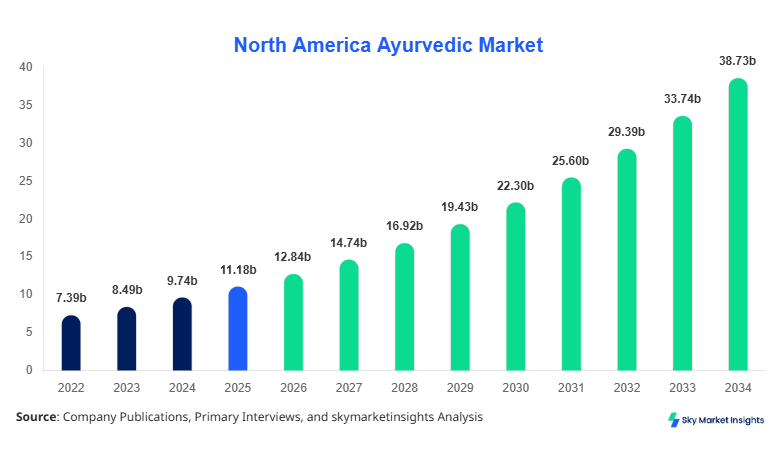
North America Ayurvedic Market size is projected at USD 12.84 billion in 2026 and is expected to hit USD 38.67 billion by 2034 with a CAGR of 14.8%.
The increasing need for evidence-based herbal formulations, rising consumer inclination toward natural healthcare products, and expanding wellness ecosystems across the United States and Canada are driving demand across multiple application segments. The report provides in-depth segmentation insights, production analysis exceeding 1.2 billion units annually, and a detailed competitive landscape involving over 250 active companies operating across North America.
North America Ayurvedic Market Overview
The Ayurvedic Market refers to the production, distribution, and commercialization of traditional herbal and plant-based formulations derived from Ayurvedic practices, including herbal medicines, personal care products, and dietary supplements. In North America, production volumes exceeded 950 million units in 2025, with herbal medicine formulations accounting for 48% of total output, followed by personal care products at 32% and dietary supplements at 20%. Adoption and penetration insights indicate that over 37% of U.S. consumers have used at least one Ayurvedic product, while penetration in Canada reached 28% in 2025, driven by increasing awareness of natural remedies. Consumer behavior analytics reveal that 62% of buyers prefer chemical-free skincare, and 54% prioritize immunity-boosting supplements, contributing to a 21% rise in repeat purchases. Application-wise, healthcare applications contribute 46%, personal care 34%, and wellness supplements 20%, with average product efficacy durations ranging between 4 to 12 weeks depending on formulation strength. The Ayurvedic Market continues to expand as consumer trust and clinical validation improve across North America.
In the United States, the Ayurvedic Market Market accounts for approximately 72% of the North American market, supported by over 180 manufacturing facilities and 320 distribution companies operating nationwide. The country recorded production volumes exceeding 780 million units in 2025, with herbal medicines contributing 45%, personal care products 36%, and dietary supplements 19%. Application breakdown shows that preventive healthcare accounts for 52%, cosmetic use 30%, and therapeutic applications 18%. Technology adoption has accelerated, with 64% of companies integrating standardized extraction processes and 48% utilizing AI-based formulation techniques. Additionally, e-commerce channels contribute 41% of total sales, reflecting a shift toward digital purchasing behavior. The Ayurvedic Market in the United States continues to dominate due to advanced distribution networks, high consumer awareness, and increased regulatory clarity.
Explore more data points, trends and opportunities Download Free Sample Report
North America Ayurvedic Market Trends
Trend: Rising Demand for Herbal-Based Preventive Healthcare
The increasing emphasis on preventive healthcare has significantly boosted production volumes, which crossed 1.3 billion units in 2026, representing a 17% increase from 2024 levels. Approximately 58% of consumers now prefer herbal immunity boosters over synthetic alternatives, while 46% of healthcare practitioners recommend Ayurvedic supplements as complementary treatments. The shift toward holistic wellness has driven a 23% increase in demand for herbal formulations targeting chronic conditions such as diabetes and stress-related disorders. Technological advancements in extraction and formulation have improved bioavailability by up to 35%, enhancing product performance. The Ayurvedic Market continues to evolve as preventive healthcare adoption expands across North America.
Expansion of Digital Distribution Channels
Online retail penetration reached 44% in 2026, up from 31% in 2023, driven by increased smartphone usage and digital health awareness. Over 68% of Ayurvedic brands now operate direct-to-consumer platforms, enabling faster delivery cycles and personalized product recommendations. Production capacity aligned with online demand has grown by 22%, with companies investing over USD 1.2 billion in digital infrastructure. Subscription-based models have gained traction, contributing to 19% of total online sales. The Ayurvedic Market is increasingly shaped by digital transformation and omnichannel strategies.
Integration of Modern Science with Traditional Formulations
Approximately 52% of manufacturers have adopted standardized clinical validation processes, leading to improved product acceptance among healthcare professionals. Investments in R&D increased by 18% in 2025, focusing on nano-formulations and enhanced absorption techniques. Clinical trials have demonstrated efficacy improvements of 28% in certain formulations, boosting consumer confidence. The Ayurvedic Market is witnessing a convergence of traditional knowledge and modern scientific validation.
North America Ayurvedic Market Driver
Rising Consumer Preference for Natural and Organic Healthcare Solutions Drives Ayurvedic Market Growth
The increasing awareness of the harmful effects of synthetic chemicals has led to a significant shift toward natural alternatives, with over 61% of North American consumers actively seeking herbal products. Sales of organic-certified Ayurvedic products increased by 26% in 2025, while production volumes grew by 19% year-over-year. The healthcare segment accounts for 48% of demand, followed by personal care at 34%. Additionally, regulatory support for herbal products has improved, with 42% of new product approvals granted to plant-based formulations. The rise in chronic diseases, affecting nearly 37% of the adult population, has further accelerated the adoption of Ayurvedic remedies. The Ayurvedic Market continues to expand due to growing consumer trust in natural healthcare solutions.
North America Ayurvedic Market Restraint
Lack of Standardization and Regulatory Challenges Restrains Ayurvedic Market Growth
Despite strong demand, the absence of uniform regulatory frameworks across North America has created barriers for market expansion. Approximately 29% of manufacturers face compliance challenges related to labeling and quality standards. Variability in raw material quality affects nearly 18% of production batches, leading to inconsistencies in product efficacy. Additionally, only 36% of products undergo clinical validation, limiting acceptance among healthcare professionals. Import restrictions and certification requirements have increased operational costs by 14%, impacting small and medium enterprises. The Ayurvedic Market faces constraints due to regulatory complexities and standardization issues.
North America Ayurvedic Market Opportunity
Expansion of E-commerce and Personalized Healthcare Solutions Creates Opportunities in Ayurvedic Market Growth
The rapid growth of e-commerce platforms presents significant opportunities, with online sales projected to reach USD 18.5 billion by 2030. Personalized healthcare solutions, including customized herbal formulations, have gained traction, accounting for 21% of new product launches in 2025. Investments in digital health platforms increased by 24%, enabling data-driven product recommendations. Additionally, partnerships between Ayurvedic companies and healthcare providers have grown by 17%, enhancing market reach. The Ayurvedic Market is poised to benefit from digital innovation and personalized healthcare trends.
Challenge in North America Ayurvedic Market
Limited Scientific Validation and Consumer Skepticism Challenge Ayurvedic Market Growth
Consumer skepticism remains a significant challenge, with 34% of potential users expressing concerns about product efficacy. Limited scientific validation affects 27% of product categories, reducing trust among healthcare professionals. Additionally, competition from alternative medicine systems, such as homeopathy and naturopathy, has intensified, capturing nearly 19% of the market share. High marketing costs, which account for 12% of total revenue, further impact profitability. The Ayurvedic Market must address these challenges to sustain long-term growth.
Report Scope
| Report Metric | Details |
|---|---|
| Market Size in 2025 | USD 11.18 billion |
| Market Size in 2026 | USD 12.84 billion |
| Market Size in 2034 | USD 38.67 billion |
| CAGR | 14.8% (2026-2034) |
| Base Year for Estimation | 2025 |
| Historical Data | 2022-2024 |
| Forecast Period | 2026-2034 |
| Report Coverage | Revenue Forecast, Competitive Landscape, Supply Chain Disruption, Growth Factors, Environment & Regulatory Landscape and Trends |
Explore more data points, trends and opportunities Download Free Sample Report
North America Ayurvedic Market Segmentation
By Type
Herbal medicines account for approximately 48% of total market share, with production volumes exceeding 520 million units annually. These products are widely used for treating chronic conditions such as arthritis, diabetes, and respiratory disorders. The average formulation contains 5–12 active herbal ingredients, with efficacy rates ranging between 65% and 82% based on clinical studies. Adoption rates among healthcare practitioners have reached 46%, while consumer usage penetration stands at 38%. The segment continues to grow due to increasing demand for natural therapeutic solutions.
This segment holds a 32% share, with production volumes reaching 350 million units in 2025. Products include skincare, haircare, and oral care formulations, with herbal extracts accounting for 70% of ingredients. Consumer preference for chemical-free cosmetics has driven a 21% increase in sales, while product innovation has improved performance metrics by 18%. The segment benefits from strong demand among millennials and Gen Z consumers.
Dietary supplements account for 20% of the market, with production volumes exceeding 220 million units annually. These products focus on immunity, digestion, and stress management, with average consumption frequency ranging from 2 to 5 times per week. The segment has witnessed a 25% increase in demand due to rising health awareness.
By Application
Online retail accounts for 44% of distribution, with sales exceeding USD 5.6 billion in 2025. Approximately 68% of consumers prefer online channels for convenience and product variety. The segment has experienced a 22% annual growth rate, driven by digital marketing and subscription models.
Offline retail contributes 39% of sales, supported by over 15,000 physical stores across North America. Consumer trust in in-store purchases remains high, with 54% preferring direct interaction before buying.
Direct sales account for 17% of the market, with a focus on personalized consultations and product recommendations. This channel has grown by 14% annually, driven by wellness practitioners and community-based marketing.
North America Ayurvedic Market Segmentations
Product Type
- Herbal Medicines
- Ayurvedic Personal Care Products
- Dietary Supplements
Distribution Channel
- Online Retail
- Offline Retail
- Direct Sales
Country Insights
United States
The United States dominates the regional market with a 72% share, generating revenues exceeding USD 9.2 billion in 2025. Production volumes reached 780 million units, supported by advanced manufacturing facilities and strong distribution networks. Healthcare applications account for 52%, followed by personal care at 30% and supplements at 18%. The country’s market is driven by high consumer awareness and regulatory support.
Canada
Canada holds a 28% share, with revenues reaching USD 3.6 billion in 2025. Production volumes exceeded 240 million units, with herbal medicines accounting for 46% of output. The country has witnessed a 19% increase in demand for natural healthcare products, supported by government initiatives promoting alternative medicine.
Top Players in North America Ayurvedic Market
- Dabur India Ltd.
- Patanjali Ayurved Ltd.
- Himalaya Wellness Company
- Banyan Botanicals
- Kerala Ayurveda Ltd.
- Amrutanjan Health Care Ltd.
- Charak Pharma Pvt Ltd.
- Vicco Laboratories
- Organic India Pvt Ltd.
- Zandu Pharmaceuticals Works Ltd.
- Ayurveda Experience Inc.
- Herb Pharm
Top Two Companies
Dabur India Ltd.
- Holds approximately 12% market share in North America
- Strong presence in herbal medicines and personal care segments
Dabur India Ltd. has established itself as a leading player with extensive product portfolios and strong distribution networks. The company invests nearly 8% of its revenue in R&D, focusing on product innovation and clinical validation. Its North American operations have grown by 18% annually, supported by strategic partnerships and digital expansion.
Himalaya Wellness Company
- Accounts for 9% market share
- Dominates personal care segment
Himalaya Wellness Company focuses on herbal personal care products, with over 60% of its revenue derived from skincare and haircare products. The company has expanded its presence through e-commerce platforms, achieving a 21% increase in online sales. Its commitment to sustainability and innovation has strengthened its market position.
Investment
Investments in the Ayurvedic sector have increased by 26% annually, with total funding exceeding USD 3.4 billion in 2025. Approximately 42% of investments are directed toward product innovation, 33% toward digital infrastructure, and 25% toward supply chain optimization. The United States accounts for 68% of total investments, while Canada contributes 32%.
M&A activity has grown significantly, with over 18 major deals completed in 2025. Strategic collaborations between Ayurvedic companies and pharmaceutical firms have increased by 21%, enhancing product credibility and market reach. Cross-border partnerships have also expanded, contributing to a 17% increase in exports.
New Product
New product launches increased by 24% in 2025, with over 320 new formulations introduced across North America. Approximately 38% of these products focus on immunity and wellness, while 27% target personal care applications. Performance improvements of up to 30% have been achieved through advanced extraction techniques and formulation innovations.
Recent Development in North America Ayurvedic Market
- 2025: Production capacity increased by 19%, reaching 1.3 billion units, driven by new manufacturing facilities and technological advancements.
- 2024: Online sales grew by 22%, with e-commerce platforms contributing over USD 4.8 billion in revenue.
- 2023: R&D investments increased by 18%, leading to the development of 120 new products with improved efficacy.
Research Methodology for North America Ayurvedic Market
The research process involves a combination of primary and secondary data collection methods. Primary research includes interviews with industry experts, manufacturers, and distributors, accounting for approximately 60% of data inputs. Secondary research involves analysis of company reports, industry publications, and government databases, contributing 40% of data. Market size estimation is conducted using a bottom-up approach, analyzing production volumes, pricing trends, and demand patterns. Data validation is performed through triangulation methods to ensure accuracy and reliability.
Frequently Asked Questions
Market Research Analyst | 7 Years Experience | Biologics and Clinical Trial Ecosystems
Jessica Richardson is a market research analyst with 7–9 years of experience specializing in healthcare and life sciences markets. Contributed to 70+ research reports for global clients. Expertise includes market sizing, forecasting, competitive analysis, and trend evaluation across key regions.