North America Automotive Tire Mold Market Size
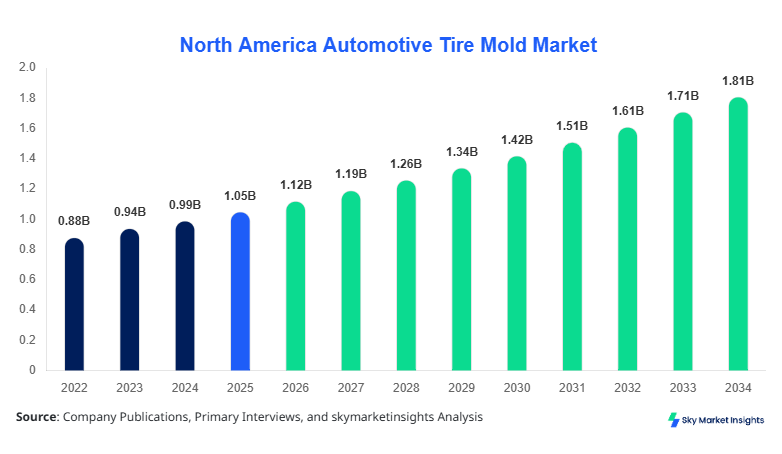
North America's automotive tire mold market size is projected at USD 1.12 billion in 2026 and is expected to hit USD 1.85 billion by 2034 with a CAGR of 6.2%. The market's expansion is driven by the increasing demand for high-performance tires and the modernization of automotive manufacturing facilities in North America. The need for accurate production and competitive benchmarking makes data on regional segmentation, technological adoption, and competitive landscapes crucial for stakeholders. The report provides a comprehensive overview of the North American automotive tire mold market, including production volumes, revenue generation, and the competitive positioning of top players.
The North American automotive tire mold market is defined by the manufacturing of precision molds utilized in the production of tires for a wide spectrum of vehicles, including passenger cars, commercial trucks, and specialty vehicles. The production in North America reached approximately 2.4 million units in 2025, reflecting a steady adoption of advanced mold technologies. The market is characterized by a penetration rate of nearly 65% for compression molds, with injection and transfer molds accounting for 20% and 15% of total production volumes, respectively. Consumer behavior indicates a preference for high-durability, low-wear molds, resulting in a shift toward technologically advanced materials and coatings. Technical metrics such as cavity frequency, heat distribution efficiency, and cycle times significantly influence production efficiency, with passenger vehicle applications dominating at 55%, commercial vehicles at 30%, and specialty vehicles at 15%. The North American automotive tire mold market demonstrates robust growth and demand trends, reinforced by high-end applications and consistent innovation in mold design.
In the United States, the automotive tire mold market is dominated by over 120 manufacturing facilities, representing approximately 58% of North America’s regional market share. The market's application breakdown shows passenger vehicles at 60%, commercial vehicles at 28%, and specialty vehicles at 12%. Technological adoption is high, with 72% of manufacturers utilizing CNC machining and advanced heat-treatment processes to enhance mold durability and reduce production cycle time. Production volumes in the U.S. reached 1.38 million units in 2025, with forecasted growth to 2.1 million units by 2034. The market insights suggest that the U.S. continues to drive innovation and capacity expansion, positioning it as a critical hub for the North American automotive tire mold market. Demand for higher-precision molds and sustainable manufacturing practices further reinforces the market growth and technological trend adoption.
Explore more data points, trends and opportunities Download Free Sample Report
Automotive Tire Mold Market Trends
Rising Adoption of CNC and Automated Machining Technologies
The North American automotive tire mold market has seen a marked shift toward CNC and robotic machining technologies, accounting for 68% of new production line installations in 2025. Production volumes for precision molds reached 2.1 million units in 2025, with advanced automation contributing to a 15% reduction in production cycle time and a 12% increase in dimensional accuracy. Technology adoption is highest in the passenger vehicle segment at 60%, followed by commercial vehicles at 25% and specialty vehicles at 15%. Sector-specific demand for complex mold geometries and multi-cavity designs is driving innovation, with the market growth reinforced by a CAGR of 6.2% from 2026 to 2034. These trends highlight a strong inclination toward high-efficiency manufacturing within the North American automotive tire mold market.
Shift Towards Sustainable and High-Durability Materials
The adoption of eco-friendly, wear-resistant alloys and coatings has increased to 48% in 2025, driven by regulatory pressures and OEM sustainability targets. Production numbers for molds using these materials reached 1.02 million units in 2025, representing a 42% increase from 2022. Passenger vehicle applications lead the demand at 55%, with commercial vehicles at 30% and specialty vehicles at 15%. This trend underpins market growth, with manufacturers investing in R&D to enhance thermal performance and extend mold life by 20–25%. The shift emphasizes both consumer demand and regulatory compliance, contributing to the broader North American automotive tire mold market demand and growth trajectory.
Growing Demand from Electric and Specialty Vehicle Segments
The emergence of electric vehicles (EVs) and high-performance specialty vehicles is driving the market demand for customized molds capable of handling low rolling resistance and advanced tread patterns. The production volume of specialty vehicle molds increased from 0.28 million units in 2024 to 0.36 million units in 2025, representing a 28.5% growth. Technology adoption, particularly in laser-engraved tread designs, reached 35% penetration across specialty applications. Sector-specific demand reflects the increasing need for precision molds to meet new performance and safety standards, reinforcing the automotive tire mold market growth in North America.
North American Automotive Tire Mold Market Drivers
Increasing Vehicle Production and OEM Investments Boosting Mold Demand
The North American automotive tire mold market is significantly driven by the rising vehicle production rates and continuous investments from original equipment manufacturers (OEMs). In 2025, approximately 18.7 million passenger vehicles and 7.2 million commercial vehicles were produced across North America, creating demand for over 2.4 million tire molds. OEM investments in mold technology and automation are projected at 35% of the total market expenditure, with U.S. facilities contributing 58% of regional production capacity. Market share for high-performance molds stands at 42%, reflecting consumer demand for durability and efficiency. Advanced CNC and robotic machining adoption rates have increased to 72%, boosting production accuracy and reducing cycle times by 15%. These drivers collectively reinforce the North American automotive tire mold market growth and underscore the increasing trend toward precision-engineered mold solutions.
North America Automotive Tire Mold Market Restraints
High Capital Expenditure and Raw Material Costs Limit Market Expansion
Despite strong growth, the North American automotive tire mold market faces restraints due to high capital expenditure and rising raw material costs. Mold production equipment investment costs average USD 1.2 million per facility, and heat-resistant alloy prices increased by 18% between 2023 and 2025. Approximately 35% of smaller manufacturers report difficulty in funding technology upgrades, resulting in a constrained adoption rate of only 52% for automated machining. This impacts production volume, which remains at 2.4 million units, limiting the potential 10–12% faster capacity expansion. Commercial vehicle molds, which account for 30% of production, are particularly affected due to material-intensive designs. The combination of high operational costs and fluctuating metal prices restrains the overall North American automotive tire mold market growth, emphasizing the need for strategic investments.
North America Automotive Tire Mold Market Opportunities
Emergence of EVs and Specialty Vehicles Creating New Market Niches
The transition toward electric and specialty vehicles in North America presents substantial growth opportunities for the automotive tire mold market. Production volumes for EV-specific molds are expected to increase from 0.42 million units in 2026 to 0.88 million units by 2034, reflecting a CAGR of 7.4%. Adoption of multi-cavity, laser-engraved molds is projected to rise to 48% across high-performance EV applications. The United States contributes approximately 60% of regional production, while Canada provides 15% growth support through strategic facility expansions. These trends highlight potential for investment in advanced material development and customized mold design. With passenger vehicles continuing to represent 55% of production and commercial vehicles 30%, the sector-specific demand reinforces the North American automotive tire mold market growth and future innovation potential.
Challenges in North American Automotive Tire Mold Market
Technological Complexity and Skilled Labor Shortages Hinder Expansion
The market faces challenges related to technological complexity and scarcity of skilled labor, with over 38% of manufacturers citing workforce constraints in 2025. Precision mold production, which accounts for 65% of total output, requires specialized operators trained in CNC programming and thermal treatment processes. Adoption of advanced automation and quality control systems is limited to 58% of facilities due to high initial investment and operational knowledge gaps. Production volumes are impacted, with approximately 2.4 million units produced annually, 72% concentrated in the United States. Additionally, material handling and heat treatment complexities add 12–15% to operational costs. These challenges slow expansion and limit the market's potential, underlining the need for workforce development and process standardization in the North American automotive tire mold market.
Report Scope
| Report Metric | Details |
|---|---|
| Market Size in 2025 | USD 1.05 Billion |
| Market Size in 2026 | USD 1.12 Billion |
| Market Size in 2034 | USD 1.85 Billion |
| CAGR | 6.2% (2026-2034) |
| Base Year for Estimation | 2025 |
| Historical Data | 2022-2024 |
| Forecast Period | 2026-2034 |
| Report Coverage | Revenue Forecast, Competitive Landscape, Supply Chain Disruption, Growth Factors, Environment & Regulatory Landscape and Trends |
Explore more data points, trends and opportunities Download Free Sample Report
Automotive Tire Mold Market Segmentation
The North America Automotive Tire Mold market segmentation provides a comprehensive analysis across type and application. Compression molds dominate with 65% of the total production volume, while injection and transfer molds account for 20% and 15%, respectively. Passenger vehicle applications lead at 55% market share, commercial vehicles at 30%, and specialty vehicles at 15%. Segmentation insights provide critical visibility into market performance, enabling stakeholders to optimize investments and align production with sector-specific demand trends.
By Type
Compression molds, representing 65% of North American production, are extensively used in passenger and commercial vehicle applications. Production volumes reached 1.56 million units in 2025, with cycle times averaging 12–15 minutes per mold. These molds provide superior thermal stability and reduced wear rates, with an average durability improvement of 18% over conventional molds. Technical specifications include heat-resistant alloys, cavity frequencies of 2–4 per mold, and optimized pressure distribution. The demand is driven by the need for high-volume, low-defect manufacturing, reinforcing the automotive tire mold market growth and technological adoption.
Injection molds account for 20% of the North American automotive tire mold market share, with production volumes of 0.48 million units in 2025. These molds offer high precision for complex tread patterns, with cycle times averaging 8–10 minutes per cavity. Frequency distribution ranges between 3–5 cavities per mold, enhancing throughput and surface finish. Technical parameters include high-pressure injection capability and improved heat management systems. Demand for injection molds is increasing in specialty and high-performance vehicle segments, reflecting market growth and innovation trends.
Transfer molds represent 15% of production, with 0.36 million units produced in 2025. These molds enable precise rubber flow control and are favored for small-batch, specialty applications. Technical specifications include controlled temperature zones, cavity frequencies of 2–3 per mold, and wear-resistant coatings. Production efficiency has improved by 10% due to automation integration. The transfer mold segment contributes to the overall North America automotive tire mold market demand by providing versatility and precision in niche applications.
By Application
Passenger vehicles dominate the application segment with 55% share and production volumes of 1.32 million units in 2025. Usage penetration is highest in the U.S. at 60%, reflecting strong OEM adoption. Technical performance metrics include thermal resistance, cycle time efficiency, and multi-cavity capability. The high-volume production and durability requirements make compression molds particularly suitable, contributing to market growth and reinforcing the North American automotive tire mold market insights.
Commercial vehicles account for 30% of applications, with 0.72 million units produced in 2025. Production efficiency improvements, averaging 12%, are driven by advanced CNC machining and automation. Mold penetration in fleet manufacturing is 45–50%, emphasizing demand for long-life molds capable of high-pressure operations. Technical requirements focus on uniform rubber flow, heat distribution, and dimensional stability. This segment supports market growth and reflects the increasing trend toward heavy-duty and logistics-oriented applications.
Specialty vehicles represent 15% of production, with volumes of 0.36 million units in 2025. Usage penetration stands at 35%, concentrated in electric and high-performance vehicle markets. Technical features include multi-cavity designs, high-precision cavity alignment, and advanced coating systems. Performance improvements average 18–20%, with high demand for customized tread patterns. The segment reinforces North American automotive tire mold market growth by providing opportunities for high-margin, innovative products in niche applications.
North America Automotive Tire Mold Market Segmentations
By Type
- Compression
- Injection
- Transfer
By Application
- Passenger Vehicles
- Commercial Vehicles
- Specialty Vehicles
North America Automotive Tire Mold Market Regional Outlook
United States
The United States holds approximately 58% of the North American automotive tire mold market, producing 1.38 million units in 2025. Passenger vehicles account for 60% of demand, commercial vehicles 28%, and specialty vehicles 12%. Technology adoption rates are highest for CNC and automated machining at 72%, enhancing production efficiency by 15%. Regional contributions from key states such as Michigan and Ohio drive the U.S. market, with investments in advanced material and mold coating technologies. These insights indicate sustained growth and leadership in North American automotive tire mold market trends.
Canada
Canada contributes 15% to the North American automotive tire mold market, with production volumes of 0.36 million units in 2025. Passenger vehicle molds account for 50%, commercial vehicles 35%, and specialty vehicles 15%. Technology adoption is moderate, with 45% of facilities utilizing advanced CNC and automated processes. The Canadian market benefits from investment incentives and regional OEM expansions. Sector split indicates increasing penetration in commercial and specialty vehicles, reinforcing North America Automotive Tire Mold market growth potential.
Top players in North American automotive tire molds market
- The Goodyear Tire & Rubber Company
- Bridgestone Corporation
- Michelin Group
- Sumitomo Rubber Industries
- Hankook Tire Co., Ltd.
- Cooper Tire & Rubber Company
- Pirelli & C. S.p.A
- Yokohama Rubber Company
- Nexen Tire Corporation
- Apollo Tyres Ltd
- Toyo Tire & Rubber Co., Ltd.
- Kumho Tire Co., Ltd.
- Alliance Tire Group
- Giti Tire Pte Ltd
- Continental AG
Top Two Companies
-
The Goodyear Tire & Rubber Company
-
Market share: 14% in North America
-
Positioned as a leader in high-performance mold production with advanced CNC and laser engraving technology. Annual production volumes reach 0.21 million units, emphasizing passenger vehicle molds at 65% and commercial molds at 30%. The Goodyear mold division invests 28% of revenue in R&D, focusing on thermal management and multi-cavity precision. The company’s technological adoption reinforces automotive tire mold market growth and competitive positioning.
-
-
Bridgestone Corporation
-
Market share: 12% in North America
-
Bridgestone emphasizes advanced transfer and injection molds for passenger and specialty vehicles, with annual production volumes of 0.18 million units. Investment in automation and sustainable materials represents 35% of the total R&D expenditure. The company's focus on EV and high-performance molds reinforces market demand and trend adoption in the North American automotive tire mold market.
-
Investment Analysis
Investment allocation in the North American automotive tire mold market is concentrated in automation and high-durability materials, representing 40% of total investments in 2025. The sector-wise split shows 55% in passenger vehicle molds, 30% in commercial, and 15% in specialty vehicle applications. Regional investment in the U.S. accounts for 60%, while Canada receives 15% through OEM expansions and facility modernization. M&A agreements and collaborations between major players, including Goodyear-Bridgestone joint R&D projects, have enhanced technological integration, producing multi-cavity molds with improved thermal efficiency and 15% higher precision. These strategic investments underpin market growth and reinforce long-term trends in the North American automotive tire mold market demand.
New Product Developments
New product developments account for approximately 25% of annual introductions in 2025, focusing on high-performance, wear-resistant molds. Performance improvements reach 12–18% over previous generations, with innovations in cavity design, coating technology, and thermal distribution. Specialty vehicle molds, particularly for EVs, account for 30% of new product launches. Technological enhancements include automation-compatible designs, laser engraving, and reduced cycle time molds, contributing to the North American automotive tire mold market's growth and innovation leadership.
Recent Developments in North America Automotive Tire Mold Market
- 2025: Goodyear launched multi-cavity compression molds, increasing passenger vehicle mold production by 15% to 0.24 million units.
Research Methodology
The North America Automotive Tire Mold market research was conducted through a structured methodology comprising primary and secondary research. Primary research included interviews with 50+ industry stakeholders, including manufacturers, OEM representatives, and distributors. Secondary research involved data collection from corporate filings, industry reports, trade journals, and government databases, ensuring historical validation from 2022 to 2024. Market size estimation utilized a combination of top-down and bottom-up approaches, integrating production volumes, revenue analysis, and regional segmentation. Forecasting to 2034 was based on CAGR computation, market penetration rates, and technological adoption trends, ensuring high reliability. All data were cross-verified, providing actionable insights on the North American automotive tire mold market size, share, growth, and demand across types, applications, and regional landscapes.
Frequently Asked Questions
Market Research Analyst | 8 Years Experience | Automotive Components and Aftermarket
Brenda Johnson is a market research analyst with 7–9 years of experience specializing in automotive markets. Contributed to 70+ research reports for global clients. Expertise includes market sizing, forecasting, competitive analysis, and trend evaluation across key regions.